
The 3-5-2 formation is one of the most flexible tactical systems in football. It gives teams three central defenders, a five-player midfield line, and two forwards, creating a structure that can provide defensive security while still offering plenty of attacking options. Although the formation looks defensive on paper, it can become highly aggressive when wing-backs move forward and midfielders support the front two.
Understanding the 3-5-2 is about more than simply knowing where 11 players stand. The system depends heavily on movement, positioning, width, transitions, and communication. Wing-backs must cover large areas, central midfielders need to support both defense and attack, and the two forwards must work together effectively.
In this 3-5-2 formation explained guide, you will learn how the system works, the role of every position, its attacking and defensive structures, major variations, advantages and disadvantages, pressing methods, common mistakes, and practical tips for players and coaches.
3-5-2 Formation – Quick Answer
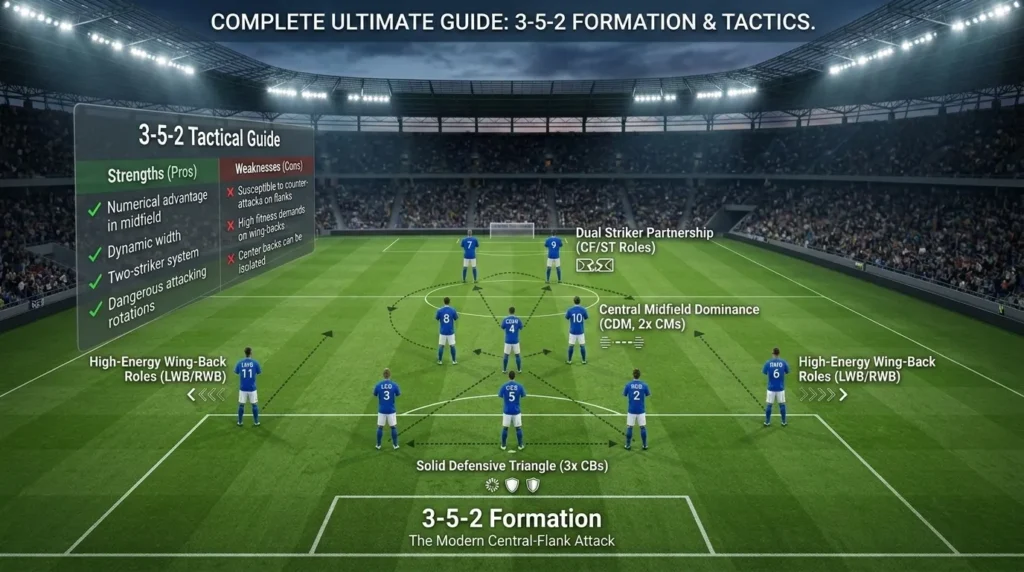
The 3-5-2 formation is a football system made up of three center-backs, five midfielders, and two forwards.
The basic structure is:
ST — ST
LM — CM — CM — CM — RM
CB — CB — CB
GK
The wide midfielders are normally wing-backs rather than traditional wide midfielders. They are expected to contribute heavily in both attack and defense.
When attacking, the formation can resemble a 3-2-5 or another attacking structure depending on player movement. When defending, the wing-backs can drop alongside the three center-backs to create a 5-3-2.
This ability to change shape is one of the biggest strengths of the system.
What Is the 3-5-2 Formation?
The 3-5-2 is a football formation that uses three central defenders, three central midfielders, two wing-backs, and two forwards.
The three defenders provide a strong central defensive base. In midfield, the team has numerical strength, while the two wing-backs provide width. Up front, two forwards can work together instead of leaving one striker isolated.
The formation can be especially useful for teams that want to dominate central areas while maintaining attacking width through the wing-backs.
However, it requires players with specific qualities. Wing-backs need excellent stamina because they may have to sprint from their own penalty area to the opposition’s final third. The central midfielders also need strong tactical awareness because they must protect the defense and support attacks.
How Does the 3-5-2 Formation Work?
The 3-5-2 works by creating numerical advantages in central areas while using wing-backs to provide width.
The three center-backs protect the central defensive zone. The midfield trio controls possession and helps connect defense with attack. The two forwards give the team multiple options in the final third.
Building From the Back
The three center-backs can spread across the defensive third to create several passing angles.
The central defender can remain deeper while the outside center-backs move wider. This can make it easier to play around an opponent’s first line of pressure.
A midfielder can also drop toward the defenders to create an additional passing option.
Controlling Central Areas
Three central midfielders give the team a strong presence in the middle of the pitch.
Depending on the tactical plan, the midfield may include:
- One defensive midfielder
- Two box-to-box midfielders
- One deep playmaker
- Two advanced midfielders
The exact combination depends on the coach and the strengths of the players.
Creating Width
Because there are no traditional wingers, the wing-backs are responsible for providing most of the team’s width.
They can stay wide during possession and advance into the final third. This forces opposing defenders to cover a larger area.
Using Two Forwards
The two forwards can create problems for opposing center-backs by making different movements.
One striker may drop deeper to link play while the other runs behind the defense. Alternatively, both can stay high and occupy the center-backs.
Player Roles in the 3-5-2 Formation
Each position has a specific purpose, but players must also understand how their movements affect teammates.
Goalkeeper
The goalkeeper’s primary responsibility is to protect the goal and organize the defensive line.
In teams that build from the back, the goalkeeper may also act as an additional passing option. Good distribution can help the three center-backs play through pressure.
Central Center-Back
The central center-back usually operates in the middle of the defensive trio.
This player needs strong positional awareness because they often provide cover behind the two outside center-backs.
Important qualities include:
- Reading the game
- Communication
- Aerial ability
- Positioning
- Passing
- Defensive leadership
Outside Center-Backs
The left and right center-backs may move wider to cover spaces behind the wing-backs.
They can also step into midfield or toward wide areas when necessary, although doing so requires careful cover from teammates.
Their ability to defend one-versus-one situations is particularly important when opponents attack the channels.
Wing-Backs
Wing-backs are arguably the most demanding positions in the 3-5-2.
They must defend like full-backs but attack like wide midfielders.
Their responsibilities include:
- Providing width
- Tracking opposing wingers
- Supporting attacks
- Making overlapping runs
- Crossing
- Pressing
- Recovering quickly after losing possession
A wing-back needs excellent stamina, pace, positioning, and decision-making.
Central Midfielders
The midfield trio controls the center of the pitch.
One midfielder may remain deeper to protect the defense, while the other two are allowed to move forward.
Their responsibilities can include:
- Passing and possession
- Ball recovery
- Supporting wing-backs
- Pressing
- Creating chances
- Making late runs
- Protecting the central defenders
The midfield must remain connected. Large gaps between the midfielders can make the formation vulnerable.
Forwards
The two forwards provide the main attacking threat.
A successful partnership often combines different qualities. For example, one player may be a physical target forward while the other specializes in movement and finishing.
The forwards can also work together to press opposing defenders.
Attacking Structure of the 3-5-2
The 3-5-2 can become highly aggressive when the team has possession.
The wing-backs push forward, midfielders advance into supporting positions, and the two forwards occupy the opposition’s defensive line.
A team may create a structure similar to:
WB — ST — ST — WB
with midfielders positioned behind them and three defenders providing security.
The exact shape changes according to the movements of individual players.
Wing-Back Overloads
One of the main attacking weapons is the wing-back.
If an opposing full-back is occupied by a midfielder or forward, the wing-back can attack the space outside them.
This can create two-versus-one situations and opportunities for crosses or cut-backs.
Midfield Runs
Central midfielders can make late runs into the penalty area.
Because opponents may focus on the two forwards, an arriving midfielder can sometimes find open space near the edge or inside the box.
Two-Striker Combinations
The front two can rotate positions, combine with short passes, or make opposite runs.
For example, one forward may drop toward the ball while the other attacks the space behind the defense.
Defensive Structure of the 3-5-2
When defending, the 3-5-2 usually becomes a 5-3-2.
The wing-backs drop alongside the three center-backs, creating a back five.
The midfield trio stays compact in front of them, while the two forwards remain available for counter-attacking opportunities.
This structure can make the central area difficult for opponents to penetrate.
Defending Wide Areas
The wing-backs are responsible for stopping attacks from wide areas.
When an opposing winger receives the ball, the nearest wing-back can move toward them while the outside center-back provides cover.
Protecting the Center
The three midfielders should stay relatively compact.
Their main objective is to prevent opponents from playing easily through the middle. The center-backs then provide another defensive layer behind them.
Pressing in a 3-5-2
The 3-5-2 can support an aggressive pressing strategy because the two forwards can pressure the opposition’s center-backs.
The midfielders then step forward to close passing options.
A common pressing idea is for one striker to pressure the ball while the second striker blocks or monitors the other center-back. The midfielders can then move toward the opposition’s central players.
However, pressing requires coordination. If the wing-backs push too high without support, opponents can exploit the wide areas.
Main Variations of the 3-5-2 Formation
The basic system can be adjusted according to the coach’s tactical philosophy.
Defensive 3-5-2
A defensive version allows the wing-backs to stay deeper and quickly form a back five.
The midfield remains compact, making the system useful for protecting a lead or defending against strong attacking teams.
Attacking 3-5-2
In an attacking version, wing-backs move high and central midfielders push forward.
The formation can create several players around the opposition penalty area while the three center-backs remain behind the attack.
3-5-2 With a Deep Playmaker
One midfielder can operate as a deep playmaker, controlling the tempo and distributing the ball from a deeper position.
The other two midfielders can make forward runs and provide defensive support.
3-5-2 With a Second Striker Dropping Deep
One forward can regularly drop into midfield to link play.
This movement can create confusion for defenders and open space for the other striker to attack.
Advantages of the 3-5-2 Formation
The 3-5-2 provides several tactical benefits.
Strong Central Defense
Three center-backs give the team considerable defensive presence in central areas.
Midfield Numerical Advantage
Three central midfielders can help a team compete against systems with two central midfielders.
Natural Two-Striker Attack
Two forwards can create better partnerships and prevent the main striker from becoming isolated.
Excellent Width
Wing-backs can provide width without requiring traditional wingers.
Flexible Defensive Shape
The system can quickly become a 5-3-2 when the wing-backs recover.
Good Counter-Attacking Potential
Two forwards can remain high and provide immediate outlets after the team wins possession.
Disadvantages of the 3-5-2 Formation
The formation also has weaknesses that coaches must manage.
Heavy Demands on Wing-Backs
Wing-backs cover large distances and can become tired, especially late in matches.
Vulnerability in Wide Areas
If wing-backs are caught high up the pitch, opponents may attack the spaces behind them.
Requires Quality Center-Backs
The outside center-backs may have to defend wide spaces, so they need pace and one-on-one defensive ability.
Midfield Can Become Too Narrow
If wing-backs stay too deep and midfielders remain central, the team may struggle to create attacking width.
Complex Positioning
Players need a strong understanding of rotations and defensive transitions. Poor communication can quickly create gaps.
3-5-2 vs 4-3-3
The 3-5-2 and 4-3-3 provide different approaches to width and defensive organization.
| Feature | 3-5-2 | 4-3-3 |
|---|---|---|
| Center-backs | 3 | 2 |
| Central midfielders | 3 | 3 |
| Wide players | Wing-backs | Wingers/full-backs |
| Strikers | 2 | 1 |
| Defensive shape | Often 5-3-2 | Often 4-5-1 |
| Attacking width | Wing-backs | Wingers and full-backs |
| Central defense | Strong | More traditional |
The 3-5-2 offers an extra center-back and two forwards, while the 4-3-3 naturally provides wide attacking players.
3-5-2 vs 4-2-3-1
The 4-2-3-1 uses four defenders, two deeper midfielders, three attacking midfielders, and one striker.
The 3-5-2 instead uses three center-backs, three central midfielders, wing-backs, and two forwards.
The 3-5-2 can offer stronger central defensive coverage and a two-striker attack, while the 4-2-3-1 provides a dedicated No. 10 and more traditional wide attacking positions.
Common Mistakes When Using a 3-5-2
Players new to the system often make tactical mistakes.
Common problems include:
- Wing-backs staying too high after losing possession
- Wing-backs staying too deep during attacks
- Center-backs moving out without adequate cover
- Midfielders occupying the same spaces
- Forwards becoming disconnected from midfield
- Large gaps between the wing-backs and outside center-backs
- Poor communication during defensive transitions
The solution is consistent positioning, communication, and repeated tactical training.
How to Play the 3-5-2 Effectively
Teams can improve their performance in this formation by following several principles.
Keep the Wing-Backs Connected
Wing-backs should understand when to attack and when to recover. Their movement must be coordinated with the outside center-backs.
Maintain Midfield Balance
One midfielder should normally remain aware of the defensive situation when teammates move forward.
Use Different Forward Movements
The two strikers should avoid making identical runs. Different movements create more problems for defenders.
Protect Against Counter-Attacks
When attacking, at least three defenders and suitable midfield cover should remain behind the ball.
Switch Play Quickly
Because opponents may become compact centrally, switching the ball toward an open wing-back can create attacking opportunities.
Press Together
The forwards, midfielders, and wing-backs must move as a unit. Individual pressing can create large gaps.
Best Player Qualities for a 3-5-2
The system requires players with specific characteristics.
Goalkeeper: Communication, positioning, and distribution.
Center-backs: Strength, positioning, anticipation, passing, and one-on-one defending.
Wing-backs: Pace, stamina, crossing, defensive awareness, and work rate.
Central midfielders: Passing, tactical intelligence, ball recovery, movement, and endurance.
Forwards: Finishing, movement, pressing, link-up play, and complementary attacking skills.
A team’s success depends on how well these qualities fit the tactical demands of the system.
Tips for Coaches Teaching the 3-5-2
Coaches should introduce the formation gradually.
A useful training progression is:
- Teach the basic 3-5-2 positions.
- Practice the defensive 5-3-2 shape.
- Teach wing-back movement.
- Practice midfield rotations.
- Introduce two-striker combinations.
- Train defensive transitions.
- Add pressing triggers.
- Practice attacking switches of play.
Small-sided games can help players understand spacing, movement, and decision-making more effectively than memorizing positions alone.
Frequently Asked Questions About the 3-5-2 Formation
What is a 3-5-2 formation in football?
The 3-5-2 formation uses three center-backs, two wing-backs, three central midfielders, and two forwards. It provides strong central numbers and a natural two-striker attack.
Is 3-5-2 a defensive formation?
Not necessarily. It can be defensive when the wing-backs drop into a 5-3-2, but it can also become highly attacking when the wing-backs and midfielders move forward.
What is the main weakness of 3-5-2?
The main weakness can be the space in wide areas behind advanced wing-backs. Opponents may target these areas during quick transitions.
What is the role of wing-backs in 3-5-2?
Wing-backs provide most of the team’s width and must contribute in both attack and defense. They need stamina, pace, crossing ability, and defensive awareness.
Is 3-5-2 good for beginners?
It can be effective for beginners, but it requires players to understand positioning and transitions. Coaches should teach the defensive and attacking shapes separately before combining them.
What type of strikers work best in 3-5-2?
A complementary partnership is often effective. One striker can provide physical strength or hold-up play, while the other offers movement, pace, or runs behind the defense.
How does 3-5-2 defend?
The formation normally changes into a 5-3-2 when the wing-backs drop alongside the three center-backs. The midfield stays compact while the two forwards remain available for transitions.
Is 3-5-2 good for counter-attacking?
Yes. Two forwards can remain higher up the pitch, giving the team immediate attacking options after winning possession. Fast wing-backs can then join the counter-attack.
Conclusion
The 3-5-2 formation is a flexible tactical system that combines three central defenders, a strong midfield presence, attacking wing-backs, and two forwards. Its ability to change between a 3-5-2, 5-3-2, and more aggressive attacking structures makes it useful for many different tactical approaches.
Its biggest strengths are central defensive coverage, midfield numbers, natural width from wing-backs, and the ability to use two forwards. However, these advantages come with demands. Wing-backs must cover large areas, outside center-backs need to defend wide spaces, and midfielders must maintain good positional balance.
The formation works best when every player understands how their movement affects the rest of the team. It is not simply about placing three defenders and five midfielders on the pitch. Effective 3-5-2 tactics depend on coordinated movement, communication, pressing, transitions, and intelligent use of space.
When these elements come together, the 3-5-2 can provide a powerful balance between defensive stability and attacking flexibility.