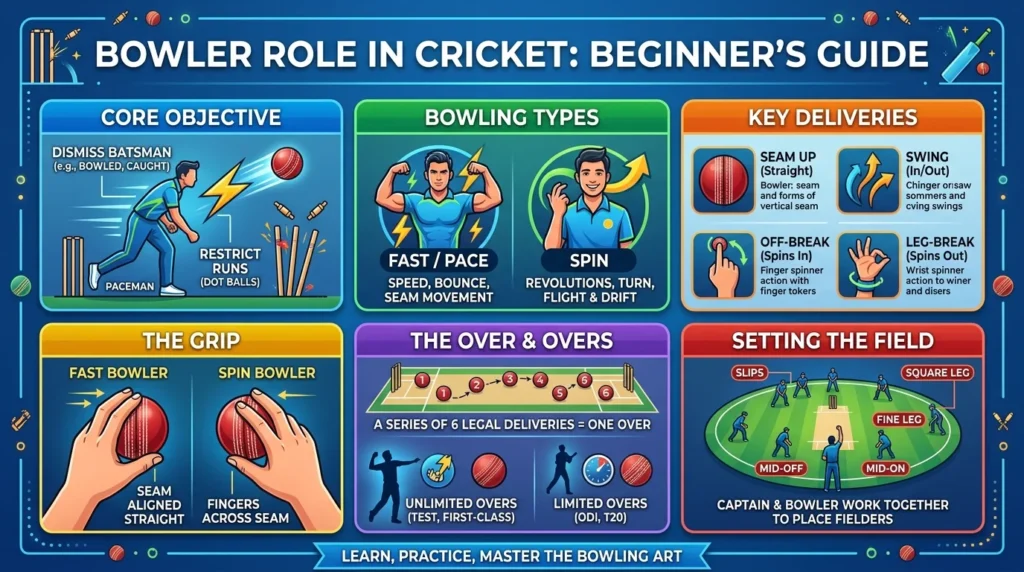
In every cricket match, bowlers play one of the most important roles on the field. While batters score runs and entertain the crowd with big shots, bowlers are responsible for stopping runs and taking wickets. A strong bowling attack can completely change the result of a match within a few overs. Whether it is fast bowling, swing bowling, seam bowling, or spin bowling, the bowler role in cricket is essential for team success.
Imagine a tense match where the batting team needs only a few runs to win. At that moment, the captain depends heavily on the bowler to control the game. A skilled bowler can create pressure, dismiss key batters, and lead the team to victory.
The role of a bowler has evolved over time with the growth of Test cricket, One Day Internationals, and T20 cricket. Modern bowlers use advanced techniques, fitness training, and match strategies to succeed in different conditions.
In this article, you will learn everything about the bowler role, including bowling types, responsibilities, techniques, rules, equipment, major tournaments, benefits of bowling, and important cricket strategies.
What is the Bowler Role in Cricket?
The bowler role in cricket is to deliver the ball toward the batter and try to dismiss them while preventing easy runs.
Main Responsibilities of a Bowler
A bowler must:
- Take wickets
- Control the scoring rate
- Build pressure on batters
- Follow the captain’s strategy
- Maintain line and length
Importance of Bowlers in Cricket
Without bowlers, cricket cannot exist because bowling starts every delivery in the game. Bowlers create opportunities for fielders and help teams dominate matches.
A good bowling unit can:
- Defend low scores
- Win difficult matches
- Break batting partnerships
- Change game momentum
History of Bowling in Cricket
Early Cricket Bowling
In early cricket, bowlers rolled the ball underarm along the ground. Over time, bowling styles developed into round-arm and eventually overarm bowling.
Evolution of Fast Bowling and Spin Bowling
Modern cricket introduced:
- Fast bowlers
- Swing bowlers
- Seam bowlers
- Spin bowlers
These variations made cricket more competitive and tactical.
Modern Bowling Era
Today’s bowlers use:
- Video analysis
- Fitness programs
- Speed measurement technology
- Tactical field settings
Modern bowling is highly scientific and strategic.
Types of Bowlers in Cricket
Fast Bowlers
Fast bowlers use speed and bounce to trouble batters.
Main Skills
- Pace
- Swing
- Seam movement
- Yorkers
- Bouncers
Famous Fast Bowlers
- Jasprit Bumrah
- Mitchell Starc
- Shaheen Afridi
Swing Bowlers
Swing bowlers move the ball in the air.
Types of Swing
- Inswing
- Outswing
- Reverse swing
Swing bowling becomes more effective in cloudy conditions.
Seam Bowlers
Seam bowlers use the seam position to move the ball after pitching.
Key Feature
Movement from the pitch surface creates difficulty for batters.
Spin Bowlers
Spin bowlers rotate the ball using finger or wrist action.
Types of Spin Bowling
- Off-spin
- Leg-spin
- Left-arm orthodox
- Chinaman bowling
Famous Spin Bowlers
- Ravichandran Ashwin
- Shane Warne
- Muttiah Muralitharan
Bowling Techniques and Strategies
Line and Length
Line and length are the foundation of bowling.
Good Line
Keeps the batter under pressure.
Good Length
Makes shot selection difficult.
Yorkers
A yorker lands near the batter’s feet.
Importance
Very effective in death overs.
Bouncers
A short-pitched delivery that rises toward the batter.
Purpose
Used to surprise or intimidate batters.
Slower Balls
Fast bowlers reduce speed to confuse batters.
Common in T20 Cricket
Used heavily in modern white-ball cricket.
Spin Variations
Spinners use different deliveries such as:
- Doosra
- Googly
- Carrom ball
- Flipper
Rules Related to Bowling
Legal Bowling Action
Bowlers must bowl with a legal arm action according to cricket laws.
No Ball Rules
A delivery becomes a no ball if:
- Front foot crosses crease
- Illegal bowling action occurs
- Dangerous bowling happens
Wide Ball Rules
A wide is called if the ball is too far from the batter.
Over Rules
An over consists of six legal deliveries.
Equipment Used by Bowlers
Cricket Ball
The ball is the main bowling equipment.
Types
- Red ball
- White ball
- Pink ball
Cricket Shoes
Bowlers wear special shoes with spikes for grip and balance.
Protective Gear
Bowling requires:
- Arm guards
- Knee support
- Fitness protection
Fitness Requirements for Bowlers
Physical Fitness
Bowlers need:
- Strength
- Speed
- Endurance
- Flexibility
Mental Strength
Bowling requires:
- Patience
- Concentration
- Tactical thinking
Injury Prevention
Fast bowlers especially must protect:
- Knees
- Ankles
- Back muscles
- Shoulders
Role of Bowlers in Different Formats
Test Cricket
Test bowlers focus on:
- Patience
- Consistency
- Long spells
One Day Cricket
ODI bowlers balance:
- Wicket-taking
- Run control
T20 Cricket
T20 bowlers use:
- Yorkers
- Slower balls
- Variation bowling
Major Bowling Skills Every Player Should Learn
Swing Control
Learning swing improves wicket-taking ability.
Accuracy
Consistent bowling line is extremely important.
Variation
Different deliveries confuse batters.
Match Awareness
Smart bowlers read:
- Pitch conditions
- Batter weakness
- Match situations
Bowler Role in Team Strategy
Powerplay Bowling
Fast bowlers attack early wickets.
Middle Overs Control
Spinners control scoring during middle overs.
Death Overs Bowling
Experienced bowlers bowl under pressure in final overs.
Major Cricket Tournaments Featuring Great Bowlers
ICC Cricket World Cup
The Cricket World Cup showcases elite bowling talent.
Indian Premier League
IPL has introduced many world-class bowlers.
ICC T20 World Cup
T20 bowling skills are highly important in this tournament.
Benefits of Bowling in Cricket
Physical Benefits
Bowling improves:
- Fitness
- Strength
- Stamina
- Coordination
Mental Benefits
Cricket bowling develops:
- Confidence
- Patience
- Discipline
- Decision-making
Teamwork Skills
Bowlers work closely with:
- Captains
- Wicketkeepers
- Fielders
Interesting Facts About Bowlers
- Fast bowlers can bowl above 150 km/h.
- Spin bowlers rely more on skill than speed.
- Reverse swing changed modern fast bowling.
- Some bowlers specialize only in T20 cricket.
- Bowling strategies vary according to pitch conditions.
Difference Between Fast Bowling and Spin Bowling
| Feature | Fast Bowling | Spin Bowling |
|---|---|---|
| Main Weapon | Speed | Ball rotation |
| Bowling Speed | Very high | Slower |
| Pitch Requirement | Bounce-friendly pitches | Turning pitches |
| Physical Demand | Higher | Moderate |
| Best Conditions | Cloudy and green pitches | Dry pitches |
Common Bowling Problems and Solutions
Problem: Poor Accuracy
Solution
Practice line and length regularly.
Problem: Lack of Swing
Solution
Maintain proper seam position.
Problem: Bowling Fatigue
Solution
Improve fitness and recovery.
Problem: Injuries
Solution
Follow proper bowling action and warm-up routines.
Future of Bowling in Cricket
Modern cricket continues to improve bowling through:
- AI-based analysis
- Smart training systems
- Speed tracking technology
- Video performance review
Young bowlers now receive scientific coaching and data analysis support to improve performance.
Conclusion
The bowler role in cricket is one of the most important positions in the game. Bowlers control the pace of the match, create pressure, and take wickets to help their team win. From fast bowling and swing bowling to spin bowling and seam bowling, every bowling style brings unique challenges and excitement to cricket.
Modern bowlers combine skill, fitness, strategy, and mental strength to perform successfully in all formats of cricket. Whether in Test matches, ODIs, or T20 cricket, bowlers remain match-winners and game changers.
For beginners and cricket fans, understanding the role of a bowler helps improve appreciation of the sport and highlights the intelligence and hard work behind successful bowling performances.

Green Benn is a dedicated sports writer specializing in cricket, including IPL and international formats. Known for clear, engaging, and informative content, Green simplifies complex match analysis and player statistics for all readers. Passionate about sports storytelling, Green delivers reliable, SEO-friendly articles that keep fans updated and informed