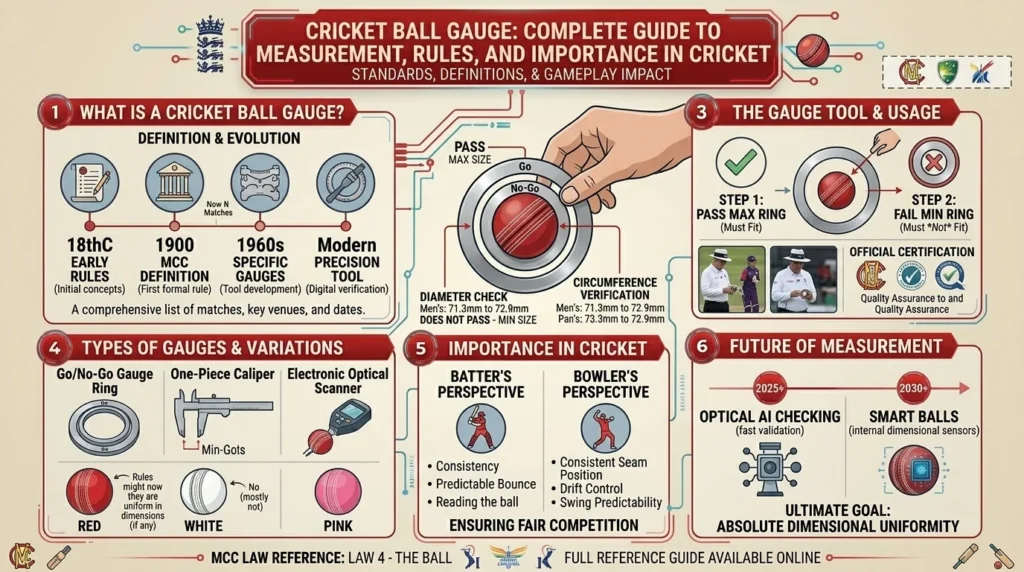

Cricket is a sport where precision and fairness play a crucial role. From the pitch dimensions to the weight of the ball, every detail matters. One such important but often overlooked tool is the Cricket Ball Gauge. This device is used to check whether a cricket ball meets the official size and shape standards set by governing bodies like the International Cricket Council.
A cricket ball must maintain a specific circumference and shape throughout a match. Over time, due to wear and tear, the ball can lose its original form. This is where a cricket ball gauge becomes essential. It ensures that the ball remains within legal limits, helping maintain fairness in the game.
What Is a Cricket Ball Gauge? Definition, Purpose, and History
A cricket ball gauge is a precision measuring tool used by umpires and match officials to check the size, circumference, and roundness of a cricket ball. It is generally designed as a metal ring, frame, or measuring device with carefully defined dimensions that correspond to the official requirements for cricket balls.
Because a cricket ball can become worn, damaged, or slightly deformed during a match, checking its physical condition is important. A gauge gives officials a practical way to determine whether the ball still meets the required standards and remains suitable for play.
Purpose of a Cricket Ball Gauge
The main purposes of a cricket ball gauge include:
- Verifying the circumference of the cricket ball
- Checking whether the ball has maintained its proper round shape
- Identifying significant deformation or damage
- Helping officials determine whether the ball still meets the required standards
- Supporting fair play and consistent match conditions
If a ball is found to be excessively damaged, deformed, or otherwise unsuitable under the applicable Laws of Cricket or competition regulations, the umpire may take the appropriate action, which can include replacing the ball.
History and Origin of the Cricket Ball Gauge
The development of the cricket ball gauge is closely connected with the wider standardization of cricket equipment. In the early history of cricket, particularly during the 16th and 17th centuries, cricket balls were largely handmade. Differences in manufacturing could result in variations in their size, shape, weight, and overall quality.
As organized cricket developed, standardized equipment became increasingly important. Variations in the condition or dimensions of a cricket ball could affect aspects of the game such as bounce, swing, seam movement, and spin, making consistent equipment standards important for fair competition.
Development of Standardized Cricket Equipment
The establishment of the Marylebone Cricket Club (MCC) in 1787 was an important milestone in the development of standardized cricket laws and equipment requirements. As the Laws of Cricket became more organized, specifications for cricket equipment, including the cricket ball, became increasingly defined.
A measuring device such as a cricket ball gauge provided officials with a practical method of checking whether a ball remained within the permitted dimensional limits. Instead of relying only on visual judgment, officials could use a standardized gauge to assess the physical size and shape of the ball.
Modern Use of Cricket Ball Gauges
Today, cricket ball inspection is an important part of professional cricket. Modern cricket balls are manufactured to consistent standards, but they can still experience considerable wear and impact during a match.
A cricket ball gauge can therefore help umpires verify that a ball has not become excessively deformed or changed beyond the permitted specifications. Along with visual inspection and other match-official procedures, it helps maintain consistency, fairness, and the integrity of cricket.
Official Cricket Ball Size and Weight Rules
The Laws of Cricket define specific requirements for the size and weight of cricket balls used in official matches. These standards help ensure that the ball performs consistently and that both teams compete under fair and predictable playing conditions.
Match officials are responsible for checking the condition and suitability of the ball before and during a match. If a ball becomes significantly damaged, deformed, or unsuitable for play, it can be replaced according to the applicable Laws of Cricket and competition regulations.
Standard Cricket Ball Measurements
For men’s senior cricket, the standard cricket ball specifications are:
- Circumference: 22.4 cm to 22.9 cm (8.81–9.00 inches)
- Weight: 155.9 g to 163 g (5.5–5.75 ounces)
These specifications are used for men’s international cricket, including Test matches, One Day Internationals (ODIs), and Twenty20 Internationals (T20Is), as well as many professional competitions.
The exact equipment requirements can vary for different categories of cricket, so women’s and junior matches may use balls with different specifications.
Why Are Cricket Ball Size and Weight Important?
The size and weight of a cricket ball can influence how it behaves during a match. A regulation ball helps provide consistent conditions for both batters and bowlers.
Maintaining standardized dimensions can contribute to predictable:
- Bounce
- Swing
- Seam movement
- Spin and grip
- Ball speed and overall behavior
Standardization also prevents one team from gaining an unfair advantage because of an unusually large, small, heavy, light, or badly deformed ball.
Role of the Umpire in Cricket Ball Inspection
Umpires have an important responsibility for monitoring the condition of the cricket ball throughout the match. They may use visual inspection and appropriate measuring equipment when there is a concern about the ball’s condition.
Umpires can:
- Check that the ball meets the required specifications before play.
- Inspect the ball when its condition is questioned.
- Assess whether the ball has become excessively worn or misshapen.
- Replace a ball when required under the applicable rules.
- Ensure that both teams play with a ball that meets the relevant standards.
By maintaining proper ball standards, umpires help protect fair competition, consistent playing conditions, and the integrity of the game.
How Does a Cricket Ball Gauge Work?
The working principle of a cricket ball gauge is simple but effective. It is designed to help umpires and match officials determine whether a cricket ball remains within the required size and shape specifications.
The gauge provides a standardized reference against which the ball can be checked. This is particularly useful when a ball has been exposed to repeated impacts from the bat, pitch, boundary, or other surfaces and appears worn or misshapen.
How a Cricket Ball Gauge Works
A cricket ball gauge is manufactured with precise dimensions based on the applicable cricket ball standards. During an inspection, the umpire checks the ball against the gauge to determine whether its circumference and general shape remain acceptable.
The inspection can be performed quickly without requiring complicated equipment. If the ball shows excessive deformation or does not meet the applicable measurement requirements, the officials can take the appropriate action under the Laws of Cricket and competition regulations.
Step-by-Step Process
- The umpire takes the cricket ball for inspection when a size or shape concern arises.
- The ball is positioned in or against the gauge according to the design of the measuring device.
- The official checks the fit to determine whether the ball remains within the permitted dimensions.
- The ball’s shape is assessed to identify any significant deformation or abnormality.
- If the ball fails the applicable inspection, the umpire follows the relevant match regulations, which may include replacing the ball.
- A suitable replacement ball is selected when replacement is required, helping maintain consistent playing conditions.
This straightforward inspection process helps officials identify a cricket ball that may no longer meet the required standards and ensures that ball condition does not unfairly influence the match.
Types of Cricket Ball Gauges
Cricket ball gauges can vary in design depending on their purpose and the level of inspection required. The basic idea behind these tools is to provide officials or manufacturers with a consistent way to assess the size and shape of a cricket ball.
In match situations, simple mechanical measuring devices are generally more practical because they are quick to use, durable, and do not require batteries or electronic equipment. More advanced measuring instruments may be used during manufacturing, quality control, or laboratory testing.
Ring Gauge
A ring gauge is a simple circular measuring device designed to check whether a cricket ball falls within the required dimensional limits. The ball is checked against the precisely manufactured opening to identify excessive size or deformation.
Its main advantages are its simple construction, portability, and ease of use. A mechanical gauge can provide a quick reference for an umpire when the condition of a cricket ball needs to be assessed.
Dual-Size or Limit Gauge
A dual-size or limit gauge uses defined measurement points to check the acceptable size range of a cricket ball. Instead of relying on a general visual assessment, the device provides a physical reference for the minimum and maximum permitted dimensions.
This type of design can make inspections faster and easier because the official can determine whether the ball falls within the specified limits without carrying out a complicated measurement.
Digital or Electronic Measuring Gauge
Digital measuring equipment can provide more precise dimensional readings than a basic mechanical gauge. These devices may use electronic sensors or digital measurement systems to determine the size or shape of an object.
They are more commonly associated with cricket ball manufacturing, quality control, equipment testing, and laboratory inspection than routine on-field umpiring. Digital systems can be useful when detailed measurements or documented quality-control results are required.
Importance of a Cricket Ball Gauge
A cricket ball gauge is useful because the condition and dimensions of the ball can affect playing conditions. Cricket balls naturally experience wear during a match, and significant damage or deformation may change how the ball behaves.
A standardized inspection method helps officials determine whether a ball remains suitable for play and supports consistent application of the Laws of Cricket.
Ensures Fair Play
A properly manufactured and suitably conditioned cricket ball helps provide consistent conditions for both teams. Checking the ball can help prevent an excessively deformed or otherwise unsuitable ball from creating an unfair advantage.
This is particularly important because bowlers and batters rely on predictable ball behavior throughout a match.
Helps Maintain Consistent Ball Performance
The condition and shape of a cricket ball can influence several aspects of its performance, including:
- Swing movement
- Seam movement
- Bounce
- Bowling grip
- Spin
- Overall ball behavior
A gauge does not measure all of these performance characteristics directly. Instead, it helps officials assess whether the ball’s physical dimensions and shape remain within the applicable requirements.
Supports Umpire Decisions
A cricket ball gauge can provide an objective physical reference when an umpire has concerns about the ball. Rather than depending entirely on visual judgment, officials can use appropriate measuring equipment alongside inspection of the ball’s overall condition.
This can make the ball-checking process more consistent and help officials decide whether further action, including replacement where required, is appropriate.
Helps Identify Significant Ball Deformation
A gauge can help reveal whether a ball has changed shape significantly as a result of repeated impacts, damage, or wear. While normal wear is expected during cricket, excessive deformation may require the ball to be assessed more carefully.
The gauge should therefore be considered one part of the overall ball-inspection process rather than a tool that determines every aspect of ball condition.
Does Not Detect Every Type of Ball Tampering
A cricket ball gauge is not a dedicated ball-tampering detection device. It primarily helps assess dimensions and physical shape.
Other forms of ball tampering or unauthorized alteration may not change the ball’s circumference enough to be detected by a gauge. Umpires therefore rely on visual inspection, observation during the match, and the applicable Laws of Cricket and competition regulations when dealing with concerns about ball condition.
Impact of Cricket Ball Condition on Gameplay
The condition of a cricket ball can have a significant effect on how it behaves during different stages of a match. As the ball is used, its surface, seam, shine, hardness, and overall shape gradually change. These changes can influence bowling movement, batting conditions, and the way the ball interacts with the pitch.
A properly maintained ball can provide predictable playing conditions, while a significantly damaged or misshapen ball may behave differently. This is why umpires and players pay close attention to the ball’s condition throughout a match.
Impact on Bowlers
Bowlers are strongly influenced by the condition of the cricket ball because different stages of wear can support different bowling techniques.
- A new cricket ball generally provides greater opportunities for conventional swing and seam movement.
- As the ball becomes older, its surface changes and fast bowlers may be able to generate reverse swing under suitable conditions.
- Spin bowlers can benefit from the grip and surface characteristics of an older ball, depending on the pitch and playing conditions.
- The condition of the seam can influence how seam bowlers attempt to move the ball after pitching.
- A ball that becomes significantly deformed or damaged may behave unpredictably and can be assessed by the umpire for possible replacement.
The exact amount of swing, seam, or spin depends on several factors, including bowling technique, pitch conditions, weather, ball condition, and the characteristics of the particular cricket ball.
Impact on Batters
The condition of the ball also affects the experience of batters throughout an innings.
- A new and properly shaped ball can provide more pace, seam movement, and swing, particularly for skilled fast bowlers.
- As the ball becomes older, its shine and surface characteristics change, which can alter the amount of movement available to bowlers.
- An older ball may provide different batting conditions compared with a new ball, although the difficulty of batting depends heavily on the pitch and bowling attack.
- A properly shaped ball provides more predictable bounce and movement.
- A severely damaged or misshapen ball may produce unusual behavior and can make stroke play more difficult.
Therefore, changes in ball condition are a normal part of cricket, but excessive damage or deformation is treated differently under the applicable Laws and competition regulations.
Impact on the Fielding Team
The fielding team also plays an important role in maintaining the ball during a match. Players may polish the ball using permitted methods to help preserve its condition and maintain the desired surface characteristics.
Proper ball care can help bowlers make effective use of the ball as it becomes older.
Fielders and captains may also monitor the ball for:
- Excessive damage
- Changes in shape
- Loss of the seam
- Unusual surface wear
- Other conditions that may require the umpire’s attention
Players must maintain the ball only in ways permitted by the Laws of Cricket and the relevant competition regulations. They cannot deliberately alter the condition of the ball using unauthorized substances, objects, or techniques.
Why Ball Condition Matters
Ball condition is important because cricket depends on a balance between bat and ball. A ball that is naturally changing through legitimate use is part of the game, but a ball that becomes excessively damaged or deformed may no longer provide suitable playing conditions.
This is where regular observation, proper ball maintenance, and umpire supervision help ensure that the game remains fair, consistent, and competitive for both teams..
Equipment Used Alongside a Cricket Ball Gauge
A cricket ball gauge is one of several tools and pieces of equipment used to help maintain proper playing standards in cricket. Match officials, ground staff, and players rely on different types of equipment to check dimensions, manage the match, maintain safety, and support accurate decision-making.
These tools work together to create consistent playing conditions and help officials apply the Laws of Cricket and relevant competition regulations correctly.
Essential Equipment
- Cricket Ball: The ball is inspected for its size, shape, condition, and suitability for play. A gauge may be used when its dimensions need to be checked.
- Cricket Bat: Bats must comply with the applicable Laws of Cricket regarding their permitted dimensions and construction.
- Protective Equipment: Helmets, batting gloves, pads, thigh protection, arm guards, and other protective equipment help reduce the risk of injury.
- Pitch Measuring Equipment: Ground staff use appropriate measuring tools to check pitch dimensions, creases, and other playing-area requirements.
- Stumps and Bails: Stumps and bails are manufactured and installed according to the dimensions specified in the Laws of Cricket.
- Umpiring Equipment: Umpires may use counters, watches, communication equipment, light meters, and other tools to manage match conditions and decisions.
- Decision-Review Technology: At the highest levels of cricket, technologies such as Hawk-Eye, UltraEdge, ball-tracking systems, and the Decision Review System (DRS) can assist officials with specific decisions when the competition regulations permit their use.
Together, these tools support accurate officiating, player safety, consistent equipment standards, and fair competition.
Role of Cricket Governing Bodies in Ball Standards
Cricket’s governing organizations play an important role in establishing and maintaining standards for equipment and playing conditions. Their regulations help ensure that cricket balls and other equipment meet the requirements applicable to a particular level or format of the game.
International Cricket Council (ICC)
The International Cricket Council (ICC) is the global governing body for international cricket. It establishes and administers regulations for international competitions and works with member boards and match officials to maintain consistent standards.
International cricket includes formats such as Test cricket, One Day Internationals (ODIs), and T20 Internationals (T20Is), each of which is played under the applicable playing conditions and regulations.
Marylebone Cricket Club (MCC)
The Marylebone Cricket Club (MCC) is responsible for the Laws of Cricket. These Laws define many of the fundamental requirements of the game, including specifications relating to cricket balls and other playing equipment.
The Laws provide the foundation for consistent application of cricket’s rules, while individual competitions can also have additional playing conditions.
National Cricket Boards
National cricket boards apply the relevant Laws and competition regulations within their domestic competitions. For example, the Board of Control for Cricket in India (BCCI) administers cricket competitions in India and establishes regulations for its tournaments.
Domestic competitions may also have specific playing conditions that supplement the Laws of Cricket.
Key Responsibilities
Cricket’s governing bodies and competition authorities have responsibilities that can include:
- Establishing and maintaining cricket ball size and weight requirements.
- Defining applicable standards for match equipment.
- Setting competition-specific playing conditions.
- Providing guidance and training for match officials.
- Monitoring compliance with relevant regulations.
- Updating rules and equipment requirements when necessary.
- Supporting fairness, consistency, and player safety across organized cricket.
These standards ensure that equipment such as cricket balls is manufactured, inspected, and used according to the requirements applicable to each competition and level of play.
Major Cricket Competitions Where Ball Standards Matter
Cricket ball standards are important across professional and international competitions because the ball can significantly influence playing conditions. Match officials ensure that the ball used during a game meets the specifications applicable to that competition and remains suitable for play throughout the match.
Ball condition becomes particularly important when the ball is damaged, significantly worn, or appears to have changed shape. In such situations, umpires can inspect the ball and follow the relevant Laws of Cricket and competition playing conditions.
ICC Cricket World Cup
The ICC Cricket World Cup is played under detailed playing conditions that include requirements for match equipment. Cricket balls used in the tournament must meet the applicable specifications for the format.
Umpires monitor the ball during matches and can assess its condition when necessary to help maintain consistent playing conditions.
Indian Premier League (IPL)
The Indian Premier League (IPL) uses standardized match equipment under its competition regulations. In fast-paced T20 cricket, the condition of the ball can influence swing, seam movement, bounce, and bowling performance.
Maintaining appropriate ball standards helps ensure that both teams compete under consistent conditions throughout the match.
The Ashes
The Ashes is a prestigious Test cricket series in which ball condition can become especially important because matches extend over multiple days.
As a Test match progresses, the ball naturally experiences wear and changes in surface condition. Umpires therefore monitor the ball throughout an innings and follow the applicable procedures when it becomes unsuitable for play.
Other International and Domestic Competitions
Ball standards are also important in numerous other competitions, including:
- ICC Champions Trophy
- ICC World Test Championship
- ICC Men’s and Women’s T20 World Cups
- International bilateral series
- First-class cricket
- Domestic one-day competitions
- Professional T20 leagues around the world
Although the formats and playing conditions can differ, maintaining appropriate ball standards is an important part of professional cricket.
Benefits of Using a Cricket Ball Gauge
A cricket ball gauge provides a practical way to check whether a ball’s physical dimensions remain within the applicable requirements. By giving match officials a standardized reference, it can support accurate inspection when there is a concern about the ball’s size or shape.
Benefits for the Game
Using appropriate ball inspection equipment can help:
- Maintain consistent equipment standards.
- Support fair conditions for both teams.
- Reduce uncertainty about the ball’s physical condition.
- Protect the balance between bat and ball.
- Support the proper application of cricket regulations.
- Maintain confidence in the integrity of professional matches.
Benefits for Players
Proper ball inspection can benefit players by helping ensure that the ball used in a match meets the applicable requirements.
It can provide:
- More consistent equipment conditions.
- Greater confidence in the fairness of the match.
- Predictable physical characteristics of the ball.
- Reduced disputes concerning ball size or deformation.
- A more consistent environment for batting and bowling.
A gauge does not guarantee identical ball performance because factors such as pitch, weather, age, and surface condition also affect the game.
Benefits for Match Officials
For umpires and match officials, a suitable measuring device can:
- Provide an objective reference when checking ball dimensions.
- Help identify significant deformation.
- Support decisions regarding the ball’s suitability for play.
- Make physical inspections more consistent.
- Complement visual examination of the ball.
- Support the enforcement of applicable playing conditions.
Interesting Facts About Cricket Ball Gauges
Although a cricket ball gauge is a relatively simple piece of equipment, it can play a useful role in maintaining cricket ball standards and supporting match officials.
- Cricket balls are manufactured to defined size and weight specifications for their intended category of cricket.
- A ball may be inspected during a match if its condition or shape becomes a concern.
- Significant deformation can affect how a ball behaves and may lead to an official assessment.
- A gauge provides a standardized physical reference rather than relying entirely on visual judgment.
- Ball inspection is particularly important in professional and international cricket.
- The condition of a cricket ball naturally changes as it is used throughout a match.
- A gauge primarily concerns physical dimensions and shape; it does not measure every aspect of ball condition.
- Ball standards help create consistent conditions for batters and bowlers.
- Different categories of cricket can have different ball specifications, so the applicable competition requirements must be followed.
- A cricket ball gauge is only one part of the broader process of ball inspection and match management.
Conclusion
The Cricket Ball Gauge may seem like a small and simple tool, but it plays a massive role in maintaining the fairness and integrity of cricket. By ensuring that the ball remains within official size and shape limits, it helps create a level playing field for all participants.
From local matches to international tournaments, this tool supports umpires in making accurate decisions and upholding the spirit of the game. As cricket continues to evolve with new technologies and formats, the importance of basic tools like the cricket ball gauge remains unchanged. It is a perfect example of how small details contribute significantly to the success and credibility of a global sport.