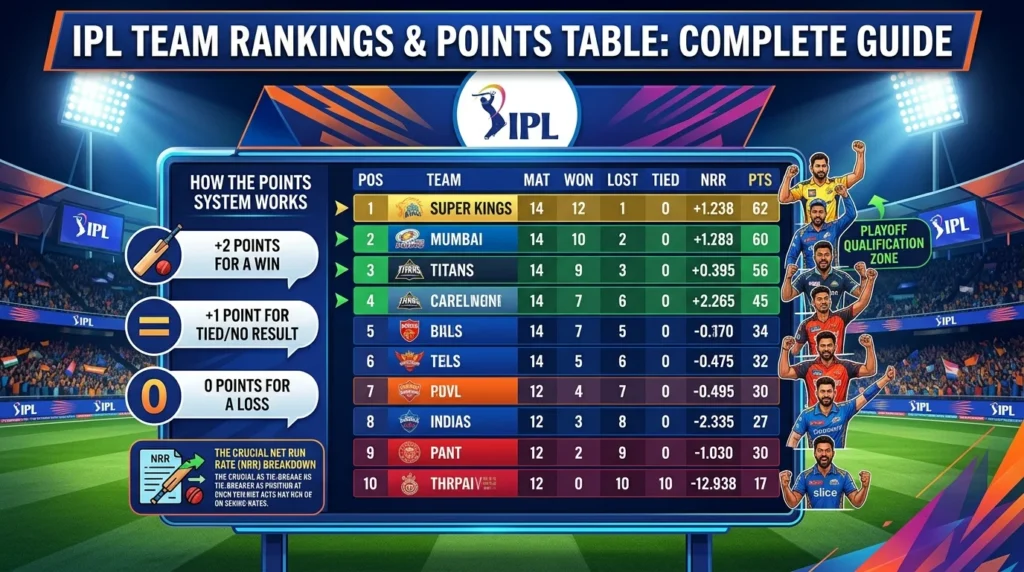

Every cricket season, millions of fans follow the Indian Premier League not just for exciting matches but also to track how their favorite teams perform on the points table. Imagine your team winning two matches in a row—your excitement grows as you check the IPL team ranking to see them move up the table. That ranking becomes a key indicator of success and consistency.
IPL team ranking is more than just numbers. It reflects team performance, strategy, player form, and match outcomes throughout the tournament. Whether you are a beginner or a passionate fan, understanding how rankings work helps you enjoy the game at a deeper level.
In this article, you will learn everything about IPL team ranking, including how the points table works, factors that affect rankings, team strategies, player roles, and interesting facts. By the end, you will have a clear understanding of how teams rise or fall in the IPL standings.
What is IPL Team Ranking?
IPL team ranking refers to the position of each team on the tournament’s points table based on their performance.
Simple Explanation
Teams earn points by winning matches. The more points they have, the higher they rank.
Practical Example
If a team wins 5 matches and loses 2, it will likely rank higher than a team with only 3 wins.
History of IPL Team Ranking System
The ranking system has been part of the IPL since its start in 2008. It helps decide which teams qualify for playoffs.
Evolution Over Time
- Initially, rankings were based mainly on wins
- Later, Net Run Rate (NRR) became important
- Tie-breaker rules were introduced for fairness
Successful Teams in IPL Rankings
- Mumbai Indians – Multiple-time champions
- Chennai Super Kings – Known for consistency
- Kolkata Knight Riders – Strong performances in key seasons
How IPL Team Ranking Works
Points System
- Win = 2 points
- Loss = 0 points
- No result = 1 point each
- Tie (Super Over decides winner)
Net Run Rate (NRR)
NRR is used when teams have equal points.
What is NRR?
It measures how quickly a team scores runs compared to how quickly they concede runs.
Ranking Criteria
- Total points
- Net Run Rate
- Head-to-head results
Rules and Gameplay Impacting Rankings
Match Format
- Each team plays 14 league matches
- Top 4 teams qualify for playoffs
Key Gameplay Factors
- Batting performance
- Bowling efficiency
- Fielding quality
These directly influence match results and rankings.
Key Factors Affecting IPL Team Ranking
1. Team Performance
Winning matches consistently is the most important factor.
2. Player Form
Star players performing well improves ranking chances.
3. Net Run Rate
Winning by large margins boosts ranking position.
4. Injuries
Missing key players can affect team performance.
5. Pitch Conditions
Different pitches favor different teams.
Team Roles and Contributions
Batters
Score runs quickly and set strong targets.
Bowlers
Take wickets and control runs.
All-Rounders
Provide balance with both bat and ball.
Fielders
Save runs and create chances for dismissals.
Techniques and Strategies for Better Ranking
Batting Strategies
- Aggressive powerplay batting
- Strong middle-order stability
- Finishing with high strike rate
Bowling Strategies
- Early wickets in powerplay
- Spin control in middle overs
- Death-over accuracy
Captaincy
Good decision-making improves team ranking.
IPL Teams and Their Ranking Strength
Top Competitive Teams
- Royal Challengers Bengaluru – Strong batting lineup
- Delhi Capitals – Balanced squad
- Sunrisers Hyderabad – Strong bowling attack
Each team has unique strengths that influence rankings.
Equipment Used in IPL Matches
- Cricket bat
- Cricket ball
- Protective gear
- Fielding equipment
Proper equipment ensures fair competition and player safety.
Major IPL Competitions and Format
League Stage
All teams compete to earn points.
Playoffs
Top 4 teams enter knockout matches.
Final
The top two teams compete for the championship.
Benefits of Understanding IPL Team Ranking
For Fans
- Better match understanding
- Increased excitement
For Players
- Motivation to perform better
- Clear performance targets
For Coaches
- Strategy planning
- Performance analysis
Interesting Facts About IPL Team Ranking
- Net Run Rate often decides playoff qualification
- Teams can qualify even with fewer wins if NRR is high
- Last-match results can change rankings dramatically
- Some teams have qualified with negative NRR
Comparison: Points vs Net Run Rate
| Feature | Points | Net Run Rate |
|---|---|---|
| Importance | Primary factor | Secondary factor |
| Based On | Wins/losses | Run scoring speed |
| Impact | Determines ranking | Breaks ties |
Common Mistakes Teams Make
- Ignoring NRR importance
- Poor team selection
- Weak middle-order performance
- Lack of death-over planning
Avoiding these mistakes improves rankings.
Future Trends in IPL Team Ranking
Technology Use
- Data analytics for performance
- AI-based match predictions
Advanced Metrics
- Player impact ratings
- Real-time ranking updates
Improved Strategies
- Data-driven decisions
- Better fitness programs
Applications of IPL Team Ranking
- Tournament qualification
- Performance evaluation
- Fan engagement
- Media analysis
Conclusion
The IPL team ranking system is a vital part of the tournament, helping fans and teams understand performance and progress. It is not just about winning matches but also about consistency, strategy, and smart gameplay.
From points and Net Run Rate to player performance and team balance, many factors influence rankings. Understanding these elements makes watching IPL more exciting and meaningful.
As the competition continues to grow, teams are becoming smarter and more competitive. Whether you are a beginner or a cricket expert, learning about IPL team ranking gives you deeper insight into the game and enhances your overall experience.