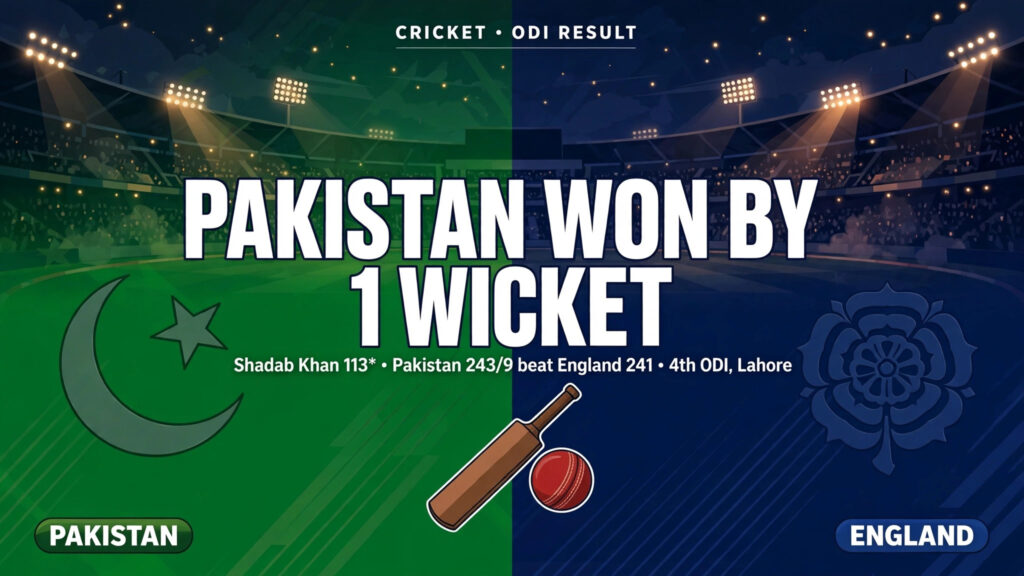
Pakistan pulled off one of the great ODI escapes at Gaddafi Stadium, Lahore, beating England by one wicket in the fourth match of the Pakistan ODI Tri-Series 2026 on Sunday, 25 October 2026. Chasing 242, Pakistan were 154 for nine before Shadab Khan produced an unbeaten 113 to carry them to 243 for nine in 47.1 overs, with 17 balls to spare.
The win, confirmed by ESPNcricinfo and multiple match reports, also booked Pakistan’s place in the tri-series final. Player of the Match Shadab Khan shared an unbroken 89-run stand for the last wicket with Haris Rauf, who finished seven not out, to complete a comeback that looked impossible midway through the chase. Read the match preview for the pre-match build-up.
England’s Innings: Duckett Holds Firm After Early Collapse
Pakistan won the toss and chose to bowl first, and captain Shaheen Shah Afridi struck immediately. Tom Banton fell for four in the opening over, Joe Root followed for five, and captain Harry Brook was run out for one by debutant Razaullah, leaving England 19 for three. Jordan Cox made six before Haris Rauf removed him, and at 52 for four England were in deep trouble.
Ben Duckett refused to let the innings fall apart. The opener made 105 off 111 balls, with 10 fours and two sixes, and shared a 93-run fifth-wicket partnership with Sam Curran, who scored 42 off 52 balls. After Curran fell to Shaheen, England’s lower order could not build on Duckett’s work. Gus Atkinson finished 36 not out off 28 balls, but England were bowled out for 241 in 46.4 overs.
Shaheen led Pakistan’s bowling with four wickets for 46 runs in 8.4 overs, a spell that also took him to 150 ODI wickets. Razaullah and Arafat Minhas took two wickets each on a day when Pakistan’s bowlers kept striking at important moments, while Jamie Overton top-scored among England’s later batters with 10.
Pakistan’s Chase: Collapse, Then Shadab’s Rescue
Pakistan’s chase started badly. Fakhar Zaman made 10, Saim Ayub six and Babar Azam 10, and the hosts slipped to 31 for three inside seven overs. Saad Baig counter-attacked with 32 off 22 balls, but his dismissal at 74 for four started another slide.
Salman Ali Agha made 26 and Hasan Nawaz 15, yet wickets kept falling. Arafat Minhas fell for one, Shaheen made four and Razaullah eight, and when the ninth wicket fell at 154 in the 34th over, England looked certain winners.
Shadab had other ideas. Returning to the side, he reached his maiden ODI century and broke the record for the most runs scored in an ODI innings while batting at number eight or below. He finished 113 not out off 96 balls, with 13 fours and five sixes, and farmed the strike superbly with last man Haris Rauf. The pair added 89 runs in 80 balls for the final wicket, turning a lost cause into a famous win.
Key Performances
| Player | Team | Performance |
|---|---|---|
| Shadab Khan | Pakistan | 113 not out off 96 balls (13 fours, 5 sixes) — Player of the Match |
| Ben Duckett | England | 105 off 111 balls (10 fours, 2 sixes) |
| Shaheen Shah Afridi | Pakistan | 4 wickets for 46 runs in 8.4 overs |
| Sam Curran | England | 42 off 52 balls |
| Jamie Overton | England | 3 wickets for 43 runs in 10 overs |
| Haris Rauf | Pakistan | 7 not out off 19 balls in the winning last-wicket stand |
For England, Gus Atkinson’s unbeaten 36 and Liam Dawson’s two wickets deserved mention, but the match belonged to Shadab. His calm under pressure, clean hitting down the ground and ability to protect Rauf from the strike at the right moments made the difference between defeat and one of Pakistan’s most memorable ODI wins.
What It Means
The result keeps Pakistan unbeaten in the tri-series after earlier wins over Sri Lanka and England, and it sends the hosts into the final with real momentum. It also underlines the value of depth in this Pakistan side: when the top order failed, the lower order and the captain’s bowling rescued the game.
For England, the defeat will hurt because they had the match in their hands at 154 for nine. Duckett’s century and the early bowling, led by Overton, showed plenty of promise, but letting a 242-run defence slip from such a commanding position is a lesson in finishing games. England must now regroup quickly for their remaining tri-series fixtures.
Their earlier Pakistan vs Sri Lanka 1st ODI recap and Pakistan vs England 2nd ODI preview show how the tournament unfolded.
Frequently Asked Questions
- Who won the Pakistan vs England 4th ODI 2026? Pakistan won by one wicket, reaching 243 for nine in 47.1 overs after England made 241 all out in 46.4 overs.
- Who was Player of the Match? Shadab Khan, for his unbeaten 113 off 96 balls and the match-winning last-wicket partnership with Haris Rauf.
- What was Shadab Khan’s score? 113 not out off 96 balls, with 13 fours and five sixes — his maiden ODI century and a record for a batter at number eight or below in ODIs.
- What were the key bowling figures? Shaheen Shah Afridi took four wickets for 46 runs for Pakistan, while Jamie Overton took three wickets for 43 runs for England.
- Where was the match played? Gaddafi Stadium, Lahore, on 25 October 2026, in the Pakistan ODI Tri-Series 2026.
Conclusion
This was a match Pakistan had lost twice — first when England recovered through Duckett, and again when their own chase collapsed to 154 for nine. Shadab Khan’s century changed the story completely, and the roar around Gaddafi Stadium at the winning moment said everything about what it meant.
Pakistan now head to the tri-series final as the form team of the tournament. England, meanwhile, will know they let a golden chance slip, and their response in the next match will be watched closely. For now, though, this one belongs to Shadab Khan and one of the great ODI comebacks.
Full scorecard: ESPNcricinfo match scorecard

Green Benn is a dedicated sports writer specializing in cricket, including IPL and international formats. Known for clear, engaging, and informative content, Green simplifies complex match analysis and player statistics for all readers. Passionate about sports storytelling, Green delivers reliable, SEO-friendly articles that keep fans updated and informed