
The 4-3-3 formation is one of the most popular and recognizable tactical systems in modern football. Used by clubs, national teams, youth coaches, and amateur sides, it provides a strong balance between attacking width, midfield control, defensive stability, and pressing. But understanding the numbers alone does not explain why this formation works so well.
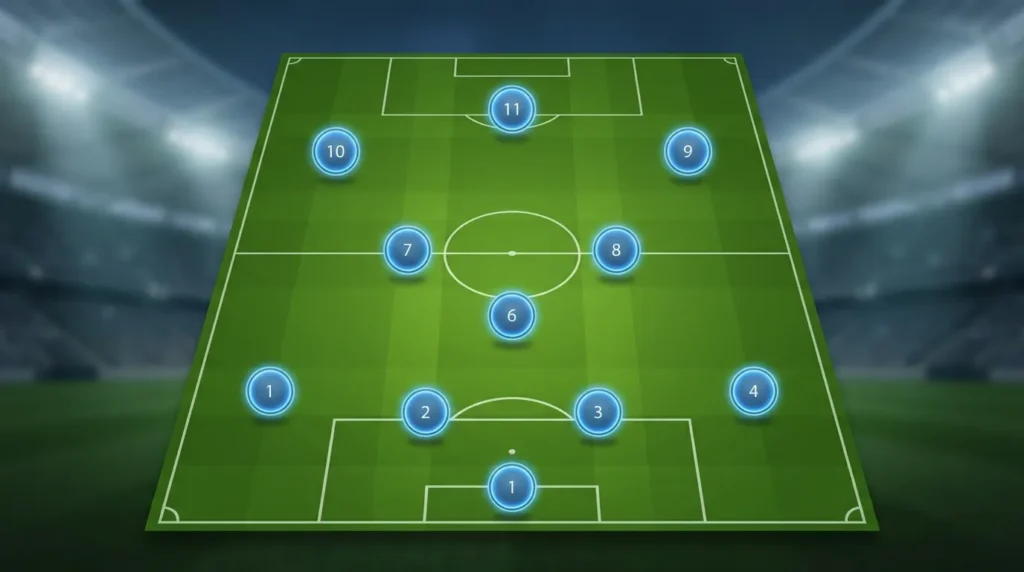
A 4-3-3 formation consists of four defenders, three midfielders, and three forwards. Usually, the front three include a central striker and two wingers who operate from the left and right sides. Behind them, a midfield trio provides support in both attack and defense.
This formation can look very different depending on the coach’s instructions. A team may use it to dominate possession, press aggressively, attack through the wings, or defend compactly. In this guide, you will learn what the 4-3-3 formation is, how it works, the role of every position, its advantages and disadvantages, variations, examples, and practical tips for using it effectively.
4-3-3 Formation – Quick Answer
The 4-3-3 formation is a football tactical system made up of four defenders, three midfielders, and three attackers.
The basic structure is:
- 4 defenders: Two center-backs and two full-backs
- 3 midfielders: Usually one defensive midfielder and two central or attacking midfielders
- 3 forwards: One center forward and two wingers
A simple structure looks like this:
LW — ST — RW
LM — CM — DM
LB — CB — CB — RB
GK
The formation gives a team natural width because the wingers stay in wide areas. The three midfielders can also create passing triangles and help the team maintain possession.
However, the system is not rigid. During an attack, full-backs may move forward while a midfielder drops deeper. During defense, the wingers may move back to form a midfield line, effectively creating a 4-5-1 shape.
What Is the 4-3-3 Formation?
The 4-3-3 is a tactical formation in which a team organizes itself around four defenders, three midfielders, and three attackers.
Its main purpose is to create balance between defense, midfield, and attack. The three forwards give the team attacking options, while the midfield trio provides a numerical presence in the central area.
One of the biggest characteristics of the system is its width. The wingers can stretch the opposition’s defense, creating space for midfielders and the striker.
The formation can also support different tactical philosophies. A possession-focused team might use short passing and overlapping full-backs, while a counter-attacking team can use the wingers’ pace to attack quickly after winning the ball.
History of the 4-3-3 Formation
The modern 4-3-3 developed from earlier football formations as coaches increasingly looked for ways to create better midfield control and attacking width.
Its development is often associated with tactical changes in European and South American football during the twentieth century. Over time, coaches adapted the formation to emphasize pressing, possession, positional play, and flexible movement.
The system became particularly influential in modern football because it can transition naturally between different shapes.
For example:
- Attacking: 2-3-5 or 3-2-5
- Balanced: 4-3-3
- Defensive: 4-5-1
This flexibility has helped make the formation useful at many levels of the game.
How Does the 4-3-3 Formation Work?
The 4-3-3 works by dividing responsibilities among three major areas while encouraging players to support one another.
The defenders protect the goal and help build attacks from the back. The midfielders connect defense with attack, while the front three provide width, movement, and goal-scoring opportunities.
Building From the Back
When a team has possession, the center-backs usually spread apart to create passing angles. The defensive midfielder can drop between or in front of them to provide another option.
The full-backs may move higher up the pitch, giving the team additional width.
Controlling the Midfield
Three midfielders can form triangles that make passing easier. A defensive midfielder often stays deeper while the other two midfielders move between defensive and attacking positions.
This structure allows the team to maintain possession and respond quickly when the ball is lost.
Attacking With Width
The wingers are crucial to the 4-3-3. They can remain wide to stretch the defense, cut inside toward goal, or combine with overlapping full-backs.
The central striker provides a focal point for attacks and can either stay between the center-backs or move into wider areas to create space.
Positions and Player Roles in a 4-3-3
Every player has specific responsibilities, although modern football allows considerable freedom.
Goalkeeper
The goalkeeper’s primary responsibility is to prevent goals. In many modern 4-3-3 systems, however, the goalkeeper also participates in building attacks.
A goalkeeper comfortable with the ball can help the team maintain possession when opponents press high.
Center-Backs
The two center-backs provide the foundation of the defensive structure.
Their responsibilities include:
- Marking opposing attackers
- Winning aerial challenges
- Covering spaces behind full-backs
- Starting attacks with accurate passes
- Maintaining defensive positioning
Good communication between the center-backs is essential.
Full-Backs
The left-back and right-back have particularly demanding roles.
Defensively, they must protect the wide areas and track opposing wingers. Attackingly, they may overlap the wingers to create two-versus-one situations.
Modern 4-3-3 systems often rely heavily on attacking full-backs.
Defensive Midfielder
The defensive midfielder is often the tactical anchor of the formation.
This player can:
- Protect the center-backs
- Break up opposition attacks
- Receive passes from defenders
- Switch play from one side to another
- Control the team’s tempo
A disciplined defensive midfielder can make the entire formation more stable.
Central Midfielders
The other two midfielders usually have more freedom.
One may specialize in carrying the ball forward, while the other may focus on creating chances, pressing, or making late runs into the penalty area.
Their ability to move between defense and attack is one of the key strengths of the 4-3-3.
Wingers
The left and right wingers provide width and direct attacking threat.
They can:
- Take on defenders
- Cross the ball
- Cut inside
- Create chances
- Score goals
- Press opposing full-backs
Fast and technically skilled wingers can make the formation extremely dangerous.
Center Forward
The striker is normally the team’s main central attacking player.
Depending on the tactical plan, the striker may act as a traditional target, a pressing forward, a link-up player, or a mobile attacker who creates space for teammates.
Main Variations of the 4-3-3 Formation
The 4-3-3 is not a single fixed system. Coaches can modify the roles within it.
4-3-3 With a Holding Midfielder
This is one of the most common versions.
One midfielder stays deeper and protects the defense, while the other two midfielders are given more freedom.
It provides a good balance between defensive security and attacking support.
4-3-3 With Two Advanced Midfielders
In this variation, the midfielders push higher when the team attacks.
The system can create strong attacking numbers around the opposition penalty area but may leave more space behind the midfield if possession is lost.
4-3-3 False Nine
Instead of playing as a traditional striker, the central forward drops into midfield.
This movement can pull center-backs away from their normal positions and create spaces for wingers or midfield runners.
4-3-3 With Inverted Wingers
In this approach, wingers play on the opposite side of their stronger foot. For example, a left-footed attacker may play on the right.
This allows them to cut inside and shoot or create chances using their stronger foot.
Advantages of the 4-3-3 Formation
The 4-3-3 has several important advantages.
Strong Attacking Width
The wingers naturally occupy wide positions, making it difficult for opponents to defend the entire width of the pitch.
Midfield Balance
Three midfielders can provide numerical support in the center and create useful passing triangles.
Effective Pressing
The front three can press opposing defenders while midfielders move forward to support them.
Multiple Attacking Options
A team can attack through the wings, the center, overlapping full-backs, quick combinations, or crosses.
Flexible Defensive Shape
When the wingers track back, the formation can become a compact 4-5-1.
Good Possession Structure
The combination of defenders, midfielders, wingers, and the striker provides numerous passing options.
Disadvantages of the 4-3-3 Formation
Despite its strengths, the formation has weaknesses.
Space Behind Full-Backs
When full-backs move forward, opponents can attack the spaces they leave behind.
Heavy Demands on Wingers
Wingers may need to contribute in both attack and defense. This requires excellent fitness and discipline.
Midfield Can Become Overloaded
If the opposing team uses four or five central midfielders, the 4-3-3 midfield trio may face numerical disadvantages.
Defensive Midfielder Has Major Responsibility
If the holding midfielder is pulled out of position, the center of the defense can become exposed.
Requires Tactical Discipline
Players must understand when to press, when to stay wide, when to move inside, and when to recover defensively.
4-3-3 vs 4-4-2
The 4-3-3 and 4-4-2 offer different tactical advantages.
| Feature | 4-3-3 | 4-4-2 |
|---|---|---|
| Defenders | 4 | 4 |
| Midfielders | 3 | 4 |
| Forwards | 3 | 2 |
| Width | Strong through wingers | Usually through wide midfielders |
| Central midfield | Three players | Two players |
| Pressing | Often aggressive | Can be more compact |
| Attacking style | Flexible and wide | Often more direct |
The 4-3-3 generally offers greater midfield control and a more natural attacking width, while the 4-4-2 provides a simple and balanced structure.
4-3-3 vs 4-2-3-1
The 4-2-3-1 has two deeper midfielders and an attacking midfielder behind the striker.
The 4-3-3 usually provides a more balanced midfield triangle, while the 4-2-3-1 can offer additional defensive protection in front of the center-backs.
Both formations can be highly effective depending on the players and tactical approach.
How to Play the 4-3-3 Effectively
Teams using this formation should focus on several important principles.
Maintain Width
Wingers should avoid moving into central areas too early. Staying wide can create space for midfielders and the striker.
Create Passing Triangles
Players should position themselves so the ball carrier has multiple passing options.
Coordinate Full-Back Overlaps
A winger can move inside while the full-back advances outside. This creates uncertainty for the defending full-back.
Press as a Unit
The front three should coordinate their pressing rather than chasing the ball individually.
Protect the Center
When a full-back attacks, midfielders should adjust their positions to prevent dangerous counter-attacks.
Switch the Point of Attack
If one side becomes crowded, quickly moving the ball to the opposite side can exploit open space.
Common Mistakes When Using a 4-3-3
Beginners often make tactical mistakes when learning this formation.
Common problems include:
- Both full-backs attacking at the same time without cover
- Wingers staying too narrow
- Midfielders occupying the same space
- The defensive midfielder moving too far forward
- The striker becoming isolated
- Players pressing individually
- Slow transitions after losing possession
The solution is usually better positioning, communication, and understanding of each player’s responsibilities.
Best Players for a 4-3-3 System
The formation does not require one specific type of player, but certain qualities are particularly valuable.
A strong 4-3-3 team usually needs:
- Mobile center-backs
- Attack-minded full-backs
- A disciplined defensive midfielder
- Hard-working central midfielders
- Fast and creative wingers
- A technically capable striker
- A goalkeeper comfortable with passing
The most important factor is not individual talent alone. Players must complement one another.
4-3-3 Formation in Modern Football
The 4-3-3 remains highly relevant because modern coaches frequently use positional rotations.
A team may begin in a 4-3-3 but change shape during possession. One full-back may move into midfield while the opposite full-back stays deeper. A winger may move inside, creating space for an overlapping defender.
As a result, modern football formations should be viewed as starting structures rather than fixed positions.
The success of a 4-3-3 depends on movement, spacing, pressing, transitions, and the individual qualities of the players.
Tips for Coaches Teaching a 4-3-3
Coaches working with beginners should introduce the formation gradually.
Start by teaching:
- Each player’s basic position.
- The team’s defensive shape.
- Passing triangles.
- Winger positioning.
- Full-back movement.
- Pressing triggers.
- Defensive transitions.
- Attacking rotations.
Small-sided training games can help players understand spacing and movement more naturally than simply memorizing positions.
Frequently Asked Questions About the 4-3-3 Formation
What is a 4-3-3 formation in football?
A 4-3-3 formation uses four defenders, three midfielders, and three forwards. It provides width, midfield support, and several attacking options.
Is 4-3-3 a good formation?
Yes. The 4-3-3 can be highly effective because it balances attacking width, midfield control, pressing, and defensive organization. Its success depends on the players and tactical instructions.
What is the main weakness of 4-3-3?
One major weakness is the space behind attacking full-backs. If the midfield does not provide adequate cover, opponents can exploit these areas during counter-attacks.
What is the difference between 4-3-3 and 4-2-3-1?
A 4-3-3 normally has three central midfielders, while a 4-2-3-1 uses two deeper midfielders and an attacking midfielder behind the striker.
How do you defend in a 4-3-3?
When defending, the wingers can drop back alongside the midfielders, creating a 4-5-1 shape. The team should remain compact and protect the central areas.
Is 4-3-3 good for beginners?
Yes, but beginners need to understand spacing and responsibilities. Coaches should teach the basic shape first before introducing complex tactical rotations.
What type of striker works best in a 4-3-3?
A striker who can hold the ball, link with teammates, make runs behind the defense, and contribute to pressing can be particularly effective.
Why do teams use 4-3-3?
Teams use 4-3-3 because it offers natural width, three midfielders, three attacking players, and the flexibility to change shape during different phases of the game.
Conclusion
The 4-3-3 formation is one of football’s most flexible tactical systems. Its structure of four defenders, three midfielders, and three forwards provides a strong foundation for possession, pressing, attacking width, and defensive organization.
Its biggest strengths come from the midfield triangle and the front three. Wingers can stretch the opposition, midfielders can control the center, and full-backs can provide additional attacking support. At the same time, the formation requires discipline because advanced full-backs and attacking wingers can leave spaces during transitions.
Ultimately, there is no universally perfect formation. The effectiveness of a 4-3-3 depends on player qualities, coaching instructions, teamwork, positioning, and the ability to adapt during a match. When players understand their responsibilities and move together, the 4-3-3 can become an extremely powerful and balanced football system.