
The offside rule is one of the most important rules in football, but it is also one of the easiest rules for beginners to misunderstand. You may have watched a match where a goal was disallowed because of offside and wondered why the attacker was penalized even though the player did not appear to do anything wrong.
The basic idea is simple: football does not allow an attacking player to gain an unfair advantage by staying too close to the opponent’s goal while waiting for a teammate to pass the ball. However, being in an offside position is not automatically an offence. A player is only penalized when they become involved in active play in a way covered by the rule.
This offside rule explained for beginners guide breaks down the rule step by step. You will learn what an offside position is, when offside becomes an offence, how the second-last defender matters, why hands and arms are ignored, and when a player cannot be offside. You will also find simple examples, common mistakes, VAR explanations, and frequently asked questions.
What Is the Offside Rule in Football?
The offside rule prevents attackers from gaining an unfair advantage by positioning themselves too close to the opponent’s goal before receiving the ball from a teammate.
Under Law 11 of the IFAB Laws of the Game, a player is in an offside position when part of the head, body, or feet is in the opponents’ half and that part is nearer to the opponent’s goal line than both the ball and the second-last opponent. The hands and arms are not considered when determining offside position. (IFAB)
However, there is an important distinction:
Being in an offside position is not itself an offence.
A player becomes penalized only when they become involved in active play in one of the ways described by Law 11.
Simple Offside Example
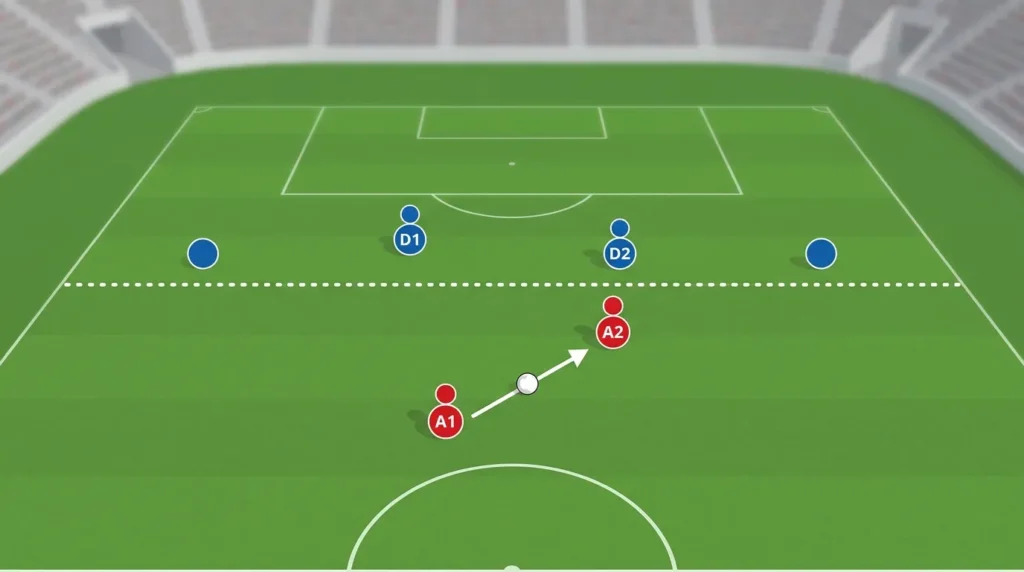
Imagine an attacker is standing behind the second-last defender. A teammate passes the ball forward to that attacker.
If the attacker was in an offside position when the teammate played the ball and then becomes actively involved by playing the ball, an offside offence can occur.
The defending team receives an indirect free kick where the offence occurred. (IFAB)
How Does the Offside Rule Work?
To understand offside, you need to check three things:
- Where the attacker is standing
- Where the ball is
- Where the second-last opponent is
The referee or assistant referee considers the attacker’s position at the exact moment a teammate plays or touches the ball.
Step 1: Check the Attacker’s Position
The attacker must be in the opponent’s half to be in an offside position. The halfway line itself does not count as the opponent’s half.
If the attacker is still in their own half, they cannot be in an offside position.
Step 2: Check the Second-Last Opponent
The attacker must be nearer to the opponent’s goal line than both:
- The ball
- The second-last opponent
The goalkeeper is often the last opponent, but the rule does not specifically say that the goalkeeper must be one of the two players considered.
Any two opponents can form the relevant defensive line.
Step 3: Check the Moment of the Pass
The player’s position is judged when the teammate plays or touches the ball, not when the attacker eventually receives it.
This is a crucial part of understanding the offside rule.
For most plays, officials use the first point of contact with the ball when determining the position. For a goalkeeper throwing the ball, the release point is used. (IFAB)
Step 4: Determine Whether the Player Becomes Involved
Even if an attacker is in an offside position, there is no automatic offence.
The player must become involved in active play, such as:
- Playing or touching the ball
- Interfering with an opponent
- Gaining an advantage from a rebound, deflection, or certain saves
This distinction is why simply standing in an offside position does not always result in a whistle. (IFAB)
What Is an Offside Position?
A player is in an offside position when all the relevant conditions of Law 11 are met.
The player must:
- Be in the opponents’ half, excluding the halfway line.
- Have part of the head, body, or feet nearer to the goal line than both the ball and the second-last opponent.
The hands and arms do not count.
A player is not in an offside position if they are level with the second-last opponent or level with the last two opponents. (IFAB)
Which Body Parts Count for Offside?
The following can be considered:
- Head
- Body
- Feet
The following do not count:
- Hands
- Arms
The upper boundary of the arm is defined in relation to the bottom of the armpit under Law 11. (IFAB)
This means an attacker can legally have a hand or arm beyond the defender’s position without being offside because of that body part.
What Is the Second-Last Defender?
The phrase second-last defender is extremely important.
Many beginners think the offside rule always compares an attacker with the goalkeeper. That is not correct.
The relevant reference point is the second-last opponent.
For example, imagine the goalkeeper is standing near the goal line while one defender is farther up the field. If an attacker is beyond that defender toward the goal, the attacker may be in an offside position.
Example
Suppose the defensive team has:
- Goalkeeper near the goal
- One defender near the penalty area
- Other defenders farther away
The defender closest to the halfway line may not be the relevant player. Officials identify the second-last opponent according to their positions at the moment the ball is played.
This is why the defensive line can change the offside decision so quickly.
When Is a Player Actually Offside?
A player in an offside position is penalized when they become involved in active play.
Interfering With Play
The simplest example is touching or playing a ball passed by a teammate.
Imagine:
- Attacker A is in an offside position.
- Midfielder B passes the ball forward.
- Attacker A plays the ball.
If the required offside conditions existed when the teammate played the ball, the referee can award an indirect free kick to the defending team.
Interfering With an Opponent
A player can also commit an offside offence without touching the ball.
For example, an attacker in an offside position may clearly block a goalkeeper’s line of vision.
If the attacker prevents an opponent from being able to play the ball by clearly obstructing their line of vision, that can be an offside offence. (IFAB)
An attacker can also be penalized for challenging an opponent for the ball or making an obvious action that clearly affects the opponent’s ability to play it.
When Is a Player Not Offside?
There are many situations where a player can be near the opponent’s goal without committing an offside offence.
The Player Is in Their Own Half
A player cannot be in an offside position while in their own half.
For example:
An attacker receives a long pass while standing inside their own half.
There is no offside offence based on that position.
The Player Is Level With the Defender
If the attacker is level with the second-last opponent, the attacker is not in an offside position.
Being level is legal.
This is why the phrase “daylight between the attacker and defender” is sometimes used informally, although officials apply the actual Law 11 criteria rather than that phrase.
The Player Is Level With the Ball
If the relevant part of the attacker’s head, body, or feet is level with the ball, the player is not in an offside position.
The attacker must be nearer to the opponent’s goal line than both the ball and second-last opponent.
Offside Exceptions: Goal Kick, Throw-In, and Corner Kick
One of the easiest ways to remember the major exceptions is the phrase:
Goal kick, throw-in, corner kick.
There is no offside offence if a player receives the ball directly from:
- A goal kick
- A throw-in
- A corner kick
This is specifically stated in Law 11.
Example: Throw-In
Suppose an attacker is standing beyond the second-last defender.
A teammate takes a throw-in directly to that attacker.
The attacker can receive the ball without being penalized for offside.
However, if the ball is subsequently played by a teammate, normal offside rules can apply to the next phase of play.
Example: Corner Kick
An attacker can stand close to the opponent’s goal during a corner kick and receive the ball directly from the corner without an offside offence.
This makes attacking set pieces particularly interesting.
Offside and a Defender’s Deliberate Play
One of the more advanced parts of the offside rule involves a defender deliberately playing the ball.
If an attacker was in an offside position and receives the ball after an opponent deliberately played it, the attacker is generally not considered to have gained an advantage from that opponent’s deliberate play, unless the opponent’s action was a deliberate save.
This is different from a simple accidental deflection.
Deliberate Play vs Deflection
A deliberate play means the defender had control of the ball with the possibility of:
- Passing it
- Gaining possession
- Clearing it
IFAB provides factors that officials can consider, such as whether the player had a clear view, whether the ball was moving quickly, whether its direction was unexpected, and whether the player had time to coordinate their movement.
This area can be difficult even for experienced football fans because the decision depends on the circumstances of the play.
Offside After a Rebound or Save
An attacker in an offside position can also be penalized for gaining an advantage when the ball rebounds or deflects from:
- The goalpost
- The crossbar
- A match official
- An opponent
The rule also covers situations involving a deliberate save by an opponent. (IFAB)
Simple Example
A striker shoots while a teammate is in an offside position.
The goalkeeper makes a deliberate save and the ball falls to the offside-positioned teammate.
If that teammate plays the ball, an offside offence can occur because the player gained an advantage from the save.
Offside Rule and VAR
VAR, or Video Assistant Referee, can review certain decisions involving goals and other match-changing situations.
Offside decisions can be especially suitable for video review because officials can examine the exact moment the ball was played and the relative positions of attackers and defenders.
VAR does not change the offside law. It helps match officials review whether the law was correctly applied.
Why Do VAR Offside Decisions Take Time?
A close offside decision can involve several questions:
- When exactly was the ball played?
- Which defender is the second-last opponent?
- Which part of the attacker’s body is relevant?
- Was the attacker in the opponent’s half?
- Did the player become involved in active play?
- Was the defender’s contact deliberate play or simply a deflection?
These details can make apparently simple decisions complicated.
Common Offside Mistakes Beginners Make
Mistake 1: Thinking Any Position Ahead of the Defender Is Offside
Being ahead of a defender does not automatically mean a player is committing an offence.
The attacker must meet the conditions for an offside position and then become involved in active play.
Mistake 2: Comparing the Attacker Only With the Goalkeeper
The rule uses the second-last opponent, not necessarily the goalkeeper.
Mistake 3: Forgetting the Ball
The attacker must be nearer to the goal line than both the ball and second-last opponent.
Mistake 4: Judging the Position When the Ball Is Received
The important moment is when the teammate plays or touches the ball.
The attacker can run behind the defender after the pass and still receive the ball legally if they were onside at the relevant moment.
Mistake 5: Thinking Hands and Arms Count
They do not count when determining an offside position.
Offside Rule Examples
Here are some simple scenarios to test your understanding.
| Situation | Offside? |
|---|---|
| Attacker is in their own half | No |
| Attacker is level with second-last opponent | No |
| Attacker is beyond second-last opponent but does not become involved | Not automatically |
| Offside-positioned attacker plays teammate’s pass | Yes, if the Law 11 conditions are met |
| Player receives directly from a throw-in | No |
| Player receives directly from a corner kick | No |
| Player receives directly from a goal kick | No |
| Attacker blocks goalkeeper’s line of vision from an offside position | Can be offside |
| Ball rebounds from a post to an offside-positioned attacker who plays it | Can be offside |
How Players Can Avoid Being Offside
Attackers can improve their positioning by learning to time their runs carefully.
Watch the Defender
Do not simply focus on the ball. Attackers should also watch the defensive line.
Time the Run
A forward can remain behind the defensive line but move forward at the correct moment.
The key is being in a legal position when the teammate plays the ball.
Stay Alert to the Ball
Players should understand when a teammate is likely to pass. A poorly timed run can turn a promising attacking move into an offside offence.
Communicate With Teammates
Good communication between midfielders and forwards helps players coordinate runs and passes.
Why Is the Offside Rule Important?
Without the offside rule, attackers could spend much of the game standing close to the opponent’s goal and waiting for long passes.
The rule encourages:
- Better movement
- Tactical defending
- Organized attacking
- Team coordination
- More balanced play
- Intelligent positioning
It also makes football more tactical because attackers must constantly judge space, timing, and defensive positioning.
Frequently Asked Questions About the Offside Rule
What Is the Offside Rule in Simple Words?
The offside rule prevents an attacker from gaining an unfair advantage by being too close to the opponent’s goal when a teammate plays the ball. However, simply being in an offside position is not automatically an offence.
Can You Be Offside in Your Own Half?
No. A player cannot be in an offside position while in their own half. The opponent’s half begins beyond the halfway line, and the halfway line itself is excluded from the opponent’s half for this purpose.
Can You Be Offside From a Corner Kick?
No. There is no offside offence when a player receives the ball directly from a corner kick. The same exception applies to a goal kick and throw-in.
Does the Goalkeeper Count as the Last Defender?
The goalkeeper can be one of the two opponents used to determine offside, but the rule is based on the second-last opponent, not specifically the goalkeeper.
Do Hands Count for Offside?
No. The hands and arms of players, including goalkeepers, are not considered when determining an offside position. The relevant parts are the head, body, and feet.
Can You Be Offside Without Touching the Ball?
Yes. A player can commit an offside offence by interfering with an opponent, such as clearly obstructing an opponent’s line of vision or challenging for the ball from an offside position.
What Happens After an Offside Offence?
The defending team is awarded an indirect free kick at the location where the offside offence occurred.
Why Is Offside Sometimes So Difficult to Judge?
Close decisions depend on the exact position of the attacker, the second-last opponent, and the ball at the moment a teammate plays or touches it. Modern matches may also use VAR to review tight decisions.
Conclusion
The offside rule may look complicated at first, but its basic structure is easier to understand once you separate offside position from an offside offence. A player is not automatically penalized simply for standing in an offside position. The player must also become involved in active play under the conditions of Law 11.
Remember the most important points: check the attacker’s position, identify the second-last opponent, consider the ball, and judge the position when the teammate plays or touches it. Also remember that there is no offside offence from a direct goal kick, throw-in, or corner kick.
For beginners, the best way to understand the rule is to watch real match situations and pause the action at the moment of the pass. Once you start noticing the defensive line and timing of attacking runs, offside decisions become much easier to understand.