
Have you ever used a word like beautiful, large, smart, or fast and wondered what kind of word it is? These words are called adjectives. Adjectives are an important part of English because they help us describe people, places, animals, objects, feelings, and ideas.
People search for “adjective” because they want to understand its meaning, types, examples, and correct use. Students often learn terms such as descriptive adjectives, comparative adjectives, superlative adjectives, possessive adjectives, and demonstrative adjectives. This can make a simple grammar topic seem difficult.
The basic idea is easy: an adjective usually describes or gives more information about a noun or pronoun. For example, in “She has a beautiful dress,” the word beautiful describes the noun dress. In “The tall boy is running,” tall gives us more information about the boy.
In this guide, you will learn what an adjective means, where the word comes from, how British and American English use it, common mistakes, everyday examples, popular adjective variations, and answers to frequently asked questions.
Adjective – Quick Answer
An adjective is a word that describes or gives more information about a noun or pronoun.
Adjectives can tell us:
- What something looks like
- How big or small it is
- What color it is
- How someone feels
- What something is like
Examples
She has a beautiful dress.
Beautiful describes the dress.
He drives a fast car.
Fast describes the car.
They live in a large house.
Large describes the house.
The red apple is fresh.
Red describes the apple.
Simple Definition
Adjective = a word that describes a noun or pronoun.
The Origin of Adjective
The word adjective comes from the Latin word adiectivum, which means something that is “added” or “joined.”
The Latin term is related to adiciere, meaning “to add” or “to throw toward.” The idea is simple: an adjective adds information to a noun.
The word later entered English through French and became a common grammar term.
For example:
a small house
The word small adds information about the noun house.
English adjectives have been used for centuries to make descriptions more detailed and clear.
Unlike some English words that have different British and American spellings, adjective is spelled the same in both varieties.
The spelling is:
Adjective
There is no standard British form and separate American form.
However, adjectives themselves can sometimes have spelling differences when they are formed from words that follow British or American spelling rules.
For example:
- British: colourful
- American: colorful
Both words are adjectives.
British English vs American English Spelling
The word adjective has the same spelling in British and American English.
However, some adjectives have different spellings because of wider differences between British and American English.
| Adjective | British English | American English |
|---|---|---|
| Adjective | adjective | adjective |
| Colourful | colourful | colorful |
| Favourite | favourite | favorite |
| Honourable | honourable | honorable |
| Centre-based | centre-based | center-based |
| Civilised | civilised | civilized |
| Organised | organised | organized |
Examples
British English:
Blue is my favourite colour.
American English:
Blue is my favorite color.
The meaning is the same. Only the spelling changes.
Another example:
It was a colourful painting. — British English
It was a colorful painting. — American English
Important Point
There is no different spelling for the word “adjective.”
Both British and American English use:
adjective
Which Spelling Should You Use?
Your choice should depend on your audience.
For US Readers
Use American English spelling when writing for:
- American schools
- US businesses
- American customers
- US websites
- American publications
For example:
This is my favorite book.
For UK Readers
Use British English spelling when writing for:
- UK schools
- British businesses
- UK readers
- British publications
For example:
This is my favourite book.
For Commonwealth Readers
British-style spelling is often suitable for countries such as Australia and New Zealand, although local style guides may have their own preferences.
For Global Websites
Choose one spelling system and use it consistently.
Do not mix:
My favourite color is blue.
Instead, choose one style:
My favourite colour is blue.
or:
My favorite color is blue.
Consistency makes your writing look more professional.
Common Mistakes with Adjective
Adjectives are easy to use, but learners often make grammar mistakes.
Mistake 1: Confusing an Adjective with an Adverb
Incorrect:
She sings beautiful.
Correct:
She sings beautifully.
Beautiful is an adjective, while beautifully is an adverb.
But:
She is beautiful.
Here, beautiful correctly describes the person.
Mistake 2: Using “More” with the Wrong Adjective
Some short adjectives normally take -er rather than more.
Incorrect:
He is more tall than his brother.
Correct:
He is taller than his brother.
Mistake 3: Incorrect Superlative Form
Incorrect:
She is the most tall student.
Correct:
She is the tallest student.
Mistake 4: Confusing Adjectives and Nouns
Incorrect:
Beauty girl
Correct:
Beautiful girl
Beauty is normally a noun, while beautiful is an adjective.
Mistake 5: Incorrect Adjective Order
When several adjectives appear before a noun, English usually follows a natural order.
Example:
She bought a beautiful small red bag.
Not every possible adjective combination sounds natural, so learners should practice common patterns.
Mistake 6: Using an Adjective When an Adverb Is Needed
Incorrect:
He drives careful.
Correct:
He drives carefully.
Careful describes a person or thing.
Carefully describes an action.
Adjective in Everyday Examples
Adjectives appear in almost every type of English communication.
In Emails
Thank you for your quick response.
Quick describes the response.
We have an important meeting tomorrow.
Important describes the meeting.
In News
The company announced a new product.
New describes the product.
The team achieved a major victory.
Major describes the victory.
On Social Media
What a beautiful day!
I bought a new phone.
This is an amazing photo.
Adjectives make social media posts more expressive.
In Formal Writing
The engineer designed a reliable system.
The company developed an efficient process.
The researchers conducted a detailed study.
Adjectives help formal writing provide clear information.
In Daily Conversation
That is a big house.
She is a kind person.
I need a new phone.
This food is delicious.
These examples show how common adjectives are in everyday English.
Adjective – Google Trends & Usage Data
The keyword “adjective” has strong educational search intent. Students, teachers, parents, and English learners often search for the term when studying grammar.
Common searches include:
- adjective meaning
- what is an adjective
- adjective examples
- types of adjectives
- adjective definition
- descriptive adjectives
- comparative adjectives
- superlative adjectives
- adjective and adverb difference
The keyword can receive searches from many countries where English is taught as a first or second language. Common English-learning markets include India, Pakistan, the United States, the United Kingdom, Canada, Australia, and other countries.
Search interest can increase during school terms, grammar lessons, and examination periods.
For SEO, an article targeting “adjective” should provide the definition quickly. Users often want a simple answer first, followed by examples, types, rules, and comparisons.
Exact search volume and country rankings change over time. Current Google Trends or keyword research data should be checked when precise numbers are needed.
Adjective Variations Comparison Table
| Type | Meaning | Example |
|---|---|---|
| Descriptive adjective | Describes a quality | a beautiful flower |
| Comparative adjective | Compares two things | taller than me |
| Superlative adjective | Shows the highest degree | the tallest student |
| Possessive adjective | Shows ownership | my book |
| Demonstrative adjective | Points to something | this car |
| Quantitative adjective | Shows amount | some water |
| Interrogative adjective | Used in questions | which book? |
| Proper adjective | Comes from a proper noun | American culture |
| Compound adjective | Two or more words working together | a well-known writer |
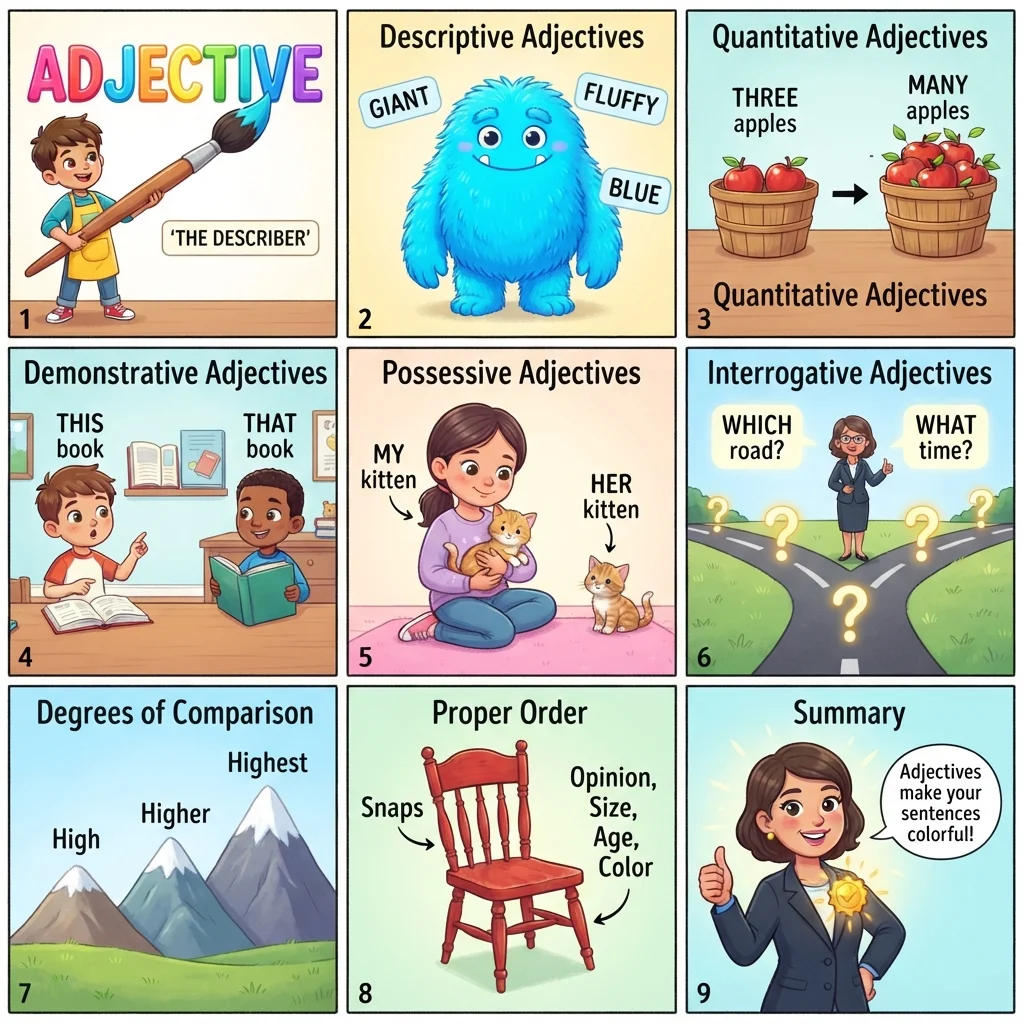
Types of Adjectives
Descriptive Adjectives
Descriptive adjectives tell us about the quality or condition of something.
Examples:
- beautiful
- large
- small
- clever
- strong
- cold
- happy
She has a beautiful voice.
Comparative Adjectives
Comparative adjectives compare two people or things.
Examples:
- taller
- smaller
- faster
- better
- stronger
Ali is taller than Ahmed.
For many short adjectives, -er is added.
fast → faster
For longer adjectives, more is often used.
beautiful → more beautiful
Superlative Adjectives
Superlative adjectives compare three or more things and show the highest or lowest degree.
Examples:
- tallest
- smallest
- fastest
- best
- most beautiful
Sara is the tallest student in the class.
Possessive Adjectives
Possessive adjectives show ownership or relationship.
Common examples include:
- my
- your
- his
- her
- its
- our
- their
This is my book.
That is their house.
Demonstrative Adjectives
Demonstrative adjectives point to specific nouns.
Examples:
- this
- that
- these
- those
This car is new.
Those shoes are expensive.
Quantitative Adjectives
These give information about quantity.
Examples:
- some
- many
- few
- several
- much
- enough
We have many books.
There is some water.
Adjective vs Adverb
One common grammar problem is knowing whether to use an adjective or an adverb.
| Adjective | Adverb |
|---|---|
| Describes a noun or pronoun | Often describes a verb |
| quick | quickly |
| careful | carefully |
| slow | slowly |
| beautiful | beautifully |
Example:
He is a careful driver.
Careful describes the noun driver.
He drives carefully.
Carefully describes the verb drives.
FAQs About Adjective
What is an adjective?
An adjective is a word that describes or gives more information about a noun or pronoun.
What is an example of an adjective?
Examples include beautiful, big, small, red, fast, happy, intelligent, and strong.
What are the main types of adjectives?
Common types include descriptive, comparative, superlative, possessive, demonstrative, quantitative, interrogative, proper, and compound adjectives.
What is a descriptive adjective?
A descriptive adjective tells us about the quality or condition of a person, place, thing, or idea.
Example:
She has a beautiful garden.
What is a comparative adjective?
A comparative adjective compares two things.
Example:
This car is faster than that car.
What is a superlative adjective?
A superlative adjective shows the highest or lowest degree among three or more things.
Example:
This is the best option.
Is “very” an adjective?
No. Very is usually an adverb because it modifies an adjective or another adverb.
Example:
She is very happy.
Happy is the adjective, while very modifies it.
Conclusion
An adjective is a word that describes a noun or pronoun. It gives readers and listeners more information about people, places, objects, animals, and ideas. Words such as beautiful, large, fast, red, happy, and strong are common adjectives.
Adjectives have many forms and types. Descriptive adjectives show qualities, comparative adjectives compare two things, and superlative adjectives show the highest or lowest degree. Other types include possessive, demonstrative, quantitative, interrogative, proper, and compound adjectives.
The word adjective has the same spelling in British and American English. However, some adjectives may have spelling differences, such as favourite/favorite and colourful/colorful. Choose the spelling style that matches your audience and use it consistently.
To improve your English, practice finding adjectives in everyday sentences. Learn how adjectives differ from adverbs and how comparative and superlative forms work. With regular practice, you can use adjectives naturally in conversation, emails, schoolwork, social media, and professional writing.