
Adjectives are important parts of English sentences because they give us more information about people, places, animals, things, and ideas. Compare these two sentences: “She bought a car” and “She bought a beautiful red car.” The second sentence gives us a much clearer picture because the words beautiful and red describe the car.
Many students search for Types of Adjectives because they want to understand more than just the basic meaning of an adjective. They want to know how many types there are, how each type works, and how to use them correctly in sentences.
The topic can be confusing because different grammar books may use different names for some adjective groups. For example, words such as this, my, and many are traditionally taught as adjectives in some grammar systems, while modern grammar may classify them as determiners.
This guide explains the main Types of Adjectives in simple English. It includes definitions, examples, common mistakes, everyday usage, comparisons, FAQs, and practical advice for students and English learners.
Types of Adjectives – Quick Answer
Types of adjectives are groups of adjectives classified according to their meaning or function in a sentence.
An adjective usually gives information about a noun or pronoun.
Simple Examples
- Beautiful flower → describes quality
- Three books → shows number
- My phone → shows possession
- This house → points to a specific house
- Italian food → shows origin
- Bigger room → compares two things
- Best player → shows the highest degree
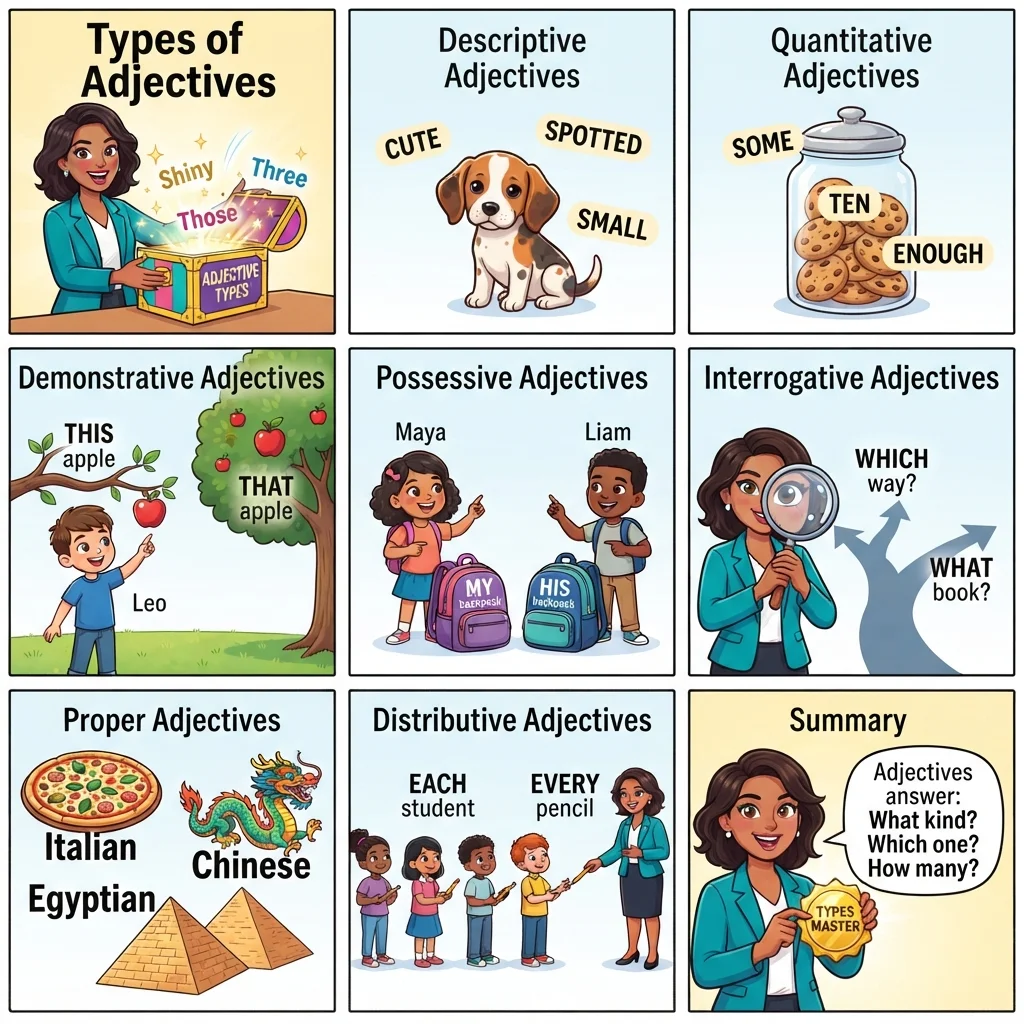
Common Types of Adjectives
- Descriptive adjectives
- Quantitative adjectives
- Numeral adjectives
- Demonstrative adjectives
- Possessive adjectives
- Interrogative adjectives
- Indefinite adjectives
- Distributive adjectives
- Proper adjectives
- Comparative adjectives
- Superlative adjectives
- Compound adjectives
- Participial adjectives
The exact number of adjective types can vary between grammar systems. Some modern grammar systems classify words such as this, my, and many as determiners rather than adjectives.
The Origin of Types of Adjectives
The word adjective comes from the Latin word adjectivum. It is connected with the idea of something being added to a noun.
The term entered English through older French and Latin grammar traditions. Its basic purpose has remained similar over time: an adjective adds information to a noun or pronoun.
The phrase “types of adjectives” is mainly used in grammar education. It helps teachers and students organize adjectives into groups according to their functions.
Different grammar books may organize adjectives in different ways. One book may list this, that, these, and those as demonstrative adjectives. Another modern grammar system may call them demonstratives or determiners.
This difference can make the topic confusing for English learners. However, the basic idea remains simple: adjectives and related words help provide more information about nouns.
For example:
She bought a beautiful dress.
The word beautiful tells us something about the dress.
He has three books.
The word three tells us the number of books.
Learning the different categories makes it easier to identify and use these words correctly.
British English vs American English Spelling
The phrase “Types of Adjectives” has the same spelling in both British English and American English.
There is no British or American spelling difference in the words types, of, or adjectives.
| Term | British English | American English |
|---|---|---|
| Types of adjectives | Types of adjectives | Types of adjectives |
| Adjective | Adjective | Adjective |
| Descriptive adjective | Descriptive adjective | Descriptive adjective |
| Comparative adjective | Comparative adjective | Comparative adjective |
| Superlative adjective | Superlative adjective | Superlative adjective |
| Proper adjective | Proper adjective | Proper adjective |
However, some individual adjectives can have different spellings in British and American English.
British English
- colourful
- favourite
- centre
American English
- colorful
- favorite
- center
These spelling differences do not change the type or function of the adjective.
For example:
She wore a colorful dress.
She wore a colourful dress.
The meaning is the same. The difference is simply the spelling style used in different varieties of English.
Which Spelling Should You Use?
Since Types of Adjectives has the same spelling in British and American English, you do not need to choose between two spellings for this keyword.
For American English
If your readers are mainly from the United States, use American spelling throughout your content.
Examples include:
- color
- favorite
- center
- traveling
For British English
If your audience is mainly from the United Kingdom, use British spelling.
Examples include:
- colour
- favourite
- centre
- travelling
For Commonwealth English
Countries such as Australia, New Zealand, and several other regions often follow British-based spelling conventions, although local preferences can vary.
For Global English
If your content is written for an international audience, either spelling system can work. The most important rule is consistency.
Do not use American spelling in one paragraph and British spelling in another without a reason.
The keyword Types of Adjectives itself remains exactly the same in both forms.
Common Mistakes with Types of Adjectives
Students often make mistakes when identifying or using adjectives. Learning these common errors can make English writing much clearer.
Mistake 1: Confusing Adjectives and Adverbs
Incorrect:
She sings beautiful.
Correct:
She sings beautifully.
Beautiful is an adjective. Beautifully is an adverb.
An adjective normally describes a noun or pronoun, while an adverb can describe a verb, adjective, or another adverb.
Mistake 2: Using “More” With an “-er” Form
Incorrect:
This book is more easier.
Correct:
This book is easier.
Do not normally use more with an adjective that already uses the -er comparative form.
Mistake 3: Confusing Comparative and Superlative Adjectives
Comparative:
Ahmed is taller than Ali.
Superlative:
Ahmed is the tallest student in the class.
Use a comparative adjective when comparing two things.
Use a superlative adjective when comparing three or more things and identifying the highest or lowest degree.
Mistake 4: Incorrect Adjective Order
Incorrect:
She bought a red beautiful dress.
Better:
She bought a beautiful red dress.
When several adjectives describe one noun, English usually follows a natural order.
A common order is:
Opinion → Size → Age → Shape → Color → Origin → Material → Noun
Example:
She bought a beautiful small new red Italian leather bag.
Not every sentence needs many adjectives. Using too many can make writing difficult to read.
Mistake 5: Confusing Adjectives With Determiners
Consider:
This book is useful.
In traditional grammar, this may be called a demonstrative adjective.
In modern grammar, this is often classified as a determiner when it appears before a noun.
The terminology may change, but the important point for learners is understanding how the word works in the sentence.
Types of Adjectives in Everyday Examples
Adjectives are used in almost every form of English communication. We use them in emails, conversations, news reports, social media posts, and formal writing.
Types of Adjectives in Emails
Adjectives help make professional emails more specific.
Examples:
Please review the attached document.
We need a quick response.
Thank you for your valuable support.
Here, attached, quick, and valuable provide additional information.
Types of Adjectives in News Writing
News articles use adjectives to describe events, people, places, and situations.
Examples:
The strong storm affected several cities.
The government announced a new policy.
The team achieved an important victory.
Good news writing uses adjectives carefully so that the information remains clear and factual.
Types of Adjectives in Social Media
Adjectives are common in short and expressive social media posts.
Examples:
What a beautiful day!
We had an amazing trip.
This is my favorite photo.
Words such as beautiful, amazing, and favorite make the message more expressive.
Types of Adjectives in Formal Writing
Formal writing uses adjectives to explain ideas clearly and precisely.
Examples:
The study provides important information.
The company introduced an advanced system.
The researchers conducted a detailed analysis.
The best formal writing uses adjectives that add useful meaning instead of unnecessary words.
Types of Adjectives in Everyday Conversation
Adjectives are also very common in normal conversations.
Examples:
I bought a new phone.
She lives in a large house.
He is a kind person.
We watched an interesting movie.
These examples show that adjectives are a normal and important part of everyday English.
Types of Adjectives – Comparison Table
| Type | Main Purpose | Examples | Example Sentence |
|---|---|---|---|
| Descriptive | Describes quality | beautiful, tall, smart | She is a smart student. |
| Quantitative | Shows amount | much, little, enough | We have enough food. |
| Numeral | Shows number or order | three, first, second | He won the first prize. |
| Demonstrative | Points to something | this, that, these, those | This book is useful. |
| Possessive | Shows possession | my, your, their | My phone is new. |
| Interrogative | Used in questions | what, which, whose | Which book is yours? |
| Indefinite | Shows an unclear amount | some, many, several | Several students arrived. |
| Distributive | Refers to members individually | each, every, either | Every student participated. |
| Proper | Comes from a proper noun | American, Italian, Shakespearean | She enjoys Italian food. |
| Comparative | Compares two things | bigger, faster, better | This car is faster. |
| Superlative | Shows the highest or lowest degree | biggest, fastest, best | He is the best player. |
| Compound | Combines two or more words | well-known, high-speed | He is a well-known writer. |
| Participial | Comes from a participle | boring, excited, broken | The movie was exciting. |
Some categories can overlap. For example, Italian is commonly called a proper adjective because it comes from the proper noun Italy.
The exact classification can vary between traditional and modern grammar systems.
Types of Adjectives – Google Trends & Usage Data
The keyword Types of Adjectives has clear educational search intent. People who search for this topic are usually looking for definitions, examples, grammar rules, school material, or help with English learning.
Common related searches include:
- types of adjectives with examples
- types of adjectives in English
- 10 types of adjectives
- kinds of adjectives
- adjective types and examples
- adjective examples
- descriptive adjectives
- comparative and superlative adjectives
- adjective definition
- examples of adjectives
Search interest can change depending on the country, school year, examination periods, and demand for English-learning content.
The topic is especially useful for:
- School students
- College students
- English learners
- ESL learners
- Teachers
- Parents
- Writers
- Test preparation students
Google Trends shows relative search interest, not a fixed worldwide search-volume number. Search interest can also change over time and from one country to another.
For SEO, the strongest search intent usually follows this pattern:
Definition → Types → Examples → Rules → Common Mistakes → FAQs
A well-organized article that answers each of these questions can provide a better experience for users searching for Types of Adjectives.
FAQs About Types of Adjectives
What are the main types of adjectives?
Common types include descriptive, quantitative, numeral, demonstrative, possessive, interrogative, indefinite, distributive, proper, comparative, superlative, compound, and participial adjectives.
What is a descriptive adjective?
A descriptive adjective tells us about the quality, appearance, size, condition, or characteristic of a noun.
Example:
She has a beautiful voice.
Here, beautiful describes the voice.
What is a possessive adjective?
A possessive adjective shows ownership or a relationship with a person or thing.
Common examples include:
my, your, his, her, its, our, their
Example:
This is my book.
What is a demonstrative adjective?
In traditional grammar, demonstrative adjectives point to specific nouns.
Common examples are:
this, that, these, those
Example:
Those shoes are expensive.
In modern grammar, these words are often called demonstratives or determiners when they come before nouns.
What is a comparative adjective?
A comparative adjective is used to compare two people, places, things, or ideas.
Examples include:
- taller
- smaller
- faster
- better
- more useful
Example:
This car is faster than that car.
What is a superlative adjective?
A superlative adjective shows the highest or lowest degree among three or more people or things.
Examples include:
- tallest
- smallest
- fastest
- best
- most useful
Example:
Sara is the tallest student in the class.
How many types of adjectives are there?
There is no single number accepted by every grammar system. Different textbooks and grammar systems classify adjectives in different ways.
A traditional grammar book may list many types, while a modern grammar system may use different categories or classify some traditional adjective types as determiners.
The important thing is to understand how each word functions in a sentence.
Conclusion
Understanding the Types of Adjectives makes English grammar easier and helps us write clearer sentences. Adjectives give extra information about people, places, animals, things, and ideas. They can describe quality, quantity, number, ownership, origin, comparison, and many other features.
Common categories include descriptive, quantitative, numeral, demonstrative, possessive, interrogative, indefinite, distributive, proper, comparative, superlative, compound, and participial adjectives. However, the exact classification can vary between traditional and modern grammar systems.
There is also no British or American spelling difference in the phrase Types of Adjectives. The phrase is written the same way in both varieties of English. Some individual adjectives may have different spellings, such as colour in British English and color in American English.
For students and English learners, the best way to master adjectives is to learn their purpose, study simple examples, understand common mistakes, and practice using them in real sentences.
Once you understand how adjectives work, your English becomes more clear, descriptive, precise, and effective.