
A corner kick can look like a simple restart, but it is one of the most important attacking situations in football. A well-delivered corner can create a clear scoring chance, while a poorly defended corner can quickly lead to a goal. For beginners, however, the rules surrounding corner kicks can sometimes be confusing.
Corner kick rules determine when a corner is awarded, where the ball must be placed, who can take it, where opponents must stand, and when the ball becomes in play. They also cover situations such as scoring directly from a corner, offside, goalkeeper handling, and what happens when the kick is taken incorrectly.
Whether you are a football fan watching a match, a player learning the laws, a coach planning set pieces, or a parent helping a young player understand the game, knowing these rules makes football much easier to follow.
In this complete guide, we will explain the corner kick rules in simple English, provide practical examples, compare corner kicks with goal kicks, discuss common mistakes, and explain how teams use corners as an attacking weapon.
What Is a Corner Kick in Football?
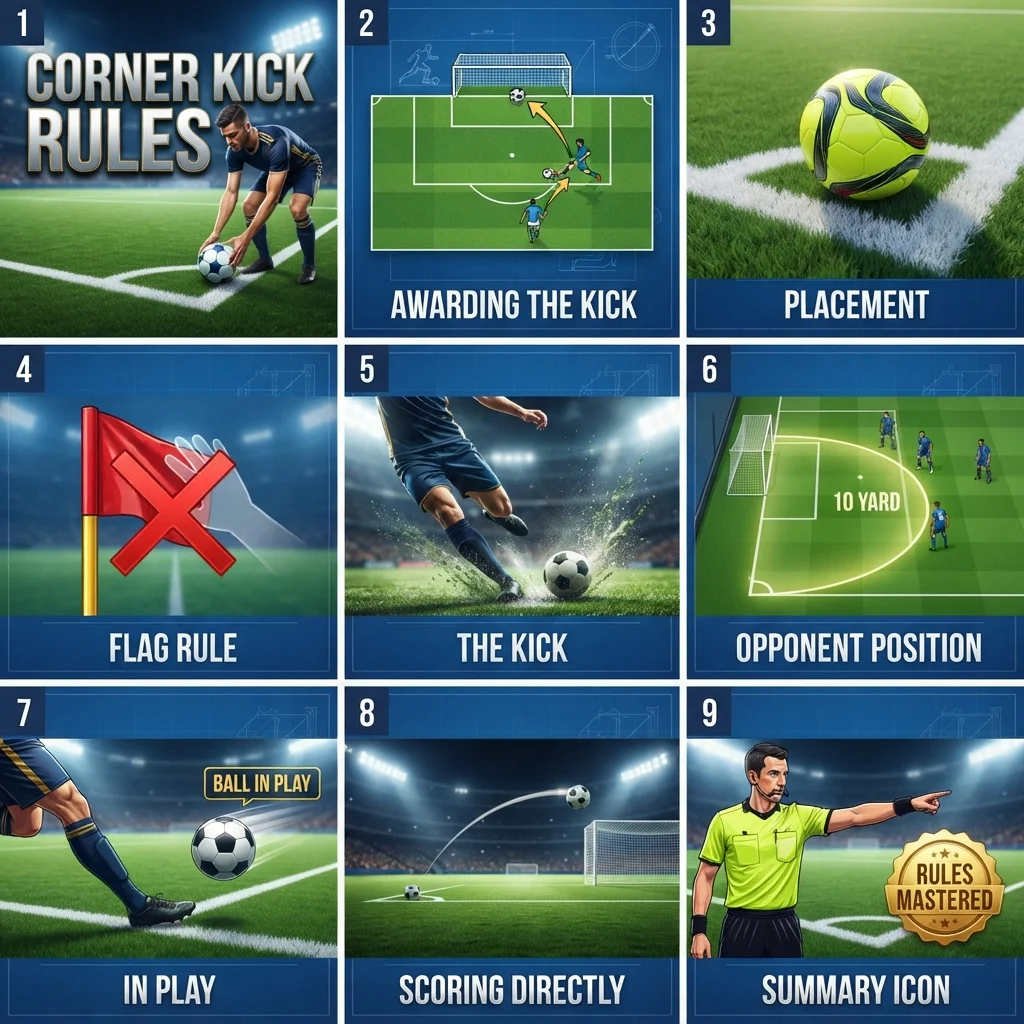
A corner kick is a method of restarting play when the entire ball crosses the goal line without a goal being scored and the last player to touch the ball was a member of the defending team.
The attacking team receives the corner kick.
The kick is taken from the corner area nearest to where the ball crossed the goal line.
Simple Corner Kick Example
Imagine Team A is attacking Team B. An attacker shoots the ball toward the goal, but a defender touches it before it crosses the goal line. The ball then goes completely over the goal line outside the goalposts.
Because the defender touched the ball last, the referee awards a corner kick to Team A.
The attacking team places the ball in the appropriate corner area and restarts play.
When Is a Corner Kick Awarded?
A corner kick is awarded when:
- The entire ball crosses the goal line.
- The ball does not enter the goal.
- The last player to touch the ball is a defending player.
- The ball crosses the goal line outside the goal.
The last touch is therefore one of the most important parts of the rule.
Corner Kick Rules: Where Is the Ball Placed?
The ball must be placed in the corner area.
There is a corner arc at each corner of the football field. The ball is placed within this area for the kick.
The Ball Must Be Stationary
The ball must be stationary before the corner kick is taken.
The kicker cannot simply move the ball while running past the corner and continue play. The ball must be properly placed before the restart.
Which Corner Is Used?
The corner kick is taken from the corner area nearest to where the ball crossed the goal line.
For example, if the ball crosses the goal line near the left corner from the attacking team’s perspective, the kick is taken from that corner.
Who Can Take a Corner Kick?
Any player from the attacking team can take the corner kick.
Usually, a midfielder, winger, or full-back takes the kick because these players may have strong crossing and set-piece skills.
A team may also have a specialist corner taker who regularly delivers corners from both sides.
Can the Goalkeeper Take a Corner?
Yes. There is no rule preventing a goalkeeper from taking a corner kick.
However, this is unusual because leaving the goal can expose the team to a counterattack.
In special situations, particularly near the end of a match when a team desperately needs a goal, a goalkeeper may move forward to take part in a corner.
How to Take a Corner Kick Step by Step
Taking a legal corner kick is simple when the basic requirements are understood.
Step 1: Place the Ball
The ball is placed inside the corner area at the correct corner.
Step 2: Make Sure the Ball Is Stationary
The ball must be stationary before the kick.
Step 3: Position the Kicker
The player taking the corner must take the kick from the corner area.
Step 4: Wait for the Correct Situation
Players from both teams position themselves around the penalty area and other tactical locations.
Step 5: Kick the Ball
The kicker delivers the ball into play.
The ball is in play when it is kicked and clearly moves.
The corner does not need to leave the corner area before another player can touch it.
Corner Kick Rules for Opposing Players
Opposing players must respect the required distance from the corner area when a corner kick is being taken.
The Laws of the Game require opponents to remain at least 9.15 meters (10 yards) from the corner arc until the ball is in play, unless a player is standing on their own goal line between the goalposts.
This gives the kicker enough space to take the restart without immediate interference.
What Happens If an Opponent Is Too Close?
If an opponent deliberately prevents or delays the corner kick by failing to respect the required distance, the referee can take disciplinary action.
Players should therefore avoid standing directly beside the ball or deliberately blocking the kicker.
When Is a Corner Kick Ball in Play?
The ball becomes in play when it is kicked and clearly moves.
It does not need to leave the corner area.
For example, a player can make a short corner by passing the ball a small distance to a teammate. Once the ball has been kicked and clearly moves, the restart has occurred.
This allows teams to use creative corner routines.
Can You Score Directly From a Corner Kick?
Yes.
A goal can be scored directly from a corner kick against the opposing team.
This is sometimes called an Olympic goal or Olimpico, although such goals are rare.
If the ball is kicked directly from the corner and enters the opponent’s goal without touching another player, the goal can count.
Can You Score an Own Goal From a Corner?
No.
If a player takes a corner kick and the ball goes directly into their own goal, an own goal is not awarded.
Instead, the opposing team receives a corner kick.
This is an important detail that is often misunderstood by new football fans.
Corner Kick and the Offside Rule
A player cannot be penalized for being offside directly from a corner kick.
This is one of the specific offside exceptions in football.
For example, an attacker can position themselves close to the goal before a corner is taken without being penalized simply because they are in an offside position.
However, once the corner has been taken and another teammate touches the ball, the normal offside law can apply to subsequent play.
Why Is This Important?
Because there is no offside offence directly from the corner kick, attacking teams can position players close to the goal.
This creates opportunities for:
- Headers
- Volleys
- Rebounds
- Flick-ons
- Screens and blocks
- Second-ball chances
Corner Kick vs Goal Kick
The difference between a corner kick and a goal kick depends mainly on which team touched the ball last.
| Situation | Restart |
|---|---|
| Defender touches ball last before it crosses goal line | Corner kick |
| Attacker touches ball last before it crosses goal line | Goal kick |
| Ball completely crosses goal line between posts and under crossbar | Goal |
| Ball completely crosses touchline | Throw-in |
This is one of the easiest ways to remember the difference.
Defender last = corner.
Attacker last = goal kick.
Types of Corner Kicks
Teams use several corner-kick techniques depending on their tactical plan.
Inswinging Corner
An inswinging corner curves toward the goal.
The delivery is designed to move into the dangerous area between the goalkeeper and attacking players.
It can be particularly difficult for defenders because the ball is moving toward the goal as it enters the penalty area.
Outswinging Corner
An outswinging corner curves away from the goal.
This delivery can give attackers space to attack the ball from outside the immediate goalmouth.
Players often target areas around the penalty spot or edge of the six-yard area.
Short Corner
A short corner involves passing the ball to a nearby teammate rather than immediately crossing it into the penalty area.
Teams use short corners to:
- Create better crossing angles.
- Move defenders away from their positions.
- Maintain possession.
- Create space.
- Change the attacking pattern.
Driven Corner
A driven corner is delivered with pace, often at a relatively low height.
The objective is to make the ball difficult to intercept and give attackers an opportunity to redirect it toward goal.
Common Corner Kick Strategies
A corner kick is not just about crossing the ball into the box. Professional teams use carefully planned routines.
Near-Post Corner
The ball is delivered toward the area near the closest goalpost.
An attacker makes a quick run toward the near post and attempts to flick or redirect the ball.
Far-Post Corner
The delivery is aimed toward the far side of the penalty area.
A taller attacker may attack the ball there, often against a smaller defender.
Crowded Goalkeeper Area
Several attacking players may position themselves around the goalkeeper.
The purpose is to make movement difficult and create uncertainty.
However, attackers must avoid committing fouls such as pushing, holding, or illegally obstructing opponents.
Edge-of-the-Box Routine
A team may position a player outside the penalty area.
If the defense clears the initial delivery, that player can receive the ball and attempt a shot from distance or help restart the attack.
Defensive Corner Kick Strategies
Defending a corner requires organization and communication.
Man-Marking
In man-marking systems, defenders are assigned specific opponents to track.
Each defender focuses on preventing their assigned attacker from reaching the ball.
Zonal Marking
In zonal defending, players protect specific areas rather than following individual opponents.
Defenders are responsible for attacking the ball if it enters their assigned zone.
Mixed System
Some teams combine man-marking and zonal defending.
For example, defenders may protect key zones while other players mark the opposition’s strongest aerial threats.
Common Corner Kick Mistakes
Understanding common mistakes can help players avoid unnecessary problems.
Placing the Ball Incorrectly
The ball must be placed correctly within the corner area.
Moving the Ball Before the Kick
The ball must be stationary before the restart.
Opponent Standing Too Close
Defenders must respect the required distance from the corner area unless an applicable exception applies.
Committing a Foul in the Penalty Area
Attackers sometimes push, hold, or block defenders while trying to reach the ball.
The referee can award a free kick or take disciplinary action if an infringement occurs.
Poor Communication
Defenders who fail to communicate may leave attackers unmarked.
Goalkeepers often play an important role in organizing defensive corner situations.
Corner Kick Rules and Goalkeeper Positioning
The goalkeeper has a difficult role during corners.
They must decide whether to:
- Catch the cross.
- Punch the ball away.
- Stay on the goal line.
- Move toward the ball.
- Communicate with defenders.
- Prepare for a second shot.
The correct decision depends on the speed and location of the delivery, player positioning, and the goalkeeper’s ability to reach the ball safely.
Why Are Corner Kicks Important?
Corner kicks are valuable because they give an attacking team a structured opportunity to put the ball into a dangerous area near the goal.
They can lead to:
- Direct goals.
- Headers.
- Shots.
- Deflections.
- Rebounds.
- Second attacks.
Teams that consistently deliver accurate corners can create several scoring opportunities during a match.
Tips for Taking Better Corner Kicks
Practice Ball Placement
A consistent delivery starts with good technique and repeatable contact.
Study the Opponent
Look at how the opposition defends corners.
Identify whether they use zonal marking, man-marking, or a mixed approach.
Vary the Delivery
Do not always send the ball to the same location.
Mix near-post, far-post, short, and deeper deliveries.
Communicate With Teammates
Players should understand their movements before the kick is taken.
Avoid Predictability
A team that uses exactly the same corner routine every time becomes easier to defend.
Interesting Facts About Corner Kicks
- A corner kick can result in a goal without another player touching the ball.
- There is no offside offence directly from a corner kick.
- The defending team must normally remain at least 9.15 meters from the corner area until the ball is in play.
- A corner can be taken short with a teammate.
- Any eligible attacking player can take the corner.
- An own goal cannot be scored directly from a corner kick; the opponents receive a corner instead.
- Corner kicks are among the most common attacking set pieces in football.
Frequently Asked Questions About Corner Kick Rules
Can you score directly from a corner kick?
Yes. A goal can be scored directly from a corner kick against the opposing team.
Is there offside from a corner kick?
No. A player cannot be penalized for being offside directly from a corner kick.
Can a corner kick be passed to another player?
Yes. A short corner is completely legal. The ball must be kicked and clearly move before another player plays it.
How far must defenders stand from a corner?
Opponents must normally remain at least 9.15 meters (10 yards) from the corner area until the ball is in play, with the specific exception for a player standing on their own goal line between the goalposts.
Can any player take a corner kick?
Yes. Any player from the attacking team can take the corner kick.
Can a goalkeeper take a corner kick?
Yes. A goalkeeper can take a corner, although it is uncommon because leaving the goal can create a defensive risk.
What happens if a corner goes directly into the kicker’s own goal?
A direct own goal cannot be scored from a corner kick. The opposing team is awarded a corner kick.
What is the difference between a corner kick and a goal kick?
A corner kick is awarded when a defending player touches the ball last before it crosses the goal line without a goal. A goal kick is awarded when an attacking player touches it last.
Conclusion
Understanding corner kick rules makes it much easier to follow football and appreciate the tactical side of the game. A corner kick is awarded when the entire ball crosses the goal line without a goal and the last touch comes from a defending player. The attacking team then restarts play from the appropriate corner area.
The ball must be stationary before the kick and becomes in play when it is kicked and clearly moves. Opponents must normally respect the 9.15-meter distance, while attacking players can use different movements and formations to create scoring opportunities. Importantly, there is no offside offence directly from a corner kick, and a goal can be scored directly against the opposition.
For players and coaches, corners should be treated as planned attacking opportunities rather than simple crosses. Good delivery, movement, communication, and tactical variation can make corner kicks one of the most effective set pieces in football.