
Imagine a football match where an attacking player shoots toward the goal, but the ball goes completely over the goal line without entering the net. What happens next? The defending team does not simply throw the ball back into play. Instead, the referee awards a goal kick, one of the most common restarts in football.
Understanding goal kick rules is important for players, coaches, referees, and fans because a goal kick can quickly change possession and create an attacking opportunity. Modern football has also changed how goal kicks are taken, especially regarding where teammates can stand and how the ball is put back into play.
In this guide, we will explain what a goal kick is, when it is awarded, who can take it, where the ball must be placed, what players can and cannot do, and what happens when a goal kick breaks the rules. We will also cover common mistakes, tactical uses, and frequently asked questions so beginners and experienced football followers can understand the rule clearly.
What Is a Goal Kick in Football?
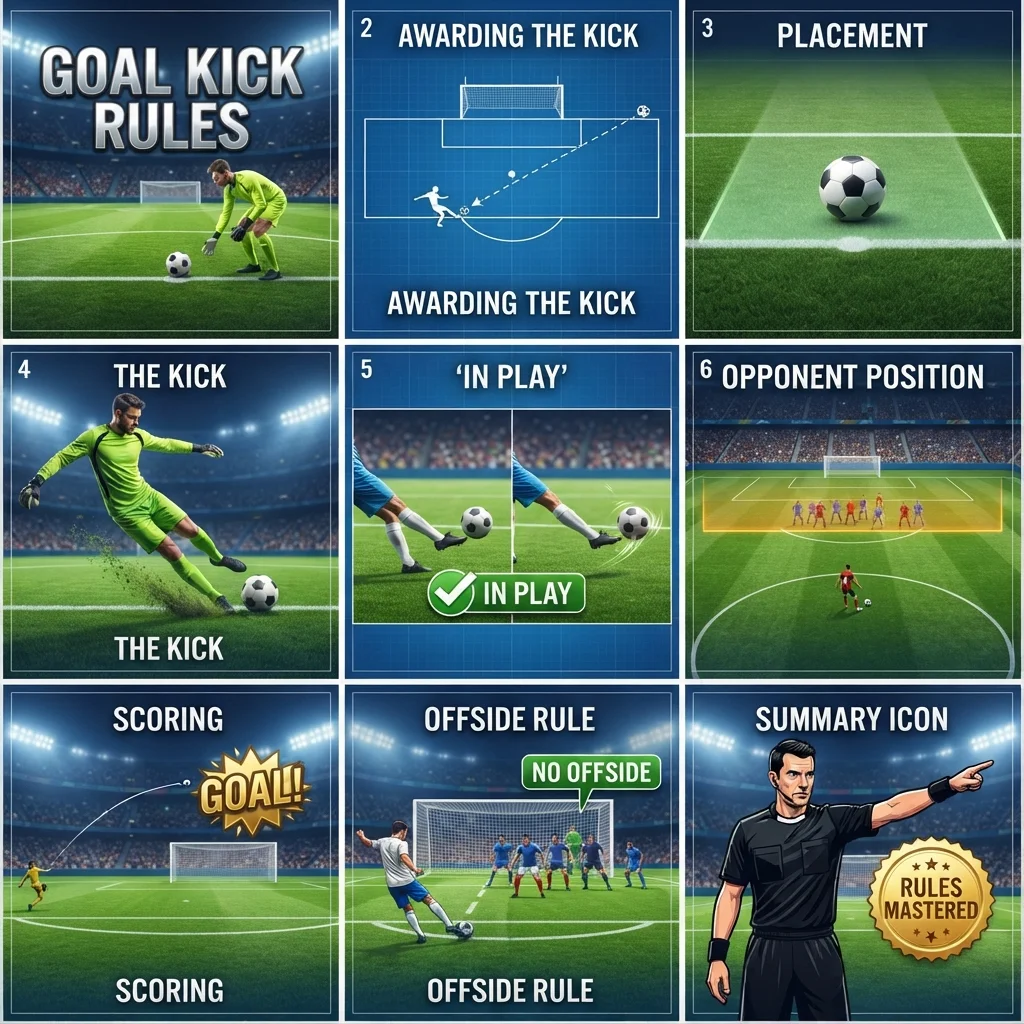
A goal kick is a method of restarting play when the ball completely crosses the goal line without a goal being scored and the ball was last touched by an attacking player.
Under the Laws of the Game, the defending team takes the goal kick. The kick is normally taken by the goalkeeper, but any player from the defending team can take it.
Simple Goal Kick Example
Suppose Team A is attacking Team B. An attacker shoots the ball toward the goal, but the shot goes wide and completely crosses the goal line.
If the last player to touch the ball was an attacker, the referee awards a goal kick to Team B.
The defending team then puts the ball back into play from inside the goal area.
When Is a Goal Kick Awarded?
A goal kick is awarded when:
- The ball completely crosses the goal line.
- The ball does not enter the goal.
- The last player to touch the ball was an attacking player.
- The restart is not a corner kick.
The important point is who touched the ball last. If a defender touches the ball last before it crosses the goal line, the restart is normally a corner kick instead.
Goal Kick Rules: How to Take a Goal Kick
The basic goal kick procedure is straightforward, but several details are important.
The Ball Must Be Stationary
The ball must be stationary before the kick is taken. The defending team cannot take a goal kick while the ball is still moving.
The Ball Is Placed Inside the Goal Area
The ball is placed anywhere within the goal area, commonly called the six-yard box.
The exact position does not have to be at a particular spot. The player taking the kick can choose a suitable location inside the goal area.
The Ball Is Kicked
A defending player kicks the ball to restart play.
The kick is complete when the ball is kicked and clearly moves.
This means the ball does not need to leave the penalty area before other players can play it. This is an important change from the older version of the law.
Who Can Take a Goal Kick?
Any defending player can take the goal kick.
Although goalkeepers commonly take them, teams sometimes allow a central defender, full-back, or another technically strong player to take the restart.
This gives teams more tactical options when building an attack from the back.
Goal Kick Rules for Players Inside the Penalty Area
Modern goal kick rules allow greater freedom for players during the restart.
Defending Players Can Receive the Ball Inside the Penalty Area
The ball does not have to leave the penalty area before a teammate can touch it.
For example, a goalkeeper can take a short goal kick to a nearby defender inside the penalty area. That defender can immediately receive and control the ball.
This rule helps teams build attacks from the back instead of always sending a long kick toward midfield.
What About Opposing Players?
Opposing players must remain outside the penalty area until the ball is in play.
They can move into the area and challenge for the ball after the ball has been kicked and clearly moves.
This prevents attackers from standing close to the ball and interfering with the restart.
When Is the Ball in Play From a Goal Kick?
One of the most important goal kick rules is knowing when play officially restarts.
The ball is in play when it is kicked and clearly moves.
Once this happens:
- Teammates can play the ball.
- Opponents can challenge according to the Laws of the Game.
- The goalkeeper can pass or receive the ball.
- Normal offside and other laws apply.
The ball does not need to leave the penalty area.
Can a Goalkeeper Take a Goal Kick?
Yes. In fact, the goalkeeper is the player most commonly associated with goal kicks.
However, there is no requirement that the goalkeeper must take it.
Why Do Goalkeepers Usually Take Goal Kicks?
Goalkeepers often take goal kicks because they:
- Have excellent kicking range.
- Can see the entire field.
- Can choose between short and long passes.
- Are usually positioned near the goal area.
- Can help organize the team’s buildup.
Modern goalkeepers are also increasingly expected to have strong passing skills.
Can Another Player Take a Goal Kick?
Yes.
A defender or another teammate may take the goal kick if the coach believes that player is better suited to the situation.
For example, a team may use a defender with excellent passing ability to start an attack from the back.
The Laws of the Game do not require a specific position to take a goal kick.
Can You Score Directly From a Goal Kick?
Yes, but there is an important distinction.
A player can score directly against the opposing team from a goal kick. If the ball travels directly into the opponents’ goal without touching another player, the goal can count.
However, a player cannot score an own goal directly from a goal kick.
If a goal kick goes directly into the taker’s own goal, the opposing team is awarded a corner kick.
Goal Kick Scoring Example
If a goalkeeper takes a powerful goal kick and the ball travels all the way into the opponents’ goal, the goal can be awarded.
This is extremely rare but is possible under the Laws of the Game.
Goal Kick vs Corner Kick
Goal kicks and corner kicks are often confused because both occur when the ball crosses the goal line.
The key difference is the player who touched the ball last.
| Situation | Restart |
|---|---|
| Attacker touches ball last and it crosses goal line without a goal | Goal kick |
| Defender touches ball last and it crosses goal line without a goal | Corner kick |
| Ball completely crosses goal line between goalposts and under crossbar | Goal |
| Ball goes out over touchline | Throw-in |
This simple rule helps determine which team receives the restart.
Goal Kick vs Throw-In
A goal kick and throw-in occur at different boundaries.
A goal kick is awarded when the ball crosses the goal line, while a throw-in is awarded when the ball completely crosses the touchline.
For a goal kick, the defending team restarts play with a kick.
For a throw-in, the opposing team restarts play by throwing the ball with both hands from behind and over the head.
Goal Kick vs Goal
It is also important to distinguish a goal kick from a goal.
If the entire ball crosses the goal line between the goalposts and underneath the crossbar, a goal is awarded, provided no infringement has occurred.
If the ball crosses the goal line outside the goal and the last touch came from an attacker, the result is a goal kick.
The position of the ball and the circumstances of the last touch therefore matter.
Common Goal Kick Strategies
A goal kick is more than simply kicking the ball as far as possible. Teams use different strategies depending on their playing style.
Short Goal Kick
A short goal kick involves passing the ball to a nearby defender.
It can help a team:
- Maintain possession.
- Draw opponents forward.
- Build attacks from the back.
- Create passing angles.
- Control the tempo.
However, short buildup can be risky if the opposition applies aggressive pressing.
Long Goal Kick
A goalkeeper may also kick the ball toward midfield or the attacking third.
Long goal kicks can be useful when:
- The opponent is pressing high.
- The team has strong aerial players.
- The goalkeeper has excellent kicking range.
- The team wants to bypass midfield pressure.
Goal Kick With a Passing Triangle
Some teams create a passing triangle between the goalkeeper and defenders.
This gives the goalkeeper multiple options and makes it harder for opponents to predict where the ball will go.
Good positioning is important because a poor pass near the penalty area can create a dangerous chance for the opposition.
Common Goal Kick Mistakes
Players can make several mistakes during a goal kick.
Opponents Enter Too Early
An attacking player may enter the penalty area before the ball is in play.
The referee can stop or retake the restart if the opponent interferes with play.
Poor First Touch
A defender receiving a short goal kick may make a poor first touch and lose possession.
This can be especially dangerous when the opponent is pressing aggressively.
Taking Too Long
Players must restart play within the required time limits. Delaying a goal kick unnecessarily can result in disciplinary action for delaying the restart.
Misunderstanding the Last Touch
Players sometimes expect a goal kick when the defender actually touched the ball last.
In that case, the correct restart may be a corner kick.
Goal Kick and the Offside Rule
The offside law contains an important exception involving goal kicks.
A player cannot be penalized for being offside directly from a goal kick.
For example, if a goalkeeper takes a goal kick and sends the ball toward an attacker who is beyond the second-last opponent, that attacker is not penalized for offside simply because of the goal kick.
However, once another player touches the ball and the normal attacking phase continues, the offside law applies normally.
This exception makes goal kicks an important way for teams to launch quick attacks.
Advantages of Using Short Goal Kicks
Short goal kicks have become an important part of modern possession-based football.
Better Ball Possession
Short passing gives teams more control over the ball.
Build From the Back
Defenders and midfielders can gradually move the ball forward rather than relying on long passes.
Create Space
A team can attract opponents toward its own goal and then use quick passes to exploit space behind the pressing players.
Improve Tactical Control
Short goal kicks allow coaches to organize structured buildup patterns.
However, the strategy requires technically capable players and good decision-making.
Disadvantages of Short Goal Kicks
Short goal kicks are not always the safest choice.
Potential problems include:
- Losing possession near the goal.
- Poor communication between defenders.
- Pressure from attacking players.
- Bad first touches.
- Risky passes across the penalty area.
Teams should choose their restart strategy based on the opponent, match situation, player abilities, and tactical plan.
Professional Tips for Taking Goal Kicks
Players can improve their goal-kick performance with a few basic principles.
Check the Field Before Kicking
The player should quickly scan the field before receiving or taking the restart.
Look for:
- Free teammates.
- Opponent positioning.
- Pressing players.
- Open passing lanes.
- Space in midfield.
Communicate With Teammates
Clear communication reduces mistakes.
The goalkeeper should communicate with defenders and midfielders before the kick whenever possible.
Use the Correct Passing Option
Do not automatically choose a long or short goal kick.
The best option depends on the pressure and available space.
Practice Both Short and Long Distribution
Goalkeepers should develop different kicking skills, including:
- Short passes.
- Driven passes.
- Long kicks.
- Lofted balls.
- Passes toward the wings.
Being able to change distribution makes a goalkeeper more difficult to press.
Goal Kick Rules: Important Points to Remember
For quick revision, remember these key points:
- A goal kick is awarded when the ball crosses the goal line without a goal.
- The last touch must normally come from an attacking player.
- The defending team takes the goal kick.
- Any defending player can take it.
- The ball is placed anywhere inside the goal area.
- The ball must be stationary before the kick.
- The ball is in play when it is kicked and clearly moves.
- Defending teammates may receive the ball inside the penalty area.
- Opponents must remain outside the penalty area until the ball is in play.
- A goal can be scored directly against the opponents from a goal kick.
- An own goal cannot be scored directly from a goal kick; the restart is a corner kick.
- A player cannot be offside directly from a goal kick.
Frequently Asked Questions About Goal Kick Rules
Can any player take a goal kick?
Yes. Any player from the defending team can take a goal kick. It does not have to be taken by the goalkeeper.
Does the ball have to leave the penalty area?
No. Under the current Laws of the Game, the ball does not have to leave the penalty area. It is in play once it is kicked and clearly moves.
Can you score directly from a goal kick?
Yes. A goal can be scored directly against the opposing team from a goal kick. However, a direct own goal results in a corner kick for the opponents.
Can a player be offside from a goal kick?
No. A player cannot be penalized for being offside directly from a goal kick.
What happens if an opponent enters the penalty area before the ball is in play?
The referee may stop or retake the goal kick if the opponent interferes with play or otherwise infringes the restart procedure.
What is the difference between a goal kick and a corner kick?
A goal kick is normally awarded when an attacking player touches the ball last before it crosses the goal line. A corner kick is normally awarded when a defending player touches it last.
Can a defender take a short goal kick?
Yes. Any defending player can take the kick, and a short pass to another defender inside the penalty area is allowed under the current rules.
Can a goalkeeper pick up the ball after a goal kick?
A goalkeeper can receive the ball from a teammate after a goal kick, but the normal deliberate kick to the goalkeeper restriction applies. If a teammate deliberately kicks the ball to the goalkeeper, the goalkeeper cannot handle it with the hands.
Conclusion
Understanding goal kick rules is essential for anyone who wants to understand modern football. A goal kick is awarded when the ball completely crosses the goal line without a goal and was last touched by an attacking player. The defending team then restarts play by kicking a stationary ball from anywhere inside the goal area.
Modern goal kicks provide much more tactical freedom than many beginners realize. Teams can play short passes inside the penalty area, build attacks from the back, or choose a long distribution to bypass pressure. Players must also understand important details involving opponents, offside, scoring directly, and the difference between a goal kick and a corner kick.
For players and coaches, the biggest lesson is that a goal kick should be treated as a tactical opportunity rather than simply a way to get the ball away from the goal. Good positioning, communication, decision-making, and accurate passing can turn a simple restart into the beginning of a dangerous attack.