
cFootball is a game of tactics, teamwork, and quick decision-making. One strategy that has become increasingly popular in modern football is the high press. Many successful teams use this approach to win possession quickly and prevent opponents from building attacks from the back. Whether you watch professional matches or play football yourself, understanding the high press can help you appreciate the game on a deeper level.
A high press is more than simply chasing the ball. It is a well-organized defensive tactic where players work together to pressure the opposing team high up the pitch. The goal is to force mistakes, recover the ball near the opponent’s goal, and create immediate scoring opportunities. Teams that execute this tactic effectively require excellent fitness, communication, discipline, and tactical awareness.
In this guide, you’ll learn what a high press in football is, how it works, why teams use it, its advantages and disadvantages, and which teams have mastered this exciting style of play.
What Is High Press in Football?
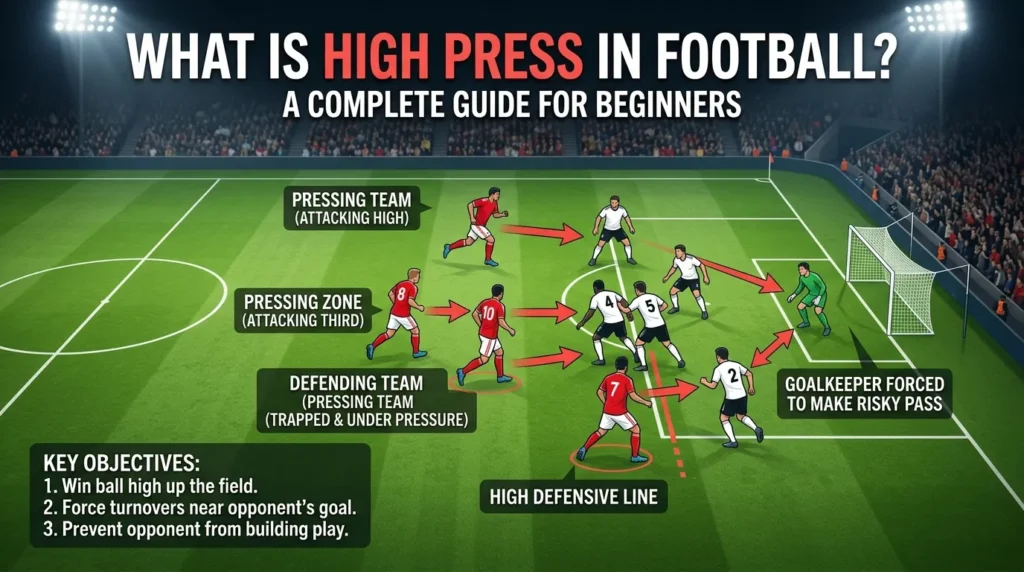
A high press in football is a defensive strategy where a team applies intense pressure to the opponent as soon as they gain possession, usually in their own defensive third. Instead of waiting in a deeper defensive position, attacking players immediately close down defenders and goalkeepers to reduce their time and space.
The objective is simple: force the opposition into making mistakes, winning the ball back quickly, and launching an attack before the defense can reorganize.
Unlike traditional defending, where teams retreat behind the ball, a high press encourages players to defend aggressively from the front.
Simple Example
Imagine the opposing goalkeeper passes the ball to a center-back. Instead of allowing the defender to control the ball comfortably, your team’s striker immediately closes him down while the midfielders block passing options. Under pressure, the defender makes a poor pass, allowing your team to regain possession near the penalty area and create a scoring chance.
History of the High Press
Although pressing has existed for decades, the modern high press became famous through several innovative coaches. Earlier football styles focused more on defensive organization and counterattacks, but tactical evolution introduced aggressive pressing as a way to dominate possession.
In recent years, many elite clubs have successfully used the high press to control matches. Their success has inspired teams at every level, from youth academies to professional leagues, to adopt similar tactics.
Today’s football relies heavily on pressing because players are fitter, faster, and more tactically disciplined than ever before.
How Does High Press Work?
A high press depends on teamwork rather than individual effort. Every player must understand their role and move together as a unit.
Step 1: Immediate Pressure
As soon as possession is lost, the nearest player quickly pressures the ball carrier to reduce available time.
Step 2: Cut Passing Lanes
Supporting players move into positions that block easy passing options. This forces the opponent to make difficult decisions.
Step 3: Compress the Playing Area
The defensive line moves forward while midfielders stay close to attackers. This reduces the amount of space available for the opposition.
Step 4: Force a Mistake
Under constant pressure, opponents may lose possession through poor passes, heavy touches, or rushed clearances.
Step 5: Launch a Quick Attack
After recovering the ball, the attacking team immediately looks for goal-scoring opportunities before the opposition can reorganize defensively.
Key Principles of High Press
Successful high pressing follows several important principles.
Team Coordination
Every player must press together. If one player presses while others remain behind, opponents can easily play around the pressure.
Compact Shape
Players stay close to one another to reduce space and make passing difficult.
Communication
Constant communication helps teammates know when to press, cover, or switch positions.
Timing
Pressing at the wrong moment can leave large spaces behind the defense. Players must recognize the right opportunities to apply pressure.
Physical Fitness
High pressing requires continuous running and repeated sprints throughout the match. Players need excellent stamina and recovery.
Why Do Teams Use High Press?
Many coaches prefer the high press because it creates both defensive and attacking advantages.
Some of the main reasons include:
- Winning possession closer to goal
- Preventing opponents from building attacks
- Creating more scoring opportunities
- Controlling possession
- Maintaining attacking momentum
- Increasing pressure on opposing defenders
- Entertaining fans with aggressive football
When executed properly, high pressing allows a team to dominate matches from the opening whistle.
Advantages of High Press
High pressing offers several important benefits.
Quick Ball Recovery
Teams regain possession much faster, allowing them to launch dangerous attacks before opponents can organize defensively.
More Goal-Scoring Chances
Winning the ball near the opponent’s penalty area often creates excellent opportunities to score.
Forces Opponent Mistakes
Constant pressure makes defenders uncomfortable, increasing the likelihood of inaccurate passes and poor decisions.
Better Control of the Game
Teams that press effectively often dominate possession and dictate the tempo of the match.
Builds Team Confidence
Successful pressing keeps players engaged and encourages an aggressive, positive mindset throughout the game.
Disadvantages of High Press
Although effective, the high press also carries certain risks.
High Physical Demands
Players must maintain intense effort for long periods, making fitness extremely important.
Vulnerable to Counterattacks
If opponents break through the press, they may find large open spaces behind the defensive line.
Requires Excellent Teamwork
A single player pressing alone can disrupt the entire system and create gaps for opponents to exploit.
Tactical Discipline Is Essential
Every player must understand positioning, movement, and pressing triggers. Without discipline, the strategy becomes ineffective.
Skills Needed for Effective High Press
Players need several important qualities to perform a successful high press.
- Excellent stamina
- Speed and acceleration
- Tactical awareness
- Fast decision-making
- Communication skills
- Teamwork
- Aggressive but controlled defending
- Strong positioning
- Quick reactions
- Mental concentration
Developing these skills helps players contribute effectively to a pressing system regardless of their position on the field.
Teams Famous for Using High Press
Several world-class football teams have built their success around the high press. These teams use coordinated movement, quick transitions, and relentless pressure to dominate matches.
Liverpool
Liverpool became one of the best examples of high pressing under their former manager, who encouraged players to win the ball back immediately after losing possession. Their fast attackers and energetic midfielders made this tactic highly effective.
Manchester City
Manchester City combines high pressing with possession-based football. Players press aggressively to regain the ball quickly and maintain control of the game.
Bayern Munich
Bayern Munich frequently uses a high defensive line and coordinated pressing to keep opponents under constant pressure. Their disciplined approach allows them to dominate possession and create numerous scoring opportunities.
Barcelona
Barcelona has long emphasized pressing after losing possession. Their players work together to recover the ball within seconds, helping them maintain their attacking style.
High Press vs Low Block
Although both are defensive strategies, they have very different objectives.
| Feature | High Press | Low Block |
|---|---|---|
| Defensive Line | High up the pitch | Close to own goal |
| Main Goal | Win the ball quickly | Protect the penalty area |
| Playing Style | Aggressive | Patient and defensive |
| Space Allowed | Very little | More space in midfield |
| Physical Demand | High | Moderate |
| Best For | Attacking teams | Defensive teams |
A high press focuses on forcing mistakes near the opponent’s goal, while a low block prioritizes defending deep and limiting scoring chances.
Common Mistakes When Using a High Press
Many teams struggle with high pressing because of simple tactical mistakes.
Pressing Alone
One player cannot successfully press without support. Every teammate must move together as a unit.
Poor Communication
Lack of communication creates gaps that skilled opponents can exploit.
Incorrect Timing
Pressing too early or too late allows opponents to escape pressure with simple passes.
Leaving Too Much Space
If defenders push forward without coordination, large spaces appear behind the defensive line.
Low Fitness Levels
High pressing requires repeated sprints throughout the match. Fatigue often leads to slower reactions and defensive errors.
Training Drills to Improve High Press
Coaches use specific exercises to develop pressing skills.
Small-Sided Games
Playing 5v5 or 6v6 matches in smaller areas encourages quick pressing and fast decision-making.
Pressing Trigger Drill
Players practice recognizing moments to press, such as poor first touches or backward passes.
Recovery Runs
Defenders and midfielders improve their ability to recover quickly if the press is broken.
Transition Games
Teams immediately switch from attack to defense after losing possession, helping players react faster during real matches.
Communication Drills
Exercises that require constant verbal communication improve teamwork and coordination during pressing situations.
Tips for Beginners
If you are new to high pressing, focus on the basics before trying advanced tactics.
- Press with your teammates, not alone.
- Stay compact and avoid leaving large gaps.
- Watch the ball and passing options.
- Improve your fitness through regular running and sprint training.
- Communicate constantly with teammates.
- Learn when to press and when to recover.
- Study professional matches to understand positioning.
- Practice pressing during training sessions before using it in competitive games.
With patience and regular practice, players can become much more effective in applying high-pressure tactics.
Interesting Facts About High Press
- High pressing has become one of the most influential tactical approaches in modern football.
- Many top clubs begin defending immediately after losing possession instead of retreating.
- Goalkeepers now play an important role by supporting defenders under pressure.
- Modern pressing relies heavily on teamwork rather than individual effort.
- Data analysis and GPS tracking help coaches measure pressing intensity during matches.
- Youth academies increasingly teach pressing principles from an early age.
Future Trends of High Press
Football tactics continue to evolve, and high pressing is expected to become even more advanced.
Smarter Tactical Analysis
Clubs use video analysis, artificial intelligence, and performance data to identify the best pressing opportunities.
Improved Player Fitness
Modern training methods help players maintain high intensity throughout the entire match.
Position-Specific Pressing
Future coaching strategies will focus on customized pressing roles for each position, making defensive systems even more organized.
Technology in Coaching
Wearable GPS devices and performance monitoring tools allow coaches to evaluate player movement, sprint distance, and pressing efficiency with greater accuracy.
Frequently Asked Questions
What is a high press in football?
A high press is a defensive tactic where players pressure opponents near their own goal to win possession quickly and create attacking opportunities.
Why do teams use a high press?
Teams use it to force mistakes, recover the ball faster, control possession, and generate more goal-scoring chances.
Is high pressing suitable for every team?
Not always. It requires excellent fitness, teamwork, tactical discipline, and players who can consistently maintain high intensity.
Which players are most important in a high press?
Every player has a role, but forwards usually initiate the press while midfielders and defenders support by closing spaces and blocking passing lanes.
What is the biggest weakness of a high press?
If opponents successfully break the press, they can exploit the open spaces behind the defensive line with quick counterattacks.
How can beginners improve their pressing?
Practice teamwork, improve fitness, communicate with teammates, and learn to recognize the right moments to apply pressure.
Conclusion
The high press in football has transformed the modern game by turning defense into an attacking weapon. Rather than waiting for opponents to advance, teams apply immediate pressure to regain possession in dangerous areas of the pitch. When every player works together with discipline, communication, and intelligent movement, a high press can disrupt even the strongest opponents.
Although this tactic demands excellent fitness and tactical awareness, its benefits often outweigh the challenges. Winning the ball quickly, controlling possession, and creating more scoring opportunities make it one of the most effective strategies in today’s football. Whether you are a player, coach, or fan, understanding how the high press works will help you appreciate the tactical side of football and recognize why so many successful teams rely on this exciting style of play.