
Football has evolved significantly over the years, with tactical innovations changing how teams attack and defend. One of the most fascinating tactical roles in modern football is the False 9. Unlike a traditional striker who stays close to the opponent’s goal, a False 9 constantly moves away from the penalty area to create space, confuse defenders, and help build attacking moves. This unique role has transformed the way many successful teams play.
The False 9 is not simply another forward position. It requires exceptional football intelligence, technical ability, vision, and creativity. Players in this role are expected to score goals, create chances, link up with midfielders, and drag defenders out of position. When executed correctly, the False 9 becomes one of the most difficult players for opponents to mark.
In this guide, you’ll learn what a False 9 in football is, how the role works, its history, key responsibilities, advantages, disadvantages, essential skills, and why many top coaches continue to use this tactical system in modern football.
What Is a False 9 in Football?
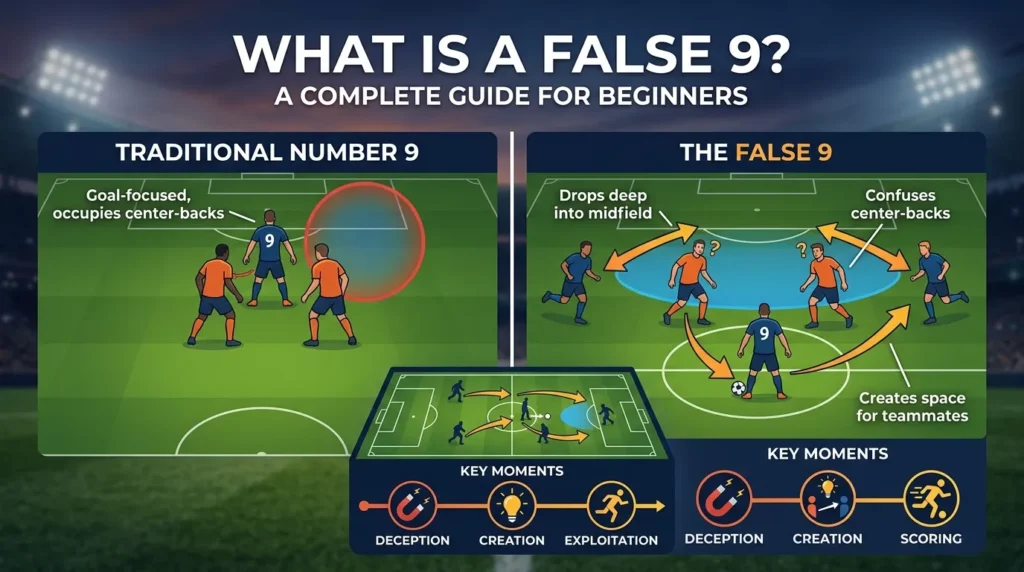
A False 9 is a forward who starts in the central striker position but regularly drops deeper into midfield instead of staying near the opposition’s defenders. The purpose is to create confusion by pulling center-backs out of their defensive line, opening spaces for wingers, attacking midfielders, or other forwards to exploit.
Unlike a traditional number 9, who focuses mainly on finishing chances inside the penalty area, the False 9 contributes heavily to build-up play and creative attacking movements.
Simple Example
Imagine the striker suddenly moves into midfield to receive the ball. A defender follows, leaving a gap behind. At the same moment, a winger or attacking midfielder runs into that open space, receives a through pass, and creates a goal-scoring opportunity. This movement is the foundation of the False 9 system.
History of the False 9
Although the term “False 9” became popular in modern football, the idea has existed for many decades. Early tactical systems occasionally used forwards who dropped deeper to help control possession, but the role gained worldwide recognition as football became more tactical and possession-oriented.
Several legendary teams successfully used the False 9 system to dominate opponents. As pressing, ball retention, and positional play became increasingly important, coaches realized that a mobile striker could create more attacking opportunities than a traditional center-forward.
Today, the False 9 remains one of the most respected tactical roles in football because of its flexibility and unpredictability.
How Does a False 9 Work?
The False 9 constantly changes position throughout the match, making it difficult for defenders to know whether to follow or stay in place.
Step 1: Start as the Central Forward
The player begins in the normal striker position, occupying the opposition’s center-backs.
Step 2: Drop into Midfield
Instead of remaining near the penalty area, the False 9 moves into deeper areas to receive the ball.
Step 3: Draw Defenders Out
If a defender follows the False 9, space opens behind the defensive line.
Step 4: Create Space for Teammates
Wingers, attacking midfielders, or overlapping full-backs attack the newly created spaces with intelligent runs.
Step 5: Build the Attack
The False 9 links play through quick passes, creative movement, and accurate decision-making before joining the attack in advanced positions.
This constant movement makes defending against a False 9 extremely challenging.
Key Responsibilities of a False 9
A False 9 performs many different tasks during a match.
Link Midfield and Attack
One of the primary responsibilities is connecting midfielders with attacking players through intelligent passing and movement.
Create Space
Dropping into midfield forces defenders to make difficult decisions, creating room for teammates.
Provide Assists
A False 9 often creates more chances than a traditional striker by delivering key passes and through balls.
Score Goals
Although creativity is important, a False 9 must still finish scoring opportunities whenever they arise.
Press Opponents
Modern football requires attacking players to defend from the front. A False 9 often initiates pressing to help the team regain possession quickly.
Characteristics of a Successful False 9
Not every striker can play this demanding role. A successful False 9 possesses a combination of technical, physical, and mental qualities.
Excellent Ball Control
The player must receive difficult passes under pressure while maintaining possession.
Vision
Exceptional awareness allows the False 9 to identify teammates making attacking runs.
Accurate Passing
Quick, precise passing helps maintain possession and unlock defensive lines.
Intelligent Movement
Knowing when to drop deep and when to attack the penalty area is crucial.
Quick Decision-Making
Football situations change rapidly, so fast thinking is essential.
Composure
Remaining calm under pressure allows better passing, shooting, and overall decision-making.
Why Do Teams Use a False 9?
Many coaches choose this tactical approach because it offers greater attacking flexibility than a traditional striker.
Some of the main reasons include:
- Creating numerical superiority in midfield
- Confusing opposing defenders
- Opening space for wingers
- Improving possession football
- Increasing passing options
- Encouraging fluid attacking movement
- Making defensive marking more difficult
The False 9 is particularly effective for teams that prioritize possession and technical football.
Advantages of Playing with a False 9
The system provides several tactical benefits.
Greater Attacking Flexibility
Players constantly interchange positions, making the attack less predictable.
Better Ball Possession
Dropping into midfield creates additional passing options and helps control possession.
Creates Defensive Confusion
Opposing center-backs often struggle to decide whether to follow the False 9 or maintain their defensive position.
More Space for Wingers
As defenders move forward, wide attackers gain additional room to attack dangerous areas.
Encourages Team Play
Success depends on coordinated movement rather than individual brilliance, leading to better teamwork and passing combinations.
Disadvantages of a False 9 System
Despite its advantages, the False 9 role also presents several challenges.
Lack of Penalty Area Presence
When the striker drops deep, there may be fewer players available inside the box to finish crosses.
Requires Highly Skilled Players
The system depends on intelligent footballers with excellent technical ability and tactical understanding.
Can Reduce Goal Numbers
If teammates fail to attack the spaces created, the team may struggle to score consistently.
Difficult to Master
The False 9 role requires experience, communication, timing, and excellent positional awareness, making it unsuitable for every team.
Essential Skills for a False 9
Players hoping to succeed as a False 9 should focus on developing the following abilities:
- Excellent first touch
- Vision and creativity
- Accurate short and long passing
- Intelligent movement
- Dribbling under pressure
- Quick decision-making
- Finishing ability
- Positional awareness
- Tactical intelligence
- Strong communication with teammates
Mastering these skills allows a False 9 to influence every phase of attacking play while creating opportunities for both themselves and their teammates.
Famous Players Who Excelled as a False 9
Several world-class footballers have mastered the False 9 role, proving how effective it can be when performed correctly.
Lionel Messi
One of the greatest examples of a False 9 is Lionel Messi. Instead of playing as a traditional striker, he often dropped into midfield to receive the ball, create chances, and score goals. His movement made it extremely difficult for defenders to mark him.
Roberto Firmino
Roberto Firmino became famous for his intelligent movement and selfless playing style. Rather than focusing only on scoring, he created space for teammates and linked midfield with attack.
Francesco Totti
Francesco Totti successfully played as a False 9 during the later stages of his career. His vision, passing ability, and football intelligence allowed him to control attacks from deeper positions.
Cesc Fàbregas
Although naturally a midfielder, Cesc Fàbregas occasionally played as a False 9 due to his exceptional passing, creativity, and tactical awareness.
These players demonstrated that intelligence and movement can sometimes be more valuable than physical strength in modern football.
False 9 vs Traditional Striker
Although both roles play in attack, they have very different responsibilities.
| Feature | False 9 | Traditional Striker |
|---|---|---|
| Starting Position | Central forward | Central forward |
| Movement | Frequently drops into midfield | Usually stays near the penalty area |
| Main Role | Create and score | Primarily score goals |
| Passing | High involvement | Moderate involvement |
| Space Creation | Creates space for teammates | Occupies defenders |
| Defensive Contribution | Often presses from the front | Depends on team tactics |
A traditional striker focuses on finishing attacks, while a False 9 combines creativity, movement, and goal scoring.
Best Formations for a False 9
Certain formations are better suited to a False 9 than others because they provide runners who can exploit the spaces created.
4-3-3 Formation
This is one of the most effective systems. Wingers move inside while the False 9 drops deep to connect midfield and attack.
4-2-3-1 Formation
The attacking midfielder and wide players benefit from the extra space created when the False 9 pulls defenders out of position.
4-6-0 Formation
This unusual system uses no traditional striker. Instead, several attacking midfielders rotate positions, making the attack unpredictable.
Common Mistakes When Playing as a False 9
Many players struggle with this role because they misunderstand its responsibilities.
Dropping Too Deep
Moving too far into midfield can leave the penalty area empty and reduce goal-scoring opportunities.
Holding the Ball Too Long
Quick passing is essential. Keeping possession for too long allows defenders to recover.
Ignoring Defensive Duties
Modern football requires attackers to press and defend when possession is lost.
Poor Communication
The False 9 must constantly coordinate movement with wingers and midfielders to avoid confusion.
Lack of Movement
Standing still defeats the purpose of the role. Continuous movement creates uncertainty for defenders.
Training Drills for a False 9
Players can improve by practicing exercises that develop movement, passing, and decision-making.
One-Touch Passing Drill
Quick passing improves link-up play and decision-making under pressure.
Small-Sided Games
Playing in tight spaces encourages creativity, movement, and rapid passing combinations.
Position Rotation Drill
Players regularly swap positions with midfielders and wingers to develop tactical flexibility.
Through Ball Practice
Passing drills focused on timing and accuracy help create scoring opportunities for teammates.
Finishing After Movement
Practice dropping into midfield before making late runs into the penalty area to improve attacking timing.
Tips for Beginners
If you want to play as a False 9, focus on developing your football intelligence rather than simply scoring goals.
- Improve your first touch every day.
- Learn to scan the field before receiving the ball.
- Practice quick, accurate passing.
- Watch professional matches to study movement.
- Communicate constantly with teammates.
- Stay patient and avoid forcing attacks.
- Work on both scoring and creating chances.
- Improve your stamina to maintain movement throughout the match.
Consistent practice and tactical awareness are the keys to mastering this role.
Interesting Facts About the False 9
- The False 9 is one of the most tactical positions in football.
- The role combines the responsibilities of a striker and an attacking midfielder.
- Modern football has increased the popularity of this system.
- A successful False 9 often creates as many goals as they score.
- Teams using a False 9 usually rely on intelligent movement rather than physical strength.
- Many youth academies now teach positional flexibility inspired by the False 9 role.
Future Trends of the False 9
Football tactics continue to evolve, and the False 9 remains an important part of modern coaching.
More Flexible Attacking Systems
Future teams are likely to use interchangeable attacking players who can perform multiple roles during a match.
Greater Use of Data Analysis
Performance statistics help coaches evaluate movement, passing accuracy, and positioning more effectively than ever before.
Hybrid Forward Roles
Modern attackers are expected to score, create chances, press opponents, and contribute defensively, making the False 9 role increasingly valuable.
Advanced Coaching Technology
Video analysis, GPS tracking, and tactical software allow coaches to refine player movement and improve attacking coordination.
Frequently Asked Questions
What is a False 9 in football?
A False 9 is a striker who drops into midfield to create space, link play, and confuse defenders instead of staying near the goal.
Why is it called a False 9?
The player wears or occupies the traditional number 9 position but performs a different tactical role by moving deeper into midfield.
Can every striker play as a False 9?
No. The role requires excellent vision, passing, movement, tactical awareness, and decision-making.
Which formation works best with a False 9?
The 4-3-3 formation is widely considered one of the best because it allows wingers to exploit the spaces created.
Does a False 9 score goals?
Yes. Although creating chances is a major responsibility, a False 9 should also contribute goals throughout the season.
What is the biggest advantage of a False 9?
The role creates confusion for defenders and opens space for teammates, making attacks more unpredictable.
What is the biggest disadvantage?
Teams may lack a traditional target inside the penalty area if the False 9 drops too deep.
Conclusion
The False 9 in football is one of the most intelligent and creative roles in the modern game. Instead of acting as a traditional striker, the player moves into deeper areas to connect midfield and attack, create space for teammates, and make defensive marking more difficult. This tactical approach requires exceptional technical ability, vision, movement, and teamwork.
While the role is challenging to master, it offers significant tactical advantages for teams that value possession, creativity, and fluid attacking football. Whether you are a player hoping to improve your tactical understanding, a coach designing attacking strategies, or a fan wanting to appreciate the finer details of the game, learning how a False 9 operates provides valuable insight into modern football tactics. As football continues to evolve, the False 9 will remain one of the sport’s most fascinating and influential positions.