
Imagine a fast bowler delivering a ball at high speed, but suddenly the umpire calls it an illegal action. The bowler is shocked, the team is disappointed, and the match situation changes completely. This is where the concept of legal bowling action becomes extremely important in cricket.
A legal bowling action ensures fairness, safety, and consistency in the game. Without proper rules, bowlers could gain unfair advantage by bending or twisting their arms beyond allowed limits. That is why cricket authorities like the ICC strictly monitor bowling actions to keep the game balanced between bat and ball.
Understanding legal bowling action is essential for players, coaches, and students of cricket. It helps bowlers develop correct techniques, avoid penalties, and maintain long-term careers in the sport.
In this article, you will learn everything about legal bowling action, including its definition, working principle, types, rules, benefits, limitations, and real-world applications in modern cricket.
2. What is Legal Bowling Action?
A legal bowling action in cricket refers to the correct method of delivering the ball where the bowler’s arm does not straighten beyond the allowed limit during the bowling motion.
Simple Definition
A bowling action is considered legal when:
- The bowler’s elbow does not extend beyond 15 degrees during delivery
- The ball is released without throwing (chucking)
- The action is smooth, controlled, and repeatable
Practical Example
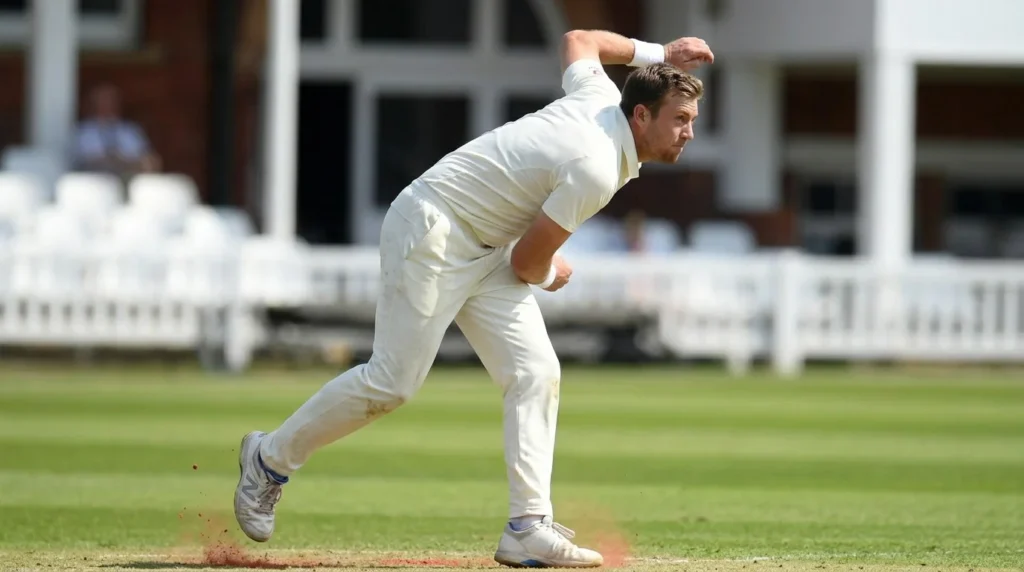
If a bowler runs in and delivers the ball with a straight arm motion without sudden jerks or excessive elbow bending, it is considered a legal bowling action.
3. Working Principle of Legal Bowling Action
The legal bowling action working principle is based on biomechanical control and consistency of movement.
Step-by-Step Explanation
- Bowler begins run-up with controlled speed
- Body aligns toward target (stumps or batsman)
- Bowling arm rotates in a circular motion
- Elbow remains within legal limit (not excessively straightening)
- Ball is released at the highest controlled point
- Follow-through maintains balance and direction
Simple Analogy
Think of it like a machine arm:
- If the machine moves smoothly within set limits → it works properly
- If it bends or breaks limits → it becomes faulty
Similarly, a bowler must stay within biomechanical limits.
4. Types / Classification of Bowling Actions
4.1 Conventional Bowling Action
- Straightforward and classic technique
- Used by most fast and spin bowlers
- Easy to control and repeat
4.2 Round Arm Action
- Arm is slightly more horizontal
- Often used in swing bowling
- Still legal if elbow remains within limit
4.3 Slingy Action
- Arm comes from a lower angle
- Creates extra speed or spin
- Must still follow legal elbow rules
4.4 Spin Bowling Action
- Slower delivery style
- Focus on finger or wrist spin
- Naturally safe and legal if controlled
5. Main Components of Legal Bowling Action
5.1 Run-up
- Builds momentum
- Must be balanced and consistent
5.2 Delivery Stride
- Final step before ball release
- Helps maintain stability
5.3 Bowling Arm
- Main component of action
- Must follow elbow restriction rules
5.4 Wrist Position
- Controls direction and spin
- Improves accuracy
5.5 Follow-through
- Maintains balance after release
- Prevents injury
6. Advantages of Legal Bowling Action
The legal bowling action advantages and disadvantages are important for understanding performance.
Advantages
- Ensures fair play in cricket
- Reduces risk of penalties
- Improves bowling consistency
- Helps prevent injuries
- Builds long-term career stability
- Increases control over ball movement
- Accepted at all levels of cricket
7. Disadvantages / Limitations
Limitations
- Takes time to master proper technique
- Some bowlers lose natural speed initially
- Strict monitoring can create pressure
- Small biomechanical differences may be corrected by authorities
- Requires continuous practice and discipline
8. Applications of Legal Bowling Action
The legal bowling action applications are found across all cricket formats.
International Cricket
- Test matches
- ODIs
- T20 Internationals
Domestic Cricket
- Club cricket
- School competitions
- League tournaments
Coaching and Training
- Used to train young bowlers
- Video analysis of action
- Biomechanical correction programs
Modern Technology
- Motion tracking systems
- AI bowling analysis tools
- 3D action correction software
9. Comparison Section
Difference Between Legal and Illegal Bowling Action
| Feature | Legal Bowling Action | Illegal Bowling Action |
|---|---|---|
| Elbow movement | Within 15° limit | Exceeds 15° limit |
| Legality | Allowed | Not allowed |
| Result | No penalty | Warning/suspension |
| Career impact | Positive | Negative |
| Fair play | Maintained | Violated |
Difference Between Legal Action and Throwing (Chucking)
| Feature | Legal Action | Throwing |
|---|---|---|
| Arm motion | Smooth rotation | Sudden straightening |
| Rule status | Allowed | Illegal |
| Detection | Standard monitoring | Strict review |
10. Selection Guide (For Bowlers)
Tips for Beginners
- Start with basic bowling drills
- Focus on smooth arm rotation
- Avoid forcing speed initially
Professional Tips
- Use video analysis for correction
- Maintain consistent run-up
- Strengthen shoulder and core muscles
Coaching Advice
- Train under certified coaches
- Regular biomechanical checks
- Practice under match pressure
11. Common Problems & Solutions
Q1: Why is my action being called illegal?
Cause: Elbow extension beyond limit
Solution: Correct arm position using coaching drills
Q2: Why is my bowling speed reduced?
Cause: Over-correction of action
Solution: Gradually rebuild rhythm and strength
Q3: Why do I feel imbalance during delivery?
Cause: Poor run-up or foot placement
Solution: Improve footwork and balance training
Q4: Why am I losing control of line and length?
Cause: Inconsistent arm movement
Solution: Practice repetition drills in nets
12. Future Trends in Legal Bowling Action
Cricket technology is improving rapidly, making action analysis more accurate.
Advanced Motion Tracking
- 3D bowling analysis systems
- Real-time elbow angle detection
AI-Based Coaching
- Automated correction feedback
- Smart training systems
Safer Training Methods
- Reduced injury risk programs
- Personalized coaching plans
Stricter Regulations
- Faster decision-making by umpires
- More accurate biomechanical testing
13. Conclusion
The legal bowling action is a fundamental part of modern cricket that ensures fairness, safety, and consistency. It defines how a bowler should deliver the ball without exceeding biomechanical limits.
Understanding and practicing legal bowling action helps players improve performance, avoid penalties, and build long-term careers in cricket. It is not just about following rules, but about developing a disciplined and efficient bowling technique.
For beginners and professionals alike, mastering legal bowling action is essential for success in all formats of the game. With proper training, analysis, and practice, every bowler can achieve a strong, effective, and legal action.