
Imagine a fast bowler running in with full speed and suddenly delivering a ball that rises sharply toward the batsman’s head. The batsman quickly ducks or plays a defensive shot to avoid injury. This type of delivery is called a bouncer, and it is one of the most exciting and controlled weapons in cricket.
The Bouncer Rule is very important in modern cricket because it ensures player safety while still allowing fast bowlers to use aggressive tactics. Without proper rules, bouncers could become dangerous and unfair for batsmen. That is why cricket governing bodies like the ICC have clearly defined how many bouncers can be bowled in an over and under what conditions.
In this article, you will learn everything about the Bouncer Rule, including its definition, working principle, types, restrictions, advantages, disadvantages, and practical applications in real matches. This guide is written in simple English so that beginners, students, and cricket enthusiasts can easily understand it.
What Is the Bouncer Rule in Cricket?
The bouncer rule in cricket controls how many short-pitched deliveries a bowler can legally deliver in an over and how these deliveries are judged under the playing conditions.
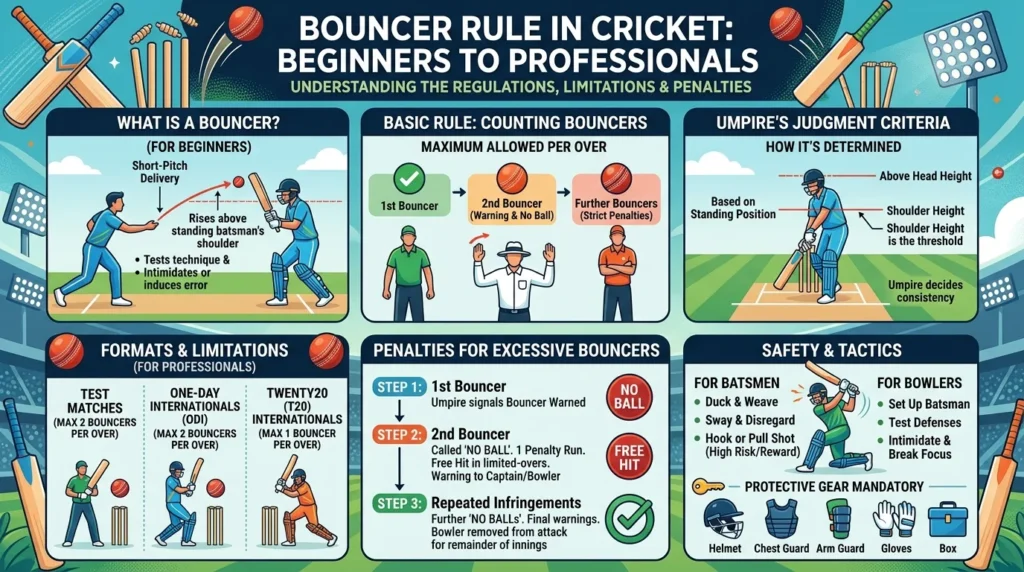
The bouncer rule in cricket controls how many short-pitched deliveries a bowler can legally deliver during an over. A bouncer is a short-pitched ball that rises significantly after bouncing and generally passes the batter around the shoulder or head area. The bouncer ball rule in cricket determines whether this type of short-pitched delivery is permitted under the playing conditions.
The rule is designed to balance attacking fast bowling with batter safety. The permitted number of bouncers is not identical in every format, so the applicable playing conditions should always be checked for the particular competition.
In many international limited-overs matches, including ODIs and T20Is, the current ICC playing conditions generally allow a bowler to deliver up to two short-pitched deliveries per over. Test cricket has different provisions, and domestic competitions may also use their own playing conditions.
These cricket bouncer rules help umpires determine whether a short-pitched delivery is legal and whether the bowler has exceeded the permitted limit.
Bouncer Rules in Cricket
The main points to understand are:
- A bouncer is a short-pitched delivery that rises sharply after bouncing.
- It is most commonly used by fast and fast-medium bowlers as an attacking tactic.
- The permitted number of short-pitched deliveries depends on the format and competition playing conditions.
- If a bowler exceeds the permitted limit, the delivery can be called a no-ball under the applicable rules.
- Umpires also have the authority to intervene when a delivery is considered dangerous or unfair, even if the bowler has not exceeded the normal bouncer limit.
- The rules are intended to protect batters while still allowing bowlers to use short-pitched bowling as a legitimate strategy.
Example of the Bouncer Rule
Suppose the playing conditions allow a bowler to deliver two short-pitched deliveries in an over. If the same bowler delivers a third delivery that falls within the definition of a regulated short-pitched delivery, the umpire can call it a no-ball under those playing conditions.
The batting team then receives the applicable no-ball penalty, and the delivery does not count as a legal ball in the over.
Why Is the Bouncer Rule Important?
The bouncer rule helps maintain a balance between competitive fast bowling and player safety. Short-pitched deliveries are an important part of cricket strategy, but unrestricted use of them could increase the risk to batters.
By limiting the number of permitted bouncers and giving umpires authority to deal with dangerous deliveries, cricket’s playing conditions allow aggressive bowling while maintaining appropriate safety standards.
What Happens If a Bowler Bowls 3 Bouncers in an Over?
What if a bowler bowls 3 bouncers in an over? If the playing conditions allow only two short-pitched deliveries in an over, the third bouncer is treated according to the specific competition’s rules and may be called a no-ball. The umpire will apply the relevant playing conditions to determine the correct decision.
3. How the Bouncer Rule Works in Cricket
The Bouncer Rule in cricket controls the number of short-pitched deliveries a bowler can legally deliver during an over. A bouncer is generally a ball that pitches short and rises toward the batter’s upper body or head. The rule allows fast bowlers to use pace and bounce as an attacking option while limiting excessive short-pitched bowling.
The exact bouncer limit can vary depending on the format, competition, and playing conditions. In many international formats, a bowler is permitted to deliver a limited number of bouncers per over. If a delivery exceeds the permitted limit, it may be called a no-ball under the applicable playing conditions.
Step-by-Step Working Process
- The bowler begins the run-up and delivers the ball.
- The ball pitches relatively short on the cricket pitch.
- After bouncing, the ball rises toward the batter’s upper body or head.
- The batter may duck, sway, defend, or play an attacking shot.
- The umpire assesses the height and nature of the delivery.
- The umpire keeps track of the short-pitched deliveries allowed under the match’s playing conditions.
- If the bowler exceeds the permitted limit, the delivery is called a no-ball where the relevant playing conditions require it.
Why the Bouncer Rule Is Important
- Maintains a fair contest: It allows fast bowlers to use bounce without giving them unlimited short-pitched deliveries.
- Improves player safety: Limiting repeated dangerous short balls helps reduce unnecessary exposure to high-speed deliveries around the head and upper body.
- Supports attacking bowling: Bowlers can still use bouncers strategically to pressure and surprise batters.
- Creates consistent standards: The rule gives umpires a framework for managing short-pitched bowling.
- Balances the game: It helps maintain an appropriate balance between aggressive fast bowling and batter safety.
Important Note
Not every ball that bounces high is automatically treated as a bouncer for the purpose of the over limit. The umpire considers the pitching length, trajectory, and height of the ball as it reaches the batter, together with the specific playing conditions of the match.
What Is the First Bounce Rule in Cricket? Complete Guide with Examples (2026)
The first bounce rule in cricket refers to the point where the cricket ball first touches the ground after being delivered by the bowler. This first bounce plays a crucial role in determining whether a delivery is legal, how it behaves after pitching, and how the batter can play the shot. Although there is no official law called the “First Bounce Rule,” players, coaches, and fans commonly use this term to describe the importance of the ball’s first pitch during a delivery.
When a bowler releases the ball, it usually lands once on the pitch before reaching the batter. The location of this first bounce affects the ball’s speed, bounce, swing, and spin. A well-pitched delivery can trouble the batter, while an incorrectly pitched ball may become easy to hit.
For fast bowlers, the ideal first bounce is generally on a good length, around 6–8 meters from the batter’s stumps. From this area, the ball can bounce unpredictably, making it difficult for the batter to judge whether to play on the front foot or back foot.
For spin bowlers, the first bounce is equally important. Landing the ball in the correct area allows the pitch to grip the ball, producing more turn and bounce. If the ball lands too full or too short, the batter usually has enough time to attack the delivery.
The first bounce also determines whether a delivery is considered legal. If a ball bounces more than once before reaching the batter, it is called a No Ball under the Laws of Cricket. Similarly, if the ball rolls along the ground without bouncing, it is also an illegal delivery.
Examples of the First Bounce Rule
- A fast bowler delivers a good-length ball that bounces once before reaching the batter. This is a legal delivery.
- A spinner lands the ball once on the pitch, and it turns sharply after bouncing. This is also a legal delivery.
- A ball bounces twice before reaching the batter. The umpire signals a No Ball.
- The ball rolls on the ground without bouncing before reaching the batter. This is also a No Ball.
Understanding the first bounce rule in cricket helps players improve their bowling accuracy and batting technique. Bowlers learn to pitch the ball in the most effective area, while batters judge the length of the delivery based on where it first lands. Mastering this basic concept is essential for beginners, coaches, and cricket enthusiasts because it directly influences the outcome of every delivery.
4. Types of Bouncers in Cricket
Fast bowlers use different variations of the bouncer depending on the match situation, pitch conditions, and batting style.
4.1 Standard Short-Pitched Bouncer
The Standard Short-Pitched Bouncer is the most commonly used type of bouncer in cricket. In this delivery, the bowler pitches the ball well short of the batter so that it rises sharply after bouncing, usually reaching chest or shoulder height. The main objective of this bouncer is not always to take a wicket immediately but to make the batter feel uncomfortable, restrict scoring opportunities, and create pressure.
Fast bowlers use this delivery to force the batter onto the back foot and reduce their ability to play attacking shots. If the batter mistimes the shot or attempts an aggressive hook or pull shot, there is a greater chance of being caught by a fielder placed on the boundary or in the deep.
The effectiveness of a standard short-pitched bouncer depends on the bowler’s pace, accuracy, bounce, and the condition of the pitch. On fast and bouncy wickets, such as those found in Australia or South Africa, this delivery becomes even more dangerous because the ball climbs quickly toward the batter.
Characteristics
- Pitches short of a good length.
- Rises toward the batter’s chest or shoulder.
- Creates pressure and forces defensive play.
- Commonly used by fast bowlers in Test matches, One Day Internationals (ODIs), and T20 cricket.
- Often sets up the batter for the next delivery, such as a full-length yorker or an outswinger.
Example
A fast bowler delivers a short-pitched ball that climbs to the batter’s shoulder height. The batter attempts a hook shot but mistimes it, and the ball is caught by a deep square-leg fielder. This is a classic example of a standard short-pitched bouncer being used successfully to create a wicket-taking opportunity.
4.2 Head-High Bouncer
A Head-High Bouncer is a short-pitched delivery that rises sharply toward the batter’s head or helmet after bouncing. This type of bouncer is designed to surprise the batter and force them into an awkward defensive movement, such as ducking, swaying, or attempting a risky hook shot.
Because of the potential risk of injury, umpires closely monitor head-high bouncers during a match. If, after bouncing, the ball passes above the batter’s head while they are standing upright at the popping crease, it is generally called a No Ball. Repeated dangerous short-pitched deliveries may also result in warnings or disciplinary action against the bowler under the Laws of Cricket.
Fast bowlers often use head-high bouncers as part of a tactical plan to unsettle the batter, but they must remain within the rules and avoid bowling excessively dangerous deliveries.
Characteristics
- Pitches short and rises sharply toward the batter’s head or helmet.
- Forces the batter to duck, evade, or play a defensive shot.
- Can be ruled a No Ball if it passes above the batter’s head after bouncing.
- Closely monitored by umpires for player safety.
- Commonly used by fast bowlers to create pressure and intimidate the batter within the laws of the game.
Example
A fast bowler delivers a short ball that climbs above the batter’s helmet while the batter is standing upright at the crease. The batter ducks to avoid the ball, and the umpire signals a No Ball because the delivery was too high after bouncing. This is an example of a head-high bouncer that exceeds the permitted height under the Laws of Cricket.
4.3 Slower Bouncer
A Slower Bouncer is a variation of the traditional bouncer in which the bowler delivers a short-pitched ball at a reduced speed instead of using maximum pace. Although the ball is pitched short like a regular bouncer, the slower pace is designed to deceive the batter, causing them to play the shot too early or mistime it.
Fast bowlers commonly use the slower bouncer in One Day Internationals (ODIs) and T20 cricket, where batters often expect high-speed deliveries and look to play aggressive shots. By reducing the pace while maintaining the same bowling action, the bowler makes it difficult for the batter to judge the timing, increasing the chances of a top edge or an easy catch.
The slower bouncer is particularly effective during the middle overs and death overs, where batters are under pressure to score quickly.
Characteristics
- Bowled with less pace than a standard bouncer.
- Pitched short to rise toward the batter.
- Uses the same bowling action to disguise the slower speed.
- Difficult for batters to judge and time correctly.
- Frequently used in ODI and T20 cricket as a deceptive variation.
- Often results in mistimed pull or hook shots.
Example
A fast bowler delivers a slower bouncer during the final overs of a T20 match. Expecting a fast short ball, the batter attempts a pull shot too early. The ball arrives later than expected, takes the top edge of the bat, and is caught by a fielder at deep square leg. This is a classic example of a slower bouncer successfully deceiving the batter.
4.4 Surprise Bouncer
A Surprise Bouncer is a tactical short-pitched delivery bowled unexpectedly after a sequence of fuller or good-length deliveries. Instead of repeatedly bowling short balls, the bowler suddenly changes the length, catching the batter off guard and disrupting their timing and rhythm.
The main objective of a surprise bouncer is to force the batter into making a hurried decision. Since the batter is expecting another full-length delivery, the unexpected short ball often results in an awkward defensive shot, a mistimed hook or pull shot, or even a top edge that can be caught by a fielder.
Fast bowlers frequently use this variation against aggressive batters who like to attack every delivery. When used at the right moment, a surprise bouncer can create valuable wicket-taking opportunities and shift the momentum of the match.
Characteristics
- Bowled unexpectedly after a series of fuller or good-length deliveries.
- Catches the batter by surprise and breaks their rhythm.
- Forces hurried or uncomfortable shot selection.
- Most effective when used occasionally rather than repeatedly.
- Commonly used by fast bowlers in Test matches, ODIs, and T20 cricket.
- Creates wicket-taking opportunities by inducing mistimed hook or pull shots.
Example
A fast bowler bowls four consecutive full-length deliveries, encouraging the batter to play on the front foot. On the fifth ball, the bowler suddenly delivers a sharp short-pitched bouncer. The surprised batter attempts a hurried hook shot, mistimes the ball, and a fielder at deep fine leg takes the catch. This is a classic example of a surprise bouncer successfully deceiving the batter.
T20 Bouncer Rule Explained (2026): How Many Bouncers Are Allowed in T20 Cricket?
The T20 bouncer rule regulates how many short-pitched deliveries a fast bowler can bowl in a single over. The rule is designed to maintain a balance between bat and ball while ensuring player safety. Bouncers remain an important weapon for fast bowlers, but they must be used within the limits set by the playing conditions.
Under the current ICC Men’s T20 International (T20I) playing conditions, each bowler is allowed a maximum of two short-pitched deliveries (bouncers) per over. A delivery is considered a bouncer if, after pitching, it passes or would have passed the batter above shoulder height while the batter is standing upright at the popping crease.
If a bowler delivers more than two bouncers in the same over, the additional short-pitched delivery is called a No Ball by the umpire. The batting team receives one extra run, and the next delivery is a Free Hit (in T20Is), allowing the batter an excellent scoring opportunity.
Why Is the T20 Bouncer Rule Important?
The bouncer rule helps achieve several important objectives:
- Protects batters from excessive dangerous short-pitched bowling.
- Maintains a fair contest between bat and ball.
- Prevents bowlers from repeatedly intimidating batters.
- Encourages bowlers to use bouncers as a tactical variation rather than on every delivery.
Example
Suppose a fast bowler delivers two legal bouncers during an over. If the third short-pitched delivery in that same over rises above the permitted shoulder height criteria, the umpire signals a No Ball because the bowler has exceeded the allowed limit of bouncers.
Key Points About the T20 Bouncer Rule
- Maximum two bouncers are allowed per over in ICC T20 Internationals.
- The third bouncer in the same over is called a No Ball.
- The batting side receives one extra run for the No Ball.
- The next delivery becomes a Free Hit.
- Umpires also monitor dangerous or excessively high short-pitched deliveries for player safety.
The T20 bouncer rule adds an important tactical element to the shortest format of cricket. Bowlers must decide the best time to use their limited bouncers, while batters must stay prepared for unexpected short-pitched deliveries. This balance makes T20 cricket more exciting, competitive, and entertaining for players and fans alike.
ODI Bouncer Rule Explained (2026): How Many Bouncers Are Allowed in One Day Internationals?
The ODI bouncer rule specifies how many short-pitched deliveries a bowler can legally bowl in a single over during a One Day International (ODI) match. The rule is designed to maintain a fair balance between bat and ball while protecting batters from excessive dangerous bowling.
Under the current ICC Men’s ODI Playing Conditions, each bowler is allowed a maximum of two short-pitched deliveries (bouncers) per over. A delivery is considered a bouncer if, after pitching, it passes or would have passed the batter above shoulder height while the batter is standing upright at the popping crease.
If a bowler bowls more than two bouncers in the same over, the extra short-pitched delivery is declared a No Ball by the umpire. The batting team receives one extra run, and in ODIs, the next delivery is also a Free Hit.
What Is Considered a Legal Bouncer in ODI Cricket?
A legal bouncer is a short-pitched delivery that rises toward the batter’s upper body but remains within the limits allowed by the ICC playing conditions.
Bowlers often use legal bouncers to:
- Surprise the batter.
- Force defensive shots.
- Set up wickets.
- Break the batter’s rhythm.
- Prevent aggressive stroke play.
Fast bowlers carefully mix bouncers with yorkers and good-length deliveries to make their bowling more effective.
What Happens If a Bowler Exceeds the Bouncer Limit?
If a bowler delivers a third bouncer in the same over:
- The umpire calls No Ball.
- The batting side receives one extra run.
- The next delivery becomes a Free Hit.
- The ball does not count as one of the six legal deliveries of the over.
This rule discourages bowlers from using excessive short-pitched bowling while still allowing them to use bouncers strategically.
Why Does the ODI Bouncer Rule Exist?
The ODI bouncer rule serves several important purposes:
- Protects batters from repeated dangerous short-pitched deliveries.
- Maintains a fair balance between batting and bowling.
- Encourages tactical rather than excessive use of bouncers.
- Improves player safety without removing an important bowling weapon.
- Makes ODI cricket more competitive and entertaining.
Example of the ODI Bouncer Rule
Imagine a fast bowler delivers two legal bouncers during an over. Later in the same over, the bowler bowls another short-pitched delivery that qualifies as a bouncer.
Since the bowler has already used the maximum permitted two bouncers, the umpire immediately signals a No Ball. The batting team is awarded one extra run, and the following delivery is a Free Hit, giving the batter an opportunity to score without most dismissal risks.
Key Points About the ODI Bouncer Rule
- A bowler may bowl a maximum of two bouncers per over in One Day Internationals.
- The third bouncer in the same over is called a No Ball.
- The batting team receives one extra run for the No Ball.
- The next delivery is a Free Hit.
- Umpires also monitor dangerous or excessively high short-pitched deliveries to ensure player safety.
- Fast bowlers use bouncers as a tactical weapon to pressure batters and create wicket-taking opportunities.
The ODI bouncer rule ensures that short-pitched bowling remains an exciting and strategic part of the game while maintaining player safety and a fair contest between bat and ball. By limiting the number of bouncers per over, the ICC encourages bowlers to use them wisely, making every short-pitched delivery more effective and unpredictable.
Test Cricket Bouncer Rule Explained (2026): How Many Bouncers Are Allowed Per Over?
The Test cricket bouncer rule defines how many short-pitched deliveries a fast bowler can legally bowl in a single over during a Test match. Unlike limited-overs cricket, Test cricket gives bowlers slightly more freedom to use short-pitched bowling as a tactical weapon. The rule helps maintain a balance between aggressive fast bowling and player safety.
According to the current ICC Men’s Test Match Playing Conditions, each bowler is allowed a maximum of two bouncers per over. A delivery is considered a bouncer if, after pitching, it passes or would have passed the batter above shoulder height while the batter is standing upright at the popping crease.
If a bowler delivers more than two bouncers in the same over, the additional short-pitched delivery is called a No Ball by the umpire. The batting side receives one extra run, and the ball does not count as one of the six legal deliveries in the over.
What Is a Legal Bouncer in Test Cricket?
A legal bouncer is a short-pitched delivery that rises toward the batter’s upper body or shoulder after bouncing. Fast bowlers use this delivery to challenge the batter’s technique, force mistakes, and create wicket-taking opportunities.
A well-directed bouncer can:
- Push the batter onto the back foot.
- Force defensive or awkward shots.
- Set up the batter for a fuller delivery.
- Create catching opportunities with fielders placed for the hook or pull shot.
What Happens If a Bowler Exceeds the Bouncer Limit?
If a bowler bowls a third bouncer in the same over, the umpire immediately calls a No Ball.
Penalties
- One extra run is awarded to the batting team.
- The delivery does not count as one of the six legal balls in the over.
- The bowler must bowl an additional legal delivery.
Unlike ODIs and T20Is, a No Ball in Test cricket does not result in a Free Hit. The batter can still be dismissed on the following delivery under the normal Laws of Cricket.
Why Does Test Cricket Have a Bouncer Rule?
The Test match bouncer rule serves several important purposes:
- Protects batters from repeated dangerous short-pitched bowling.
- Maintains a fair contest between bat and ball.
- Allows fast bowlers to use bouncers as a strategic weapon.
- Encourages skill, accuracy, and tactical bowling.
- Improves player safety while preserving the traditional challenge of Test cricket.
Example of the Test Bouncer Rule
A fast bowler delivers two legal bouncers during an over to pressure the batter. On the fifth ball of the over, the bowler bowls another short-pitched delivery that qualifies as a bouncer.
Since the bowler has already used the maximum two permitted bouncers, the umpire signals a No Ball. The batting side receives one extra run, and the bowler must bowl an additional legal delivery to complete the over.
Key Points About the Test Cricket Bouncer Rule
- A bowler may bowl a maximum of two bouncers per over in Test cricket.
- The third bouncer in the same over is called a No Ball.
- The batting team receives one extra run.
- The No Ball does not result in a Free Hit.
- Umpires also monitor dangerous or excessively high short-pitched deliveries to ensure player safety.
- Fast bowlers use bouncers strategically to create pressure and dismiss batters.
The Test cricket bouncer rule allows fast bowlers to use aggressive short-pitched bowling while ensuring the game remains fair and safe. By limiting the number of bouncers per over, the rule encourages bowlers to use them thoughtfully, making each delivery more effective and maintaining the unique tactical battle between bowler and batter in Test cricket.
5. Key Elements of the Bouncer Rule
Several people and match conditions work together to ensure the Bouncer Rule is applied correctly.
5.1 Fast Bowler
The bowler uses pace, bounce, and accuracy to execute a legal short-pitched delivery while remaining within the permitted number of bouncers per over.
5.2 Batter
The batter must react quickly by defending, ducking, swaying away, or playing attacking shots such as the hook or pull shot.
5.3 Umpire
The umpire is responsible for identifying bouncers, counting the number delivered in each over, judging dangerous short-pitched bowling, and calling a no-ball whenever the bowler exceeds the allowed limit.
5.4 Cricket Pitch
The condition of the pitch significantly affects how high and quickly a bouncer rises. Hard pitches generally produce steeper and faster bounce than softer surfaces.
5.5 Playing Conditions
The match regulations determine the maximum number of permitted bouncers per over. These conditions may vary between Test matches, One Day Internationals, T20 Internationals, and domestic competitions, so players and officials must follow the specific rules for that tournament.
6. Advantages of Bouncer Rule
The Bouncer Rule advantages and disadvantages are important to understand.
Advantages
- Ensures player safety
- Maintains fair competition
- Controls aggressive bowling
- Reduces injury risk
- Improves game discipline
- Encourages skill-based cricket
7. Disadvantages / Limitations
Limitations
- Reduces bowling aggression slightly
- Limits fast bowler creativity
- Sometimes controversial decisions
- Depends on umpire judgment
- May reduce excitement in some situations
8. Applications of the Bouncer Rule in Cricket
The Bouncer Rule is applied across all levels of cricket to ensure that short-pitched bowling remains competitive while maintaining player safety. It helps match officials regulate aggressive fast bowling and creates a fair balance between bowlers and batters. Whether in international tournaments or local competitions, the rule promotes consistent enforcement of cricket laws.
8.1 International Cricket
The Bouncer Rule is strictly enforced in international matches under the playing conditions set by the governing body and match officials.
It is applied in:
- Test Matches
- One Day Internationals (ODIs)
- Twenty20 Internationals (T20Is)
- ICC tournaments such as the Cricket World Cup and Champions Trophy
The permitted number of bouncers per over may vary depending on the format and competition regulations.
8.2 Domestic and League Cricket
Domestic cricket boards also implement the Bouncer Rule to maintain consistency and player safety throughout national competitions.
It is commonly used in:
- First-Class Cricket
- List A Matches
- Domestic T20 Leagues
- Franchise Cricket
- Club Cricket
- University and School Tournaments
Each cricket board follows its own playing conditions while remaining aligned with the Laws of Cricket.
8.3 Bowling Strategy and Match Tactics
Fast bowlers use the Bouncer Rule strategically to challenge batters without exceeding the permitted limit.
Common tactical applications include:
- Breaking a batter’s rhythm
- Forcing defensive shots
- Setting up wicket-taking deliveries
- Creating pressure during crucial overs
- Supporting aggressive field placements
- Controlling scoring opportunities
8.4 Player Safety and Fair Play
One of the primary purposes of the Bouncer Rule is to protect players from excessive short-pitched bowling while preserving the competitive nature of the game.
The rule helps to:
- Reduce the risk of head and upper-body injuries
- Prevent dangerous repetitive bowling
- Ensure fair competition between bat and ball
- Encourage responsible fast bowling
- Improve consistency in umpiring decisions
8.5 Coaching and Player Development
Cricket coaches use the Bouncer Rule when training both bowlers and batters to prepare them for competitive matches.
It helps players learn:
- Proper execution of legal bouncers
- Safe techniques for facing short-pitched bowling
- Tactical decision-making under pressure
- Match awareness and discipline
- Effective bowling plans within the laws of the game
9. Comparison Section
Difference Between Bouncer and Yorker
| Feature | Bouncer | Yorker |
|---|---|---|
| Bounce | High bounce | No bounce or low bounce |
| Target | Upper body/head | Feet/base of stumps |
| Purpose | Intimidation | Wicket taking |
| Risk | High safety concern | Less dangerous |
Difference Between Bouncer Rule and Beamer Rule
| Feature | Bouncer Rule | Beamer Rule |
|---|---|---|
| Purpose | Limit short balls | Prevent dangerous full toss |
| Safety Level | Medium risk | High risk |
| Control | Over count per over | Immediate no-ball |
10. Bowling Strategy and Best Practices for Using Bouncers
Using the bouncer effectively requires more than just pace. A successful short-pitched delivery depends on accuracy, timing, variation, and understanding the batter’s strengths and weaknesses. The best fast bowlers use bouncers as a tactical weapon rather than relying on them repeatedly.
10.1 Tips for Beginners
If you are learning fast bowling, focus on mastering the basics before attempting aggressive short-pitched deliveries.
Best practices include:
- Develop a smooth and balanced bowling action.
- Practice accurate line and length before increasing speed.
- Bowl bouncers during net sessions under coaching supervision.
- Build strength and fitness to maintain consistent pace.
- Learn the legal limits for bouncers in your competition.
10.2 Professional Bowling Tips
Experienced fast bowlers use bouncers strategically to create wicket-taking opportunities.
Professional techniques include:
- Combine bouncers with yorkers and full-length deliveries.
- Observe the batter’s footwork and weaknesses.
- Use surprise bouncers instead of predictable ones.
- Vary pace to keep the batter guessing.
- Set attacking field placements before bowling a bouncer.
10.3 Match Strategy
A well-planned bowling strategy makes the bouncer far more effective.
Strategic advice:
- Avoid bowling too many bouncers in succession.
- Use short-pitched deliveries during pressure situations.
- Maintain control over pace and bounce.
- Adapt your bowling plan to pitch conditions.
- Stay within the permitted number of bouncers per over.
11. Common Problems with Bouncers and Their Solutions
Fast bowlers often face challenges when learning or executing bouncers. Understanding the causes and applying the correct solutions can improve both accuracy and effectiveness.
11.1 Why Are My Bouncers Going Too High?
Possible Causes
- Incorrect release point
- Excessive backspin
- Poor bowling rhythm
- Inconsistent follow-through
Solution
- Release the ball slightly earlier.
- Maintain a consistent bowling action.
- Practice on a good-length target during training.
- Work with a coach to improve your release position.
11.2 Why Am I Receiving Warnings from the Umpire?
Possible Causes
- Exceeding the allowed number of bouncers in an over
- Repeated dangerous short-pitched bowling
Solution
- Learn the playing conditions for your competition.
- Count your bouncers during each over.
- Use a variety of deliveries instead of relying only on short-pitched bowling.
11.3 Why Is the Batter Easily Hitting My Bouncers?
Possible Causes
- Predictable bowling pattern
- Lack of pace variation
- Poor line and length
Solution
- Mix bouncers with yorkers, slower balls, and fuller deliveries.
- Change your pace occasionally.
- Bowl bouncers only when they support your overall bowling plan.
11.4 Why Did the Umpire Call a No-Ball?
Possible Causes
- Exceeding the permitted bouncer limit
- Delivering an excessively high or dangerous short-pitched ball
Solution
- Improve your control over length and bounce.
- Stay within the competition’s bouncer regulations.
- Focus on accuracy rather than maximum speed.
12. Future of the Bouncer Rule in Cricket
As cricket continues to evolve, the Bouncer Rule is expected to become even more effective through technological advancements, improved safety measures, and data-driven match strategies. The objective remains the same—maintaining an exciting contest between bat and ball while protecting players.
12.1 Advanced Umpiring Technology
Technology is playing an increasingly important role in ensuring accurate officiating.
Future developments may include:
- Enhanced ball-tracking systems
- AI-assisted umpiring decisions
- Real-time monitoring of short-pitched deliveries
- Improved video review technology
12.2 Improved Player Safety
Cricket equipment continues to evolve, helping reduce injuries caused by high-speed deliveries.
Safety improvements include:
- Advanced helmet designs
- Better neck and face protection
- Improved chest and arm guards
- Enhanced safety standards for protective equipment
12.3 Smarter Bowling Strategies
Modern teams increasingly rely on performance analytics and technology to improve bowling tactics.
Emerging trends include:
- Data-driven bowling plans
- AI-based performance analysis
- Batter-specific bowling strategies
- Better workload management for fast bowlers
- More balanced and disciplined use of bouncers in all formats of cricket
13. Conclusion
The Bouncer Rule in cricket is a crucial part of modern cricket regulations that ensures both excitement and safety. It allows fast bowlers to use short-pitched deliveries strategically while preventing excessive aggression that could harm batsmen.
Understanding the rule helps players improve their game awareness, control bowling strategy, and maintain fair play. Whether you are a beginner or an advanced cricketer, knowing how bouncers work and how they are regulated is essential for success on the field.
In the end, cricket is about balance—between attack and defense, speed and control, aggression and safety. The bouncer rule ensures that this balance is always maintained.