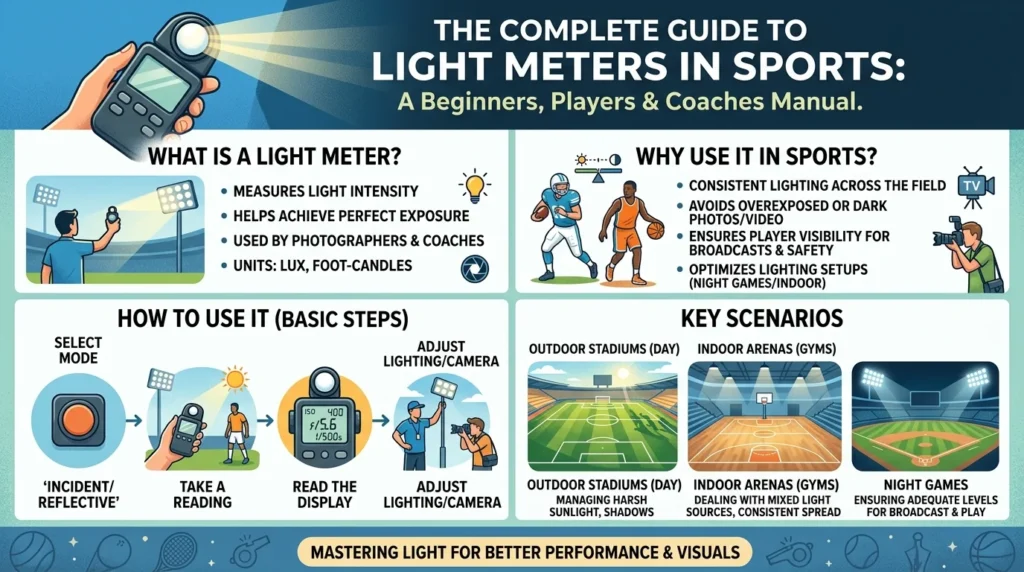
Imagine a cricket match where the sky suddenly turns cloudy, and players struggle to see the ball clearly. The umpire pauses the game and uses a device to measure light conditions before deciding whether play should continue. That device is called a light meter, and it plays an important role in modern sports.
A light meter helps measure the intensity of light in a playing environment. This is especially important in outdoor sports like cricket, football, and athletics, where visibility can directly affect performance and safety.
In this article, you will learn everything about the light meter, including its history, working principle, importance in sports, types, usage, and benefits. Whether you are a student, athlete, coach, or sports fan, this guide will help you understand how light conditions impact gameplay and why light meters are essential.
What is a Light Meter?
A light meter is a device used to measure the amount of light in a specific area. It tells how bright or dark the environment is by calculating light intensity, usually in units called lux.
Simple Explanation
Think of a light meter as a “brightness checker.” It helps determine whether there is enough light to play safely and fairly.
Example in Sports
In cricket matches, especially test matches, umpires use a light meter when natural light decreases. If the light level is too low, the match may be stopped to ensure player safety.
History of Light Meters in Sports
Light meters were originally developed for photography to measure exposure. Over time, their use expanded into different fields, including sports.
Key Developments
- Early light meters were manual and less accurate
- Digital light meters improved precision
- Sports authorities started using them for fair play
- Now commonly used in cricket and stadium management
Today, light meters are part of official decision-making in many sports events.
Light Meter Working Principle
Understanding the light meter working principle is simple when broken down step by step.
How It Works
- Light Detection
- The sensor captures light from the environment
- Conversion
- Light energy is converted into electrical signals
- Measurement
- The device calculates intensity in lux
- Display
- The result is shown on a digital screen
Easy Analogy
Think of it like your eyes:
- More light = easier to see
- Less light = harder to see
A light meter does the same but gives a precise number instead of just a feeling.
Importance of Light Meter in Sports
Light meters are very important for maintaining fairness and safety.
Key Reasons
- Ensure players can clearly see the ball
- Prevent injuries due to poor visibility
- Maintain fair competition
- Help umpires make correct decisions
Example
In cricket, if the light is too low, fast bowlers become dangerous because batsmen cannot see the ball properly. A light meter helps decide when to stop play.
Types of Light Meters
Digital Light Meters
- Most common type
- Easy to use
- Provides accurate readings
Analog Light Meters
- Older type
- Uses needle display
- Less common today
Smartphone Light Meter Apps
- Available on mobile phones
- Convenient but less accurate
- Used for basic measurements
Professional Sports Light Meters
- High precision
- Used by officials and stadium managers
- Designed for outdoor conditions
Light Meter Use in Different Sports
Cricket
- Used by umpires to check visibility
- Important in test matches
- Helps decide bad light conditions
Football (Soccer)
- Ensures proper lighting in stadiums
- Used during night matches
Athletics
- Helps maintain standard lighting conditions
- Important for televised events
Indoor Sports
- Basketball, badminton, and volleyball
- Ensures consistent lighting for players and viewers
Equipment Related to Light Meter
Light meters are part of a larger system in sports environments.
Common Equipment
- Stadium floodlights
- Lux measurement devices
- Lighting control systems
- Backup power systems
Role in Stadiums
Proper lighting ensures:
- Better performance
- Clear visibility
- High-quality broadcasting
Rules and Regulations Related to Light in Sports
Different sports have specific rules about lighting.
Cricket Rules
- Umpires use light meter readings
- Players can appeal for bad light
- Play may stop if light is unsafe
Football Standards
- Minimum lux levels required
- FIFA sets lighting guidelines
Indoor Sports Rules
- Even lighting across the court
- No shadows or glare
Techniques and Strategies Related to Lighting
Light conditions can affect gameplay strategies.
For Players
- Adjust vision based on light
- Use protective gear if needed
- Focus more during low light
For Coaches
- Train players in different lighting conditions
- Prepare for day-night matches
For Officials
- Monitor light regularly
- Ensure fair conditions
Player Roles and Light Conditions
Different players are affected differently by light.
Batsmen (Cricket)
- Need clear visibility
- Most affected by poor light
Bowlers
- Fast bowlers become risky in low light
Fielders
- Catching becomes difficult
Goalkeepers (Football)
- Need clear vision for fast reactions
Light Meter Applications in Sports
The light meter applications are wide and important.
Main Applications
- Match decision-making
- Stadium lighting design
- Training sessions
- Broadcasting quality
- Safety monitoring
Advantages and Disadvantages of Light Meter
Advantages
- Accurate light measurement
- Improves player safety
- Supports fair play
- Helps officials make correct decisions
- Enhances game quality
Disadvantages
- Requires proper calibration
- Can be affected by weather conditions
- Expensive professional devices
- Needs trained personnel
Comparison: Light Meter vs Human Judgment
| Feature | Light Meter | Human Judgment |
|---|---|---|
| Accuracy | High | Low to Medium |
| Reliability | Consistent | Varies |
| Decision Making | Data-based | Experience-based |
| Use in Sports | Official | Supportive only |
This shows the difference between light meter and human judgment clearly.
How to Use a Light Meter
Step-by-Step Guide
- Turn on the device
- Point sensor toward light source
- Hold steady for accurate reading
- Read value on display
- Compare with required standards
Tips
- Avoid shadows
- Take multiple readings
- Use calibrated devices
Benefits of Proper Lighting in Sports
Physical Benefits
- Better visibility
- Improved performance
- Reduced injury risk
Mental Benefits
- Increased confidence
- Better focus
- Reduced stress
Interesting Facts About Light Meter in Sports
- Cricket is the most famous sport using light meters
- Day-night matches rely heavily on artificial lighting
- Television broadcasting needs higher light levels than players
- Modern stadiums use smart lighting systems
Future Trends in Light Meter Technology
Technology is improving rapidly in sports lighting.
Smart Light Meters
- Connected to IoT systems
- Real-time monitoring
AI-Based Systems
- Automatic light adjustment
- Predictive analysis
Energy-Efficient Lighting
- LED floodlights
- Reduced power consumption
Advanced Stadium Systems
- Fully automated lighting control
- Integrated with match management systems
Conclusion
The light meter is a simple yet powerful tool that plays a crucial role in modern sports. From ensuring player safety to maintaining fair competition, it helps officials make accurate decisions based on real data.
In this article, you learned about the light meter’s definition, working principle, types, applications, and importance in sports. You also explored how lighting affects players, strategies, and overall gameplay.
For athletes, coaches, and sports enthusiasts, understanding light conditions is essential. As technology continues to evolve, light meters will become even more advanced, making sports safer and more professional.

Green Benn is a dedicated sports writer specializing in cricket, including IPL and international formats. Known for clear, engaging, and informative content, Green simplifies complex match analysis and player statistics for all readers. Passionate about sports storytelling, Green delivers reliable, SEO-friendly articles that keep fans updated and informed