
Imagine reading a sentence that repeats the same name again and again: “Sarah told Sarah’s teacher that Sarah would bring Sarah’s book.” It sounds awkward. Pronouns solve this problem by making English shorter, smoother, and easier to understand.
People search for pronoun because this basic grammar term can be confusing. Learners often know words such as I, you, he, she, it, and they, but they may not know why these words are called pronouns or how to use different types correctly. Questions about pronoun types, pronoun examples, subject and object pronouns, possessive pronouns, and reflexive pronouns are common among students and English learners.
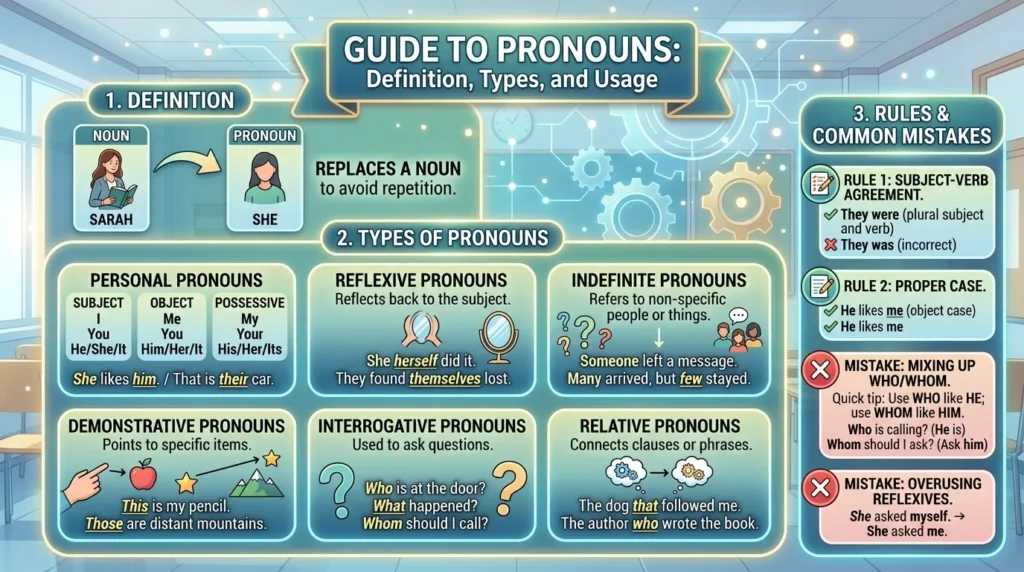
A pronoun is a word that can take the place of a noun or noun phrase. For example, instead of saying “Maria is a doctor. Maria works in a hospital,” we can say, “Maria is a doctor. She works in a hospital.”
This guide explains what a pronoun means, its origin, major types, British and American English usage, common mistakes, everyday examples, and frequently asked questions.
Definition of Pronoun and Examples
A pronoun is a word that is used in place of a noun to avoid repeating the same name or thing. Pronouns make sentences shorter, clearer, and easier to understand. Common pronouns include I, you, he, she, it, we, they, me, him, her, and them.
Examples:
- Ali is a student. He is very hardworking.
- Sara is my friend. She is kind.
- The book is on the table. It is new.
- Ahmed and I are classmates. We study together.
- The children are playing. They are happy.
In these sentences, he, she, it, we, and they are pronouns because they are used instead of nouns.
Pronoun – Quick Answer
A pronoun is a word used instead of a noun or noun phrase to avoid repetition and make sentences easier to read and understand.
Simple Example
Without a pronoun:
David said David would finish David’s work.
With pronouns:
David said he would finish his work.
Here, he and his are pronouns.
Common Pronouns
Some common English pronouns include:
- I
- you
- he
- she
- it
- we
- they
- me
- him
- her
- us
- them
- this
- that
- who
- which
- someone
- everyone
Pronouns can perform different jobs in a sentence, so English has several types of pronouns.
Types of Pronouns
There are several common types of pronouns.
1. Personal Pronouns
Personal pronouns refer to people or things.
Examples:
- I
- you
- he
- she
- it
- we
- they
Example:
She is my sister.
2. Object Pronouns
Object pronouns receive the action of a verb or follow a preposition.
Examples:
- me
- you
- him
- her
- it
- us
- them
The teacher called him.
3. Possessive Pronouns
Possessive pronouns show ownership.
Examples:
- mine
- yours
- his
- hers
- ours
- theirs
This book is mine.
4. Reflexive Pronouns
Reflexive pronouns refer back to the subject.
Examples:
- myself
- yourself
- himself
- herself
- itself
- ourselves
- yourselves
- themselves
She taught herself English.
5. Demonstrative Pronouns
These point to specific people or things.
Examples:
- this
- that
- these
- those
This is my phone.
6. Interrogative Pronouns
These are used to ask questions.
Examples:
- who
- whom
- whose
- which
- what
Who called you?
7. Relative Pronouns
Relative pronouns connect a clause to a noun or noun phrase.
Examples:
- who
- whom
- whose
- which
- that
The woman who called is my manager.
8. Indefinite Pronouns
Indefinite pronouns refer to people or things without naming a specific person or thing.
Examples:
- someone
- anyone
- everyone
- nobody
- something
- nothing
- several
- many
Someone left a bag here.
9. Reciprocal Pronouns
Reciprocal pronouns describe actions or feelings shared between people.
Examples:
- each other
- one another
The two friends helped each other.
The Origin of Pronoun
The word pronoun comes from the Latin term pronomen, which means “in place of a noun.” It combines the Latin words pro, meaning “for” or “in place of,” and nomen, meaning “name.”
The basic purpose of a pronoun has remained the same: it can stand in for a noun or noun phrase.
For example:
Maria is a teacher. She works at a school.
The word she replaces Maria in the second sentence.
Pronouns have existed in English for centuries. Old English had pronouns with different forms based on grammatical case, number, and gender. Many of these forms changed over time as English developed into the modern language.
The spelling pronoun is the same in British and American English. There is no major spelling difference between the two varieties.
British English vs American English Spelling
The word pronoun has the same spelling in British and American English.
The main differences appear in pronoun usage, especially with collective nouns, singular they, and certain formal constructions.
| Feature | British English | American English |
|---|---|---|
| Pronoun spelling | pronoun | pronoun |
| Personal pronouns | Same basic system | Same basic system |
| Possessive pronouns | Same | Same |
| Reflexive pronouns | Same | Same |
| Singular “they” | Common | Common |
| Collective nouns | Can use singular or plural agreement | Usually singular agreement |
| “Who/whom” | Both used | Both used, with whom often less common in speech |
Collective Noun Example
British English can sometimes use a plural pronoun when a collective noun refers to individuals.
The team said they were ready.
American English often treats the group as a single unit:
The team said it was ready.
However, they is also widely used in American English when referring to people in a group.
Singular “They”
Both British and American English use they as a singular pronoun when gender is unknown, irrelevant, or when a person uses they/them pronouns.
Someone left their phone on the desk.
This usage is now common in modern English.
Which Spelling Should You Use?
There is only one standard spelling: pronoun.
You should use pronoun for both British and American English audiences.
For US Audiences
Use pronoun in schoolwork, business writing, academic writing, and everyday communication.
For UK Audiences
Use pronoun in the same way.
For Commonwealth Countries
Australia, Canada, New Zealand, India, and other Commonwealth countries also use pronoun.
For Global Audiences
Pronoun is the standard and widely understood term.
The important point is not spelling. It is choosing the correct pronoun for the noun, person, number, and meaning.
Common Mistakes with Pronoun
Pronoun errors are common because English pronouns change form depending on their role.
Mistake 1: Using “Me” as the Subject
❌ Me and John went to the store.
✅ John and I went to the store.
I is a subject pronoun.
Mistake 2: Using “I” as the Object
❌ She called I yesterday.
✅ She called me yesterday.
Me is the object pronoun.
Mistake 3: Confusing “Your” and “You’re”
❌ Your going to enjoy the movie.
✅ You’re going to enjoy the movie.
Your shows possession.
You’re means you are.
Mistake 4: Confusing “Their,” “There,” and “They’re”
❌ Their going to the office.
✅ They’re going to the office.
Remember:
- their = belonging to them
- there = a place
- they’re = they are
Mistake 5: Using “Himself” Without a Matching Subject
❌ Himself fixed the machine.
✅ He fixed the machine himself.
A reflexive pronoun normally refers back to another noun or pronoun.
Mistake 6: Unclear Pronoun Reference
❌ John told Mark that he was late.
Who was late—John or Mark?
A clearer sentence is:
John told Mark, “I was late.”
Or:
John told Mark that Mark was late.
Clear pronoun reference prevents confusion.
Mistake 7: Confusing “Its” and “It’s”
❌ The company changed it’s policy.
✅ The company changed its policy.
Its shows possession.
It’s means it is or it has.
Pronoun in Everyday Examples
Pronouns are used constantly in everyday English. They make communication shorter and prevent unnecessary repetition.
In Emails
- I will send the report tomorrow.
- Please contact me if you have questions.
- They will join the meeting at 10 a.m.
- The document is mine.
In News Articles
- They announced the results on Monday.
- The company said it would expand its operations.
- She won the award.
- The officials said they would investigate the issue.
On Social Media
- I love this place!
- They look amazing.
- Is this phone yours?
- Someone left a comment on my post.
In Formal Writing
- We examined the results carefully.
- The researchers stated that they needed more data.
- The organization changed its policy.
- Those were the main findings.
Pronoun Comparison Table
| Pronoun Type | Examples | Main Use |
|---|---|---|
| Personal | I, you, he, she, they | Refers to people or things |
| Object | me, him, her, us, them | Receives an action |
| Possessive | mine, yours, hers, ours | Shows ownership |
| Reflexive | myself, himself, themselves | Refers back to the subject |
| Demonstrative | this, that, these, those | Points to something |
| Interrogative | who, what, which | Asks questions |
| Relative | who, which, that | Connects clauses |
| Indefinite | someone, anyone, everyone | Refers generally |
| Reciprocal | each other, one another | Shows shared action |
Subject Pronouns vs Object Pronouns
One of the most important pronoun rules is knowing the difference between subject and object forms.
| Subject Pronoun | Object Pronoun | Example |
|---|---|---|
| I | me | She called me. |
| you | you | I helped you. |
| he | him | We saw him. |
| she | her | I called her. |
| it | it | I fixed it. |
| we | us | They invited us. |
| they | them | We met them. |
Example
She helped him.
She is the subject because she performs the action.
Him is the object because he receives the action.
Pronoun – Google Trends & Usage Data
Search interest in pronoun is strongly connected with English grammar, language learning, education, and writing. Students and English learners often search for the term when studying parts of speech, sentence structure, and grammar rules.
Common related searches include:
- pronoun definition
- pronoun examples
- types of pronouns
- personal pronouns
- pronoun list
- subject and object pronouns
- possessive pronouns
- reflexive pronouns
- pronoun exercises
Search interest can vary by country and educational season. Grammar-related searches often increase during school terms, examination periods, and times when learners are studying English.
The word also appears in modern discussions about language and identity, especially around personal pronouns and singular they. This gives the topic both educational and everyday relevance.
For SEO content, the strongest approach is to explain the basic definition first, then cover the major pronoun types, examples, common mistakes, and practical sentence use.
FAQs About Pronoun
1. What is a pronoun?
A pronoun is a word that replaces a noun or noun phrase to avoid repetition.
Example:
Maria is a doctor. She works at a hospital.
2. What are the main types of pronouns?
Common types include personal, object, possessive, reflexive, demonstrative, interrogative, relative, indefinite, and reciprocal pronouns.
3. What are examples of pronouns?
Common examples include:
I, you, he, she, it, we, they, me, him, her, us, them, this, that, who, and someone.
4. What is a personal pronoun?
A personal pronoun refers to a person or thing.
Examples include I, you, he, she, it, we, and they.
They are my friends.
5. What is a possessive pronoun?
A possessive pronoun shows ownership.
Examples include mine, yours, his, hers, ours, and theirs.
This laptop is mine.
6. What is a reflexive pronoun?
A reflexive pronoun refers back to the subject of a sentence.
Examples include myself, yourself, himself, herself, ourselves, and themselves.
He taught himself how to cook.
7. What is the difference between a noun and a pronoun?
A noun names a person, place, thing, animal, idea, or concept. A pronoun can replace a noun or noun phrase.
Sarah is tired. She needs rest.
Sarah is a noun, while she is a pronoun.
8. Can “they” be singular?
Yes. They can be used as a singular pronoun when a person’s gender is unknown, irrelevant, or when the person uses they/them pronouns.
Someone forgot their keys.
9. What is the difference between “who” and “whom”?
Who is traditionally used as a subject, while whom is traditionally used as an object.
Who called you?
Whom did you call?
In modern everyday English, who is often used instead of whom, especially in informal speech.
Conclusion
A pronoun is a word that replaces a noun or noun phrase and helps make English sentences shorter, clearer, and less repetitive. Common pronouns include I, you, he, she, it, we, they, me, him, her, us, and them.
English has several types of pronouns, including personal, object, possessive, reflexive, demonstrative, interrogative, relative, indefinite, and reciprocal pronouns. Each type has a different purpose. For example, she is a personal pronoun, her can be an object pronoun, and hers is a possessive pronoun.
The spelling pronoun is the same in British and American English. However, some usage patterns can vary, especially with collective nouns and certain formal constructions. Modern English also commonly uses singular they when appropriate.
The best way to learn pronouns is to practice them in real sentences. Pay close attention to whether a pronoun is acting as a subject, object, or possessive form. Also make sure that each pronoun clearly refers to the correct noun. With regular practice, pronoun use becomes natural and helps make your writing more professional and easy to understand.