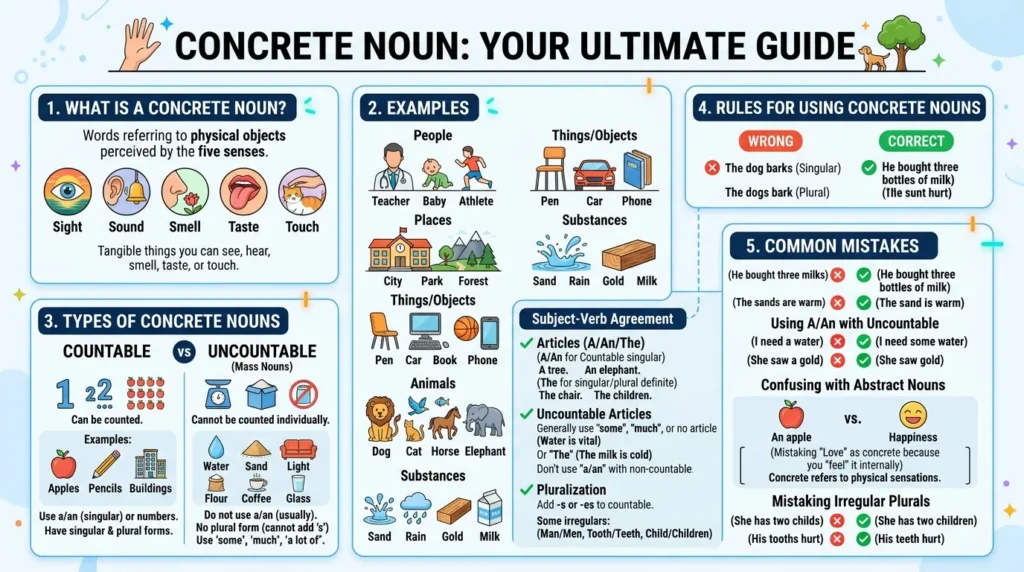

Can you see, touch, hear, smell, or taste something? If yes, its name may be a concrete noun. Words such as book, apple, dog, car, and music are common examples.
People search for concrete noun because this grammar term can be confusing, especially when compared with an abstract noun. Learners often know that nouns name people, places, animals, and things, but they may not know why some nouns are called concrete while others are abstract.
A concrete noun usually names something that can be experienced through one or more of the five senses. For example, you can see and touch a table. You can hear music. You can smell a flower. You can taste an apple. You can also feel rain.
This guide explains the meaning of concrete noun in simple English. It covers its origin, British and American English usage, common mistakes, everyday examples, word categories, comparisons with abstract nouns, and frequently asked questions. Whether you are a student, teacher, English learner, or writer, this guide will help you recognize and use concrete nouns correctly.
Concrete Noun – Quick Answer
A concrete noun is a noun that names a person, place, animal, object, or thing that can usually be experienced through one or more of the five senses.
The five senses are:
- Sight – see
- Hearing – hear
- Touch – feel
- Smell – smell
- Taste – taste
Examples of Concrete Nouns
- Person: teacher, doctor, child
- Animal: dog, cat, horse
- Place: school, park, house
- Object: table, phone, chair
- Food: apple, bread, cake
- Natural things: tree, rain, mountain
Examples in Sentences
I bought a new phone.
The dog is sleeping.
She ate an apple.
We visited the museum.
I heard beautiful music.
Each highlighted noun refers to something that can be experienced physically through at least one sense.
The Origin of Concrete Noun
The word concrete comes from the Latin word concretus, meaning “grown together,” “thickened,” or “formed.” It comes from concrescere, meaning “to grow together.”
The word noun comes from the Latin nomen, meaning “name.”
In grammar, the term concrete noun developed to describe nouns that refer to things that have a physical or sensory existence.
This creates a useful contrast:
- Concrete noun → something experienced through the senses
- Abstract noun → an idea, feeling, quality, or concept
For example:
flower → concrete noun
beauty → abstract noun
You can see and touch a flower. However, beauty is a quality or idea rather than a physical object.
The spelling concrete noun is the same in British and American English. There is no major spelling difference between the two varieties.
British English vs American English Spelling
The term concrete noun is spelled exactly the same in British and American English. Both varieties use the same basic grammar definition.
| Feature | British English | American English |
|---|---|---|
| Concrete noun | concrete noun | concrete noun |
| Spelling | Same | Same |
| Meaning | Sensory or physical noun | Sensory or physical noun |
| Capitalization | Lowercase normally | Lowercase normally |
| Examples | book, dog, house | book, dog, house |
Examples
British English:
The child picked up a stone.
American English:
The child picked up a stone.
There is no spelling change in the noun classification.
Important Note
A concrete noun does not have to be something you can physically touch.
For example:
I heard music.
Music is generally treated as a concrete noun because it can be experienced through hearing.
Similarly:
I smelled coffee.
Coffee can be a concrete noun because it can be experienced through smell and taste.
Which Spelling Should You Use?
There is only one standard spelling: concrete noun.
You should use it for both American and British English audiences.
For US Audiences
Use concrete noun in:
- School assignments
- Grammar books
- Business writing
- Educational websites
- Everyday communication
For UK Audiences
Use concrete noun in the same way.
For example:
A chair is a concrete noun because you can see and touch it.
For Commonwealth Countries
Countries such as Australia, Canada, New Zealand, and India also use the term concrete noun.
For Global Audiences
Concrete noun is the clearest and most widely understood term.
There is no need to change the spelling for an international audience.
Common Mistakes with Concrete Noun
Learners often make mistakes when deciding whether a noun is concrete or abstract.
Mistake 1: Thinking a Concrete Noun Must Be Touchable
❌ If I cannot touch it, it cannot be a concrete noun.
✅ A concrete noun can be experienced through any of the senses, not only touch.
For example:
Music is generally a concrete noun because you can hear it.
Mistake 2: Confusing Concrete and Abstract Nouns
❌ Happiness is a concrete noun.
✅ Happiness is an abstract noun.
Happiness is a feeling or state. It is not a physical object that you can experience through your senses in the same way as a chair or an apple.
Mistake 3: Assuming All Physical-Looking Words Are Concrete
Context can matter.
For example, light can have different meanings:
The light is on.
Here, light refers to something that can be seen.
But:
She gave me some light on the problem.
Here, light means understanding or information, so it has an abstract meaning.
Mistake 4: Capitalizing Concrete Nouns
❌ The Dog is in the Garden.
✅ The dog is in the garden.
Concrete nouns do not normally require capital letters.
Mistake 5: Confusing Concrete Nouns With Proper Nouns
A noun can be both concrete and proper.
For example:
London is a beautiful city.
London is a proper noun because it is a specific place. It can also be considered concrete because it refers to a physical place.
Concrete Noun in Everyday Examples
Concrete nouns appear everywhere in everyday English. We use them when talking about people, places, objects, food, animals, and things we experience.
In Emails
- Please bring your laptop to the meeting.
- The documents are on the desk.
- I left my phone at home.
- The office will close at 5 p.m.
In News Articles
- The government opened a new hospital.
- A car crashed near the bridge.
- The company launched a new product.
- The airport reopened after the storm.
On Social Media
- This coffee is amazing!
- My dog loves this park.
- Look at this beautiful sunset.
- I bought a new camera today.
In Formal Writing
- The building was completed in 2026.
- The machine requires regular maintenance.
- The researcher examined the sample.
- The equipment was tested before use.
Concrete Noun vs Abstract Noun
The most common comparison is between concrete and abstract nouns.
| Concrete Noun | Abstract Noun |
|---|---|
| book | knowledge |
| flower | beauty |
| friend | friendship |
| teacher | education |
| smile | happiness |
| soldier | courage |
| gift | kindness |
| house | safety |
| music | joy |
| food | health |
Simple Rule
Ask:
Can I experience the thing through one or more of my senses?
If yes, it may be a concrete noun.
If it names an idea, feeling, quality, or concept, it may be an abstract noun.
Concrete Noun Variations Compared
Concrete nouns can belong to other noun categories too.
| Concrete Noun | Other Category | Example |
|---|---|---|
| dog | Common noun | The dog is friendly. |
| London | Proper noun | London is crowded today. |
| team | Collective noun | The team arrived. |
| apples | Countable noun | I bought three apples. |
| water | Uncountable noun | The water is cold. |
| toothbrush | Compound noun | I need a new toothbrush. |
| teacher | Common + countable | The teacher entered. |
| school | Common + concrete | The school is nearby. |
This is important because noun categories are not always separate boxes. One noun can belong to several categories.
For example, apple is:
- A common noun
- A concrete noun
- A countable noun
Concrete Noun – Google Trends & Usage Data
Search interest for concrete noun is mainly connected with English grammar education. Students, teachers, parents, and English learners often search for the term when studying parts of speech, completing homework, or preparing for grammar tests.
Related searches often include:
- concrete noun definition
- concrete noun examples
- concrete and abstract nouns
- examples of concrete nouns
- concrete noun list
- concrete noun exercises
- is music a concrete noun?
- is water a concrete noun?
Interest can vary by country and educational season. Grammar searches often become more common during school terms, examination periods, and times when students are learning English.
The topic is especially useful for ESL and EFL learners because many learners first understand nouns as physical objects. Learning concrete and abstract nouns helps them understand that nouns can describe both physical experiences and non-physical ideas.
How to Identify a Concrete Noun
You can use a simple five-sense test.
1. Can You See It?
tree
You can see a tree.
2. Can You Hear It?
music
You can hear music.
3. Can You Touch It?
table
You can touch a table.
4. Can You Smell It?
perfume
You can smell perfume.
5. Can You Taste It?
cake
You can taste cake.
If a noun refers to something that can be experienced through one or more senses, it can generally be classified as a concrete noun.
FAQs About Concrete Noun
1. What is a concrete noun?
A concrete noun names a person, place, animal, object, or thing that can usually be experienced through one or more of the five senses.
Examples include book, dog, teacher, house, apple, and music.
2. What are 10 examples of concrete nouns?
Ten examples are:
book, table, dog, cat, apple, car, house, teacher, phone, and flower.
3. What is the difference between a concrete noun and an abstract noun?
A concrete noun refers to something that can usually be experienced through the senses. An abstract noun names an idea, feeling, quality, or concept.
Example:
- flower → concrete noun
- beauty → abstract noun
4. Is a person a concrete noun?
Yes. Words that name people, such as teacher, doctor, child, and friend, are generally concrete nouns because people can be experienced through the senses.
5. Is music a concrete noun?
Yes, music is commonly classified as a concrete noun because it can be experienced through hearing.
6. Is water a concrete noun?
Yes. Water is generally a concrete noun because it can be seen, touched, and tasted. It is also normally an uncountable noun.
7. Can a concrete noun also be a proper noun?
Yes. A noun can belong to more than one category.
For example, London is a proper noun because it names a specific city. It can also be viewed as concrete because it refers to a physical place.
8. Can a concrete noun be uncountable?
Yes. Some concrete nouns are uncountable.
Examples include:
- water
- milk
- rice
- furniture
- equipment
9. Is “school” a concrete noun?
Usually, school can be treated as a concrete noun when it refers to the physical school building or institution. The exact classification can depend on context.
Conclusion
A concrete noun names a person, place, animal, object, or other thing that can usually be experienced through one or more of the five senses. Examples include dog, book, house, apple, teacher, music, water, and flower.
The easiest way to identify a concrete noun is to use the five-sense test. Ask whether you can see, hear, touch, smell, or taste what the noun represents. If you can, the noun is often concrete. This makes concrete nouns different from abstract nouns, which describe ideas, feelings, qualities, and states such as love, happiness, honesty, and freedom.
Concrete nouns do not have a special spelling in British or American English. The term concrete noun is written the same way in both varieties. A concrete noun can also belong to another category, such as a proper, countable, or collective noun.
Once you understand the difference between physical and non-physical meanings, identifying concrete nouns becomes much easier. Use real examples from everyday life, and practice comparing concrete nouns with abstract nouns to strengthen your grammar skills.