Cricket is a game of precision, timing, and strict rules that define fairness between batters and bowlers. One of the most important yet often overlooked parts of the cricket pitch is the return crease. It plays a crucial role in bowling legality, helping umpires decide whether a bowler’s delivery is valid or not.
For beginners, the return crease may look like just another set of white lines on the pitch. However, it is a key part of cricket laws that ensures bowlers maintain proper body position while delivering the ball. Without it, the game would lose structure and fairness.
In this article, we will explore everything about the return crease, including its meaning, rules, purpose, history, techniques, and importance in modern cricket.
What Is the Return Crease in Cricket?
Definition of the Return Crease
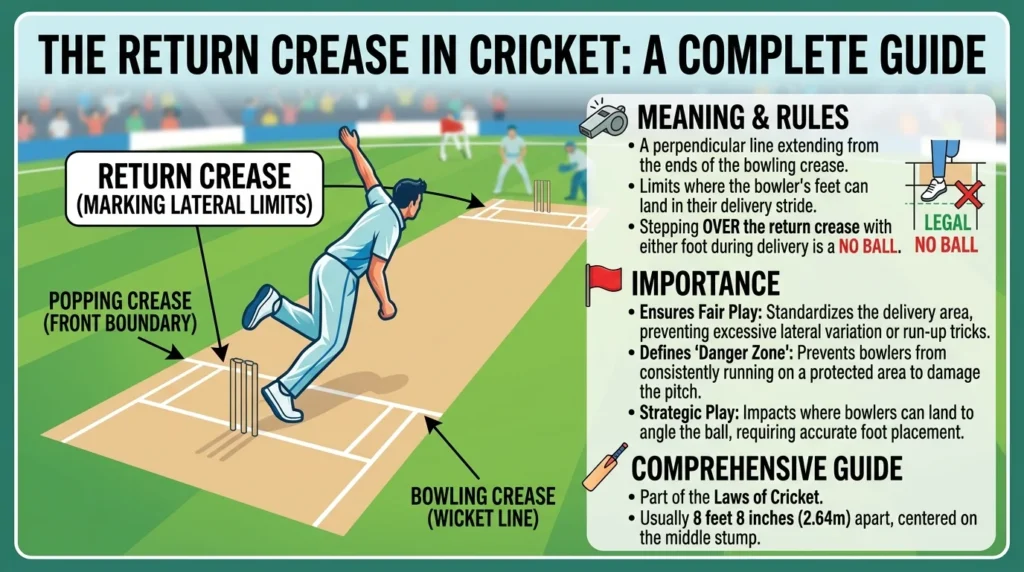
The return crease is one of the important markings on a cricket pitch that helps regulate a bowler’s position during the delivery stride. It consists of two parallel lines drawn at right angles (90°) to the bowling crease, one on each side of the stumps. These lines define the lateral boundary within which the bowler’s back foot must remain when delivering the ball. The return crease plays a vital role in ensuring fair bowling and maintaining the integrity of the game.
Crease Meaning in Cricket
The crease meaning in cricket refers to the marked lines on the pitch that define important positions for batters, bowlers, and umpires. Cricket has different types of creases, including the return crease, bowling crease, and popping crease, and each one has a specific purpose under the Laws of Cricket.
Understanding the crease in cricket meaning helps beginners understand how the pitch is divided into legal areas and how umpires judge actions such as bowling, batting, run-outs, and stumpings.
Location of the Return Crease on the Cricket Pitch
The return crease is positioned as follows:
- Drawn perpendicular (90°) to the bowling crease.
- Located on both sides of the middle stump at the bowler’s end.
- Begins at the bowling crease and extends behind it.
- Each return crease is 1.32 meters (4 feet 4 inches) behind the bowling crease, as specified in the International Cricket Council Laws of Cricket.
- Forms part of the bowler’s legal delivery area together with the bowling crease and popping crease.
These markings provide a clear reference for umpires when judging whether a delivery is legal.
Purpose of the Return Crease
The return crease serves several important functions during a cricket match:
- Defines the legal sideways position of the bowler’s back foot during delivery.
- Prevents bowlers from delivering the ball from an unfairly wide angle.
- Helps umpires determine whether a delivery is legal.
- Ensures consistency and fairness for both batters and bowlers.
- Maintains standardized bowling conditions across all levels of cricket.
- Supports the enforcement of the Laws of Cricket regarding legal deliveries.
Without the return crease, bowlers could gain an unfair advantage by significantly altering their angle of delivery, making it more difficult for batters to play the ball fairly.
History and Origin of the Return Crease
Early Development of Cricket Pitch Markings
In the early history of cricket, the pitch had very few markings, and bowlers had greater freedom in their approach and delivery. As the game evolved during the 18th and 19th centuries, standardized pitch dimensions and crease markings became necessary to ensure fairness and consistency. Cricket’s governing authorities gradually introduced clearly defined creases to regulate both batting and bowling, making the game more structured and easier for umpires to officiate.
Introduction of the Return Crease
The return crease was introduced as part of the standardized crease system to regulate the bowler’s position during delivery. Its primary purpose was to define the legal area in which the bowler’s back foot must remain, preventing bowlers from gaining an unfair advantage by delivering the ball from excessively wide angles.
The introduction of the return crease helped to:
- Standardize bowling actions across all levels of cricket.
- Ensure fair competition between batters and bowlers.
- Prevent illegal deliveries caused by incorrect foot placement.
- Provide umpires with a clear visual guide for judging legal deliveries.
- Improve the consistency and accuracy of officiating.
Over time, the return crease became an essential part of the official cricket pitch layout and is now recognized under the Laws of Cricket.
Evolution in Modern Cricket
In modern cricket, the return crease remains a critical reference for determining whether a delivery is legal. With advancements in technology, monitoring has become more accurate than ever before.
Today, the return crease is closely observed using:
- On-field umpires during every delivery.
- High-definition television broadcast cameras.
- Slow-motion video replays for detailed analysis.
- Third umpire technology when required.
- Multiple camera angles to review foot placement in close decisions.
These technological advancements have significantly improved the accuracy of umpiring decisions, ensuring that bowlers comply with the Laws of Cricket while maintaining fairness and consistency in international, domestic, and grassroots matches.
Rules of Return Crease in Cricket
Legal Bowling Position
A bowler must ensure:
- Back foot lands inside return crease
- No part of foot touches outside line
- Proper alignment during delivery
Rules of the Return Crease in Cricket
The return crease plays an important role in determining whether a bowler delivers the ball legally. The Laws of Cricket require the bowler’s back foot to remain within the boundaries of the return crease during the delivery stride. If these rules are not followed, the umpire may call a no-ball, resulting in a penalty for the bowling side.
Legal Bowling Position
For a delivery to be considered legal, the bowler must comply with the return crease requirements throughout the delivery stride.
A bowler must ensure that:
- The back foot lands within the return crease at the moment of delivery.
- No part of the back foot touches or crosses the outside edge of the return crease line.
- The foot remains inside the crease while the ball is being delivered.
- The delivery action complies with all other bowling regulations, including front-foot requirements.
Following these rules ensures that the bowler delivers the ball from a fair and consistent position.
No-Ball Rule
A bowler commits a no-ball if the back foot lands outside the return crease or touches the return crease in an illegal manner during delivery.
When a no-ball is called:
- The batting team is awarded one extra run.
- The delivery does not count as one of the six legal balls in the over.
- The ball must be re-bowled.
- Depending on the match format, the batting side may receive a Free Hit on the next delivery following a front-foot no-ball, although a return-crease no-ball itself is simply penalized under the Laws applicable to illegal deliveries.
Even a small error in foot placement can result in a no-ball, making accuracy essential for every bowler.
Role of the Umpire
The on-field umpire carefully observes the bowler’s feet and body position during every delivery to ensure compliance with the Laws of Cricket.
The umpire monitors:
- The back foot’s position relative to the return crease.
- Whether any part of the foot crosses the outside edge of the crease.
- The front foot in relation to the popping crease.
- The bowler’s overall delivery action and alignment.
In professional cricket, television replays and multiple camera angles may assist officials in reviewing close decisions, helping ensure that no-ball calls are as accurate as possible. Consistent enforcement of these rules maintains fairness for both bowlers and batters throughout the match.No-Ball Rule
If a bowler steps outside the return crease:
- It is declared a no-ball
- Batting team gets an extra run
- The delivery must be re-bowled
Umpire Decision
Umpires closely watch:
- Foot landing position
- Body alignment
- Delivery motion
Even a slight mistake can lead to a penalty.
Importance of the Return Crease in Cricket
The return crease is a fundamental marking on the cricket pitch that helps maintain fairness, consistency, and safety during bowling. By defining the legal position of a bowler’s back foot, it ensures that every delivery is made within the boundaries established by the Laws of Cricket. The return crease not only protects the balance between bat and ball but also assists umpires in making accurate decisions throughout the match.
Ensures Fair Bowling
One of the primary purposes of the return crease is to ensure that bowlers do not gain an unfair advantage through their position at the point of delivery.
The return crease helps to:
- Prevent bowlers from delivering the ball from excessively wide angles.
- Restrict illegal sideways movement during the delivery stride.
- Ensure the back foot remains within the legal bowling area.
- Create equal playing conditions for both bowlers and batters.
- Maintain consistency in bowling actions across all levels of cricket.
By enforcing these rules, the return crease promotes fair competition and preserves the integrity of the game.
Maintains Bowling Discipline
The return crease encourages bowlers to develop proper technique and maintain control over their movements during every delivery.
It helps bowlers to:
- Follow the correct bowling technique.
- Maintain proper foot placement throughout the delivery stride.
- Develop consistent and repeatable bowling actions.
- Avoid unnecessary no-balls caused by incorrect positioning.
- Improve overall discipline and accuracy while bowling.
This discipline is especially important in professional cricket, where even minor foot placement errors can result in penalties.
Improves Umpiring Accuracy
The return crease provides umpires with a clearly marked reference point for judging the legality of a delivery.
It assists officials by:
- Providing a visual guide for monitoring the bowler’s back foot.
- Helping determine whether a delivery should be called a no-ball.
- Supporting accurate on-field decision-making.
- Reducing uncertainty during close calls.
- Complementing video replay technology and third-umpire reviews in professional matches.
The clearly defined markings of the return crease make officiating more consistent and help ensure that the Laws of Cricket are applied fairly in every match.
Bowling Techniques Related to the Return Crease
The return crease plays a significant role in a bowler’s technique and consistency. Regardless of whether a bowler is a fast bowler, spinner, or swing bowler, maintaining proper foot placement within the return crease is essential for delivering legal balls and avoiding no-ball penalties.
Fast Bowlers
Fast bowlers generate speed through a powerful run-up and delivery stride. Because of their momentum, maintaining correct back-foot placement inside the return crease requires excellent balance and coordination.
Key techniques for fast bowlers include:
- Maintaining balance throughout the run-up.
- Landing the back foot completely within the return crease.
- Keeping the delivery stride controlled and aligned.
- Avoiding sideways movement that may cause the foot to cross the return crease.
- Following through smoothly after releasing the ball.
Proper technique allows fast bowlers to bowl at high speed while remaining within the Laws of Cricket.
Spin Bowlers
Spin bowlers rely more on precision, rhythm, and body control than pace. Accurate foot placement helps them maintain balance while generating spin and variation.
Important techniques include:
- Controlled body rotation during delivery.
- Accurate positioning of the back foot inside the return crease.
- Stable landing to maintain balance.
- Smooth pivot and follow-through.
- Consistent release point for improved accuracy and spin.
These techniques enable spinners to bowl effectively while complying with the legal bowling requirements.
Swing Bowlers
Swing bowlers depend on a repeatable bowling action to produce consistent movement through the air. Proper alignment with the return crease is essential for maintaining accuracy and seam position.
Swing bowlers focus on:
- Maintaining perfect alignment throughout the delivery stride.
- Keeping the back foot inside the return crease.
- Using a smooth and consistent run-up.
- Preserving proper wrist and seam position at release.
- Repeating the same bowling action for maximum control.
A stable and legal bowling action helps swing bowlers generate both conventional and reverse swing more effectively.
Player Roles and the Importance of the Return Crease
The return crease primarily affects the bowler, but it also supports fair play for other players and assists match officials in enforcing the Laws of Cricket.
Bowlers
Bowlers have the greatest responsibility for complying with the return crease rules.
Their responsibilities include:
- Delivering every ball from a legal position.
- Keeping the back foot within the return crease.
- Avoiding no-balls caused by incorrect foot placement.
- Maintaining a consistent and controlled bowling action.
- Following the Laws of Cricket throughout the delivery stride.
Proper use of the return crease helps bowlers maintain discipline and avoid unnecessary penalties.
Wicketkeeper and Fielders
Although wicketkeepers and fielders are not directly governed by the return crease, they benefit from legal and consistent bowling.
Proper bowling helps them:
- Anticipate the line and length of deliveries more accurately.
- Position themselves effectively for catches and run-out opportunities.
- Execute planned fielding strategies with greater confidence.
- Maintain defensive and attacking field placements based on predictable bowling patterns.
Consistent bowling improves overall team coordination and fielding performance.
Umpires
Umpires are responsible for ensuring that bowlers comply with the return crease regulations on every delivery.
Their duties include:
- Monitoring the bowler’s back-foot position.
- Determining whether a delivery is legal.
- Calling a no-ball when the return crease is infringed.
- Applying the Laws of Cricket fairly and consistently.
- Using television replays and third-umpire technology when available to review close decisions.
Their role is essential in maintaining fairness and consistency throughout the match.
Equipment and Cricket Pitch Markings
The return crease is one of several important markings on a cricket pitch. Accurate measurement and regular maintenance ensure that matches are played according to the official specifications.
Cricket Pitch Markings
A standard cricket pitch includes several clearly marked lines that assist players and umpires during the game.
These include:
- Return crease
- Bowling crease
- Popping crease
- Protected area (danger area)
Each marking serves a specific purpose in regulating batting, bowling, and player movement during a match.
Pitch Measuring and Marking Equipment
Ground staff use specialized equipment to ensure that all crease markings comply with official cricket dimensions.
Common tools include:
- Measuring tapes
- Surveying strings
- White marking paint or chalk
- Line-marking machines
- Pitch marking stencils
- Measuring templates for crease accuracy
These tools help maintain precise and consistent pitch markings for domestic and international matches.
Maintenance of the Return Crease
Regular maintenance ensures that the return crease remains clearly visible throughout the match and continues to meet official standards.
Ground staff typically:
- Repaint the crease before every match.
- Inspect the markings between innings when necessary.
- Repair faded or damaged lines.
- Verify all measurements according to the Laws of Cricket.
- Ensure the crease remains visible under all playing conditions.
Proper maintenance allows players to identify the legal bowling area easily and helps umpires make accurate decisions during every delivery.
Major Cricket Rules Related to the Crease System
The crease system is an essential part of a cricket pitch and plays a crucial role in regulating batting, bowling, and umpiring decisions. The three primary creases—the bowling crease, popping crease, and return crease—work together to ensure fair play, consistent gameplay, and accurate decision-making under the Laws of Cricket.
Bowling Crease Rule
The bowling crease is the horizontal line passing through the stumps at each end of the pitch. It serves as the reference line for positioning the stumps and forms part of the legal delivery area for bowlers.
Its importance includes:
- Defining the location of the stumps.
- Serving as a reference for the bowler’s delivery stride.
- Working together with the return crease to determine legal foot placement.
- Helping umpires judge the legality of a delivery.
The bowling crease is a key component in ensuring that bowlers deliver the ball from the correct position.
Popping Crease Rule
The popping crease is located 1.22 meters (4 feet) in front of the bowling crease and is one of the most frequently used markings during a cricket match.
It is used to:
- Determine whether a batter is safely inside the crease during run-outs and stumpings.
- Judge front-foot no-balls by checking the bowler’s front-foot position.
- Define the batter’s safe area while running between the wickets.
- Assist umpires in making accurate decisions throughout the match.
The popping crease plays a vital role in both batting and bowling regulations.
Return Crease Rule
The return crease consists of two parallel lines drawn perpendicular to the bowling crease on either side of the stumps. It regulates the sideways movement of the bowler during the delivery stride.
Its functions include:
- Defining the legal position of the bowler’s back foot.
- Preventing bowlers from delivering the ball from excessively wide angles.
- Helping umpires identify illegal deliveries.
- Maintaining fairness and consistency in bowling actions.
The return crease is an important safeguard against unfair bowling techniques.
How the Crease System Works Together
Although each crease has a different purpose, they work together as a complete system to regulate the game.
Together, the crease markings help to:
- Ensure fair competition between batters and bowlers.
- Standardize cricket pitch dimensions worldwide.
- Support accurate umpiring decisions.
- Enforce the Laws of Cricket consistently.
- Maintain the structure and integrity of every cricket match.
Benefits of the Return Crease in Cricket
The return crease offers several advantages beyond enforcing the rules. It promotes proper bowling technique, improves player discipline, and contributes to a fair and professional playing environment.
Benefits for Bowlers
Using the return crease correctly helps bowlers improve their overall performance by encouraging sound technique and controlled movement.
Key benefits include:
- Improves balance during the delivery stride.
- Enhances coordination between the run-up and ball release.
- Encourages consistent foot placement.
- Develops disciplined bowling habits.
- Reduces the risk of bowling no-balls due to incorrect positioning.
- Promotes a repeatable and efficient bowling action.
These improvements contribute to greater accuracy and consistency in bowling.
Mental Benefits
The return crease also helps bowlers develop important mental skills that are essential in competitive cricket.
These include:
- Improved concentration during every delivery.
- Better awareness of body positioning.
- Increased confidence through consistent technique.
- Enhanced decision-making under pressure.
- Greater self-discipline and focus during long spells of bowling.
Maintaining legal foot placement requires continuous attention, helping bowlers strengthen their mental discipline.
Improving the Quality of the Game
The return crease plays an important role in maintaining high standards of play at every level of cricket.
It helps to:
- Ensure fair competition between teams.
- Prevent illegal deliveries and unfair bowling advantages.
- Improve the consistency of umpiring decisions.
- Support professional standards in domestic and international cricket.
- Enhance the viewing experience by promoting fair and well-regulated gameplay.
By clearly defining the legal bowling area, the return crease contributes to a more balanced, competitive, and enjoyable game for players, officials, and spectators alike.
Common Mistakes Related to the Return Crease
Maintaining proper foot placement within the return crease is an important skill for every bowler. Even experienced players can occasionally make errors during the delivery stride, resulting in no-balls and unnecessary penalties. Understanding these common mistakes helps bowlers improve their technique and consistency.
Overstepping the Return Crease
One of the most common mistakes occurs when the bowler’s back foot lands outside the return crease during delivery.
This usually happens because of:
- Excessive sideways movement during the delivery stride.
- An uncontrolled run-up.
- Poor body alignment.
- Loss of balance before releasing the ball.
- Attempting to generate extra pace or a wider delivery angle.
Such mistakes can result in an immediate no-ball, giving the batting team an advantage.
Incorrect Foot Placement
Accurate foot placement is essential for a legal delivery. Misplacing the back foot can disrupt the bowling action and lead to penalties.
Poor foot placement may result in:
- No-ball calls by the umpire.
- Extra runs awarded to the batting team.
- Additional deliveries in the over.
- Reduced bowling rhythm and consistency.
- Loss of momentum for the bowling side.
Regular footwork drills help bowlers develop a repeatable and legal delivery action.
Lack of Crease Awareness
New and inexperienced bowlers often focus primarily on bowling speed, swing, or spin while paying little attention to their position relative to the return crease.
Common beginner mistakes include:
- Ignoring the return crease boundaries.
- Concentrating only on pace or spin.
- Using an inconsistent run-up.
- Failing to check foot placement during practice.
- Developing poor bowling habits early in their training.
Coaches encourage bowlers to build crease awareness from the beginning to improve both accuracy and discipline.
Interesting Facts About the Return Crease
The return crease may appear to be a simple pitch marking, but it plays a vital role in every cricket match.
Some interesting facts include:
- Every cricket pitch follows the same standard return crease dimensions under the Laws of Cricket.
- Even a tiny infringement in back-foot placement can result in a no-ball.
- The return crease has been an important part of standardized cricket pitch markings for many years.
- Professional umpires closely monitor the return crease during every delivery.
- Television broadcasts use high-definition cameras and slow-motion replays to review close no-ball decisions.
- The return crease is mandatory in international, domestic, and most organized recreational cricket matches.
- Proper use of the return crease helps maintain fairness between bowlers and batters.
Role of the Return Crease in Modern Cricket
As cricket continues to evolve, the return crease remains one of the most important reference points for ensuring legal bowling actions. Modern technology, advanced coaching methods, and improved officiating have increased the accuracy of crease-related decisions.
Use of Technology
Technology has greatly improved the ability of officials to monitor foot placement and review close decisions.
Modern cricket uses:
- High-definition broadcast cameras.
- Slow-motion video replays.
- Multiple camera angles.
- Third-umpire reviews when necessary.
- Advanced broadcast analysis tools for close no-ball decisions.
These technologies assist officials in making accurate and consistent decisions during professional matches.
Importance for Fast Bowlers
Fast bowlers face unique challenges because of their speed and momentum during the delivery stride.
They must carefully manage:
- High-speed run-ups.
- Powerful delivery actions.
- Accurate back-foot placement.
- Proper body alignment.
- Consistent balance throughout the bowling action.
Maintaining control while generating pace is essential to avoid costly no-balls.
Importance in Coaching
Modern cricket coaching emphasizes crease discipline as a fundamental bowling skill.
Coaches regularly train bowlers through:
- Foot placement drills.
- Delivery stride practice.
- Run-up consistency exercises.
- Balance and coordination training.
- Video analysis of bowling actions.
- Repetition to develop muscle memory and consistent technique.
These coaching methods help bowlers maintain legal actions while improving accuracy and performance.
Future of Return Crease Rules
Advances in sports technology are expected to further improve the accuracy and efficiency of crease-related decisions. While the basic Laws of Cricket are unlikely to change significantly, technological innovations will continue to support umpires and enhance the fairness of the game.
Advanced Technology Integration
Future cricket may benefit from even more sophisticated officiating systems, including:
- Automated no-ball detection systems.
- Artificial intelligence (AI) for foot-placement analysis.
- Real-time player tracking technology.
- Smart camera systems with enhanced precision.
- Improved sensor-based decision support for umpires.
These innovations could reduce the time required to review close decisions and improve overall accuracy.
Greater Accuracy and Fairness
The continued integration of technology is expected to provide several benefits for the game.
Future developments may help to:
- Minimize human error in officiating.
- Deliver faster and more consistent decisions.
- Increase confidence in umpiring accuracy.
- Improve transparency in decision-making.
- Ensure fair competition for both bowlers and batters.
As cricket embraces new technologies, the return crease will remain a fundamental part of the game’s laws, helping preserve fairness, consistency, and the integrity of bowling across all formats.
What Is the Return Crease in Cricket?
Definition of the Return Crease
The return crease is one of the important markings on a cricket pitch that helps regulate a bowler’s position during the delivery stride. It consists of two parallel lines drawn at right angles (90°) to the bowling crease, one on each side of the stumps. These lines define the lateral boundary within which the bowler’s back foot must remain when delivering the ball. The return crease plays a vital role in ensuring fair bowling and maintaining the integrity of the game.
Location of the Return Crease on the Cricket Pitch
The return crease is positioned as follows:
- Drawn perpendicular (90°) to the bowling crease.
- Located on both sides of the middle stump at the bowler’s end.
- Begins at the bowling crease and extends behind it.
- Each return crease is 1.32 meters (4 feet 4 inches) behind the bowling crease, as specified in the International Cricket Council Laws of Cricket.
- Forms part of the bowler’s legal delivery area together with the bowling crease and popping crease.
These markings provide a clear reference for umpires when judging whether a delivery is legal.
Purpose of the Return Crease
The return crease serves several important functions during a cricket match:
- Defines the legal sideways position of the bowler’s back foot during delivery.
- Prevents bowlers from delivering the ball from an unfairly wide angle.
- Helps umpires determine whether a delivery is legal.
- Ensures consistency and fairness for both batters and bowlers.
- Maintains standardized bowling conditions across all levels of cricket.
- Supports the enforcement of the Laws of Cricket regarding legal deliveries.
Without the return crease, bowlers could gain an unfair advantage by significantly altering their angle of delivery, making it more difficult for batters to play the ball fairly.
History and Origin of the Return Crease
Early Development of Cricket Pitch Markings
In the early history of cricket, the pitch had very few markings, and bowlers had greater freedom in their approach and delivery. As the game evolved during the 18th and 19th centuries, standardized pitch dimensions and crease markings became necessary to ensure fairness and consistency. Cricket’s governing authorities gradually introduced clearly defined creases to regulate both batting and bowling, making the game more structured and easier for umpires to officiate.
Introduction of the Return Crease
The return crease was introduced as part of the standardized crease system to regulate the bowler’s position during delivery. Its primary purpose was to define the legal area in which the bowler’s back foot must remain, preventing bowlers from gaining an unfair advantage by delivering the ball from excessively wide angles.
The introduction of the return crease helped to:
- Standardize bowling actions across all levels of cricket.
- Ensure fair competition between batters and bowlers.
- Prevent illegal deliveries caused by incorrect foot placement.
- Provide umpires with a clear visual guide for judging legal deliveries.
- Improve the consistency and accuracy of officiating.
Over time, the return crease became an essential part of the official cricket pitch layout and is now recognized under the Laws of Cricket.
Evolution in Modern Cricket
In modern cricket, the return crease remains a critical reference for determining whether a delivery is legal. With advancements in technology, monitoring has become more accurate than ever before.
Today, the return crease is closely observed using:
- On-field umpires during every delivery.
- High-definition television broadcast cameras.
- Slow-motion video replays for detailed analysis.
- Third umpire technology when required.
- Multiple camera angles to review foot placement in close decisions.
These technological advancements have significantly improved the accuracy of umpiring decisions, ensuring that bowlers comply with the Laws of Cricket while maintaining fairness and consistency in international, domestic, and grassroots matches.
Rules of Return Crease in Cricket
Legal Bowling Position
A bowler must ensure:
- Back foot lands inside return crease
- No part of foot touches outside line
- Proper alignment during delivery
Rules of the Return Crease in Cricket
The return crease plays an important role in determining whether a bowler delivers the ball legally. The Laws of Cricket require the bowler’s back foot to remain within the boundaries of the return crease during the delivery stride. If these rules are not followed, the umpire may call a no-ball, resulting in a penalty for the bowling side.
Legal Bowling Position
For a delivery to be considered legal, the bowler must comply with the return crease requirements throughout the delivery stride.
A bowler must ensure that:
- The back foot lands within the return crease at the moment of delivery.
- No part of the back foot touches or crosses the outside edge of the return crease line.
- The foot remains inside the crease while the ball is being delivered.
- The delivery action complies with all other bowling regulations, including front-foot requirements.
Following these rules ensures that the bowler delivers the ball from a fair and consistent position.
No-Ball Rule
A bowler commits a no-ball if the back foot lands outside the return crease or touches the return crease in an illegal manner during delivery.
When a no-ball is called:
- The batting team is awarded one extra run.
- The delivery does not count as one of the six legal balls in the over.
- The ball must be re-bowled.
- Depending on the match format, the batting side may receive a Free Hit on the next delivery following a front-foot no-ball, although a return-crease no-ball itself is simply penalized under the Laws applicable to illegal deliveries.
Even a small error in foot placement can result in a no-ball, making accuracy essential for every bowler.
Role of the Umpire
The on-field umpire carefully observes the bowler’s feet and body position during every delivery to ensure compliance with the Laws of Cricket.
The umpire monitors:
- The back foot’s position relative to the return crease.
- Whether any part of the foot crosses the outside edge of the crease.
- The front foot in relation to the popping crease.
- The bowler’s overall delivery action and alignment.
In professional cricket, television replays and multiple camera angles may assist officials in reviewing close decisions, helping ensure that no-ball calls are as accurate as possible. Consistent enforcement of these rules maintains fairness for both bowlers and batters throughout the match.No-Ball Rule
If a bowler steps outside the return crease:
- It is declared a no-ball
- Batting team gets an extra run
- The delivery must be re-bowled
Umpire Decision
Umpires closely watch:
- Foot landing position
- Body alignment
- Delivery motion
Even a slight mistake can lead to a penalty.
Importance of the Return Crease in Cricket
The return crease is a fundamental marking on the cricket pitch that helps maintain fairness, consistency, and safety during bowling. By defining the legal position of a bowler’s back foot, it ensures that every delivery is made within the boundaries established by the Laws of Cricket. The return crease not only protects the balance between bat and ball but also assists umpires in making accurate decisions throughout the match.
Ensures Fair Bowling
One of the primary purposes of the return crease is to ensure that bowlers do not gain an unfair advantage through their position at the point of delivery.
The return crease helps to:
- Prevent bowlers from delivering the ball from excessively wide angles.
- Restrict illegal sideways movement during the delivery stride.
- Ensure the back foot remains within the legal bowling area.
- Create equal playing conditions for both bowlers and batters.
- Maintain consistency in bowling actions across all levels of cricket.
By enforcing these rules, the return crease promotes fair competition and preserves the integrity of the game.
Maintains Bowling Discipline
The return crease encourages bowlers to develop proper technique and maintain control over their movements during every delivery.
It helps bowlers to:
- Follow the correct bowling technique.
- Maintain proper foot placement throughout the delivery stride.
- Develop consistent and repeatable bowling actions.
- Avoid unnecessary no-balls caused by incorrect positioning.
- Improve overall discipline and accuracy while bowling.
This discipline is especially important in professional cricket, where even minor foot placement errors can result in penalties.
Improves Umpiring Accuracy
The return crease provides umpires with a clearly marked reference point for judging the legality of a delivery.
It assists officials by:
- Providing a visual guide for monitoring the bowler’s back foot.
- Helping determine whether a delivery should be called a no-ball.
- Supporting accurate on-field decision-making.
- Reducing uncertainty during close calls.
- Complementing video replay technology and third-umpire reviews in professional matches.
The clearly defined markings of the return crease make officiating more consistent and help ensure that the Laws of Cricket are applied fairly in every match.
Bowling Techniques Related to the Return Crease
The return crease plays a significant role in a bowler’s technique and consistency. Regardless of whether a bowler is a fast bowler, spinner, or swing bowler, maintaining proper foot placement within the return crease is essential for delivering legal balls and avoiding no-ball penalties.
Fast Bowlers
Fast bowlers generate speed through a powerful run-up and delivery stride. Because of their momentum, maintaining correct back-foot placement inside the return crease requires excellent balance and coordination.
Key techniques for fast bowlers include:
- Maintaining balance throughout the run-up.
- Landing the back foot completely within the return crease.
- Keeping the delivery stride controlled and aligned.
- Avoiding sideways movement that may cause the foot to cross the return crease.
- Following through smoothly after releasing the ball.
Proper technique allows fast bowlers to bowl at high speed while remaining within the Laws of Cricket.
Spin Bowlers
Spin bowlers rely more on precision, rhythm, and body control than pace. Accurate foot placement helps them maintain balance while generating spin and variation.
Important techniques include:
- Controlled body rotation during delivery.
- Accurate positioning of the back foot inside the return crease.
- Stable landing to maintain balance.
- Smooth pivot and follow-through.
- Consistent release point for improved accuracy and spin.
These techniques enable spinners to bowl effectively while complying with the legal bowling requirements.
Swing Bowlers
Swing bowlers depend on a repeatable bowling action to produce consistent movement through the air. Proper alignment with the return crease is essential for maintaining accuracy and seam position.
Swing bowlers focus on:
- Maintaining perfect alignment throughout the delivery stride.
- Keeping the back foot inside the return crease.
- Using a smooth and consistent run-up.
- Preserving proper wrist and seam position at release.
- Repeating the same bowling action for maximum control.
A stable and legal bowling action helps swing bowlers generate both conventional and reverse swing more effectively.
Player Roles and the Importance of the Return Crease
The return crease primarily affects the bowler, but it also supports fair play for other players and assists match officials in enforcing the Laws of Cricket.
Bowlers
Bowlers have the greatest responsibility for complying with the return crease rules.
Their responsibilities include:
- Delivering every ball from a legal position.
- Keeping the back foot within the return crease.
- Avoiding no-balls caused by incorrect foot placement.
- Maintaining a consistent and controlled bowling action.
- Following the Laws of Cricket throughout the delivery stride.
Proper use of the return crease helps bowlers maintain discipline and avoid unnecessary penalties.
Wicketkeeper and Fielders
Although wicketkeepers and fielders are not directly governed by the return crease, they benefit from legal and consistent bowling.
Proper bowling helps them:
- Anticipate the line and length of deliveries more accurately.
- Position themselves effectively for catches and run-out opportunities.
- Execute planned fielding strategies with greater confidence.
- Maintain defensive and attacking field placements based on predictable bowling patterns.
Consistent bowling improves overall team coordination and fielding performance.
Umpires
Umpires are responsible for ensuring that bowlers comply with the return crease regulations on every delivery.
Their duties include:
- Monitoring the bowler’s back-foot position.
- Determining whether a delivery is legal.
- Calling a no-ball when the return crease is infringed.
- Applying the Laws of Cricket fairly and consistently.
- Using television replays and third-umpire technology when available to review close decisions.
Their role is essential in maintaining fairness and consistency throughout the match.
Equipment and Cricket Pitch Markings
The return crease is one of several important markings on a cricket pitch. Accurate measurement and regular maintenance ensure that matches are played according to the official specifications.
Cricket Pitch Markings
A standard cricket pitch includes several clearly marked lines that assist players and umpires during the game.
These include:
- Return crease
- Bowling crease
- Popping crease
- Protected area (danger area)
Each marking serves a specific purpose in regulating batting, bowling, and player movement during a match.
Pitch Measuring and Marking Equipment
Ground staff use specialized equipment to ensure that all crease markings comply with official cricket dimensions.
Common tools include:
- Measuring tapes
- Surveying strings
- White marking paint or chalk
- Line-marking machines
- Pitch marking stencils
- Measuring templates for crease accuracy
These tools help maintain precise and consistent pitch markings for domestic and international matches.
Maintenance of the Return Crease
Regular maintenance ensures that the return crease remains clearly visible throughout the match and continues to meet official standards.
Ground staff typically:
- Repaint the crease before every match.
- Inspect the markings between innings when necessary.
- Repair faded or damaged lines.
- Verify all measurements according to the Laws of Cricket.
- Ensure the crease remains visible under all playing conditions.
Proper maintenance allows players to identify the legal bowling area easily and helps umpires make accurate decisions during every delivery.
Major Cricket Rules Related to the Crease System
The crease system is an essential part of a cricket pitch and plays a crucial role in regulating batting, bowling, and umpiring decisions. The three primary creases—the bowling crease, popping crease, and return crease—work together to ensure fair play, consistent gameplay, and accurate decision-making under the Laws of Cricket.
Bowling Crease Rule
The bowling crease is the horizontal line passing through the stumps at each end of the pitch. It serves as the reference line for positioning the stumps and forms part of the legal delivery area for bowlers.
Its importance includes:
- Defining the location of the stumps.
- Serving as a reference for the bowler’s delivery stride.
- Working together with the return crease to determine legal foot placement.
- Helping umpires judge the legality of a delivery.
The bowling crease is a key component in ensuring that bowlers deliver the ball from the correct position.
Popping Crease Rule
The popping crease is located 1.22 meters (4 feet) in front of the bowling crease and is one of the most frequently used markings during a cricket match.
It is used to:
- Determine whether a batter is safely inside the crease during run-outs and stumpings.
- Judge front-foot no-balls by checking the bowler’s front-foot position.
- Define the batter’s safe area while running between the wickets.
- Assist umpires in making accurate decisions throughout the match.
The popping crease plays a vital role in both batting and bowling regulations.
Return Crease Rule
The return crease consists of two parallel lines drawn perpendicular to the bowling crease on either side of the stumps. It regulates the sideways movement of the bowler during the delivery stride.
Its functions include:
- Defining the legal position of the bowler’s back foot.
- Preventing bowlers from delivering the ball from excessively wide angles.
- Helping umpires identify illegal deliveries.
- Maintaining fairness and consistency in bowling actions.
The return crease is an important safeguard against unfair bowling techniques.
How the Crease System Works Together
Although each crease has a different purpose, they work together as a complete system to regulate the game.
Together, the crease markings help to:
- Ensure fair competition between batters and bowlers.
- Standardize cricket pitch dimensions worldwide.
- Support accurate umpiring decisions.
- Enforce the Laws of Cricket consistently.
- Maintain the structure and integrity of every cricket match.
Benefits of the Return Crease in Cricket
The return crease offers several advantages beyond enforcing the rules. It promotes proper bowling technique, improves player discipline, and contributes to a fair and professional playing environment.
Benefits for Bowlers
Using the return crease correctly helps bowlers improve their overall performance by encouraging sound technique and controlled movement.
Key benefits include:
- Improves balance during the delivery stride.
- Enhances coordination between the run-up and ball release.
- Encourages consistent foot placement.
- Develops disciplined bowling habits.
- Reduces the risk of bowling no-balls due to incorrect positioning.
- Promotes a repeatable and efficient bowling action.
These improvements contribute to greater accuracy and consistency in bowling.
Mental Benefits
The return crease also helps bowlers develop important mental skills that are essential in competitive cricket.
These include:
- Improved concentration during every delivery.
- Better awareness of body positioning.
- Increased confidence through consistent technique.
- Enhanced decision-making under pressure.
- Greater self-discipline and focus during long spells of bowling.
Maintaining legal foot placement requires continuous attention, helping bowlers strengthen their mental discipline.
Improving the Quality of the Game
The return crease plays an important role in maintaining high standards of play at every level of cricket.
It helps to:
- Ensure fair competition between teams.
- Prevent illegal deliveries and unfair bowling advantages.
- Improve the consistency of umpiring decisions.
- Support professional standards in domestic and international cricket.
- Enhance the viewing experience by promoting fair and well-regulated gameplay.
By clearly defining the legal bowling area, the return crease contributes to a more balanced, competitive, and enjoyable game for players, officials, and spectators alike.
Common Mistakes Related to the Return Crease
Maintaining proper foot placement within the return crease is an important skill for every bowler. Even experienced players can occasionally make errors during the delivery stride, resulting in no-balls and unnecessary penalties. Understanding these common mistakes helps bowlers improve their technique and consistency.
Overstepping the Return Crease
One of the most common mistakes occurs when the bowler’s back foot lands outside the return crease during delivery.
This usually happens because of:
- Excessive sideways movement during the delivery stride.
- An uncontrolled run-up.
- Poor body alignment.
- Loss of balance before releasing the ball.
- Attempting to generate extra pace or a wider delivery angle.
Such mistakes can result in an immediate no-ball, giving the batting team an advantage.
Incorrect Foot Placement
Accurate foot placement is essential for a legal delivery. Misplacing the back foot can disrupt the bowling action and lead to penalties.
Poor foot placement may result in:
- No-ball calls by the umpire.
- Extra runs awarded to the batting team.
- Additional deliveries in the over.
- Reduced bowling rhythm and consistency.
- Loss of momentum for the bowling side.
Regular footwork drills help bowlers develop a repeatable and legal delivery action.
Lack of Crease Awareness
New and inexperienced bowlers often focus primarily on bowling speed, swing, or spin while paying little attention to their position relative to the return crease.
Common beginner mistakes include:
- Ignoring the return crease boundaries.
- Concentrating only on pace or spin.
- Using an inconsistent run-up.
- Failing to check foot placement during practice.
- Developing poor bowling habits early in their training.
Coaches encourage bowlers to build crease awareness from the beginning to improve both accuracy and discipline.
Interesting Facts About the Return Crease
The return crease may appear to be a simple pitch marking, but it plays a vital role in every cricket match.
Some interesting facts include:
- Every cricket pitch follows the same standard return crease dimensions under the Laws of Cricket.
- Even a tiny infringement in back-foot placement can result in a no-ball.
- The return crease has been an important part of standardized cricket pitch markings for many years.
- Professional umpires closely monitor the return crease during every delivery.
- Television broadcasts use high-definition cameras and slow-motion replays to review close no-ball decisions.
- The return crease is mandatory in international, domestic, and most organized recreational cricket matches.
- Proper use of the return crease helps maintain fairness between bowlers and batters.
Role of the Return Crease in Modern Cricket
As cricket continues to evolve, the return crease remains one of the most important reference points for ensuring legal bowling actions. Modern technology, advanced coaching methods, and improved officiating have increased the accuracy of crease-related decisions.
Use of Technology
Technology has greatly improved the ability of officials to monitor foot placement and review close decisions.
Modern cricket uses:
- High-definition broadcast cameras.
- Slow-motion video replays.
- Multiple camera angles.
- Third-umpire reviews when necessary.
- Advanced broadcast analysis tools for close no-ball decisions.
These technologies assist officials in making accurate and consistent decisions during professional matches.
Importance for Fast Bowlers
Fast bowlers face unique challenges because of their speed and momentum during the delivery stride.
They must carefully manage:
- High-speed run-ups.
- Powerful delivery actions.
- Accurate back-foot placement.
- Proper body alignment.
- Consistent balance throughout the bowling action.
Maintaining control while generating pace is essential to avoid costly no-balls.
Importance in Coaching
Modern cricket coaching emphasizes crease discipline as a fundamental bowling skill.
Coaches regularly train bowlers through:
- Foot placement drills.
- Delivery stride practice.
- Run-up consistency exercises.
- Balance and coordination training.
- Video analysis of bowling actions.
- Repetition to develop muscle memory and consistent technique.
These coaching methods help bowlers maintain legal actions while improving accuracy and performance.
Future of Return Crease Rules
Advances in sports technology are expected to further improve the accuracy and efficiency of crease-related decisions. While the basic Laws of Cricket are unlikely to change significantly, technological innovations will continue to support umpires and enhance the fairness of the game.
Advanced Technology Integration
Future cricket may benefit from even more sophisticated officiating systems, including:
- Automated no-ball detection systems.
- Artificial intelligence (AI) for foot-placement analysis.
- Real-time player tracking technology.
- Smart camera systems with enhanced precision.
- Improved sensor-based decision support for umpires.
These innovations could reduce the time required to review close decisions and improve overall accuracy.
Greater Accuracy and Fairness
The continued integration of technology is expected to provide several benefits for the game.
Future developments may help to:
- Minimize human error in officiating.
- Deliver faster and more consistent decisions.
- Increase confidence in umpiring accuracy.
- Improve transparency in decision-making.
- Ensure fair competition for both bowlers and batters.
As cricket embraces new technologies, the return crease will remain a fundamental part of the game’s laws, helping preserve fairness, consistency, and the integrity of bowling across all formats.
Conclusion
The return crease is a vital part of cricket that ensures fair and disciplined bowling. It may look like a simple line on the pitch, but it plays a major role in maintaining the rules of the game. From preventing illegal deliveries to helping umpires make accurate decisions, the return crease is essential for modern cricket.
Understanding this concept helps players improve their skills and helps fans better enjoy the technical side of the game. In short, the return crease is not just a marking—it is a foundation of fair cricket.

Green Benn is a dedicated sports writer specializing in cricket, including IPL and international formats. Known for clear, engaging, and informative content, Green simplifies complex match analysis and player statistics for all readers. Passionate about sports storytelling, Green delivers reliable, SEO-friendly articles that keep fans updated and informed