
Cricket is one of the most popular sports in the world, and One Day International (ODI) cricket has played a major role in making the game exciting for modern audiences. The start of ODI cricket marked a turning point in the history of the sport, introducing a faster, more thrilling format compared to traditional Test matches.
In this article, we will explore the start of ODI cricket, its history, rules, gameplay, techniques, famous tournaments, and much more in a simple and easy-to-understand way.
Introduction to ODI Cricket
One Day International (ODI) cricket is a limited-overs format where each team plays a fixed number of overs, usually 50 overs per side. The team that scores more runs wins the match.
The start of ODI cricket brought a new style of play that focused on speed, strategy, and entertainment. Unlike Test cricket, which can last up to five days, ODI matches are completed in a single day.
This format is loved by fans because it combines patience, aggression, and excitement in one match.
History and Start of ODI Cricket
Early Development of Limited Overs Cricket
Before ODI cricket officially began, cricket was mainly played in the Test format. However, people started looking for a shorter version of the game that could finish in one day.
In the 1960s, English domestic cricket introduced limited-overs matches to attract more spectators. These matches were shorter and more exciting.
First Official ODI Match
The start of ODI cricket at the international level happened on:
- 5 January 1971
- Played between Australia and England
- Venue: Melbourne Cricket Ground (MCG)
This match was not planned as a full ODI series. It was arranged as a replacement for a Test match that was abandoned due to rain. However, it became the first official ODI match in history.
Growth of ODI Cricket
After the success of the first ODI match, the format quickly became popular. The International Cricket Council (ICC) officially adopted ODIs as a major format.
Key developments included:
- Introduction of World Cup in 1975
- Use of colored clothing (later years)
- Day-night matches with floodlights
- Faster scoring strategies
Rules and Gameplay of ODI Cricket
Basic Structure
Each ODI match has:
- Two teams
- 50 overs per team
- 6 balls per over
- One innings per team
Objective of the Game
The main goal is simple:
- Score more runs than the opponent team
- Restrict the opponent from scoring runs
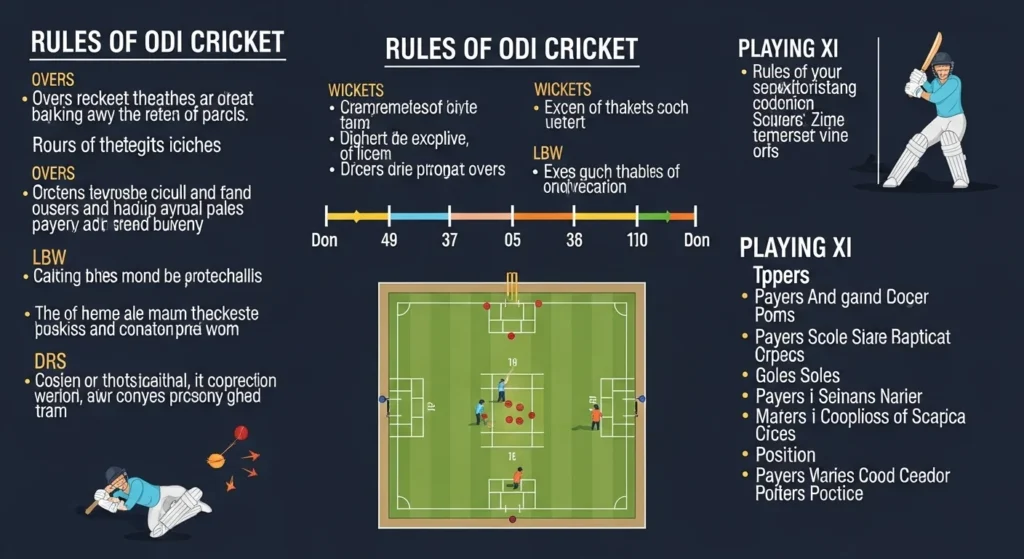
Important Rules
- Each bowler can bowl a maximum of 10 overs
- Fielding restrictions apply in powerplay overs
- No-balls and wides give extra runs and extra balls
- A batsman is out if dismissed by bowled, caught, LBW, run out, etc.
Powerplay Rules
ODI cricket includes special fielding restrictions called powerplays:
- First 10 overs: Only 2 fielders allowed outside the 30-yard circle
- Middle overs: Fewer restrictions
- Final overs: Maximum attacking field allowed
These rules make the game more exciting and high-scoring.
Techniques and Strategies in ODI Cricket
Batting Strategies
Batting in ODI cricket requires balance between aggression and caution.
Key techniques include:
- Building a strong opening partnership
- Rotating the strike regularly
- Playing attacking shots in powerplay
- Accelerating scoring in final overs
Bowling Strategies
Bowlers in ODI cricket use different tactics:
- Bowling accurate line and length
- Using variations like yorkers and slower balls
- Setting defensive fields in middle overs
- Targeting weak batsmen
Fielding Strategies
Good fielding can change the match result.
Important fielding strategies:
- Aggressive field placements in early overs
- Saving boundaries in death overs
- Quick throwing and direct hits
- Coordinated teamwork
Player Roles in ODI Cricket
Batsmen
Batsmen are responsible for scoring runs. They are usually classified as:
- Opening batsmen
- Middle-order batsmen
- Finishers (lower order hitters)
Bowlers
Bowlers try to dismiss batsmen and restrict runs:
- Fast bowlers (use speed and bounce)
- Spin bowlers (use turning and variation)
All-Rounders
All-rounders are very valuable players who:
- Bat and bowl
- Provide balance to the team
- Contribute in both innings
Wicketkeeper
The wicketkeeper plays behind the stumps and is responsible for:
- Catching balls
- Stumping batsmen
- Supporting fielding strategies
Equipment Used in ODI Cricket
Cricket requires specific equipment for safety and performance:
Bat
- Made of willow wood
- Used to hit the ball and score runs
Ball
- Hard leather ball
- Used by bowlers to challenge batsmen
Protective Gear
- Helmet
- Pads
- Gloves
- Chest guard
- Thigh guard
Clothing
Modern ODI cricket uses:
- Colored team jerseys
- Comfortable sports shoes
- Lightweight fabric for performance
Major ODI Cricket Tournaments
ICC Cricket World Cup
The biggest ODI tournament is the ICC Cricket World Cup:
- First held in 1975
- Played every 4 years
- Teams from all over the world participate
ICC Champions Trophy
- Short tournament featuring top-ranked teams
- High-level competition
Bilateral Series
Countries often play ODI series against each other, such as:
- India vs Australia series
- England vs South Africa series
These series help teams improve rankings and performance.
Benefits of Playing ODI Cricket
Physical Benefits
- Improves stamina and fitness
- Enhances hand-eye coordination
- Builds strength and agility
- Encourages outdoor physical activity
Mental Benefits
- Improves concentration
- Develops decision-making skills
- Teaches teamwork
- Builds patience and discipline
Social Benefits
- Promotes teamwork
- Builds friendships
- Encourages sportsmanship
- Develops leadership skills
Interesting Facts About the Start of ODI Cricket
Here are some interesting facts:
- The first ODI match was not originally planned as an ODI.
- Early ODI matches had no colored uniforms.
- The first Cricket World Cup in 1975 was played in England.
- ODI cricket introduced night matches using floodlights later in its development.
- Modern ODI matches are much faster and more aggressive than early ones.
Evolution of ODI Cricket Over Time
Since the start of ODI cricket, the game has changed significantly:
- Scoring rates have increased
- Batting techniques have become more aggressive
- Equipment quality has improved
- Technology like DRS (Decision Review System) is now used
- Fielding standards are much higher
Modern ODI cricket is more entertaining and competitive than ever before.
Conclusion
The start of ODI cricket marked a revolutionary moment in the history of the sport. It transformed cricket from a slow-paced game into a fast, exciting, and audience-friendly format.
From its first match in 1971 to modern-day World Cups, ODI cricket has continued to grow in popularity across the globe. It offers the perfect balance between strategy, skill, and entertainment.
Whether you are a beginner or a cricket fan, understanding the start of ODI cricket helps you appreciate how the game evolved into one of the most loved sports formats in the world.