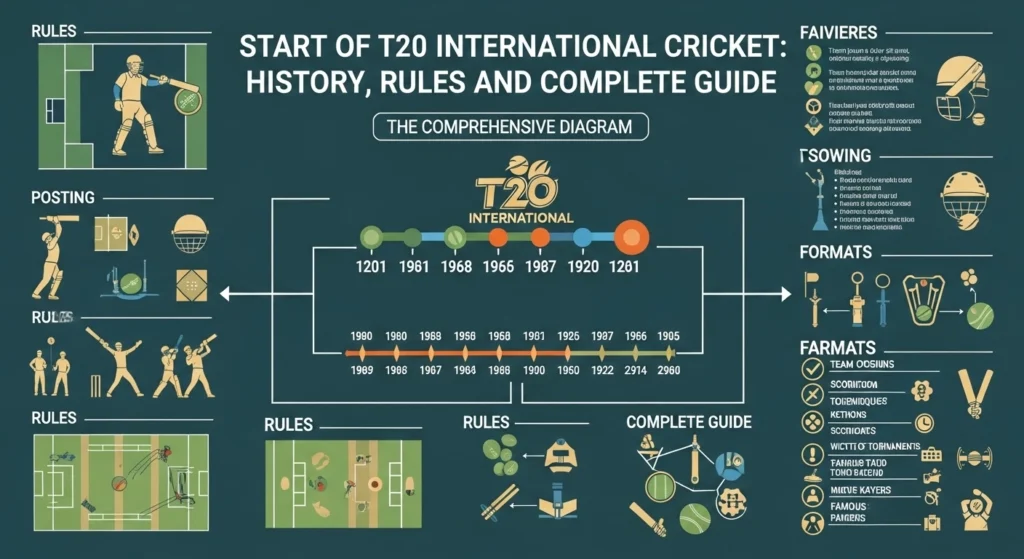
Cricket has evolved significantly over the years, and one of the biggest changes in modern times is the introduction of Twenty20 (T20) cricket. The start of T20 International cricket brought a fast, exciting, and highly entertaining format that completely changed how the game is played and enjoyed. Unlike traditional formats like Test and One Day International (ODI), T20 cricket is short, action-packed, and designed to fit into modern lifestyles.
This format quickly gained popularity among fans, especially younger audiences, because matches are completed in just a few hours. It combines aggressive batting, creative bowling, and energetic fielding, making every moment important. In this article, you will learn about the start of T20 International cricket, its history, rules, gameplay, techniques, player roles, equipment, major tournaments, benefits, and interesting facts.
Introduction to T20 International Cricket
T20 International cricket is the shortest format of international cricket, where each team plays a maximum of 20 overs. The team that scores more runs in these overs wins the match.
The start of T20 International cricket was aimed at making cricket more entertaining and accessible. With shorter match duration, it became easier for fans to watch the game in a single sitting.
Key features of T20 cricket include:
- Fast-paced gameplay
- High scoring matches
- Aggressive batting style
- Strategic bowling and fielding
History and Start of T20 International Cricket
Early Development of T20 Format
The T20 format was first introduced in domestic cricket in England in 2003 by the England and Wales Cricket Board (ECB). The goal was to attract more spectators and bring excitement to the game.
First T20 International Match
The official start of T20 International cricket took place on:
- 17 February 2005
- Match between Australia and New Zealand
- Venue: Eden Park, Auckland
This match was played in a fun and experimental style, with players wearing retro uniforms. However, it marked the beginning of a new era in cricket.
Growth of T20 Cricket
After the success of the first match, T20 cricket rapidly gained global attention. Major developments included:
- Introduction of ICC T20 World Cup in 2007
- Launch of domestic leagues like IPL
- Increased popularity worldwide
- Adoption of modern playing styles
Rules and Gameplay of T20 International Cricket
Basic Match Structure
- Each team plays 20 overs
- Each over consists of 6 balls
- One innings per team
- Match duration: around 3 hours
Objective of the Game
- Score maximum runs in 20 overs
- Restrict the opponent from scoring
Key Rules
- Maximum of 4 overs per bowler
- Fielding restrictions in powerplay overs
- Free hit after a no-ball
- Super over in case of a tie
Powerplay Rules
- First 6 overs: Only 2 fielders allowed outside the circle
- Remaining overs: Up to 5 fielders outside
These rules encourage aggressive batting and high scoring.
Techniques and Strategies in T20 Cricket
Batting Techniques
Batting in T20 cricket focuses on scoring quickly.
Important techniques:
- Power hitting
- Innovative shots (scoop, reverse sweep)
- Strike rotation
- Finishing strong in death overs
Bowling Strategies
Bowlers use smart variations to control runs:
- Yorkers in death overs
- Slower balls
- Wide line deliveries
- Bouncers to surprise batsmen
Fielding Strategies
Fielding is very important in T20:
- Quick reflexes
- Boundary saving dives
- Accurate throws
- Smart field placements
Player Roles in T20 International Cricket
Batsmen
- Openers: Start aggressively
- Middle order: Stabilize and accelerate
- Finishers: Score quickly in final overs
Bowlers
- Fast bowlers: Use pace and variations
- Spin bowlers: Control middle overs
All-Rounders
All-rounders are key players because they:
- Contribute in batting and bowling
- Provide flexibility to the team
Wicketkeeper
- Catches balls behind the stumps
- Performs stumpings
- Guides field placements
Equipment Used in T20 Cricket
Bat
- Made of high-quality willow
- Designed for powerful hitting
Ball
- Leather ball used in international matches
Protective Gear
- Helmet
- Gloves
- Pads
- Guards
Clothing
- Colored jerseys
- Lightweight and comfortable
Major T20 International Tournaments
ICC T20 World Cup
- First held in 2007
- Played every 2 years (approx.)
- Top teams compete globally
Domestic Leagues
- Indian Premier League (IPL)
- Big Bash League (BBL)
- Pakistan Super League (PSL)
These leagues increased the popularity of T20 cricket worldwide.
Benefits of Playing T20 Cricket
Physical Benefits
- Improves fitness and stamina
- Enhances reflexes and agility
- Builds strength
Mental Benefits
- Improves decision-making
- Enhances focus and concentration
- Develops strategic thinking
Social Benefits
- Encourages teamwork
- Builds communication skills
- Promotes sportsmanship
Interesting Facts About the Start of T20 International Cricket
- The first T20 International match was played for entertainment purposes.
- Players wore retro-style uniforms in the first match.
- T20 cricket is the fastest-growing format globally.
- It helped cricket reach new audiences worldwide.
- T20 matches are shorter than ODI and Test matches.
Evolution of T20 International Cricket
Since the start of T20 International cricket, the game has evolved rapidly:
- Higher scoring matches
- Advanced batting techniques
- Improved fitness levels
- Use of technology (DRS, analytics)
- Professional leagues boosting talent
T20 cricket has become a global phenomenon.
Conclusion
The start of T20 International cricket revolutionized the game by introducing a fast, exciting, and modern format. It made cricket more accessible and entertaining for people of all ages. From its first match in 2005 to global tournaments and leagues today, T20 cricket has transformed how the sport is played and watched.
With its thrilling gameplay, strategic depth, and global appeal, T20 cricket continues to grow in popularity. It is not just a format but a new era in cricket that combines skill, speed, and entertainment.

Green Benn is a dedicated sports writer specializing in cricket, including IPL and international formats. Known for clear, engaging, and informative content, Green simplifies complex match analysis and player statistics for all readers. Passionate about sports storytelling, Green delivers reliable, SEO-friendly articles that keep fans updated and informed