
If you have ever watched a cricket match, you may have noticed how much attention players give to the ball. Bowlers polish it carefully, batsmen study its movement, and fielders react quickly to it. This small object—the cricket ball—plays a huge role in deciding the outcome of a match.
Understanding what a cricket ball is and how it behaves is important for anyone who wants to learn or enjoy cricket. Whether you are a beginner, student, or sports fan, knowing about the cricket ball helps you understand bowling techniques, swing, spin, and gameplay better.
In this article, you will learn everything about what is cricket ball, including its definition, history, structure, types, rules, techniques, and its importance in modern cricket. This guide uses simple and clear language so that beginners can easily understand.
What is Cricket Ball?
A cricket ball is a hard, solid ball used in the sport of cricket. It is designed to be durable and capable of maintaining its shape and performance during long matches.
Simple Explanation
In simple words:
- It is the main object used in cricket
- Bowlers use it to deliver the ball
- Batsmen hit it to score runs
Practical Example
During a cricket match:
- The bowler throws the ball toward the batsman
- The batsman tries to hit it
- Fielders catch or stop it
History of Cricket Ball
The cricket ball has evolved over time along with the game itself.
Early Development
- Cricket started in England in the 16th century
- Early balls were made from simple materials like wood or cloth
Modern Design
- By the 18th century, leather balls became standard
- Red cricket balls were introduced for Test matches
- White balls came later for limited-overs cricket
Evolution in Formats
- Red ball for Test cricket
- White ball for ODI and T20 matches
- Pink ball for day-night Test matches
Structure of a Cricket Ball
The cricket ball is carefully designed for performance and durability.
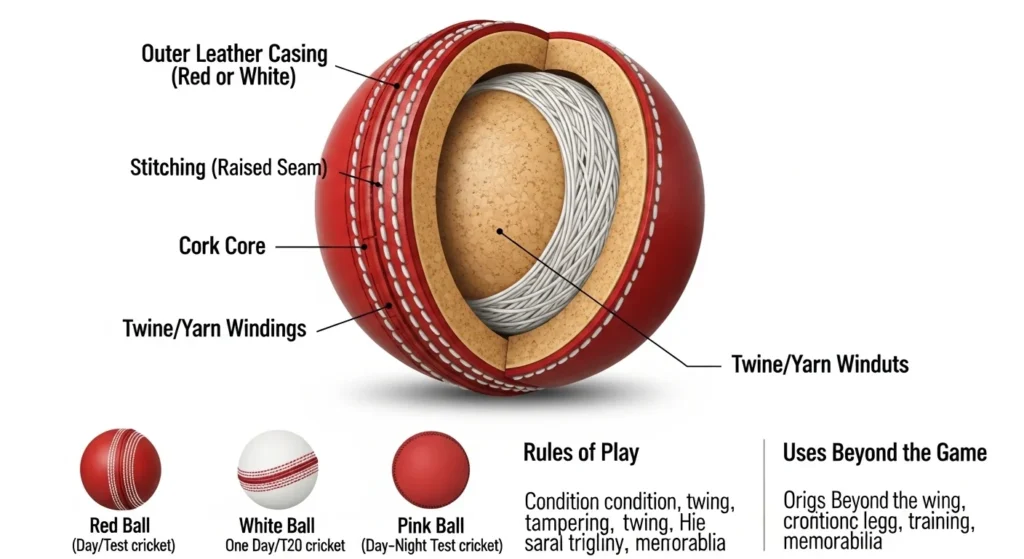
Outer Cover
- Made of high-quality leather
- Usually red or white in color
Core (Inner Part)
- Made of cork and rubber
- Provides hardness and bounce
Seam
- Raised stitching joining leather pieces
- Helps bowlers create swing and seam movement
Layers
- Cork core wrapped with string
- Covered with leather casing
Types of Cricket Balls
Different formats of cricket use different types of balls.
Red Cricket Ball
- Used in Test matches
- Suitable for long-duration games
- Maintains swing for longer time
White Cricket Ball
- Used in ODI and T20 matches
- Visible under floodlights
- Wears out faster than red ball
Pink Cricket Ball
- Used in day-night Test matches
- Better visibility in evening conditions
- Combines features of red and white balls
Tennis Cricket Ball
- Used in casual or street cricket
- Softer and safer
- Not used in professional matches
Rules Related to Cricket Ball
The cricket ball is governed by specific rules.
Standard Weight and Size
- Weight: 155.9 to 163 grams
- Circumference: 22.4 to 22.9 cm
Ball Usage Rules
- Cannot be tampered with
- Only polishing is allowed
- Replaced if damaged
Ball Change
- In limited-overs cricket, balls are replaced after a fixed number of overs
- In Test cricket, the same ball is used for a long time
Role of Cricket Ball in Gameplay
The cricket ball directly affects how the game is played.
Bowling
- Fast bowlers use speed and swing
- Spin bowlers use rotation
Batting
- Batsmen judge bounce and movement
- Timing depends on ball condition
Fielding
- Fielders catch, throw, and stop the ball
- Quick reactions are needed
Important Techniques Related to Cricket Ball
Swing Bowling
- Ball moves in the air
- Depends on seam position and shine
Seam Bowling
- Ball deviates after pitching
- Uses seam alignment
Spin Bowling
- Ball rotates and changes direction
- Used by spinners
Reverse Swing
- Occurs with older ball
- Moves opposite to normal swing
Equipment Related to Cricket Ball
The cricket ball is part of a complete cricket setup.
Related Equipment
- Cricket bat
- Gloves
- Pads
- Helmet
All these are used to protect players and enhance performance.
Major Tournaments Using Cricket Ball
Cricket balls are used in various international tournaments.
International Events
- ICC Cricket World Cup
- ICC T20 World Cup
- Test Championship
Domestic Leagues
- T20 leagues
- First-class matches
Each format may use a different type of cricket ball.
Benefits of Playing with Cricket Ball
Playing cricket with a proper ball offers many benefits.
Physical Benefits
- Improves fitness
- Enhances coordination
- Builds strength
Mental Benefits
- Improves focus
- Develops strategy skills
- Builds teamwork
Interesting Facts About Cricket Ball
- A cricket ball can last up to 80 overs in Test cricket
- The seam has about 80 stitches
- Bowlers carefully shine one side for swing
- Ball condition affects match results
Comparison: Cricket Ball vs Tennis Ball
Understanding the difference between cricket ball and tennis ball is helpful.
| Feature | Cricket Ball | Tennis Ball |
|---|---|---|
| Material | Leather | Rubber |
| Hardness | Hard | Soft |
| Usage | Professional cricket | Casual games |
| Bounce | Controlled | Higher |
| Safety | Requires protection | Safer |
Tips for Beginners
- Always use proper protective gear
- Start with a softer ball
- Practice basic bowling and batting
- Learn how the ball behaves
Conclusion
A cricket ball is one of the most important elements of the game of cricket. From its strong leather construction to its role in swing, spin, and bounce, it directly influences how the game is played. Understanding what is cricket ball helps players and fans appreciate the sport at a deeper level.
Different types of cricket balls are used in different formats, and each has unique characteristics. Whether you are a beginner or an experienced player, learning about the cricket ball improves your knowledge and performance.
By understanding its structure, rules, and techniques, you can enjoy cricket more and develop better skills. The cricket ball may be small in size, but its impact on the game is huge.