
Writing becomes much easier when you know how sentences work. A short sentence can give a clear fact. A question can ask for information. A command can tell someone what to do. A sentence can also show strong feelings.
This is why many students, teachers, writers, and English learners search for Types of Sentences. They want to understand the different sentence forms and learn how to use them correctly.
The term may seem simple, but it can cause confusion. Some learners mix up a question with a statement. Others are unsure about commands, exclamations, or sentence structures. Knowing the main types helps you write better English and understand what a writer means.
In English grammar, sentences are commonly grouped by their purpose into four main types: declarative, interrogative, imperative, and exclamatory. They can also be grouped by their structure as simple, compound, complex, and compound-complex sentences.
This guide explains the Types of Sentences in simple English. You will learn their meanings, examples, common mistakes, everyday uses, and practical writing tips.
Types of Sentences – Quick Answer
Types of Sentences are different forms of sentences used to express facts, ask questions, give commands, or show strong feelings.
There are four main types based on purpose:
| Type | Main Purpose | Example |
|---|---|---|
| Declarative | Gives information | The sun is bright. |
| Interrogative | Asks a question | Is the sun bright? |
| Imperative | Gives a command or request | Open the window. |
| Exclamatory | Shows strong feeling | What a beautiful day! |
Declarative Sentence
A declarative sentence gives information or states an opinion.
Examples:
- I live in Riyadh.
- She likes English.
- The machine is working.
- Water boils at 100°C.
Most declarative sentences end with a period (.).
Interrogative Sentence
An interrogative sentence asks a question.
Examples:
- Where do you live?
- Are you ready?
- What is your name?
- Did you finish your work?
Interrogative sentences usually end with a question mark (?).
Imperative Sentence
An imperative sentence gives a command, instruction, advice, or request.
Examples:
- Close the door.
- Please sit down.
- Turn off the light.
- Follow the instructions.
The subject you is often understood rather than written.
Exclamatory Sentence
An exclamatory sentence shows strong emotion, such as surprise, excitement, anger, or joy.
Examples:
- What a beautiful view!
- That is amazing!
- I cannot believe it!
- What a great idea!
Exclamatory sentences normally end with an exclamation mark (!).
The Origin of Types of Sentences
The word sentence comes from the Latin word sententia, meaning a thought, opinion, or judgment. The word later entered Old French and Middle English before becoming the English word sentence.
The idea of classifying sentences has a long history in grammar. Teachers and grammarians have studied how people use sentences to communicate different meanings.
The four common purpose-based types developed from basic communication needs:
- Declarative sentences tell something.
- Interrogative sentences ask something.
- Imperative sentences tell someone to do something.
- Exclamatory sentences express strong emotion.
English does not have major British and American spelling differences for the phrase Types of Sentences. The spelling is the same in both varieties.
However, British and American English can differ in punctuation, vocabulary, and some grammar rules. These differences can affect how sentences are written.
For example:
British English:
The team have won the match.
American English:
The team has won the match.
Both forms can be correct within their own variety of English.
British English vs American English Spelling
The phrase Types of Sentences has the same spelling in British and American English.
The main differences appear in related words and general spelling patterns.
| British English | American English |
|---|---|
| colour | color |
| favourite | favorite |
| organise | organize |
| realise | realize |
| centre | center |
| travelling | traveling |
| cancelled | canceled |
These differences do not change the meaning of Types of Sentences.
Sentence Punctuation
British and American English also have some differences in punctuation style.
For example, quotation marks can be handled differently:
British style:
She said, ‘The test is easy.’
American style:
She said, “The test is easy.”
Both styles are widely understood.
The most important rule is consistency. If you choose British English, follow British conventions throughout your article. If you choose American English, keep your spelling and punctuation consistent.
Which Spelling Should You Use?
The correct choice depends on your audience.
Use American English for a US Audience
If your website targets readers in the United States, American English is usually the best choice.
For example:
- color
- favorite
- center
- organize
This is especially useful for US schools, businesses, websites, and educational content.
Use British English for the UK and Some Commonwealth Audiences
British English is common in the United Kingdom and is also used in many educational and professional settings around the world.
Examples include:
- colour
- favourite
- centre
- organise
Use One Style for a Global Audience
If your website targets readers from many countries, either style can work.
The key is consistency.
Do not write color in one section and colour in another unless you are directly comparing the two forms.
For an international educational website, simple and widely understood English is often the best approach.
Common Mistakes with Types of Sentences
Learning sentence types is easy, but students often make a few common mistakes.
Mistake 1: Confusing a Statement with a Question
Incorrect:
You are coming tomorrow.
If you want to ask a question, use:
Are you coming tomorrow?
The punctuation and sentence structure should match the purpose.
Mistake 2: Using a Question Mark After Every Question-Like Phrase
Some sentences contain words such as who, what, or why but are not questions.
Example:
I know why she left.
This is a statement, so it needs a period.
Correct:
I know why she left.
Mistake 3: Confusing Commands with Statements
Compare:
You close the door.
Close the door.
The second sentence is a clear imperative because it gives a command.
Mistake 4: Overusing Exclamation Marks
Incorrect:
This is a great article!!!
In professional writing, one exclamation mark is usually enough.
Better:
This is a great article!
In formal writing, a normal period may be better:
This is a useful article.
Mistake 5: Forgetting the Sentence Structure
Purpose and structure are not the same thing.
For example:
I work every day.
This is a declarative sentence and also a simple sentence.
I work every day because I need money.
This is a declarative sentence and a complex sentence.
Understanding both systems gives you better control over English grammar.
Types of Sentences in Everyday Examples
The four main sentence types appear everywhere in daily communication.
In Emails
Emails use different sentence types depending on the purpose.
Declarative:
The meeting starts at 10 a.m.
Interrogative:
Can you attend the meeting?
Imperative:
Please send the report before noon.
Exclamatory:
That is great news!
Professional emails usually use more declarative, interrogative, and polite imperative sentences. Exclamatory sentences should be used carefully.
In News
News writing mainly uses declarative sentences.
Example:
The company opened a new factory on Monday.
News writers use statements because they need to provide clear information.
Questions may appear in headlines or interviews.
Example:
What caused the power failure?
On Social Media
Social media uses all four types.
Declarative:
I finally finished my project.
Interrogative:
What do you think about it?
Imperative:
Share this post with your friends.
Exclamatory:
We won the match!
Social media often uses shorter sentences and more emotional language.
In Formal Writing
Academic and professional writing mainly uses declarative sentences.
Example:
The study shows a clear relationship between exercise and health.
Questions may be used to introduce a topic, while commands are less common.
Good formal writing should be clear, direct, and easy to understand.
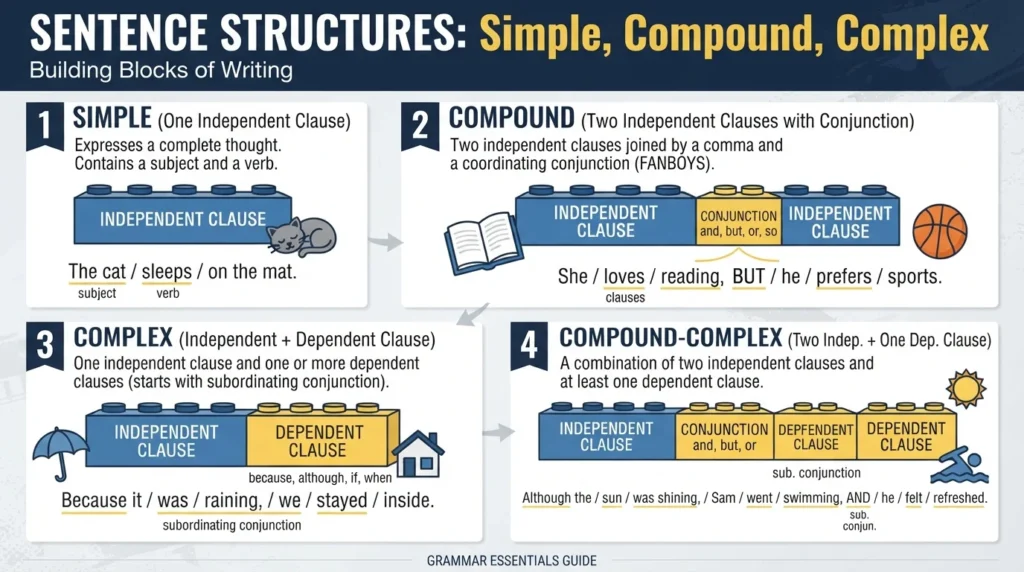
Types of Sentences by Structure
Sentences can also be classified according to their structure.
Simple Sentence
A simple sentence has one independent clause.
Example:
The boy plays cricket.
Compound Sentence
A compound sentence contains two independent clauses joined by a conjunction.
Example:
The boy plays cricket, and his sister watches him.
Complex Sentence
A complex sentence contains an independent clause and a dependent clause.
Example:
The boy plays cricket because he enjoys the game.
Compound-Complex Sentence
A compound-complex sentence contains at least two independent clauses and one dependent clause.
Example:
The boy plays cricket because he enjoys the game, and his sister watches him.
These structural types are different from the four purpose-based types.
Types of Sentences – Comparison Table
The following table brings the main sentence categories together.
| Sentence Type | Based On | Purpose | Example |
|---|---|---|---|
| Declarative | Purpose | Gives information | She is a teacher. |
| Interrogative | Purpose | Asks a question | Is she a teacher? |
| Imperative | Purpose | Gives an order or request | Open the book. |
| Exclamatory | Purpose | Shows strong emotion | What a great teacher! |
| Simple | Structure | One independent clause | She teaches English. |
| Compound | Structure | Two independent clauses | She teaches English, and I teach math. |
| Complex | Structure | Main and dependent clauses | She teaches English because she loves it. |
| Compound-complex | Structure | Multiple main and dependent clauses | She teaches English because she loves it, and I teach math. |
Types of Sentences – Google Trends & Usage Data
Types of Sentences is a common educational search topic because students and English learners often need quick grammar explanations.
Search interest usually comes from several groups:
- School and college students
- English language learners
- Teachers
- Parents helping children with homework
- Writers and bloggers
- People preparing for English tests
The keyword also has strong educational intent. Many users searching for Types of Sentences want a definition, examples, a grammar chart, or a simple explanation.
Search behavior can vary by country. Countries where English is widely taught as a second language can generate strong interest in basic grammar topics. The exact level of interest also changes during school and examination periods.
For SEO, content targeting this keyword should answer the question quickly before providing deeper explanations.
A strong article should include:
- A short definition
- Four main sentence types
- Clear examples
- Sentence structure types
- Comparison tables
- Common mistakes
- FAQs
- Simple explanations
Do not repeat the keyword in every paragraph. Google can understand related terms such as sentence types, kinds of sentences, sentence examples, declarative sentence, interrogative sentence, imperative sentence, and exclamatory sentence.
FAQs About Types of Sentences
What are the 4 main types of sentences?
The four main types are declarative, interrogative, imperative, and exclamatory. They are classified by their purpose.
What is a declarative sentence?
A declarative sentence gives information or states an idea.
Example:
The weather is hot today.
What is an interrogative sentence?
An interrogative sentence asks a question.
Example:
Is the weather hot today?
What is an imperative sentence?
An imperative sentence gives a command, request, instruction, or advice.
Example:
Please close the window.
What is an exclamatory sentence?
An exclamatory sentence expresses strong emotion.
Example:
What a beautiful sunset!
What are the 4 types of sentences by structure?
The four common structural types are simple, compound, complex, and compound-complex sentences.
What is the difference between sentence types and sentence structures?
Sentence types describe the purpose of a sentence, while sentence structures describe how its clauses are organized.
For example:
Please close the door.
This is an imperative sentence because it gives a command. It is also a simple sentence because it contains one independent clause.
Which sentence type is most common?
Declarative sentences are very common because people use them to give information, describe things, and express ideas.
Conclusion
Understanding the Types of Sentences is one of the basic skills needed for good English writing. The four main purpose-based types are declarative, interrogative, imperative, and exclamatory. Each type has a different job.
Declarative sentences give information. Interrogative sentences ask questions. Imperative sentences give commands, requests, or instructions. Exclamatory sentences show strong feelings.
Sentences can also be classified by structure. Simple, compound, complex, and compound-complex sentences explain how clauses are arranged.
The phrase Types of Sentences has the same spelling in British and American English. However, related English words can have different spellings, such as colour/color and favourite/favorite. Choose the English style that matches your audience and use it consistently.
For students, teachers, writers, and English learners, learning sentence types makes grammar easier. It also helps create clearer emails, articles, social posts, academic work, and professional documents. Once you understand these basic forms, you can build stronger sentences and communicate your ideas with greater confidence.