
Have you ever said “Wow!”, “Oh!”, “Oops!”, or “Hurray!” to show a sudden feeling? These short words are called interjections. They are common in everyday English, but many students and English learners are not sure what they mean or how to use them correctly.
People often search for “Interjection” because they want a simple definition, examples, types, or help with English grammar. Some learners also confuse interjections with other parts of speech because an interjection can appear at the beginning, middle, or end of a sentence.
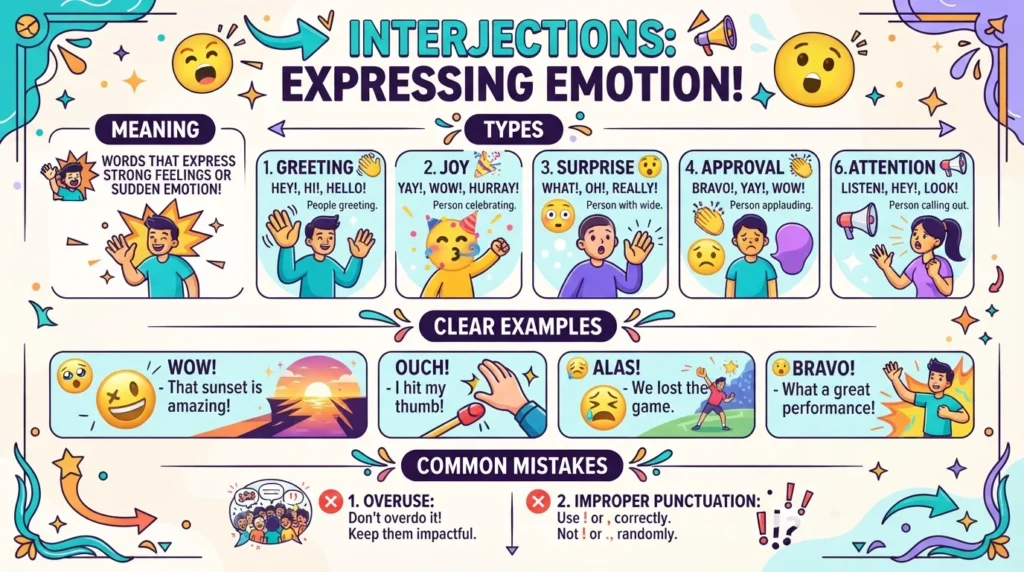
An interjection is mainly used to express a strong or sudden feeling, reaction, or emotion. It can show happiness, surprise, pain, anger, fear, excitement, or sadness.
For example:
- Wow! That is beautiful.
- Oops! I dropped my phone.
- Hurray! We won the match.
- Oh! I forgot my keys.
- Ouch! That hurts.
This guide explains what an interjection is, where the word comes from, British and American spelling, common mistakes, everyday examples, and the main types of interjections.
Interjection – Quick Answer
An interjection is a word or short expression used to express a sudden feeling, emotion, reaction, or response.
Common interjections include:
- Wow! — surprise or admiration
- Oh! — surprise or realization
- Oops! — a small mistake
- Ouch! — pain
- Hurray! — happiness or celebration
- Hey! — attention or surprise
- Alas! — sadness
- Ah! — understanding or relief
- Uh-oh! — concern about a problem
Simple Examples
Wow! That car looks amazing.
Oops! I made a mistake.
Ouch! My hand hurts.
Hurray! We passed the exam.
The interjection often stands apart from the main sentence. It may be followed by an exclamation mark, although not every interjection needs one.
For example:
Oh, I understand now.
Here, Oh shows a sudden reaction.
Types of Interjections
Interjections can express many different emotions and reactions. Their meaning often depends on the situation and tone.
Interjections of Joy
These show happiness, excitement, or celebration.
Examples:
- Hurray!
- Yay!
- Wow!
Example:
Hurray! We won the final.
Interjections of Surprise
These show sudden surprise or shock.
Examples:
- Oh!
- Wow!
- What!
Example:
Wow! You finished the project already.
Interjections of Pain
These show physical or emotional pain.
Examples:
- Ouch!
- Ow!
Example:
Ouch! That was hot.
Interjections of Sadness
These show sorrow or regret.
Examples:
- Alas!
- Oh no!
Example:
Alas! We missed the last train.
Interjections of Greeting
These are used when meeting or calling someone.
Examples:
- Hello!
- Hi!
- Hey!
Example:
Hey! How are you?
Interjections of Attention
These are used to get someone’s attention.
Examples:
- Hey!
- Look!
- Listen!
Example:
Hey! Please wait for me.
Interjections of Approval
These show agreement, praise, or approval.
Examples:
- Bravo!
- Well done!
- Great!
Example:
Bravo! That was an excellent performance.
The Origin of Interjection
The word interjection comes from Latin. It is related to the Latin word intericere, which carries the idea of throwing or placing something between. The term developed through French and Latin forms before becoming part of English grammar.
The name makes sense because an interjection is often inserted into a sentence or conversation to express a sudden reaction.
For example:
I was, oh, very surprised by the news.
The word oh interrupts the normal flow of the sentence and expresses the speaker’s reaction.
Interjections have been recognized in English grammar for a long time. They are different from many other parts of speech because their main purpose is often to express emotion rather than describe an action, object, or quality.
Why Are Interjections Sometimes Written Differently?
The standard spelling of the grammar term is:
interjection
There is no standard British-American spelling difference for this word.
Some individual interjections can have different accepted forms. For example:
- okay / OK
- ah / aah
- hurray / hooray
- uh-oh / uh oh
These variations usually relate to the way people represent speech sounds in writing. They do not mean that British and American English have different spellings of the word interjection itself.
British English vs American English Spelling
The word interjection is spelled the same way in British English and American English.
| Feature | British English | American English |
|---|---|---|
| Singular | interjection | interjection |
| Plural | interjections | interjections |
| Spelling | interjection | interjection |
| Meaning | Same | Same |
| Grammar use | Same | Same |
| Standard spelling difference | None | None |
Examples
British English:
What is an interjection?
American English:
What is an interjection?
The spelling is identical.
The main British-American spelling differences are found in words such as colour/color, favour/favor, and centre/center. Interjection is not one of these words.
Which Spelling Should You Use?
Use interjection for both British and American English.
For a US Audience
Write:
interjection
This is the standard American spelling.
For a UK or Commonwealth Audience
Write:
interjection
The same spelling is standard in British English and widely used across Commonwealth English.
For a Global Audience
Use:
interjection
There is no need to create different versions of this word for different English-speaking audiences.
For SEO, focus on natural search variations such as:
- interjection
- what is an interjection
- interjection definition
- interjection examples
- types of interjections
- examples of interjections
- interjections in English
- common interjections
These variations can help an article answer different forms of the same search intent.
Common Mistakes with Interjection
Interjections are simple, but learners often make mistakes with punctuation, meaning, and sentence structure.
Mistake 1: Confusing an Interjection With a Verb
An interjection expresses a reaction. It does not normally describe an action performed by a subject.
For example:
Wow! That is amazing.
Wow expresses a reaction. It is not the verb of the sentence.
Mistake 2: Using Too Many Exclamation Marks
Incorrect:
Wow!!!! That is amazing!!!!
This can make writing look informal or careless.
Better:
Wow! That is amazing!
One exclamation mark is normally enough.
Mistake 3: Using an Interjection in Formal Writing Too Often
Words such as wow, yay, and oops are common in casual communication.
For example:
Wow! That was a great presentation.
This is natural in conversation, but formal reports usually need a more neutral style.
Instead of:
Wow! The results were excellent.
Formal writing could say:
The results were excellent.
Mistake 4: Thinking Every Interjection Must Have an Exclamation Mark
An interjection does not always need an exclamation mark.
For example:
Oh, I see what you mean.
Here, a comma works naturally.
Mistake 5: Confusing “Oh” and “Ouch”
These words have different meanings.
Oh! can show surprise, realization, or emotion.
Oh! I forgot about the meeting.
Ouch! normally shows pain.
Ouch! I hurt my finger.
Mistake 6: Using an Interjection Without Considering Context
The same interjection can have different meanings depending on tone.
For example:
Oh! You are here.
This may show surprise.
But:
Oh, I understand.
This may show realization.
Context helps the reader understand the speaker’s emotion.
Interjection in Everyday Examples
Interjections are common in spoken English and informal writing. They appear in emails, text messages, social media posts, conversations, news, and some forms of formal writing.
Interjections in Emails
Informal email:
Hi! I hope you are doing well.
Another example:
Oops! I forgot to attach the file.
In professional emails, simple greetings such as Hi and Hello are common. Strong emotional interjections are usually used less often.
Interjections in News
News writing can include interjections when reporting direct speech.
“Wow! I cannot believe we won,” the player said.
The interjection helps show the speaker’s emotion.
Interjections on Social Media
Social media uses interjections frequently because they make posts sound natural and emotional.
Examples:
Wow! This view is incredible.
Yay! The weekend is here.
Oops! Wrong photo.
Oh no! I missed the bus.
Interjections in Formal Writing
Interjections are less common in formal academic and professional writing.
However, they may appear when a writer quotes someone’s exact words.
The student said, “Wow! I did not expect that result.”
In normal formal writing, it is often better to describe the emotion directly.
Instead of:
Wow! The results were surprising.
Use:
The results were surprisingly positive.
Interjection Variations Compared Side by Side
| Interjection | Emotion or Purpose | Example |
|---|---|---|
| Wow! | Surprise or admiration | Wow! That is beautiful. |
| Oh! | Surprise or realization | Oh! I understand now. |
| Ouch! | Pain | Ouch! That hurts. |
| Oops! | Small mistake | Oops! I dropped the glass. |
| Hurray! | Joy or celebration | Hurray! We won. |
| Yay! | Happiness | Yay! We are going on vacation. |
| Alas! | Sadness or regret | Alas! The plan failed. |
| Hey! | Attention or greeting | Hey! Come here. |
| Ah! | Understanding or relief | Ah! Now I see the problem. |
| Bravo! | Praise or approval | Bravo! Excellent work. |
| Uh-oh! | Concern or trouble | Uh-oh! Something went wrong. |
| Hello! | Greeting | Hello! How are you? |
Interjection – Google Trends & Usage Data
The keyword “interjection” has strong educational search intent. Students, teachers, English learners, and people studying grammar may search for the term when they need a definition, examples, or help identifying interjections in sentences.
Search interest can vary by country, school calendars, examination periods, English-learning demand, and the selected Google Trends period. Google Trends shows relative search interest rather than an exact number of searches, so its figures should be used as an indicator of popularity.
Related searches can be especially useful for SEO. Common variations include:
- what is an interjection
- interjection definition
- interjection examples
- types of interjections
- examples of interjection
- interjections in English
- 10 examples of interjections
- interjection words
- common interjections
- interjection in grammar
For educational SEO, the best approach is to answer the main question quickly and then cover types, examples, punctuation, mistakes, and real-life usage.
The keyword can also attract searches from different learning levels. Beginners often want a simple definition, while students may search for specific types or examples for homework and exams.
Why Are Interjections Important?
Interjections make language more expressive.
Compare these two sentences:
The team won the match.
Hurray! The team won the match.
The second sentence clearly shows excitement.
Another example is:
I dropped my phone.
Compared with:
Oops! I dropped my phone.
The word oops adds emotion and tells the reader that the event was accidental.
Interjections can therefore make conversations and informal writing sound more natural. They help people express feelings quickly without using a long sentence.
However, they should be used carefully in formal writing. Too many interjections can make a professional or academic text sound casual.
FAQs About Interjection
What is an interjection in simple words?
An interjection is a word or short expression that shows a sudden feeling, emotion, reaction, or response.
What are 10 examples of interjections?
Ten common examples are wow, oh, ouch, oops, hurray, yay, alas, hey, ah, and bravo.
What are the main types of interjections?
Interjections can express joy, surprise, pain, sadness, greeting, attention, approval, and other emotions or reactions.
Is “wow” an interjection?
Yes. Wow is commonly used as an interjection to show surprise, excitement, or admiration.
Example:
Wow! That is an amazing building.
Is “oh” an interjection?
Yes. Oh can be an interjection. It can show surprise, realization, disappointment, or other reactions depending on the context.
Is “oops” an interjection?
Yes. Oops is an informal interjection used when someone makes a small mistake or has an accidental problem.
Example:
Oops! I sent the wrong message.
Does an interjection always need an exclamation mark?
No. An interjection can be followed by an exclamation mark, comma, or other punctuation depending on how it is used.
Example:
Wow! That is great.
Oh, I understand.
Is “hello” an interjection?
Hello can function as an interjection when it is used as a greeting or to get someone’s attention.
Example:
Hello! How are you?
Are interjections used in formal writing?
They can be used in formal writing, especially inside quotations, but they are generally more common in conversation and informal writing.
Is “interjection” spelled differently in British and American English?
No. Interjection has the same standard spelling in British and American English.
Conclusion
An interjection is a word or short expression that shows a sudden feeling, emotion, reaction, or response. Common examples include wow, oh, ouch, oops, hurray, yay, hey, and alas.
Interjections are useful because they add emotion and natural expression to communication. They can show happiness, surprise, pain, sadness, approval, attention, or concern. They are especially common in conversations, messages, social media, and informal writing.
The word interjection comes from a Latin root connected with the idea of placing or throwing something between. Despite differences between British and American English, interjection has the same standard spelling in both varieties.
For students and English learners, the easiest way to understand an interjection is to look at what emotion or reaction the word expresses. Remember that punctuation depends on the sentence and tone. Also, avoid using too many emotional interjections in formal writing. When used correctly, interjections make English more natural, expressive, and engaging.