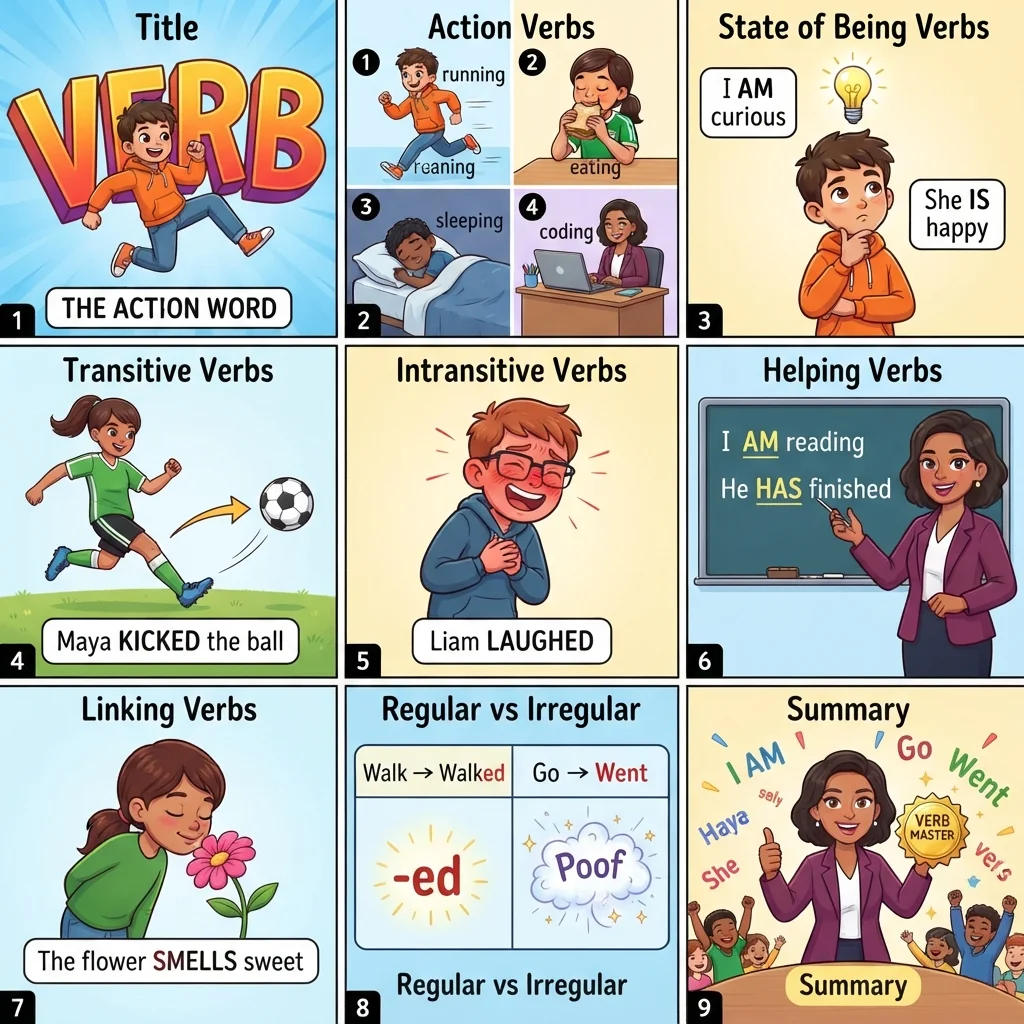

Have you ever wondered what a verb is and why it is so important in English? A verb is one of the most important parts of a sentence. It tells us what someone does, what happens, or what something is. Words such as run, eat, write, think, become, is, and have are verbs.
People search for “verb” because they want a simple meaning, clear examples, or help understanding different types of verbs. Students often learn terms such as action verbs, helping verbs, linking verbs, regular verbs, and irregular verbs. This can make grammar feel confusing.
The good news is that the basic idea is simple. A verb usually shows an action, state, or condition. It helps us understand what the subject does or what the subject is.
In this guide, you will learn the meaning and origin of verb, its main types, common mistakes, everyday examples, spelling variations, and answers to common questions. The goal is to make verbs easy to understand and use correctly.
Verb – Quick Answer
A verb is a word that shows an action, state, or occurrence.
Examples of action verbs
- Run
- Eat
- Write
- Read
- Play
- Work
- Sleep
Example:
Sarah writes a letter.
Here, writes is the verb because it tells us what Sarah does.
Examples of state verbs
Some verbs describe a state rather than a physical action.
- Be
- Know
- Like
- Want
- Believe
- Understand
Example:
I know the answer.
The verb know describes a mental state.
Simple definition
Verb = a word that tells what someone or something does, is, or experiences.
Every complete English sentence normally needs a verb.
The Origin of Verb
The word verb has a long history. It comes from the Latin word verbum, meaning “word.” Latin grammar used verbum for a word that expressed an action or state.
The word later entered English through Old French and Middle English. Over time, verb became the standard English grammar term for a word that expresses an action, occurrence, or state.
The spelling verb is quite stable in modern English. Unlike some words that have different British and American spellings, such as colour/color or centre/center, verb is normally spelled the same in both varieties.
However, verbs themselves can have different spellings or forms. For example:
- travel → travelled in British English
- travel → traveled in American English
- cancel → cancelled in British English
- cancel → canceled in American English
These differences come from different spelling conventions rather than a different meaning of the word verb.
English developed from several languages, including Germanic languages, Latin, French, and Greek. This history explains why English grammar and spelling contain many patterns and exceptions.
British English vs American English Spelling
The word verb is spelled the same in British and American English.
The main differences appear in some verb forms, especially when adding endings such as -ed or -ing.
| Verb | British English | American English |
|---|---|---|
| Verb | verb | verb |
| Travel | travelled | traveled |
| Cancel | cancelled | canceled |
| Label | labelled | labeled |
| Dial | dialled | dialed |
| Program | programmed | programmed |
| Learn | learnt / learned | learned |
| Burn | burnt / burned | burned |
British English often keeps a doubled l in words such as travelled and cancelled. American English usually uses one l in these forms.
There are also differences in some past-tense verbs:
- British: learnt
- American: learned
- British: dreamt
- American: dreamed
- British: burnt
- American: burned
Both forms can be correct, depending on the English variety and context.
Important point
There is no British spelling “verb” and American spelling “verb.” The noun verb is standard in both forms of English.
Which Spelling Should You Use?
Your choice should depend on your audience.
For a US audience
Use American English if you write for:
- American students
- US customers
- American businesses
- US schools
- American websites
For example:
The machine canceled the operation.
For a UK audience
Use British English if your readers are mainly from:
- United Kingdom
- England
- Scotland
- Wales
- Northern Ireland
For example:
The machine cancelled the operation.
For Commonwealth audiences
British-style spelling is often suitable for countries such as Australia, New Zealand, and some other Commonwealth countries, although each country has its own language preferences.
For global websites
Choose one spelling system and use it consistently.
If your website targets international readers, consistency is more important than mixing different spelling systems.
For example, do not use:
The technician travelled to the site and canceled the test.
Choose one style:
The technician travelled to the site and cancelled the test.
or:
The technician traveled to the site and canceled the test.
Common Mistakes with Verb
Learning verbs can be easy, but some mistakes are very common.
Mistake 1: Confusing a verb with an adjective
Incorrect understanding:
“Happy” is a verb.
Usually, happy is an adjective. It describes a person or thing.
Example:
She is happy.
Here, is is the verb, while happy is the adjective.
Mistake 2: Forgetting the verb
Incorrect:
John very tired.
Correct:
John is very tired.
The verb is completes the sentence.
Mistake 3: Using the wrong verb form
Incorrect:
She walk to school every day.
Correct:
She walks to school every day.
The verb must agree with the subject.
Mistake 4: Confusing regular and irregular verbs
Regular:
walk → walked
Irregular:
go → went
You cannot normally change go to goed.
Mistake 5: Using the wrong tense
Incorrect:
Yesterday, I go to work.
Correct:
Yesterday, I went to work.
The past-time word yesterday requires the appropriate past form.
Mistake 6: Confusing helping verbs
English often uses helping verbs such as:
- am
- is
- are
- was
- were
- have
- has
- had
- do
- does
- did
- will
- can
- should
Example:
She is studying.
Here, is helps the main verb studying.
Verb in Everyday Examples
Verbs appear everywhere in English. You use them when speaking, writing messages, sending emails, reading news, and posting on social media.
In emails
I attached the requested document.
The verb attached shows the action.
Another example:
We will contact you tomorrow.
Here, will contact shows a future action.
In news
The company opened a new factory.
The verb opened tells us what the company did.
Another example:
Prices increased this month.
The verb increased tells us what happened.
On social media
I love this photo!
The verb love describes a feeling.
We visited Dubai last week.
The verb visited describes an action.
In formal writing
The engineer examined the electrical system.
The verb examined describes the engineer’s action.
In everyday conversation
I need some help.
She works at a hospital.
They are watching a movie.
These simple examples show why verbs are essential in daily English.
Verb – Google Trends & Usage Data
The keyword “verb” has broad and long-term search interest because it is a basic English grammar term.
Searches for verb commonly come from people who want to:
- Learn English grammar
- Complete school assignments
- Understand parts of speech
- Find verb examples
- Learn different types of verbs
- Improve writing
- Prepare for English tests
The word also has interest across many countries because English is taught as a first or second language around the world.
Search interest can vary by country, season, and education cycles. For example, grammar-related searches may increase when students are studying for exams or completing schoolwork.
The search intent behind “verb” is mainly informational. Users usually want a definition first, followed by examples and explanations.
For SEO, an article targeting this keyword should therefore answer the question quickly. It should then provide useful supporting topics such as:
- What is a verb?
- Types of verbs
- Verb examples
- Action verbs
- Helping verbs
- Linking verbs
- Regular and irregular verbs
- Verb forms
- Verb tenses
Because Google Trends data changes over time, exact search-volume numbers should be checked in the current Google Trends tool rather than treated as permanent figures.
Verb Variations Comparison Table
| Variation | Meaning / Use | Example |
|---|---|---|
| Verb | A word showing action, state, or occurrence | She runs. |
| Action verb | Shows an action | He jumps. |
| Helping verb | Helps the main verb | She is working. |
| Linking verb | Connects the subject to information about it | He is tired. |
| Regular verb | Usually forms the past with -ed | walk → walked |
| Irregular verb | Changes form in a different way | go → went |
| Transitive verb | Takes a direct object | She opened the door. |
| Intransitive verb | Does not take a direct object | The baby slept. |
| Modal verb | Shows ability, possibility, duty, or permission | You can go. |
| Phrasal verb | Verb combined with another word | Please turn off the light. |
Types of Verbs
Understanding the main types makes English grammar much easier.
Action Verbs
Action verbs show physical or mental actions.
Examples:
- run
- write
- think
- read
- build
- speak
The student reads a book.
Helping Verbs
Helping verbs work with main verbs.
She is studying English.
Here, is helps studying.
Linking Verbs
Linking verbs connect a subject to information about the subject.
The food is hot.
The verb is links food with hot.
Regular Verbs
Regular verbs normally form their past tense by adding -ed.
work → worked
clean → cleaned
Irregular Verbs
Irregular verbs do not follow the normal -ed pattern.
go → went
eat → ate
see → saw
Modal Verbs
Modal verbs express ideas such as ability, possibility, permission, or necessity.
Examples include:
- can
- could
- may
- might
- must
- should
- would
You should study.
He can swim.
Verb Forms in English
Many English verbs have several forms.
Consider the verb write:
| Form | Example |
|---|---|
| Base form | write |
| Third-person form | writes |
| -ing form | writing |
| Past form | wrote |
| Past participle | written |
Examples:
I write every day.
She writes every day.
I am writing now.
I wrote yesterday.
I have written the report.
Learning these forms helps you use English tenses correctly.
FAQs About Verb
What is a verb?
A verb is a word that shows an action, state, or occurrence. Examples include run, eat, think, is, and have.
What is an example of a verb?
Examples include walk, speak, write, read, work, sleep, and learn.
Is “is” a verb?
Yes. Is is a form of the verb be. It can work as a linking or helping verb.
What are the five forms of a verb?
Many English verbs can have five common forms: base form, third-person singular form, present participle, past form, and past participle.
For write, these are:
write, writes, writing, wrote, written.
What is an action verb?
An action verb shows something that a person, animal, or thing does.
Example:
The boy runs.
What is a helping verb?
A helping verb works with a main verb to express tense, possibility, ability, or another meaning.
Example:
She is working.
What is the difference between a verb and a noun?
A verb usually shows an action, state, or occurrence, while a noun names a person, place, thing, or idea.
Example:
The student writes.
Student is a noun, and writes is a verb.
Conclusion
A verb is one of the most important parts of English grammar. It tells us what someone or something does, what happens, or what state something is in. Words such as run, write, think, is, have, and become can all function as verbs.
The word verb comes from the Latin verbum, meaning “word.” Today, the spelling verb is the same in British and American English. However, some verb forms can have spelling differences, such as travelled in British English and traveled in American English.
To use verbs correctly, learn their main types and forms. Pay attention to subject-verb agreement, verb tense, regular and irregular forms, and helping verbs. For professional writing, choose British or American English based on your audience and stay consistent.
If you understand verbs, you have a strong foundation for learning English sentences, tenses, and grammar. Start with simple examples, practice often, and gradually learn more complex verb forms.