
A free kick can change the direction of a football match in just a few seconds. A player may stand over the ball, the referee gives the signal, and the attacking team suddenly has an opportunity to create a goal. However, not every free kick works in the same way. Understanding the difference between a direct vs indirect free kick is important for players, coaches, referees, and fans.
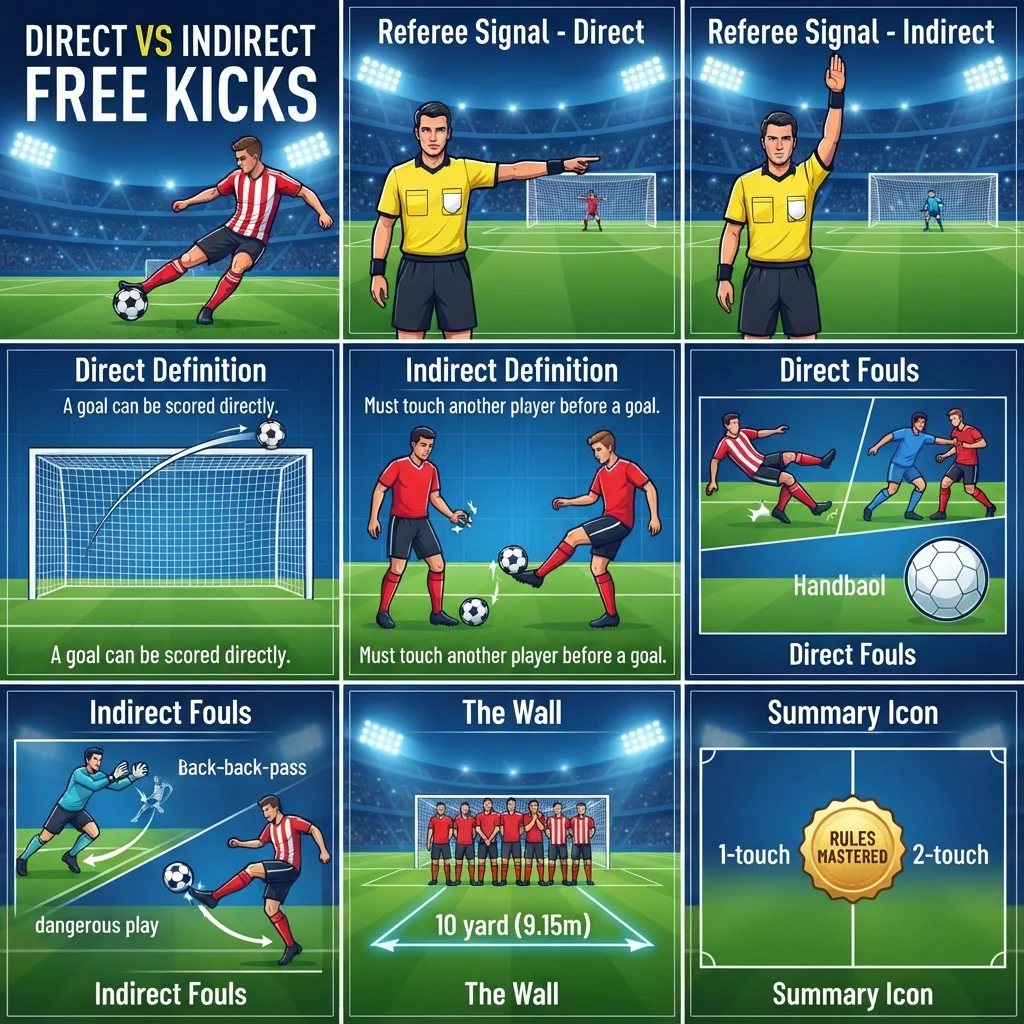
The main difference is simple: a goal can be scored directly from a direct free kick, while an indirect free kick must touch another player before a goal can count. This basic rule creates many different attacking strategies and defensive responsibilities.
The Laws of the Game, maintained by the International Football Association Board (IFAB), define the procedures for both types of free kicks. The rules cover where the kick is taken, how opponents must position themselves, when the ball becomes active, and what happens if the ball enters the goal.
This guide explains direct and indirect free kicks in simple language, including their differences, rules, examples, referee signals, common mistakes, tactics, and frequently asked questions.
What Is a Free Kick in Football?
A free kick is a method of restarting play after certain offences or misconduct. Depending on the offence, the referee awards either a direct free kick or an indirect free kick to the opposing team.
Free kicks are generally taken from the location where the offence occurred, although the Laws of the Game provide specific exceptions for certain situations.
For example, if a defender commits a foul outside the penalty area, the attacking team may receive a free kick from the location of the foul.
Free kicks are important because they can provide an immediate attacking opportunity, allow a team to keep possession, or help a team move the ball into a more dangerous area.
Direct vs Indirect Free Kick: Quick Difference
The easiest way to understand the difference is to focus on whether the ball must touch another player before a goal can be scored.
| Feature | Direct Free Kick | Indirect Free Kick |
|---|---|---|
| Goal directly from kick | Yes | No |
| Must touch another player before scoring | No | Yes |
| Referee signal | Usually points to the direction of play | Arm raised above the head |
| Common cause | Fouls such as holding, pushing, kicking, or tripping | Offside, dangerous play, goalkeeper-related offences, and certain technical offences |
| Direct shot at goal | Legal | Cannot score directly |
| Own goal directly from kick | Corner kick | Corner kick |
| Main attacking threat | Direct shot or cross | Combination play or pass |
IFAB states that a direct free kick can result in a goal if kicked directly into the opponents’ goal. An indirect free kick cannot produce a goal unless another player touches the ball first.
What Is a Direct Free Kick?
A direct free kick allows a player to attempt to score directly without another player touching the ball first.
This is why direct free kicks near the penalty area are among the most dangerous set-piece situations in football.
Common Direct Free Kick Offences
Direct free kicks are commonly awarded for offences such as:
- Kicking or attempting to kick an opponent
- Tripping or attempting to trip an opponent
- Jumping at an opponent
- Charging an opponent illegally
- Pushing
- Striking or attempting to strike
- Tackling or challenging in an illegal manner
- Holding an opponent
- Deliberate handball, subject to the Laws of the Game
The exact decision depends on the nature of the offence and the referee’s judgment. IFAB Law 12 lists the offences that can result in a direct free kick.
Example of a Direct Free Kick
Imagine a defender pushes an attacker just outside the penalty area. The referee awards a direct free kick.
The attacking player can shoot directly toward the goal. If the ball goes into the goal without touching another player, the goal counts.
This is one of the clearest examples of why direct free kicks are dangerous.
What Is an Indirect Free Kick?
An indirect free kick is different because a goal cannot be scored directly from the kick.
The ball must touch another player from either team before it enters the opponents’ goal for the goal to count.
Common Indirect Free Kick Offences
Indirect free kicks can be awarded for several technical or non-contact offences, including:
- Offside
- Dangerous play
- Certain goalkeeper offences
- Certain technical offences
- A second touch by the kicker before another player touches the ball
The exact offence depends on the situation and the applicable Law.
Example of an Indirect Free Kick
Suppose an attacker receives an indirect free kick near the penalty area.
The player cannot simply shoot the ball directly into the goal and score. Instead, the ball must touch a teammate or opponent first.
For example:
Player A → Player B → Goal
If Player B touches the ball before it enters the goal, the goal can count.
Direct vs Indirect Free Kick: Referee Signals
One of the easiest ways for spectators to identify an indirect free kick is to watch the referee.
Direct Free Kick Signal
For a direct free kick, the referee generally indicates the direction of the restart with the arm.
Players can then prepare for the restart based on the location and situation.
Indirect Free Kick Signal
For an indirect free kick, the referee raises an arm above the head. The referee keeps the arm raised until the kick has been taken and the ball touches another player, goes out of play, or it becomes clear that a goal cannot be scored directly.
This signal is especially important because players need to know that a direct shot cannot immediately produce a goal.
Direct Free Kick Rules
Several important rules apply when a direct free kick is taken.
The Ball Must Be Stationary
The ball must be stationary before the free kick is taken.
Once it is kicked and clearly moves, the ball is in play.
Opponents Must Keep Their Distance
Opponents normally must remain at least 9.15 meters (10 yards) from the ball until it is in play.
There are specific exceptions, including situations involving the goal line and certain free kicks inside the penalty area.
A Direct Shot Is Allowed
The kicker can shoot directly at the opponents’ goal.
If the ball enters the goal without touching another player, the goal is awarded.
The Kicker Cannot Touch the Ball Twice
After taking the free kick, the kicker cannot touch the ball again until another player has touched it.
If the kicker touches it again first, an indirect free kick is awarded to the opponents.
Indirect Free Kick Rules
Indirect free kicks follow many of the same basic procedures but have one crucial scoring restriction.
The Ball Must Be Stationary
Like a direct free kick, the ball must be stationary before the kick.
It becomes in play when it is kicked and clearly moves.
Another Player Must Touch the Ball
The most important rule is that another player must touch the ball before a goal can be scored.
The touch can come from a teammate or an opponent.
Direct Shot Does Not Count as a Goal
If a player takes an indirect free kick and the ball goes directly into the opponents’ goal without touching anyone, the goal is not awarded.
Instead, the defending team receives a goal kick.
What Happens If a Free Kick Goes Into the Goal?
The result depends on the type of free kick and which goal the ball enters.
| Situation | Restart |
|---|---|
| Direct free kick directly into opponents’ goal | Goal |
| Indirect free kick directly into opponents’ goal | Goal kick |
| Direct free kick directly into own goal | Corner kick |
| Indirect free kick directly into own goal | Corner kick |
| Indirect free kick touches another player before entering opponents’ goal | Goal can count |
These outcomes are specifically covered under Law 13.
Direct vs Indirect Free Kick: Main Differences Explained
Scoring Opportunity
A direct free kick provides a direct route to goal. A skilled player can shoot over or around a defensive wall.
An indirect free kick requires an additional touch, so teams usually use a pass, flick, or planned combination.
Referee Signal
The raised-arm signal is the major visual difference. An indirect free kick is clearly signaled by the referee’s raised arm.
Tactical Approach
Direct free kicks near the penalty area can be used for:
- Direct shots
- Crosses
- Low driven balls
- Passes into the penalty area
Indirect free kicks usually involve planned combinations because another player must touch the ball.
How to Take a Free Kick Step by Step
Regardless of whether the kick is direct or indirect, players should follow a controlled process.
Step 1: Identify the Type of Free Kick
Look at the referee’s signal and listen to instructions. Knowing whether the kick is direct or indirect changes the attacking plan.
Step 2: Place the Ball Correctly
The ball should be stationary at the correct location.
Step 3: Check the Defensive Position
Opponents must normally stay at least 9.15 meters away until the ball is in play.
Step 4: Choose the Strategy
The kicker should decide whether to shoot, pass, cross, or use a set-piece routine.
Step 5: Take the Kick
The kicker plays the ball according to the Laws of the Game.
Step 6: Continue Playing
Once the ball is in play, normal football continues. The original kicker must not touch the ball again until another player has touched it.
Attacking Strategies for Direct Free Kicks
Direct free kicks close to the penalty area can be used in several ways.
Direct Shot
A skilled player can attempt to place the ball beyond the goalkeeper.
Common techniques include:
- Curling the ball around the wall
- Shooting over the wall
- Driving the ball low
- Using power rather than curl
Cross Into the Penalty Area
The kicker may send the ball toward teammates instead of shooting.
This can create opportunities for:
- Headers
- Volleys
- Second-ball finishes
- Deflections
Short Passing Routine
A team can use a short pass to change the angle of attack and move defenders out of position.
Attacking Strategies for Indirect Free Kicks
Indirect free kicks require more teamwork because another player must touch the ball.
Short Pass
The kicker can pass to a nearby teammate, who then shoots or crosses.
Touch and Shoot
One player touches the ball while another immediately takes a shot.
Cross and Header
The first player delivers the ball into the penalty area, where teammates attempt to score.
Quick Restart
When allowed and tactically useful, a team may restart quickly instead of waiting for a complex set-piece formation.
Common Mistakes Players Make
Understanding the rules is not enough. Players must also avoid common errors.
Mistake 1: Shooting Directly From an Indirect Free Kick
If the ball goes straight into the opponents’ goal without touching another player, it is not a goal.
Mistake 2: Touching the Ball Twice
The kicker cannot play the ball again until another player has touched it.
Mistake 3: Ignoring the Referee’s Signal
Players should always check whether the referee has awarded a direct or indirect free kick.
Mistake 4: Standing Too Close to the Ball
Opponents must normally respect the required 9.15-meter distance.
Mistake 5: Forgetting the Defensive Wall Rule
When three or more defenders form a wall, attacking players must remain at least 1 meter (1 yard) from the wall until the ball is in play.
Direct vs Indirect Free Kick: Practical Examples
Example 1: Foul Outside the Penalty Area
A defender trips an attacker outside the penalty area.
Result: Direct free kick.
The attacker may shoot directly at goal.
Example 2: Offside
An attacker is penalized for an offside offence.
Result: Indirect free kick.
A direct shot cannot produce a goal.
Example 3: Indirect Free Kick and Goal
A player takes an indirect free kick and passes to a teammate. The teammate shoots and scores.
Result: Goal, because another player touched the ball first.
Example 4: Direct Free Kick Into Own Goal
A defender takes a free kick and kicks it directly into their own goal without another player touching it.
Result: Corner kick to the opponents.
Important Rules Inside the Penalty Area
Free kicks inside the penalty area have additional procedures.
For example, when a free kick is awarded to the defending team inside its own goal area, it can be taken from anywhere in that area. For an attacking indirect free kick inside the opponents’ goal area, the kick is taken from the nearest point on the goal-area line parallel to the goal line.
Opponents must also respect the required distance and, in relevant situations, remain outside the penalty area until the ball is in play.
Professional Tips for Players
Players can improve their free-kick performance by combining technical ability with rule knowledge.
For Kickers
- Check the referee’s signal before taking the kick.
- Know whether the kick is direct or indirect.
- Study the goalkeeper’s position.
- Look for gaps in the defensive wall.
- Practice both power and accuracy.
- Communicate with teammates.
- Avoid touching the ball twice.
For Defenders
- Quickly organize the defensive wall.
- Maintain the required distance.
- Watch runners as well as the ball.
- Avoid unnecessary fouls near the penalty area.
- Follow the goalkeeper’s instructions.
For Coaches
Coaches should practice different free-kick situations rather than relying on one routine. Players should understand what to do if the defense changes its wall, marking, or goalkeeper position.
Why Understanding Free Kick Rules Matters
Knowing the difference between direct and indirect free kicks helps players make better decisions during matches.
It also prevents avoidable mistakes. A player who understands that an indirect free kick cannot produce a direct goal will not waste an opportunity by shooting straight into the net.
For referees, coaches, and students of football, these rules are equally important because they explain why different restarts produce different outcomes.
The current Laws of the Game provide detailed procedures for both types of free kick, including ball position, player distance, scoring outcomes, and offences.
Interesting Facts About Direct and Indirect Free Kicks
- A direct free kick can result in a goal without another player touching the ball.
- An indirect free kick cannot result in a direct goal.
- The referee raises an arm to indicate an indirect free kick.
- The normal opponent distance is 9.15 meters, or 10 yards.
- An indirect free kick may still become a goal-scoring opportunity after a teammate touches the ball.
- A direct or indirect free kick kicked directly into the taker’s own goal results in a corner kick.
- The kicker cannot touch the ball twice before another player touches it.
- Attacking players must stay at least 1 meter from a defensive wall containing three or more defenders until the ball is in play.
Frequently Asked Questions About Direct vs Indirect Free Kick
1. What is the main difference between a direct and indirect free kick?
A goal can be scored directly from a direct free kick. An indirect free kick must touch another player before a goal can count.
2. Can you score directly from an indirect free kick?
No. If an indirect free kick goes directly into the opponents’ goal without touching another player, a goal kick is awarded.
3. Can you score directly from a direct free kick?
Yes. A direct free kick can go straight into the opponents’ goal and count.
4. How does the referee signal an indirect free kick?
The referee raises an arm above the head and keeps it raised until the ball touches another player, goes out of play, or it becomes clear that a direct goal cannot be scored.
5. How far away must opponents be from a free kick?
Opponents must normally remain at least 9.15 meters, or 10 yards, from the ball until it is in play. Certain situations have specific exceptions.
6. Can the same player touch the ball twice from a free kick?
No. The kicker must wait until another player touches the ball. A second touch results in an indirect free kick to the opponents, subject to the specific circumstances of the offence.
7. Is offside restarted with a direct or indirect free kick?
An offside offence is restarted with an indirect free kick.
8. What happens if a free kick goes directly into the taker’s own goal?
Whether the free kick is direct or indirect, a ball kicked directly into the taker’s own goal results in a corner kick for the opposing team.
Conclusion
Understanding direct vs indirect free kick rules makes football easier to follow and helps players make smarter decisions during matches. The most important difference is simple: a direct free kick can score directly, while an indirect free kick requires the ball to touch another player before a goal can count.
Players should also remember the basic procedures. The ball must be stationary, opponents normally need to stay 9.15 meters away, and the kicker cannot touch the ball twice before another player touches it. The referee’s raised-arm signal identifies an indirect free kick and helps everyone understand the type of restart.
For attacking players, knowing these rules can improve set-piece routines and scoring opportunities. For defenders, it helps prevent unnecessary fouls and positioning errors. Whether you are a beginner, player, coach, referee, or football fan, learning these differences gives you a much clearer understanding of the game.