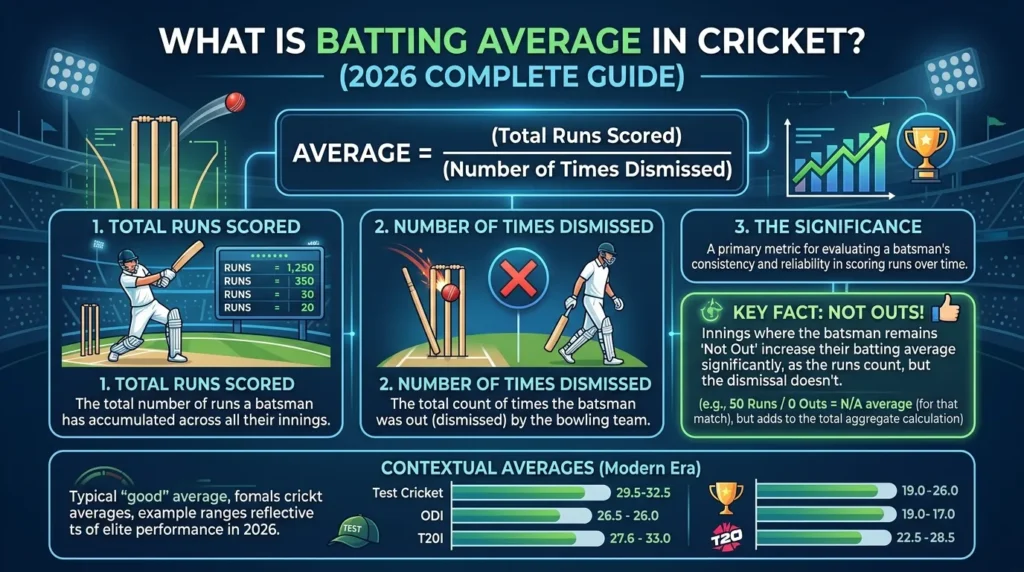
In cricket, every batter wants to score as many runs as possible, but simply scoring runs does not tell the complete story. Imagine two players: one scores 600 runs in a season but gets out 30 times, while another scores 550 runs but is dismissed only 12 times. Which player performed better? This is where the batting average becomes important.
The batting average is one of the most widely used statistics in cricket. It measures how many runs a batter scores on average before getting out. Coaches, selectors, commentators, and fans use this statistic to evaluate a player’s consistency, reliability, and overall batting performance.
Whether you are a beginner learning cricket or an experienced fan analyzing player statistics, understanding batting average helps you compare players more accurately. In this guide, you will learn what batting average is, how it is calculated, why it matters, its history, factors that affect it, famous batting averages, advantages, limitations, and much more.
2. What Is Batting Average? (2026): Definition, Formula, Calculation, and Examples
A batting average is one of the most important statistics in cricket. It measures the average number of runs a batter scores each time they are dismissed. The batting average helps evaluate a player’s consistency, reliability, and overall batting performance over a series of matches or throughout their career.
Unlike total runs, which only show how many runs a player has scored, the batting average also considers how often the batter gets out. This makes it a more accurate indicator of a player’s ability to score runs consistently while staying at the crease for longer periods.
A batter with a high batting average usually scores runs regularly and loses their wicket less frequently, making them a valuable player for the team.
Simple Definition
In simple terms, the batting average tells you how many runs a batter scores on average before getting out.
It is calculated by dividing the total number of runs scored by the number of times the batter has been dismissed.
Batting Average Formula
Batting Average = Total Runs Scored ÷ Number of Times Dismissed
Formula:
Batting Average = Runs ÷ Outs
This simple formula is used in all formats of cricket, including Test matches, One Day Internationals (ODIs), Twenty20 Internationals (T20Is), franchise leagues, and domestic cricket.
Practical Example
Suppose a batter has the following career statistics:
- Total Runs Scored: 800
- Times Dismissed: 20
Using the batting average formula:
Batting Average = 800 ÷ 20 = 40.00
Answer: The batter has a batting average of 40.00.
This means the player scores an average of 40 runs every time they are dismissed.
Another Example
Consider another player with these statistics:
- Runs Scored: 2,450
- Times Out: 50
Calculation:
Batting Average = 2,450 ÷ 50 = 49.00
This player’s batting average is 49.00, indicating excellent consistency and run-scoring ability.
Why Is Batting Average Important?
Batting average is one of the key performance indicators used by coaches, selectors, analysts, commentators, and cricket fans to judge a batter’s effectiveness.
It helps to:
- Measure batting consistency.
- Compare players across different seasons.
- Evaluate long-term performance.
- Select players for international and domestic teams.
- Analyze a batter’s career progression.
- Assess performance under different playing conditions.
How to Interpret a Batting Average
Generally, the higher the batting average, the more consistent and dependable the batter is.
A rough guide is:
- Below 20: Poor batting performance
- 20–30: Average performance
- 30–40: Good performance
- 40–50: Very good performance
- Above 50: Excellent or world-class performance (especially in Test cricket)
However, what is considered a “good” batting average depends on the format of the game. For example, averages in Test cricket are usually higher than in T20 cricket, where batters often play more aggressive shots and are dismissed more frequently.
Key Factors That Affect Batting Average
Several factors influence a batter’s average, including:
- Total runs scored
- Number of dismissals
- Batting position
- Match format (Test, ODI, or T20)
- Pitch conditions
- Quality of the opposition bowling attack
- Playing style (aggressive or defensive)
- Number of not-out innings
Why Batting Average Matters
The batting average remains one of the most trusted statistics in cricket because it combines run-scoring ability with consistency. While modern cricket also uses metrics such as strike rate and advanced analytics, batting average continues to be a fundamental measure of a batter’s overall performance.
In 2026, batting average is still widely used by international teams, domestic leagues, cricket analysts, broadcasters, and fans to evaluate players, compare careers, and identify the most reliable batters across all formats of the game.
History of Batting Average
Batting average has been used since the early years of organized cricket during the 19th century. As official scorekeeping became more accurate, statisticians needed a simple way to compare batters across different matches and seasons.
Today, batting average is recognized by the International Cricket Council (ICC) and is one of the most important performance indicators in international and domestic cricket.
Although modern cricket now uses additional statistics such as strike rate and advanced analytics, batting average remains one of the most trusted measures of batting consistency.
3. How Is Batting Average Calculated? (2026): Formula, Step-by-Step Method, and Examples
Calculating a batting average is simple and is one of the most common methods used to measure a batter’s performance in cricket. The calculation is based on two key statistics:
- Total runs scored
- Number of times the batter has been dismissed
An important point to remember is that not-out innings are not counted as dismissals. Since the batter has not lost their wicket in those innings, they are excluded from the denominator when calculating the batting average. This ensures the statistic accurately reflects how many runs a player scores each time they are actually dismissed.
Batting Average Formula
Batting Average = Total Runs Scored ÷ Number of Times Dismissed
Or,
Batting Average = Total Runs ÷ (Innings Played − Not-Out Innings)
This formula is used in Test cricket, One Day Internationals (ODIs), Twenty20 Internationals (T20Is), domestic cricket, and franchise leagues around the world.
Step-by-Step Calculation Process
Follow these simple steps to calculate a batter’s average:
Step 1: Find the Total Runs
Determine the total number of runs the batter has scored.
Step 2: Count the Innings Played
Find the total number of innings in which the player has batted.
Step 3: Calculate the Number of Dismissals
Subtract the number of not-out innings from the total innings played.
Dismissals = Innings Played − Not Outs
Step 4: Apply the Formula
Divide the total runs scored by the number of dismissals.
The result is the batter’s average.
Example 1
Suppose a batter has the following statistics:
- Runs Scored: 1,200
- Innings Played: 30
- Not-Out Innings: 5
Step 1: Calculate Dismissals
30 − 5 = 25 dismissals
Step 2: Apply the Formula
Batting Average = 1,200 ÷ 25
Batting Average = 48.00
Answer: The player averages 48 runs every time they are dismissed.
Example 2
Another batter has these career statistics:
- Runs Scored: 520
- Innings Played: 15
- Not Outs: 2
Step 1: Calculate Dismissals
15 − 2 = 13 dismissals
Step 2: Apply the Formula
Batting Average = 520 ÷ 13
Batting Average = 40.00
Answer: The batter has an average of 40.00.
Example 3
Consider another example:
- Runs Scored: 3,150
- Innings Played: 75
- Not Outs: 12
Dismissals
75 − 12 = 63
Calculation
3,150 ÷ 63 = 50.00
This means the batter scores an average of 50 runs each time they are dismissed.
Why Are Not-Out Innings Excluded?
A not-out innings means the batter remained unbeaten when the innings ended or the match finished. Since the player did not lose their wicket, it would be unfair to count that innings as a dismissal.
Excluding not-out innings provides a more accurate measurement of a batter’s scoring ability and consistency.
For example:
- Player A scores 500 runs and is dismissed 10 times.
- Player B scores 500 runs but is dismissed only 8 times.
Although both players have the same number of runs, Player B has the higher batting average because they remained not out more often.
Why Is Batting Average Important? (2026)
Batting average is one of the most important performance statistics in cricket because it measures how consistently a player scores runs over time. It helps coaches, selectors, analysts, commentators, and fans evaluate a batter’s reliability across different match situations.
A higher batting average generally indicates that a player scores runs regularly while losing their wicket less frequently.
Benefits of Batting Average
Batting average helps to:
- Measure a batter’s consistency.
- Compare the performance of different players.
- Evaluate long-term career statistics.
- Support team selection decisions.
- Analyze performance across different tournaments.
- Assess reliability under pressure.
- Track improvement throughout a player’s career.
- Compare batting records across different cricket formats.
Batting Average vs. Strike Rate
While batting average measures consistency, strike rate measures scoring speed.
For example:
- A player with a batting average of 52 is highly consistent.
- A player with a strike rate of 150 scores runs very quickly.
Modern teams consider both batting average and strike rate when selecting players, especially in limited-overs cricket. In Test cricket, batting average is often given greater importance, whereas in T20 cricket, strike rate and batting average are usually evaluated together to judge a batter’s overall effectiveness.
Understanding both statistics provides a more complete picture of a player’s batting performance in 2026.
Batting Average in Different Formats
Test Cricket
Batting average is especially important in Test cricket because players focus on building long innings.
A batting average above 50 is considered world-class.
One Day Internationals (ODIs)
In ODI cricket, both batting average and strike rate are important.
A good ODI batter usually combines consistency with quick scoring.
T20 Cricket
Although strike rate is often emphasized in T20 cricket, batting average still reflects a player’s ability to survive and score consistently.
Players with both high averages and high strike rates are extremely valuable.
4. What Is Considered a Good Batting Average? (2026)
A good batting average depends on the format of cricket being played. Since each format has different playing conditions, scoring rates, and strategies, the average considered “good” varies between Test cricket, One Day Internationals (ODIs), T20 cricket, and First-Class cricket.
For example, Test cricket rewards patience and long innings, so batters generally have higher averages. In contrast, T20 cricket requires aggressive batting, where players take more risks, resulting in comparatively lower batting averages.
The following table provides a general guide for evaluating batting averages.
| Cricket Format | Good Batting Average |
|---|---|
| Test Cricket | 45–50+ |
| ODI Cricket | 40–45+ |
| T20 Cricket | 30–40+ |
| First-Class Cricket | 45+ |
Elite international batters often maintain averages well above these values, demonstrating exceptional consistency over many years.
How to Interpret a Batting Average
Although there is no fixed rule, batting averages can generally be interpreted as follows:
| Batting Average | Performance Level |
|---|---|
| Below 20 | Poor |
| 20–30 | Average |
| 30–40 | Good |
| 40–50 | Very Good |
| Above 50 | Excellent / World-Class |
These values may vary depending on the playing format and level of competition.
5. Factors That Affect Batting Average (2026)
A player’s batting average is influenced by several technical, tactical, and environmental factors. Understanding these factors helps explain why averages differ between players and formats.
1. Batting Position
The batting position has a major impact on a player’s average.
- Opening batters face the new ball, fresh bowlers, and the toughest batting conditions.
- Middle-order batters often benefit from a more settled pitch.
- Lower-order batters usually have fewer opportunities to build long innings.
As a result, batting position can significantly influence a player’s overall average.
2. Pitch Conditions
The condition of the pitch plays an important role in batting performance.
On flat, batting-friendly pitches, players generally score more runs and achieve higher averages.
On difficult pitches with uneven bounce or excessive movement, scoring becomes much harder, often leading to lower batting averages.
3. Bowling Quality
The quality of the opposition bowling attack greatly affects batting statistics.
Facing world-class fast bowlers and spin bowlers usually makes scoring more difficult.
On the other hand, weaker bowling attacks often allow batters to score more freely and improve their averages.
4. Match Format
Each format of cricket demands a different batting approach.
- Test Cricket: Rewards patience, concentration, and long innings.
- ODI Cricket: Requires a balance between consistency and scoring speed.
- T20 Cricket: Encourages aggressive stroke play and rapid scoring.
Because of these differences, batting averages naturally vary across formats.
5. Playing Conditions
Several external conditions can influence batting performance, including:
- Swing
- Seam movement
- Spin-friendly pitches
- Weather conditions
- Ground size
- Altitude
- Outfield speed
- Day or night matches
Experienced batters learn to adapt their technique according to these conditions.
6. Fitness and Concentration
Physical fitness and mental focus are essential for maintaining a high batting average.
Fit players can bat for longer periods, while strong concentration helps them avoid unnecessary dismissals and build larger innings.
7. Experience
Experienced players generally have better game awareness, improved shot selection, and greater confidence under pressure, all of which contribute to higher batting averages over time.
6. Batting Average vs. Strike Rate (2026)
Many beginners confuse batting average with strike rate, but these statistics measure two completely different aspects of batting performance.
- Batting average measures consistency.
- Strike rate measures scoring speed.
Both statistics are important, but their importance varies depending on the format of the game.
| Feature | Batting Average | Strike Rate |
|---|---|---|
| Measures | Consistency | Scoring Speed |
| Formula | Runs ÷ Dismissals | (Runs ÷ Balls Faced) × 100 |
| Main Purpose | Evaluates reliability | Measures attacking ability |
| Most Important In | Test Cricket | T20 Cricket |
| Indicates | Ability to score consistently | Ability to score quickly |
| Higher Value Means | Greater consistency | Faster scoring rate |
Which Statistic Is More Important?
The answer depends on the format.
- Test Cricket: Batting average is usually more important because staying at the crease and scoring consistently are essential.
- ODI Cricket: Both batting average and strike rate are equally important.
- T20 Cricket: Strike rate often receives greater attention, although a solid batting average is still valuable.
The world’s best batters maintain an excellent balance between consistency and scoring speed.
7. Batting Techniques That Improve Batting Average (2026)
Professional cricketers continually work on their batting techniques to improve consistency and increase their batting average. Small technical improvements can lead to significantly better performances over an entire season or career.
1. Smart Shot Selection
Choosing the right shot for each delivery is one of the most effective ways to avoid unnecessary dismissals.
Professional batters focus on playing high-percentage shots and avoid taking unnecessary risks, especially early in their innings.
2. Good Footwork
Proper foot movement allows batters to adjust quickly to different deliveries.
Good footwork helps players:
- Handle fast bowling more effectively.
- Play spin bowling confidently.
- Maintain balance while playing attacking and defensive shots.
3. Patience and Concentration
Successful batters understand the importance of building an innings.
Remaining patient, leaving good deliveries, and avoiding risky shots early in the innings often lead to larger scores and higher batting averages.
4. Physical Fitness
Fitness plays a crucial role in batting performance.
A fit player can:
- Bat for longer periods.
- Run quickly between the wickets.
- Maintain concentration throughout long innings.
- Recover more effectively between matches.
5. Regular Practice
Consistent practice is essential for improving batting average.
Professional players regularly work on:
- Net practice against pace and spin.
- Throw-down sessions.
- Match simulations.
- Shot selection.
- Defensive techniques.
- Playing under pressure.
Regular training improves confidence, consistency, and overall batting performance.
6. Learning from Match Analysis
Modern cricketers use video analysis and performance data to identify weaknesses, improve technique, and develop strategies against different bowlers. This analytical approach helps players make better decisions and steadily improve their batting average over time.
By combining strong technique, smart decision-making, physical fitness, and consistent practice, batters can significantly improve their batting average and become more dependable performers across all formats of cricket in 2026.
Player Roles and Batting Average
Different batting positions produce different averages.
Opening Batter
- Faces new ball
- Deals with swing
- Builds the innings
Top-Order Batter
- Scores consistently
- Anchors innings
- Handles pressure
Middle-Order Batter
- Stabilizes innings
- Rotates strike
- Accelerates when required
Finisher
- Scores quickly
- Often remains not out
- Can improve batting average through unbeaten innings
Equipment That Helps Batters
Modern equipment improves batting performance.
Cricket Bat
- Large sweet spot
- Lightweight
- Better balance
Batting Gloves
Provide grip and hand protection.
Helmet
Protects against fast bowling.
Batting Pads
Protect legs from injury.
Cricket Shoes
Improve stability and foot movement.
Major Cricket Tournaments Where Batting Average Matters
Batting average is closely followed during major competitions.
Important tournaments include:
- ICC Cricket World Cup
- ICC Champions Trophy
- ICC T20 World Cup
- World Test Championship
- Indian Premier League (IPL)
- Big Bash League (BBL)
- Pakistan Super League (PSL)
- The Hundred
- Caribbean Premier League (CPL)
Selectors and analysts frequently compare batting averages during these tournaments.
Advantages of Batting Average
Batting average offers several benefits.
- Easy to calculate.
- Measures consistency.
- Helps compare players.
- Useful for career analysis.
- Widely accepted worldwide.
- Supports team selection.
- Tracks long-term improvement.
- Valuable for coaches and analysts.
Limitations of Batting Average
Despite its usefulness, batting average has limitations.
- Does not measure scoring speed.
- Ignores match situations.
- Not-outs can inflate averages.
- Cannot fully evaluate aggressive batters.
- Does not consider pitch difficulty.
- Less useful in fast-paced T20 cricket.
Because of these limitations, experts usually analyze batting average alongside strike rate and other statistics.
Interesting Facts About Batting Average
- Sir Donald Bradman’s Test batting average of 99.94 is widely regarded as one of the greatest achievements in sports history.
- Batting average has been used in cricket statistics for over 100 years.
- A player can score fewer runs than another player but still have a higher batting average.
- Remaining not out improves batting average.
- Modern analysts combine batting average with advanced performance metrics.
Frequently Asked Questions
Why is batting average important?
It measures how consistently a batter scores runs before getting out.
Is a higher batting average always better?
Generally yes, but strike rate and match situation should also be considered.
Does a not-out innings affect batting average?
Yes. A not-out innings is not counted as a dismissal, which can increase the batting average.
Which format values batting average the most?
Test cricket places the greatest emphasis on batting average because consistency is essential over long innings.
Can batting average decrease?
Yes. Frequent dismissals without scoring many runs reduce the average.
Benefits of Understanding Batting Average
Learning batting average helps:
- Analyze player performance.
- Compare careers fairly.
- Understand cricket statistics.
- Improve coaching decisions.
- Develop better batting strategies.
- Appreciate the game more deeply.
Conclusion
The batting average is one of cricket’s most valuable and respected performance statistics. It provides a simple yet effective way to measure how consistently a batter scores runs before being dismissed. While modern cricket also values strike rate, batting average remains an essential indicator of reliability, especially in longer formats such as Test and One Day International cricket. By understanding how batting average is calculated, the factors that influence it, and its strengths and limitations, players, coaches, and fans can better evaluate batting performances. Whether you are following international tournaments or improving your own cricket knowledge, mastering the concept of batting average will help you appreciate the game at a much deeper level.

Green Benn is a dedicated sports writer specializing in cricket, including IPL and international formats. Known for clear, engaging, and informative content, Green simplifies complex match analysis and player statistics for all readers. Passionate about sports storytelling, Green delivers reliable, SEO-friendly articles that keep fans updated and informed