Cricket is one of the few outdoor sports where weather can have a major impact on the outcome of a match. Heavy rain, poor light, thunderstorms, or unsafe playing conditions can interrupt play for hours or even prevent a match from being completed. To reduce the chances of important matches ending without a result, cricket governing bodies introduced the concept of a Reserve Day.
Many fans ask, “What is Reserve Day in cricket?” The term is commonly heard during ICC tournaments, World Cup finals, Champions Trophy matches, and other major competitions. A reserve day acts as an additional day set aside to complete a match if the scheduled playing day is significantly affected by bad weather or other unavoidable circumstances.
Understanding how a reserve day works helps fans appreciate tournament planning, match regulations, and fair competition. In this guide, you’ll learn everything about Reserve Day, including its meaning, history, rules, purpose, advantages, examples, major tournaments that use it, and interesting facts. Whether you’re a beginner or a lifelong cricket fan, this guide explains the concept in simple and easy English.
What Is Reserve Day in Cricket?
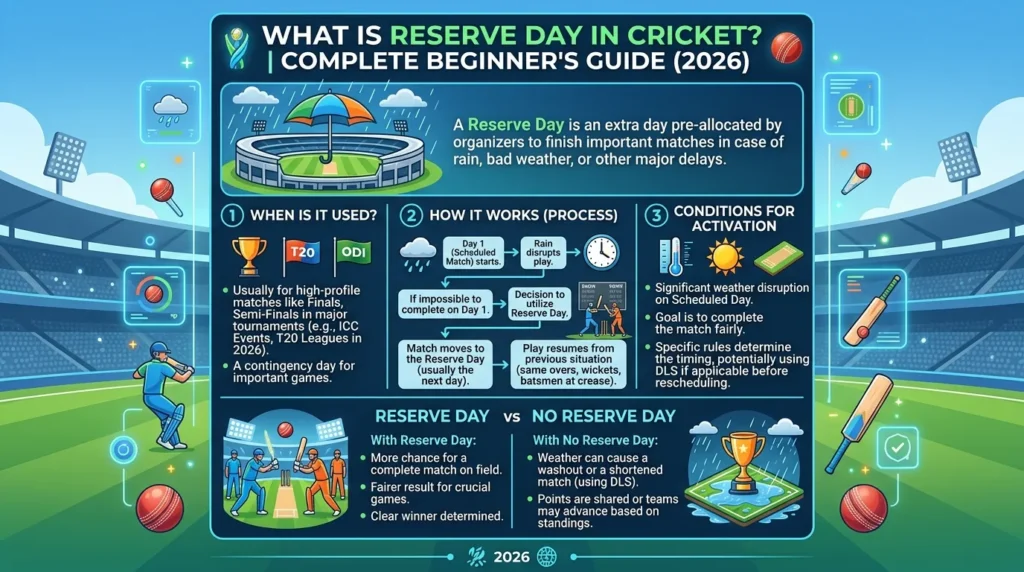
A Reserve Day is an additional day scheduled by the tournament organizers to complete a cricket match if it cannot be finished on its original scheduled day due to rain, bad weather, poor light, or other exceptional circumstances.
Unlike a normal match day, a reserve day is only used when required. If the match finishes on the original day, the reserve day is not used.
Simple Explanation
Think of a reserve day as a backup day. If bad weather stops an important cricket match from finishing, players return on the reserve day to complete the remaining overs.
Why Is a Reserve Day Important?
Cricket matches can last several hours, making them highly vulnerable to weather interruptions. A reserve day helps ensure that important matches are decided by cricket rather than weather.
Main Reasons
- Reduces the chance of abandoned matches.
- Helps determine a deserving winner.
- Improves fairness in major tournaments.
- Protects broadcasters and spectators.
- Preserves the competitive integrity of knockout matches.
History of Reserve Days
Reserve days became more common after several important international matches were heavily affected by rain. Cricket administrators recognized that championship finals should not be decided by weather alone.
Over the years, the International Cricket Council (ICC) introduced reserve days for selected knockout matches, especially finals. Today, reserve days are standard for many major ICC tournament finals and are also used in some bilateral series and domestic competitions when necessary.
How Does a Reserve Day Work?
If a match cannot be completed on the scheduled day, officials decide whether the reserve day will be used according to the tournament’s playing conditions.
Step-by-Step Process
- The match begins on the scheduled date.
- Rain or bad weather interrupts play.
- Umpires attempt to complete the match using available playing time.
- If completion is impossible, officials announce the use of the reserve day.
- Play resumes from the exact point where it stopped.
- The remaining overs are completed until a result is achieved.
The score, wickets, and overs already played are carried forward to the reserve day.
Rules for Using a Reserve Day
The exact rules vary slightly between tournaments, but the general principles are similar.
Match Resumes From the Same Position
The match continues from:
- Same score
- Same wickets
- Same batting side
- Same remaining overs
It does not restart from the beginning.
Reserve Day Is Only Used If Necessary
If the match finishes normally, the reserve day is cancelled.
Playing Conditions Remain the Same
The same playing conditions continue unless modified by the tournament regulations.
Difference Between Reserve Day and Extra Time
Many people confuse reserve day with extra playing time.
| Feature | Reserve Day | Extra Time |
|---|---|---|
| Duration | Next scheduled day | Additional time on the same day |
| Purpose | Complete unfinished matches | Finish play before ending the day |
| Used For | Major interruptions | Minor delays |
| Common Cause | Rain or bad weather | Short rain delays or slow over rates |
When Is a Reserve Day Used?
Reserve days are generally reserved for high-profile matches.
Common Situations
- ICC tournament finals
- ICC knockout matches
- Champions Trophy finals
- World Test Championship Final
- Important domestic finals
League-stage matches rarely have reserve days because of scheduling limitations.
Major Cricket Tournaments That Use Reserve Days
Several prestigious tournaments include reserve days.
ICC Cricket World Cup
Reserve days are commonly allocated for knockout matches and finals.
ICC Champions Trophy
The final often includes a reserve day.
ICC World Test Championship Final
The championship final includes a reserve day to compensate for weather interruptions.
ICC Women’s Cricket World Cup
Important knockout matches may also have reserve days.
What Happens If Rain Continues on the Reserve Day?
Sometimes weather affects both the scheduled day and the reserve day.
Possible outcomes include:
- DLS Method if enough overs are completed.
- Match declared No Result.
- Trophy shared (depending on tournament rules).
- Higher-ranked team advances in certain competitions.
Each tournament has its own regulations.
DLS Method and Reserve Day
The Duckworth-Lewis-Stern (DLS) method is different from a reserve day.
Reserve Day
Provides another opportunity to complete the match.
DLS Method
Calculates revised targets in rain-affected limited-overs matches.
Both systems may work together during weather interruptions.
Advantages of a Reserve Day
Fair Competition
Teams receive every possible opportunity to complete the match.
Better Results
Champions are decided by cricket rather than weather.
Improved Fan Experience
Supporters are more likely to see a complete contest.
Broadcast Protection
Television networks can continue coverage instead of losing the event.
Better Tournament Reputation
Reserve days increase confidence in tournament organization.
Disadvantages of a Reserve Day
Although useful, reserve days also have some limitations.
- Increased tournament costs
- Scheduling difficulties
- Player fatigue
- Venue availability issues
- Travel adjustments for teams
Despite these challenges, reserve days remain valuable for major events.
Role of Officials During a Reserve Day
Several officials help manage reserve day operations.
Match Referee
Ensures tournament regulations are followed.
Umpires
Monitor playing conditions and decide when play can resume.
Ground Staff
Prepare the pitch and remove water using covers and drying equipment.
Tournament Organizers
Coordinate scheduling, broadcasting, and logistics.
Equipment Used During Weather Delays
Several pieces of equipment help protect the field.
Covers
Protect the pitch from rain.
Super Soppers
Remove standing water quickly.
Drainage Systems
Allow water to leave the field efficiently.
Weather Monitoring Systems
Provide accurate forecasts for match officials.
Benefits of Cricket Despite Weather Challenges
Even though reserve days exist because of weather, cricket offers many benefits.
Physical Benefits
- Improves fitness
- Enhances coordination
- Develops agility
- Builds stamina
Mental Benefits
- Improves concentration
- Develops strategic thinking
- Encourages teamwork
- Builds patience
Interesting Facts About Reserve Days
- Reserve days are mainly used for important international matches.
- Most league matches do not have reserve days.
- The reserve day is announced before the tournament begins.
- Play resumes from the same score rather than restarting.
- Weather forecasting plays a major role in tournament planning.
- Not every rain-affected match automatically receives a reserve day.
Frequently Asked Questions
Is a Reserve Day Used for Every Cricket Match?
No. Reserve days are generally reserved for major finals and important knockout matches.
Does the Match Restart on the Reserve Day?
No. Play resumes from the exact point where it stopped.
Is Reserve Day Used in Test Cricket?
The World Test Championship Final includes a reserve day, but regular Test matches usually do not because they already last up to five days.
What Happens If Both Days Are Washed Out?
Tournament rules determine the outcome. The match may end as a No Result, use the DLS method if applicable, or follow competition-specific regulations.
Who Decides Whether to Use the Reserve Day?
The match referee and tournament officials apply the official playing conditions established before the tournament.
Conclusion
A Reserve Day is an essential part of modern cricket, ensuring that important matches have the best possible chance of producing a fair result. Instead of allowing rain or bad weather to decide championships, tournament organizers provide an additional day to complete unfinished matches. This approach protects the integrity of the competition, benefits players and fans, and ensures that major trophies are won through performance on the field.
As international cricket continues to grow, reserve days will remain an important feature of ICC events and other prestigious tournaments. Understanding what a Reserve Day is in cricket helps every fan appreciate the careful planning and fairness behind the world’s biggest cricket competitions.

Green Benn is a dedicated sports writer specializing in cricket, including IPL and international formats. Known for clear, engaging, and informative content, Green simplifies complex match analysis and player statistics for all readers. Passionate about sports storytelling, Green delivers reliable, SEO-friendly articles that keep fans updated and informed