
Football tactics have changed dramatically over the past two decades, and one of the biggest tactical innovations is the inverted winger. If you watch top clubs like Manchester City, Liverpool, Arsenal, Real Madrid, or Bayern Munich, you’ve probably seen wide players who don’t simply stay near the touchline and cross the ball. Instead, they cut inside, attack central areas, shoot with their stronger foot, and create scoring opportunities. This modern role has become one of the most effective attacking weapons in football.
But what is an inverted winger, and why has this position become so important in today’s game? Whether you’re a football fan, beginner, coach, player, or parent, understanding this tactical role will help you appreciate how modern teams create chances and dominate matches.
In this guide, you’ll learn the definition of an inverted winger, how the role works, its history, key responsibilities, advantages, disadvantages, essential skills, tactical examples, common mistakes, coaching tips, and why many of the world’s best attackers thrive in this position.
What Is an Inverted Winger?
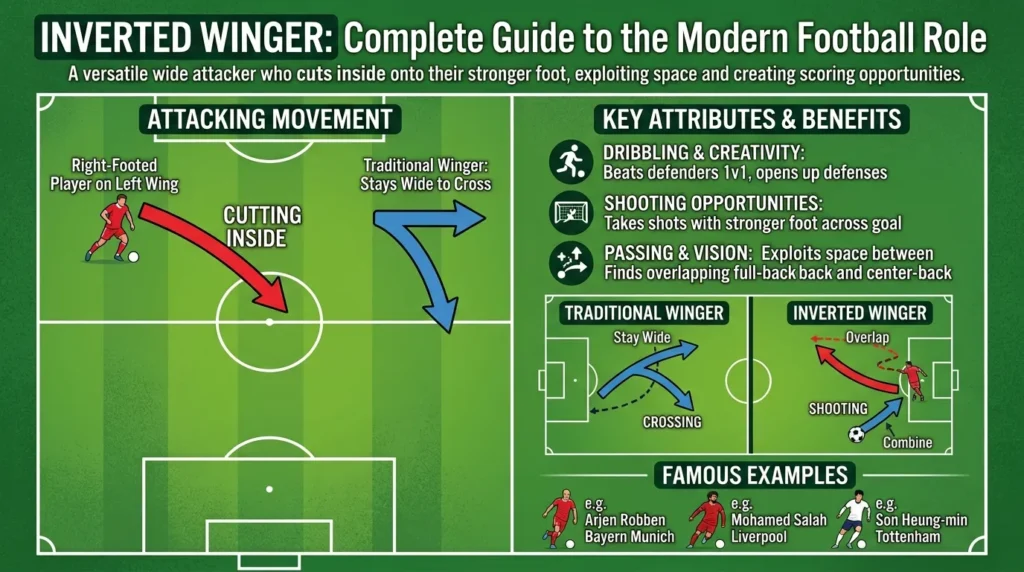
An inverted winger is a wide attacking player who plays on the opposite side of their strongest foot.
For example:
- A left-footed player plays on the right wing.
- A right-footed player plays on the left wing.
Instead of staying wide and delivering crosses, an inverted winger frequently moves toward the center of the pitch to shoot, create chances, or combine with teammates.
Simple Example
Imagine a right-footed player starting on the left side. As they receive the ball, they dribble inside toward goal using their stronger right foot. This gives them better angles to:
- Shoot
- Play through passes
- Combine with the striker
- Create space for an overlapping full-back
This movement is what makes an inverted winger different from a traditional winger.
The History of the Inverted Winger
Football once relied heavily on traditional wingers whose primary job was to beat defenders down the line and deliver crosses into the penalty area.
As tactics evolved, coaches realized that wide attackers could become additional goal scorers rather than just creators.
Managers such as:
- Pep Guardiola
- Jürgen Klopp
- José Mourinho
- Carlo Ancelotti
- Arsène Wenger
popularized systems where wide players regularly cut inside to attack central spaces.
Today, the inverted winger is considered one of football’s most influential attacking positions.
How Does an Inverted Winger Work?
The inverted winger changes the team’s attacking shape by moving from wide areas into central positions.
Step 1: Start Wide
The player begins near the touchline to stretch the defense.
Step 2: Receive the Ball
The winger collects the ball while facing the defender.
Step 3: Cut Inside
Instead of dribbling toward the corner flag, they move toward the middle using their stronger foot.
Step 4: Make a Decision
From central areas, the player may:
- Shoot
- Pass
- Dribble
- Play a through ball
- Combine with teammates
Step 5: Support the Attack
The overlapping full-back often runs into the space left behind, giving the team extra attacking width.
Inverted Winger vs Traditional Winger
| Feature | Inverted Winger | Traditional Winger |
|---|---|---|
| Strong Foot | Opposite side | Same side |
| Main Movement | Cuts inside | Stays wide |
| Primary Goal | Score and create | Deliver crosses |
| Shooting Angle | Excellent | Limited |
| Crossing Style | Inside or cut-back | Traditional cross |
| Full-Back Support | Requires overlaps | Less dependent |
The biggest difference between an inverted winger and a traditional winger is their movement. One attacks central areas, while the other focuses on width.
Main Responsibilities of an Inverted Winger
Score Goals
Modern inverted wingers often finish as one of the team’s leading scorers.
Create Chances
They provide assists through:
- Through balls
- Short passes
- Cut-backs
- Quick combinations
Stretch the Defense
Starting wide forces defenders to spread across the field.
Link Midfield and Attack
Inverted wingers frequently combine with attacking midfielders and strikers.
Press Defenders
Many modern systems require inverted wingers to press aggressively after losing possession.
Key Characteristics of an Inverted Winger
Successful players in this role usually possess several important qualities.
Strong Preferred Foot
Since they cut inside, their stronger foot is positioned toward goal.
Excellent Dribbling
Quick changes of direction help beat defenders.
Finishing Ability
Modern inverted wingers must consistently score goals.
Vision
Finding teammates in crowded central areas requires outstanding awareness.
Pace
Speed allows players to attack quickly during counterattacks.
Decision-Making
Knowing when to shoot, pass, or dribble separates elite players from average ones.
Essential Skills Every Inverted Winger Needs
Ball Control
A good first touch creates attacking opportunities.
One-on-One Dribbling
Beating defenders opens space for teammates.
Accurate Shooting
Most goals come after cutting inside.
Passing
Short combinations and through passes are essential.
Off-the-Ball Movement
Smart positioning helps create space before receiving possession.
Tactical Awareness
Players must understand when to stay wide and when to move centrally.
Advantages of Playing as an Inverted Winger
The role offers many tactical benefits.
- Better shooting angles
- Increased goal-scoring opportunities
- Creates numerical advantages in midfield
- Opens space for attacking full-backs
- Harder for defenders to predict
- More creative passing options
- Supports quick transitions
- Improves attacking flexibility
- Creates overloads in central areas
Because of these strengths, many coaches build their attacking systems around inverted wingers.
Disadvantages of the Inverted Winger Role
Despite its advantages, the role has limitations.
- Less natural crossing ability
- Can make attacks too narrow
- Requires attacking full-backs for width
- Demands excellent tactical understanding
- Higher defensive workload
- Can become predictable if always cutting inside
Successful teams balance these weaknesses through teamwork and tactical discipline.
Famous Examples of Inverted Wingers
Many world-class footballers have excelled in this role.
Lionel Messi
Although often playing as a forward, Messi frequently started on the right before cutting inside with his left foot.
Mohamed Salah
The Liverpool star attacks from the right using his powerful left foot.
Arjen Robben
Robben became famous for cutting inside from the right and curling shots into the far corner.
Riyad Mahrez
His close control and left foot make him a classic inverted winger.
Bukayo Saka
Saka combines creativity, goals, and intelligent movement from wide areas.
These players helped redefine how modern wingers influence matches.
Tactical Formations That Use Inverted Wingers
Several formations suit this role perfectly.
4-3-3
The most common system.
Wide forwards support the striker while full-backs provide width.
4-2-3-1
Allows inverted wingers to combine with the attacking midfielder.
3-4-3
Wing-backs provide width while inverted wingers attack central spaces.
4-1-4-1
Offers balance between possession and counterattacking football.
Step-by-Step Guide to Playing as an Inverted Winger
- Start in a wide position.
- Receive the ball facing the defender.
- Observe teammates and defenders.
- Attack the inside channel.
- Use your stronger foot.
- Decide quickly whether to pass or shoot.
- Continue moving after releasing the ball.
- Press immediately if possession is lost.
Repeating these habits helps develop consistency.
Common Mistakes Inverted Wingers Make
Many young players struggle because of simple errors.
- Cutting inside every time
- Ignoring overlapping full-backs
- Holding the ball too long
- Shooting from poor positions
- Poor defensive tracking
- Weak off-the-ball movement
- Predictable dribbling
Avoiding these mistakes makes players more effective.
Coaching Tips for Developing an Inverted Winger
Coaches can improve players by focusing on:
Encourage Decision-Making
Players should recognize when to pass, shoot, or dribble.
Improve Weak Foot
A reliable weaker foot prevents defenders from forcing predictable movements.
Practice Finishing
Most sessions should include shooting after cutting inside.
Develop Tactical Awareness
Players should understand spacing and movement patterns.
Build Fitness
Modern wingers cover significant distances during matches.
Interesting Facts About Inverted Wingers
- The role became popular during the 2000s.
- Many of today’s top scorers play as inverted wingers.
- The position increases attacking flexibility.
- Teams often rely on overlapping full-backs to support them.
- Cutting inside creates better shooting angles than staying wide.
- Many youth academies now train wide players specifically for this role.
Future Trends of the Inverted Winger
Football tactics continue to evolve, and inverted wingers are expected to become even more versatile.
Future developments include:
- Greater positional freedom
- More frequent midfield rotations
- Increased pressing responsibilities
- Advanced data analysis for movement patterns
- Integration with attacking wing-backs
- Higher emphasis on versatility and adaptability
Players who can perform multiple attacking roles will become increasingly valuable.
Frequently Asked Questions
What is an inverted winger in football?
An inverted winger is a wide attacking player who plays on the opposite side of their stronger foot and regularly cuts inside to create or score goals.
Why are inverted wingers so effective?
They create better shooting angles, overload central areas, and make defending more difficult through unpredictable movement.
Can an inverted winger still cross the ball?
Yes. While they often cut inside, they can still deliver crosses, especially cut-backs after reaching the penalty area.
Which foot should an inverted winger use?
Typically, a right-footed player plays on the left wing, while a left-footed player plays on the right wing.
Is an inverted winger better than a traditional winger?
Neither role is universally better. The best choice depends on a team’s tactical system, player strengths, and match strategy.
Which formations suit inverted wingers best?
The 4-3-3, 4-2-3-1, and 3-4-3 formations are among the most effective systems for inverted wingers.
What skills should young inverted wingers develop first?
Dribbling, ball control, shooting, decision-making, tactical awareness, and off-the-ball movement are the most important foundations.
Conclusion
The inverted winger has become one of the defining positions in modern football. Unlike traditional wide players who mainly deliver crosses, inverted wingers attack central areas, create scoring chances, and often become key goal scorers. Their ability to combine dribbling, finishing, creativity, and intelligent movement makes them invaluable in today’s tactical systems. However, success in this role requires technical ability, tactical awareness, teamwork, and consistent decision-making. Whether you are a player looking to improve, a coach developing young talent, or a football fan eager to understand modern tactics, learning how an inverted winger operates provides a deeper appreciation of the game. As football continues to evolve, this exciting position will remain central to attacking strategies at every level of the sport.