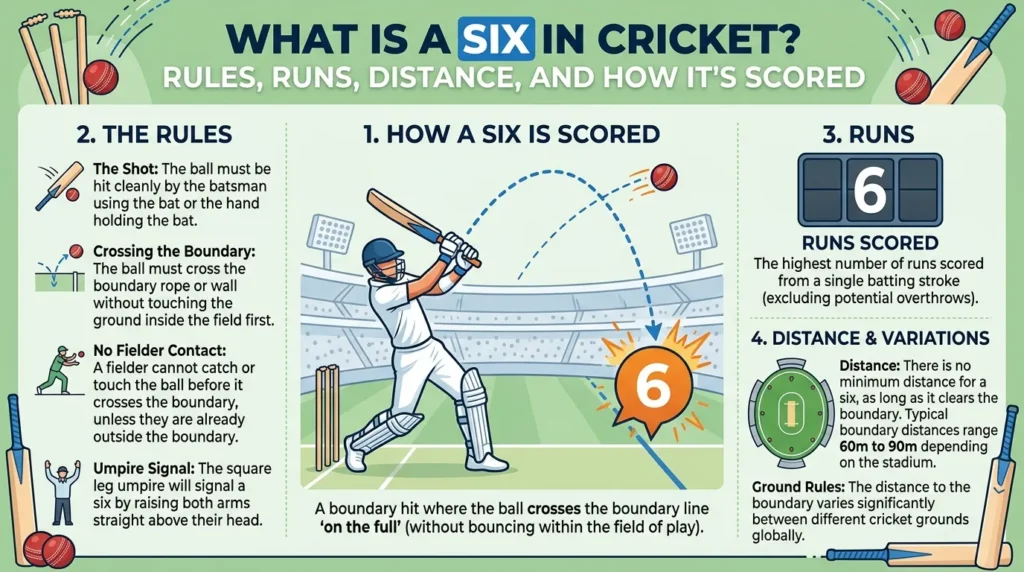
A six is one of the most exciting moments in cricket. When a batter hits the ball over the boundary without the ball touching the ground, the batter scores six runs. It is the highest number of runs that can normally be scored from one legal hit with the bat.
Sixes are common in limited-overs cricket, especially in T20 matches, where batters often use powerful shots to score quickly. However, a six can occur in Test and ODI cricket as well.
For beginners, understanding what is six in cricket is important because it is closely linked to the boundary rules. A ball that reaches or crosses the boundary after touching the ground normally gives four runs. A ball that crosses the boundary without touching the ground inside the field of play gives six runs.
The six is not simply about hitting the ball a long distance. The ball must satisfy the boundary rules. This article explains the rules, scoring method, techniques, famous sixes, equipment, records, strategies, and interesting facts about sixes in cricket.
What Is Six in Cricket?
A six in cricket is scored when a batter hits a legal delivery over the boundary rope without the ball first touching the ground within the field of play.
The batter receives six runs for the shot.
For example, if a batter hits a delivery high into the air and the ball travels directly over the boundary rope without bouncing inside the field, it is a six.
Simple Definition
A six is six runs awarded when a batter hits the ball over the boundary without it touching the ground inside the field.
It is one of the most valuable outcomes from a single batting shot.
Six vs Four
The key difference is whether the ball touches the ground before reaching the boundary.
| Result | What Happens | Runs |
|---|---|---|
| Six | Ball crosses boundary without bouncing | 6 |
| Four | Ball reaches boundary after touching the ground | 4 |
| Running | Batters complete runs between wickets | Varies |
For example:
Ball flies directly over the boundary → 6 runs
Ball bounces and then reaches the boundary → 4 runs
How Does a Batter Score Six Runs?
A batter scores a six when the ball is struck with the bat and crosses the boundary without first touching the ground inside the field.
The shot can be played in many directions.
Straight Six
The batter hits the ball straight back over the bowler’s head.
This is often called a straight six.
Leg-Side Six
The batter hits the ball toward the leg side, such as over:
- Midwicket
- Square leg
- Fine leg
Off-Side Six
A batter can also hit a six toward the off side.
Common areas include:
- Cover
- Extra cover
- Point
- Third man
Pull or Hook Six
Short-pitched deliveries can be attacked with a pull or hook shot.
The batter uses the pace of the ball and directs it toward the boundary.
Lofted Six
A lofted shot sends the ball high into the air.
If it clears the boundary without bouncing, it counts as six.
Six Rules in Cricket
The Laws of Cricket contain specific boundary rules.
A batter does not automatically score six simply because the ball travels a long distance. The ball must cross the boundary under the correct conditions.
The Ball Must Cross the Boundary
The ball must cross the boundary line or boundary rope.
If it remains inside the field, the batter does not receive six simply because the shot was powerful.
The Ball Must Not Touch the Ground Before Crossing
This is the most important rule.
If the ball bounces inside the field before reaching the boundary, it is normally a four, not a six.
For example:
Batter hits ball → ball bounces → ball crosses boundary = 4 runs
But:
Batter hits ball → ball flies directly over boundary = 6 runs
A Fielder Can Affect the Result
A fielder can sometimes catch or touch the ball near the boundary.
The boundary laws also contain special provisions for fielders who touch the boundary or become airborne while touching the boundary area. Therefore, the final result depends on the exact circumstances.
How Many Runs Is a Six in Cricket?
A six is worth six runs.
These six runs are added to the batter’s individual score and the team’s total.
For example, if a batter has:
42 runs
and hits a six, the batter’s score becomes:
48 runs
The team’s score also increases by six runs.
Sixes in a Batter’s Score
A scorecard can show the number of fours and sixes hit by a batter.
For example:
Rohit Sharma – 86
- Fours: 7
- Sixes: 5
The five sixes contributed:
5 × 6 = 30 runs
The remaining runs came from fours, singles, doubles, triples, and other scoring plays.
Can a Six Be Scored Without a Bat?
Yes, but there is an important distinction.
Under the Laws of Cricket, a boundary can result in six runs in certain situations involving the ball being struck by the batter or, in specific circumstances, contact with the batter’s person.
However, a batter cannot simply score a six by intentionally throwing the ball or using an illegal action.
For beginners, the easiest rule to remember is:
A normal six comes from a batter hitting the ball with the bat over the boundary without the ball bouncing first.
Can a No-Ball Result in a Six?
Yes.
A batter can hit a no-ball over the boundary for six.
In that situation, the batting team receives:
- 1 no-ball extra
- 6 runs from the boundary
Therefore, the team can receive 7 runs from the delivery.
For example:
No-ball + batter hits six = 7 team runs
The six itself counts toward the batter’s score, while the no-ball extra is added separately.
What About a Wide?
A wide normally cannot be hit with the bat in the same way because the delivery is outside the batter’s legal reach area as defined by the Laws.
If the ball passes the boundary as a wide without being legally hit, the resulting boundary award is handled under the wide and boundary laws rather than being recorded as a batter’s six.
What Is a Six in Different Cricket Formats?
Sixes are possible in all major formats of cricket.
Test Cricket
Test cricket lasts up to five days and allows batters to build long innings.
Sixes are less frequent than in T20 cricket, but powerful batters can still hit them.
One-Day International Cricket
ODI matches normally consist of 50 overs per side.
Six-hitting is an important part of ODI batting, especially during the middle and final overs.
T20 Cricket
T20 cricket is designed for fast scoring.
Teams have only 20 overs per innings, so batters often take more risks.
As a result, sixes are particularly important in T20 cricket.
T10 and Other Short Formats
Shorter formats can produce even more aggressive batting.
With fewer overs available, batters often attempt to hit boundaries from the beginning.
Techniques Used to Hit a Six
Hitting a six requires more than physical strength.
A batter needs timing, balance, shot selection, and an understanding of the bowler.
Timing
Good timing can send the ball a long distance without requiring maximum strength.
A well-timed shot can travel farther than a poorly timed powerful shot.
Bat Speed
Fast bat movement can generate greater power.
However, bat speed must be combined with control.
Footwork
Good footwork allows the batter to get into the right position.
For example, a batter may move forward to hit a full delivery or move back against a shorter delivery.
Reading the Bowler
Experienced batters watch:
- Bowling speed
- Length
- Line
- Field placement
- Bowler’s variations
They use this information to select the right shot.
Body Balance
A batter needs good balance while playing an attacking shot.
Losing balance can reduce control and increase the chance of getting out.
Common Shots Used to Hit Sixes
Different batting shots can produce sixes.
Straight Drive
A powerful lofted straight drive can travel over the bowler.
Lofted Drive
The batter lifts the ball over the infield toward cover or mid-off.
Pull Shot
A short ball can be pulled toward the leg side.
Hook Shot
A very short delivery can be hooked toward the boundary.
Sweep and Reverse Sweep
Against spin bowling, batters may use sweep-style shots to attack the boundary.
Slog
A slog is a powerful attacking shot, often aimed toward the leg side.
Slog Sweep
The slog sweep is especially common against spin bowling.
Role of the Bowler in Preventing Sixes
Bowling strategy is just as important as batting technique.
A bowler can reduce the chance of a six by controlling:
- Line
- Length
- Speed
- Variation
- Field placement
Yorker
A well-executed yorker can be difficult to hit for a six because the ball reaches the batter near the feet.
Slower Ball
Slower deliveries can disrupt the batter’s timing.
Bouncer
A well-directed short ball can make it difficult for the batter to play a controlled attacking shot.
Field Placement
Captains can place fielders near common six-hitting areas.
However, in limited-overs cricket, fielding restrictions may limit where certain fielders can be placed.
Why Are Sixes Important in Cricket?
Sixes can change a match very quickly.
A single six provides six runs without requiring the batters to run between the wickets.
Fast Scoring
A batter can score six runs instantly.
This is especially valuable when a team needs a high run rate.
Pressure on Bowlers
Repeated sixes can put pressure on bowlers.
A bowler who concedes several sixes may change:
- Line
- Length
- Speed
- Field placement
Momentum
Sixes can also increase a team’s confidence.
A powerful six can energize the batting team and the crowd.
Six-Hitting Strategy in T20 Cricket
In T20 cricket, six-hitting is a major part of modern batting strategy.
Batters often target specific bowlers and areas of the field.
Powerplay
During the powerplay, fielding restrictions can create gaps in the field.
Batters may attack these gaps with lofted shots.
Middle Overs
Against spin bowling, batters may use sweeps, slog sweeps, and lofted shots.
Death Overs
The final overs are often the most aggressive phase of an innings.
Batters may attempt to hit almost every suitable delivery for a boundary.
Equipment Used to Hit Sixes
A batter’s equipment can influence performance, but skill remains the most important factor.
Cricket Bat
The bat is the main piece of equipment used to hit the ball.
Modern bats are commonly made from willow.
Cricket Ball
The type of cricket ball varies by format and competition.
Batting Gloves
Gloves protect the hands and help the batter maintain grip.
Helmet
A helmet protects the head from fast deliveries.
Pads
Leg pads protect the batter’s legs.
Shoes
Cricket shoes provide grip and stability while batting.
Major Cricket Tournaments Where Sixes Matter
Sixes are a major part of many major cricket competitions.
ICC Cricket World Cup
ODI World Cup matches often feature important sixes during high-pressure situations.
ICC Men’s T20 World Cup
T20 cricket encourages aggressive batting, making sixes a major part of the tournament.
Indian Premier League
The Indian Premier League (IPL) is famous for aggressive batting and big sixes.
Many of the world’s best T20 batters compete in the tournament.
Big Bash League
Australia’s Big Bash League is another major T20 competition where six-hitting is an important part of the game.
The Hundred
The Hundred also features aggressive batting, although its playing structure differs from traditional 20-over cricket.
Famous Six-Hitting Players
Many great batters have become famous for their ability to hit sixes.
Some well-known six-hitters include:
- Chris Gayle
- Shahid Afridi
- Rohit Sharma
- AB de Villiers
- MS Dhoni
- Andre Russell
- Jos Buttler
- Glenn Maxwell
- Brendon McCullum
- Yuvraj Singh
Each player has used different techniques and styles to hit long sixes.
Interesting Facts About Sixes in Cricket
Here are some interesting facts about sixes:
Six Is the Highest Normal Boundary Score
A six is the highest number of runs normally awarded for a single boundary hit by a batter.
Sixes Do Not Require Running
The batter receives six runs without needing to run between the wickets.
Sixes Can Come From No-Balls
A batter can hit a no-ball for six, giving the team seven runs from the delivery when the no-ball extra is added.
Six-Hitting Requires Timing
Strength helps, but timing and technique are also crucial.
Short Formats Encourage More Sixes
T20 and other short formats generally produce more aggressive boundary hitting because teams have limited time to score.
Six vs Four: Key Difference
Understanding the difference between a four and a six is essential for beginners.
| Feature | Four | Six |
|---|---|---|
| Runs | 4 | 6 |
| Ball touches ground before boundary | Usually yes | No |
| Running required | No | No |
| Common in cricket | Yes | Yes |
| Maximum normal boundary score | No | Yes |
The easiest rule is:
Four = ball reaches the boundary after touching the ground.
Six = ball crosses the boundary without touching the ground inside the field.
Frequently Asked Questions About Sixes in Cricket
What is a six in cricket?
A six is scored when a batter hits a legal delivery over the boundary without the ball first touching the ground inside the field. It is worth six runs.
How many runs is a six?
A six is worth six runs to the batter and team.
Can a batter hit a six on a no-ball?
Yes. A batter can hit a no-ball for six. The team then receives six runs from the shot plus the no-ball extra.
Is a six counted in the batter’s score?
Yes. The six runs are added to the batter’s individual score.
What is the difference between a four and a six?
A four normally occurs when the ball reaches the boundary after touching the ground. A six occurs when the ball crosses the boundary without touching the ground inside the field.
Can a six be scored in Test cricket?
Yes. Sixes can be scored in Test cricket, ODI cricket, T20 cricket, and other formats.
Why are sixes important in T20 cricket?
T20 teams have only 20 overs, so batters need to score quickly. Sixes provide six runs without requiring running and can greatly increase the scoring rate.
Conclusion
A six in cricket is one of the most exciting and valuable shots in the game. It occurs when a batter hits the ball over the boundary without the ball touching the ground inside the field. The batter receives six runs, making it the highest normal boundary score in cricket.
The basic difference between a four and a six is simple: a four normally reaches the boundary after touching the ground, while a six crosses the boundary without bouncing inside the field. Sixes can be scored in Test matches, ODIs, T20s, and other cricket formats.
Hitting a six requires more than strength. Timing, footwork, bat speed, balance, shot selection, and reading the bowler all play important roles. Bowlers and captains also use variations and field placements to reduce the chance of sixes.
Six-hitting has become especially important in modern T20 cricket. Players use aggressive techniques during powerplays, middle overs, and death overs to increase the run rate.
For beginners, the key fact is easy to remember: when the ball is hit over the boundary without touching the ground inside the field, it is a six and counts for six runs.

Green Benn is a dedicated sports writer specializing in cricket, including IPL and international formats. Known for clear, engaging, and informative content, Green simplifies complex match analysis and player statistics for all readers. Passionate about sports storytelling, Green delivers reliable, SEO-friendly articles that keep fans updated and informed