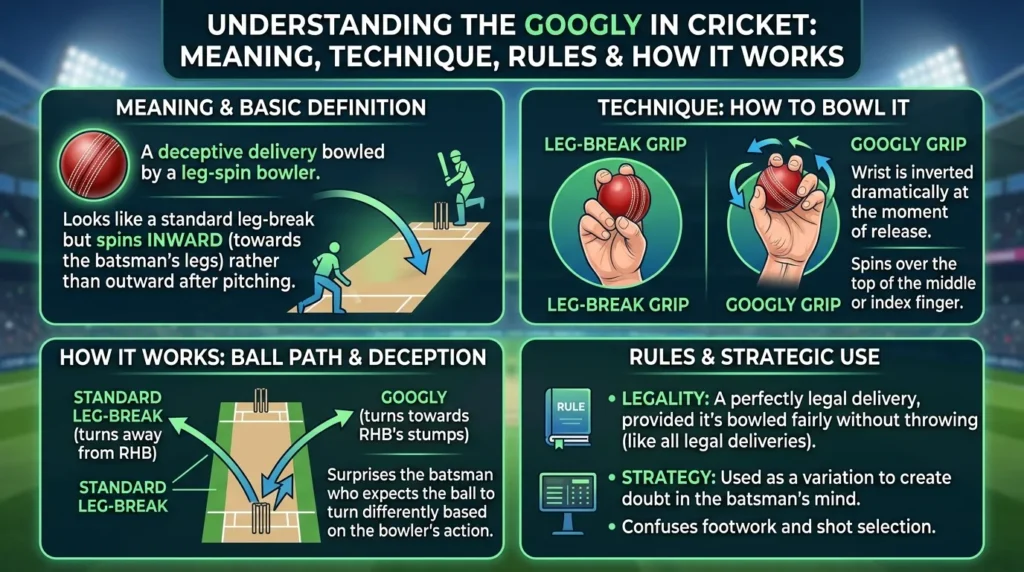
A googly is one of the most famous and effective deliveries in cricket. It is a type of ball bowled by a leg-spin bowler that looks like a normal leg-break but turns in the opposite direction.
For a right-arm leg-spinner bowling to a right-handed batter, a normal leg-break usually moves from the leg side toward the off side after pitching. A googly does the opposite. It moves from the off side toward the leg side after bouncing.
This change in direction makes the googly difficult to read. A batter may expect the ball to move one way but suddenly see it turn the other way after pitching. If the batter misreads the delivery, it can lead to a bowled dismissal, lbw, or a catch.
The googly is not a separate type of cricket ball. It is a bowling variation produced through wrist-spin technique. It is especially useful when a bowler wants to surprise the batter.
In this guide, we will explain what is googly in cricket, how it works, who bowls it, how to identify it, how batters play it, and why it remains such an important weapon in modern cricket.
What Is Googly in Cricket?
A googly is a deceptive delivery bowled by a leg-spinner that turns in the opposite direction to the bowler’s normal leg-break.
For a right-arm leg-spinner:
- Normal leg-break → turns from leg side toward off side for a right-handed batter.
- Googly → turns from off side toward leg side for a right-handed batter.
The exact movement depends on the bowler’s arm, the batter’s stance, and the direction of the delivery.
Simple Definition
A googly is a leg-spin delivery that turns in the opposite direction to the bowler’s normal leg-break.
The main purpose of a googly is deception.
Why Is It Difficult to Face?
The batter may read the bowler’s action as a normal leg-break.
However, after pitching, the ball moves in the opposite direction.
This can cause the batter to:
- Miss the ball
- Play the wrong shot
- Get bowled
- Be trapped lbw
- Hit the ball in the air
How Does a Googly Work?
A googly is created by changing the wrist position and release used for a normal leg-break.
The bowler still uses wrist spin, but the ball is released differently.
Normal Leg-Break
A traditional leg-break is delivered with the wrist and fingers positioned to create one direction of spin.
After pitching, the ball moves across the batter.
Googly
For the googly, the leg-spinner rotates the wrist in the opposite manner during release.
This produces a different direction of rotation.
When the ball lands on the pitch, the spin causes it to move the opposite way.
The Role of Spin
Spin is the key to a googly.
The ball rotates as it travels through the air. When it hits the pitch, friction between the ball and surface helps produce sideways movement.
The amount of turn depends on factors such as:
- Spin rate
- Pitch condition
- Ball condition
- Release
- Bowling speed
- Surface grip
Who Bowls a Googly?
A googly is mainly associated with leg-spin bowlers.
Leg-spin is a wrist-spin style of bowling.
A right-arm leg-spinner normally uses the googly as a variation against both right-handed and left-handed batters.
Leg-Spinner
The leg-spinner’s main weapon is the leg-break.
The googly acts as a surprise delivery.
Other variations may include:
- Top-spinner
- Flipper
- Slider
- Wrong’un
The googly is sometimes also called a wrong’un, especially in some cricket terminology.
History and Origin of the Googly
The exact history of the word googly is not completely settled, but the delivery became strongly associated with English leg-spinner Bernard Bosanquet in the early 20th century.
Bosanquet is widely credited with developing and popularizing the delivery.
He used a wrist action that allowed him to disguise the direction of spin.
The word googly became established as the name for this deceptive leg-spin delivery.
Bernard Bosanquet
Bosanquet played international cricket for England and became famous for his unusual bowling style.
His innovation changed how leg-spin could be used.
The key idea was simple but powerful:
Make the batter expect one direction, then make the ball turn the other way.
This principle remains at the heart of the googly today.
Googly vs Leg-Break
Understanding the difference between a googly and a leg-break is essential.
| Feature | Leg-Break | Googly |
|---|---|---|
| Bowler | Leg-spinner | Leg-spinner |
| Type | Main delivery | Variation |
| Direction for right-hander | Leg to off | Off to leg |
| Purpose | Normal spin attack | Deception |
| Surprise factor | Lower | High |
| Main skill | Wrist spin | Wrist spin and disguise |
A leg-spinner usually builds an attack around the leg-break and uses the googly when the batter is expecting the normal delivery.
How to Bowl a Googly
Bowling a googly requires practice and good wrist control.
It should not be attempted only by changing the direction of the arm. The bowler must create the correct spin at release.
Step 1: Use the Correct Grip
The bowler holds the cricket ball in a standard leg-spin grip.
The fingers should provide control without creating excessive tension.
Step 2: Prepare the Wrist
The wrist position changes compared with a normal leg-break.
This helps create the opposite spin.
Step 3: Release the Ball
At release, the bowler rotates the wrist and fingers to produce the required spin.
This is the most important part of the delivery.
Step 4: Maintain a Similar Action
A good googly should look similar to the bowler’s normal leg-break.
If the bowler changes the action too much, the batter may identify the delivery before it pitches.
Step 5: Control the Length
Spin alone is not enough.
The bowler needs to land the googly in a difficult area.
A good length or slightly fuller delivery can create strong attacking opportunities.
How to Read a Googly
Facing a googly is difficult because the delivery is designed to deceive the batter.
However, experienced batters look for small clues.
Watch the Bowler’s Wrist
The wrist can sometimes reveal the type of delivery.
However, modern bowlers have become very good at hiding these signals.
Watch the Release
The batter can study the release point.
The position of the hand and fingers may provide information about the expected spin.
Read the Pitch
A batter can also consider:
- Pitch condition
- Previous deliveries
- Bowler’s patterns
- Field placement
Do Not Guess Too Early
Trying to predict every ball can be dangerous.
The batter needs to watch the ball closely and react as late as possible.
How Do Batters Play a Googly?
The correct response depends on the line and length of the delivery.
Play With a Straight Bat
If the googly is attacking the stumps, a straight-bat defense can reduce the chance of an edge.
Move Forward
A batter may step forward to reduce the amount of turn available.
This can be useful against spin on a slow pitch.
Use the Sweep
Against a suitable line and length, a batter can use a sweep or reverse-style shot.
However, the shot must be chosen carefully.
Play With the Turn
Reading the direction of spin allows the batter to choose the correct side of the bat.
The biggest mistake is assuming that every leg-spinner delivery will turn in the same direction.
Why Is the Googly So Effective?
The biggest advantage of a googly is deception.
It Looks Like a Leg-Break
The bowler tries to make the action look almost identical to a normal delivery.
It Changes Direction After Pitching
The batter may initially move into position for a leg-break.
After bouncing, the ball turns the other way.
It Attacks the Stumps
A well-bowled googly can move toward the stumps.
This creates opportunities for:
- Bowled
- LBW
- Caught behind
- Inside edge
- Bat-pad catches
Googly Bowling Strategy
A googly works best when it is used as part of a larger bowling plan.
A bowler should not necessarily bowl a googly every ball.
Use the Leg-Break First
The normal leg-break establishes an expectation.
The batter begins to anticipate the usual direction.
Introduce the Googly
The bowler can then use the googly to break that expectation.
Change the Pace
A googly can also be bowled at different speeds.
A slower googly may give the batter more time but can produce extra turn.
A faster googly can surprise the batter.
Use Field Placement
The captain can position fielders based on the bowler’s plan.
Possible positions include:
- Slip
- Short leg
- Leg slip
- Point
- Cover
- Midwicket
- Deep square leg
The exact field depends on the batter, match situation, pitch, and bowling plan.
Googly in Different Cricket Formats
The googly can be used in every major format.
Test Cricket
In Test cricket, a googly can be especially dangerous when the pitch offers significant turn.
Batters may face long spells of spin and become vulnerable to variations.
ODI Cricket
In ODIs, leg-spinners often use the googly to control the middle overs and create wickets.
T20 Cricket
The googly is extremely useful in T20 cricket because batters are often looking to attack.
A deceptive delivery can turn an attacking shot into a wicket.
Famous Googly Bowlers
Many great leg-spinners have developed excellent googlies.
Shane Warne
Australian legend Shane Warne was famous for his exceptional leg-spin and variations.
He used changes in spin, flight, and pace to deceive batters.
Anil Kumble
Indian spinner Anil Kumble was known for his effective variations and accuracy.
Abdul Qadir
Pakistan’s Abdul Qadir was one of the great leg-spinners of his era and helped popularize attacking wrist-spin bowling.
Rashid Khan
Afghanistan’s Rashid Khan has become one of the most successful modern T20 leg-spinners.
His quick action and variations make him difficult to attack.
Yuzvendra Chahal
India’s Yuzvendra Chahal is another modern leg-spinner who uses the googly as part of his bowling attack.
Equipment Needed to Bowl a Googly
A bowler does not need special equipment to bowl a googly.
The basic cricket equipment includes:
Cricket Ball
The ball is essential for developing spin and practicing release.
Cricket Shoes
Good shoes provide grip during the run-up and delivery stride.
Cricket Stumps
Stumps help the bowler practice accuracy.
Cricket Pitch
A proper pitch helps the bowler understand how the ball behaves after landing.
Protective Equipment
During practice, batters should use suitable protective equipment, especially when facing fast or advanced spin bowling.
Benefits of Learning the Googly
Learning a googly can improve a spin bowler’s overall bowling skills.
Better Variation
The bowler gains another delivery to use against batters.
Improved Deception
Learning to disguise the googly also improves control over bowling actions.
More Wicket Opportunities
A good googly can create opportunities when batters are expecting a leg-break.
Better Match Strategy
Having multiple deliveries allows the bowler to respond to different batters and match situations.
Common Mistakes When Bowling a Googly
Beginners often struggle with the googly.
Changing the Entire Action
If the bowling action changes too much, the batter can identify the delivery.
Poor Wrist Position
Incorrect wrist movement can reduce spin.
Too Much Focus on Spin
A huge amount of spin is not always necessary.
Accuracy and deception are also important.
Poor Length
Even a perfect googly can be easy to hit if it is too short or too full.
Bowling It Too Often
If every delivery is a googly, the batter can adjust.
Variation is the key.
Interesting Facts About the Googly
- The googly is one of cricket’s most famous deceptive deliveries.
- It is strongly associated with leg-spin bowling.
- Bernard Bosanquet is widely credited with developing it.
- It is sometimes called a wrong’un.
- A googly turns opposite to the expected leg-break.
- It can be used in Test, ODI, and T20 cricket.
- Wrist position and release are central to producing the delivery.
- Good googlies are difficult to identify before the ball pitches.
- The delivery is especially valuable when a batter becomes comfortable against normal leg-spin.
- Modern T20 cricket has increased the importance of deceptive spin variations.
Frequently Asked Questions About Googly
What is a googly in cricket?
A googly is a leg-spin delivery that turns in the opposite direction to a normal leg-break.
Why is it called a googly?
The term became associated with the unusual deceptive delivery developed and popularized by English leg-spinner Bernard Bosanquet.
Is a googly a leg-spin delivery?
Yes. A googly is a variation of leg-spin bowling.
What is another name for a googly?
A googly is also commonly called a wrong’un.
Who invented the googly?
English cricketer Bernard Bosanquet is widely credited with developing the delivery.
Does a googly turn both ways?
No. The important feature is that it turns in the opposite direction to the bowler’s normal leg-break.
Is a googly difficult to bowl?
Yes. It requires good wrist control, spin, accuracy, and the ability to disguise the delivery.
How can a batter identify a googly?
Batters may watch the bowler’s wrist, hand position, release, and previous bowling patterns. However, a well-disguised googly can be very difficult to identify.
Conclusion
A googly in cricket is a deceptive leg-spin delivery that turns in the opposite direction to a normal leg-break. Its main purpose is to surprise the batter and create a wicket opportunity.
For a right-arm leg-spinner bowling to a right-handed batter, a normal leg-break generally moves from leg side toward off side after pitching, while the googly moves in the opposite direction. This sudden change makes the delivery difficult to read.
The googly depends on wrist position, finger control, release, accuracy, and disguise. A bowler must make the googly look similar to the normal leg-break so the batter cannot easily predict it.
The delivery has a long history and is widely associated with Bernard Bosanquet, who developed and popularized the technique in the early 20th century. Today, the googly remains an important weapon in Test, ODI, and T20 cricket.
For young bowlers, learning a googly can add another useful variation to their attack. However, accuracy should come before excessive spin. A well-disguised googly bowled in the right area can be much more dangerous than a delivery that simply turns sharply.
In simple terms, remember this: a googly is the leg-spinner’s surprise ball—the delivery that looks like one type of spin but turns the other way.

Green Benn is a dedicated sports writer specializing in cricket, including IPL and international formats. Known for clear, engaging, and informative content, Green simplifies complex match analysis and player statistics for all readers. Passionate about sports storytelling, Green delivers reliable, SEO-friendly articles that keep fans updated and informed