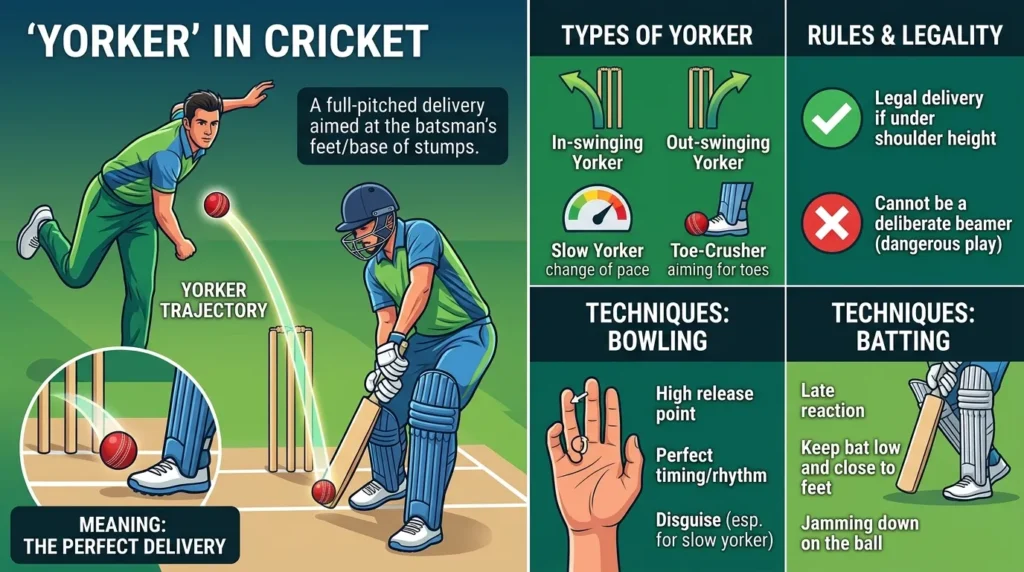

A yorker is one of the most effective and respected deliveries in cricket. It is a ball bowled close to the batter’s feet, usually landing near the base of the stumps or the batter’s toes. When bowled accurately, a yorker is very difficult to score from.
The delivery is especially important in limited-overs cricket, where bowlers need to stop batters from hitting boundaries. Fast bowlers often use yorkers during the death overs, when only a few runs can decide the result of a match.
A yorker can also be useful in Test cricket. Fast bowlers can use it to attack the stumps, break partnerships, or surprise a batter who is expecting a shorter delivery.
The main challenge is accuracy. A yorker that is too full can become a full toss, while one that is too short can become a half volley or a good-length ball. Therefore, bowlers need excellent control and timing.
In this guide, we explain what is a yorker in cricket, how it works, its types, history, bowling technique, batting strategies, advantages, disadvantages, famous yorker bowlers, and common mistakes.
What Is a Yorker in Cricket?
A yorker is a cricket delivery that pitches very close to the batter’s feet, usually near the popping crease and the base of the stumps.
It is normally aimed at the batter’s toes or the area directly in front of the stumps.
Simple Definition
A yorker is a delivery that lands close to the batter’s feet, making it difficult to play attacking shots.
The yorker is usually associated with fast bowling, although slower and spin variations can also be delivered with a similar length.
Why Is a Yorker Difficult to Face?
A well-bowled yorker gives the batter very little room to play a normal cricket shot.
The batter has to react quickly because:
- The ball is very close to the feet.
- It can attack the stumps.
- There is little room for a full swing.
- A small mistake can result in a bowled or lbw dismissal.
- It can prevent boundary shots.
How Does a Yorker Work?
The main feature of a yorker is its length.
Unlike a good-length ball, which pitches farther away from the batter, a yorker lands very close to the batter.
Ideal Yorker Length
There is no single exact distance that defines every yorker because the correct landing point depends on factors such as:
- Bowler’s speed
- Batter’s stance
- Bowling angle
- Crease position
- Pitch conditions
The goal is to land the ball close enough to the batter that it becomes difficult to hit.
Attack the Base of the Stumps
One of the most common yorker targets is the base of the stumps.
If the batter misses the ball, it can hit the stumps.
This makes the yorker both a defensive and attacking delivery.
History and Origin of the Yorker
The yorker has been part of cricket for a very long time.
The exact origin of the term is debated, but the delivery became strongly associated with English cricket and fast bowling.
The word is often linked to Yorkshire, although the exact linguistic history is not completely certain.
Over time, the yorker became an important weapon for fast bowlers.
As limited-overs cricket developed, the delivery became even more valuable because bowlers needed a reliable way to restrict aggressive batters.
Types of Yorkers
Yorkers are not all identical. Bowlers can use different variations depending on the match situation.
Fast Yorker
A fast yorker is delivered at high speed and lands close to the batter’s feet.
It is particularly difficult to play when the batter is expecting a slower delivery.
Swinging Yorker
A swinging yorker moves through the air before reaching the batter.
It can be especially dangerous because the batter may initially judge the ball incorrectly.
Inswinging Yorker
An inswinging yorker moves toward the batter’s body or stumps.
For a batter, this can create a strong lbw or bowled opportunity.
Outswinging Yorker
An outswinging yorker moves away from the batter.
It can cause an outside edge if the batter tries to reach for it.
Slower Yorker
A slower yorker is delivered with reduced pace.
It is commonly used in T20 cricket because batters often expect fast deliveries at the death.
Wide Yorker
A wide yorker is aimed outside the batter’s reach, usually near the wide line.
It can be very effective against batters who move across the crease to create room.
Yorker vs Full Toss
A yorker and full toss are often confused by beginners.
The key difference is whether the ball bounces.
| Feature | Yorker | Full Toss |
|---|---|---|
| Bounces? | Yes, normally | No |
| Landing point | Near batter’s feet | No pitch contact |
| Main target | Stumps or toes | Varies |
| Scoring difficulty | Usually high | Can be easier |
| Common use | Restrict runs and take wickets | Variation or accidental delivery |
A bowler trying to bowl a yorker may accidentally release the ball too early.
The result can be a full toss.
Yorker vs Good-Length Ball
A good-length delivery pitches farther from the batter than a yorker.
| Feature | Yorker | Good-Length Ball |
|---|---|---|
| Pitch location | Very close to batter | Middle area |
| Main target | Feet and stumps | Uncertain shot |
| Reaction time | Very limited | More time |
| Common purpose | Prevent scoring | Build pressure |
Both deliveries are useful, but they create different problems for the batter.
How to Bowl a Yorker
Bowling a yorker requires excellent control.
Step 1: Choose the Target
The bowler should decide where the ball should land.
Common targets include:
- Base of stumps
- Batter’s toes
- Leg stump
- Off stump
- Wide outside off stump
Step 2: Maintain the Run-Up
A consistent run-up helps the bowler maintain rhythm and balance.
Step 3: Release at the Correct Point
Release point is extremely important.
If the ball is released too early, it may become a full toss.
If it is released too late, it may land too short.
Step 4: Keep the Wrist Firm
A strong wrist position helps the bowler control the direction and movement of the ball.
Step 5: Follow Through
A balanced follow-through helps maintain control and reduce unnecessary variation in the release.
Why Is a Yorker So Effective?
A yorker creates several problems for the batter.
It Attacks the Stumps
If the batter misses, the ball can hit the stumps.
It Limits the Bat Swing
The batter has very little space to swing freely.
It Prevents Lofted Shots
A ball at the batter’s feet is difficult to hit high over the field.
It Reduces Boundary Opportunities
Accurate yorkers often produce defensive shots or low-risk singles.
It Creates Pressure
Repeated yorkers can force a batter to change position or attempt risky shots.
Yorkers in Different Cricket Formats
Yorker in Test Cricket
In Test cricket, yorkers can be used to attack the stumps and surprise batters.
Fast bowlers may use them after a series of shorter or good-length deliveries.
A well-timed yorker can break a partnership.
Yorker in ODI Cricket
In ODIs, yorkers are especially useful during the final overs.
Bowlers use them to stop batters from hitting straight boundaries.
Yorker in T20 Cricket
The yorker is one of the most important weapons in T20 cricket.
During the death overs, batters usually attack aggressively.
A well-directed yorker can limit their options.
Yorker Bowling at the Death
The final overs of a limited-overs innings are often called the death overs.
Batters usually try to score as many runs as possible during this period.
Bowlers therefore need deliveries that are difficult to hit.
The yorker is one of the best options.
Why Yorkers Work at the Death
A yorker:
- Attacks the stumps.
- Limits the batter’s swing.
- Makes big straight hits difficult.
- Can be aimed at the toes.
- Can be combined with slower variations.
However, accuracy is critical.
A slightly misplaced yorker can become an easy scoring opportunity.
How Batters Play a Yorker
Batters need specific techniques to deal with yorkers.
Get the Bat Down Quickly
The most important skill is getting the bat close to the ground before the ball reaches the batter.
Use a Straight Bat
A straight-bat defense can protect the stumps.
Dig Out the Yorker
The batter can use the bat to block or guide the ball into an open area.
Move Across the Crease
Some batters move across the crease to change the bowler’s target.
However, this can create risks.
Pre-Meditated Shots
In T20 cricket, batters sometimes anticipate a yorker and prepare a specific shot.
Examples include:
- Scoop
- Flick
- Drive
- Square shot
- Pick-up shot
These require excellent timing.
How to Counter a Wide Yorker
A wide yorker can be difficult because it is outside the batter’s normal hitting zone.
Batters may:
- Move toward the ball.
- Reach with an extended bat.
- Open the face of the bat.
- Use a square shot.
- Move across the crease before the delivery.
Bowlers use wide yorkers because they reduce the batter’s ability to hit straight.
Yorker Bowling Strategy
A good bowler does not simply bowl yorkers repeatedly.
Variation is important.
Mix Yorkers With Bouncers
A short ball can make the batter move backward.
The bowler can then surprise the batter with a yorker.
Change Pace
A slower yorker can be difficult to hit if the batter expects high speed.
Change Direction
Bowlers can target different areas:
- Leg stump
- Middle stump
- Off stump
- Wide outside off
Watch the Batter’s Movement
Modern batters often move around the crease.
Bowlers must adjust their target accordingly.
Common Yorker Bowling Mistakes
Bowling Too Full
If the ball does not bounce and reaches the batter directly, it can become a full toss.
Bowling Too Short
If the ball lands too far away, the batter may drive it comfortably.
Poor Accuracy
A yorker outside the intended area can become an easy scoring ball.
Predictable Bowling
If every delivery is a yorker, the batter may prepare for it.
Ignoring the Crease
The batter can move forward, backward, or sideways.
Bowlers must adjust their target based on this movement.
Famous Yorker Bowlers
Many great fast bowlers have become famous for their ability to bowl accurate yorkers.
Wasim Akram
Pakistan’s Wasim Akram was known for his exceptional swing bowling and ability to produce dangerous yorkers.
Waqar Younis
Waqar Younis was famous for his pace, reverse swing, and attacking yorkers.
His ability to hit the stumps at high speed made him extremely difficult to face.
Lasith Malinga
Sri Lankan bowler Lasith Malinga became one of the most recognizable yorker specialists in modern limited-overs cricket.
His unusual action and accuracy made his yorkers particularly dangerous.
Jasprit Bumrah
India’s Jasprit Bumrah is widely recognized for his ability to bowl accurate yorkers, especially in limited-overs cricket.
His unusual action, pace changes, and control make his yorker difficult to predict.
Equipment Used for Yorker Practice
No special equipment is required to bowl a yorker.
Cricket Ball
The ball is essential for practicing pace, swing, and accuracy.
Cricket Stumps
Stumps provide a clear target.
Bowling Markers
Cones or markers can be placed near the batter’s feet to create a target area.
Cricket Shoes
Proper cricket shoes help with grip and balance during the run-up.
Protective Equipment
Batters should use appropriate protection during fast-bowling practice.
This may include:
- Helmet
- Pads
- Gloves
- Abdominal guard
- Chest protection when appropriate
Benefits of Learning the Yorker
Learning to bowl yorkers can improve a bowler’s overall performance.
Better Run Control
Accurate yorkers make it harder for batters to score boundaries.
More Wicket Opportunities
A yorker can result in:
- Bowled
- LBW
- Caught after a mistimed shot
Better Death Bowling
Yorkers are essential for many limited-overs death-over strategies.
Improved Accuracy
Practicing yorkers helps bowlers develop better control of their release point and length.
Interesting Facts About Yorkers
- A yorker normally lands very close to the batter’s feet.
- The base of the stumps is a common target.
- Yorkers are especially valuable in limited-overs cricket.
- A bowler can accidentally turn a yorker attempt into a full toss.
- A wide yorker is often used against aggressive batters.
- Slower yorkers are common in T20 cricket.
- Swing can make a yorker even more dangerous.
- Yorkers can produce bowled and lbw dismissals.
- Many of the world’s best fast bowlers have used yorkers as major weapons.
- Accuracy is more important than simply bowling at maximum speed.
Frequently Asked Questions About Yorker
What is a yorker in cricket?
A yorker is a delivery that pitches very close to the batter’s feet, usually near the base of the stumps or toes.
Why is a yorker difficult to hit?
It gives the batter very little space to play a normal attacking shot and can also directly attack the stumps.
Is a yorker a fast ball?
A yorker is usually associated with fast bowling, but the term mainly describes the length and target of the delivery, not simply its speed.
Can a yorker be a no-ball?
A normal yorker is not automatically a no-ball. However, a delivery can be called a no-ball for other reasons under the Laws of Cricket, such as an illegal bowling action or overstepping the crease.
What is a wide yorker?
A wide yorker is aimed outside the batter’s reach, usually close to the wide line, while still landing near the batter’s crease.
Who is famous for bowling yorkers?
Lasith Malinga, Wasim Akram, Waqar Younis, and Jasprit Bumrah are among the bowlers widely known for their yorker skills.
Can spin bowlers bowl yorkers?
The term is most commonly associated with fast bowling, but spin bowlers can also deliver very full balls that land close to the batter’s feet.
How can a batter defend a yorker?
A batter can quickly bring the bat down, use a straight-bat defense, or guide the ball into an open area.
Conclusion
A yorker in cricket is one of the most effective deliveries a bowler can use. It lands very close to the batter’s feet and is often aimed at the base of the stumps. Because there is little room for the batter to swing, a well-bowled yorker can be extremely difficult to score from.
The delivery is particularly important in ODI and T20 cricket, where bowlers must control scoring during the final overs. Fast bowlers can also use yorkers in Test cricket to surprise batters and attack the stumps.
There are several variations, including fast yorkers, swinging yorkers, slower yorkers, inswinging yorkers, outswinging yorkers, and wide yorkers. Each can create a different challenge for the batter.
However, bowling a yorker requires excellent accuracy. A ball released too early can become a full toss, while one released too late can land too short. This is why professional bowlers spend a great deal of time practicing their release point and target.
For beginners, the easiest way to remember a yorker is simple: it is a delivery aimed at the batter’s feet and the base of the stumps. When combined with pace, swing, and variation, it becomes one of cricket’s most powerful bowling weapons.

Jon Smith is a passionate sports writer specializing in cricket and global sporting events. With a keen eye for match analysis and player performance, he creates clear, engaging, and informative content. His work focuses on simplifying complex sports insights, making them accessible for beginners and experienced fans alike worldwide.