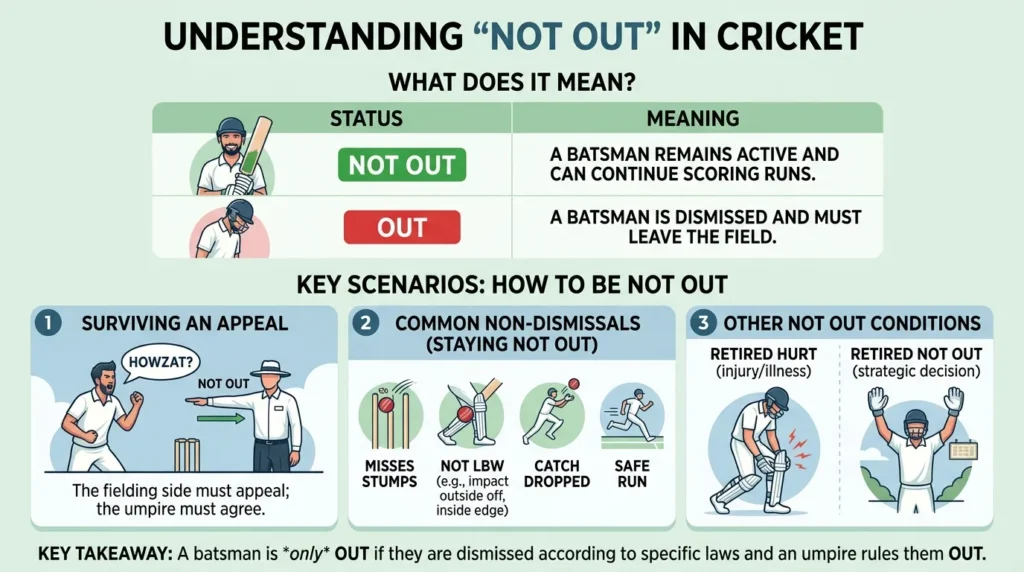

In cricket, you may often hear a commentator say, “The batsman is not out.” But what exactly does not out mean, and when is a batter considered not out?
In simple terms, a batter is not out when they have not been dismissed during their innings. A batter can score runs, face many deliveries, or remain at the crease when the innings ends without losing their wicket.
For beginners, the term can be confusing because “not out” is not a method of scoring runs. Instead, it describes the dismissal status of a batter.
For example, if a player scores 80 runs and the team reaches its target before the player is dismissed, the scorecard may show 80 not out (80). The asterisk () is commonly used to indicate that the batter remained not out.
Understanding not out is important when reading cricket scorecards, player statistics, batting averages, and match results. This guide explains what not out means, how it works, when a batter remains not out, how it affects batting averages, and several common situations involving not-out batters.
What Does Not Out Mean in Cricket?
Not out means that a batter was still at the crease and had not been dismissed when their innings ended.
A batter can be not out for several reasons.
For example:
- The team reaches its target.
- The innings reaches its maximum number of overs.
- The innings ends because the required overs are completed.
- The match ends because of weather or another interruption.
- The batting team declares its innings.
- The batting team loses all available wickets, leaving one batter without a dismissal partner in some circumstances.
Simple Example
Imagine Team A scores 250 runs.
A batter scores:
75 not out
This means the batter scored 75 runs but was never dismissed.
The scorecard may show:
Player A — 75*
The asterisk means not out.
Not Out Is Not a Separate Scoring Method
A batter does not receive extra runs for being not out.
If a player scores 75 not out, they have scored 75 runs.
“Not out” simply tells us that the player’s wicket was still intact when their innings ended.
How Does a Batter Become Not Out?
A batter becomes or remains not out when they are still batting when the innings ends.
Team Reaches the Target
This is one of the most common situations in limited-overs cricket.
Suppose a team needs 20 runs to win.
A batter scores the final 20 runs needed for victory without being dismissed.
The batter could finish with:
55 not out
The innings ends because the team has won.
Innings Reaches Its Over Limit
In a 20-over match, a team normally has up to 20 overs to bat.
If the innings ends after 20 overs and a batter has not been dismissed, that batter is recorded as not out.
For example:
- Batter A: 90*
- Batter B: 35
- Team total: 165/6
The batter with 90 remains not out at the end of the innings.
Test Match Declaration
In Test cricket, a captain can declare an innings closed.
If two batters are at the crease when the captain declares, both are recorded as not out.
For example:
- Batter A: 150*
- Batter B: 80*
The captain may declare after deciding that the team’s total is large enough.
Match Ends Before a Dismissal
Weather, bad light, or other match conditions can sometimes end an innings or match before a batter is dismissed.
The batter’s score may therefore remain not out.
Not Out and the Cricket Scorecard
The not-out symbol is easy to recognize on a cricket scorecard.
An asterisk (*) normally indicates that a batter was not out.
For example:
| Batter | Runs | Status |
|---|---|---|
| Rohit | 82 | Out |
| Gill | 45 | Out |
| Player C | 67* | Not out |
The 67* means Player C scored 67 runs and remained not out.
Why Is the Asterisk Used?
The asterisk quickly tells readers that the batter’s innings did not end because of a dismissal.
This is useful when looking at:
- Live scores
- Match scorecards
- Cricket statistics
- Batting records
- Player profiles
Not Out vs Out
The difference between out and not out is simple.
| Feature | Out | Not Out |
|---|---|---|
| Batter dismissed? | Yes | No |
| Innings ended by dismissal? | Yes | No |
| Asterisk used? | Usually no | Yes (*) |
| Example | 50 | 50* |
| Included in batting average denominator? | Yes | No |
Example
Suppose two players both score 50 runs.
Player A: 50
Player A was dismissed.
Player B: 50*
Player B was not dismissed.
Although both scored 50 runs, their statistical records are different because one innings ended with a dismissal and the other did not.
How Not Out Affects Batting Average
One of the most important reasons not out matters is its effect on batting average.
A batter’s batting average is generally calculated as:
[
Batting\ Average = \frac{Total\ Runs}{Number\ of\ Times\ Dismissed}
]
Notice that the number of innings is not simply used.
A not-out innings does not count as a dismissal.
Example
Suppose a batter has:
- Total runs = 300
- Innings = 6
- Dismissals = 5
The batting average is:
[
300 \div 5 = 60
]
So the player’s batting average is 60.
The player may have batted six times, but they were dismissed only five times.
Why Not Outs Matter
Not-out innings can significantly increase a player’s batting average.
For example, a batter scoring:
- 0
- 50
- 100*
- 70
- 80*
has scored:
300 runs
But the batter was dismissed only three times.
Therefore:
[
300 \div 3 = 100
]
The not-out innings make a major statistical difference.
Not Out in Test Cricket
Not out is especially important in Test cricket because players can make very large scores.
A batter may remain at the crease for several sessions.
Example
A batter scores:
200 not out
The team then declares its innings.
The player receives credit for:
200 runs
and one not-out innings.
If the player later scores another century, the not-out record continues to affect their batting statistics.
Double Centuries and Not Outs
Not-out innings can produce memorable records.
A player may score:
- 150*
- 200*
- 250*
- 300*
These scores indicate that the player reached those totals without being dismissed.
Not Out in ODI Cricket
In One Day Internationals, not-out scores are common when a team successfully chases a target.
For example:
Team A scores:
280/8
Team B chases the target and reaches:
281/5
The batter who hits the winning runs may finish with:
110*
The player was not dismissed before the target was reached.
Why Not Outs Are Common in Successful Chases
When a team wins before losing all its wickets, some batters must remain not out.
This makes not-out scores particularly common in successful run chases.
Not Out in T20 Cricket
Not out is also very common in T20 cricket.
Because T20 matches have only 20 overs per innings, a batter may remain at the crease when the team completes its overs.
For example:
Team score: 190/6
The final batter at the crease may finish with:
72*
The player was still batting when the 20 overs ended.
Not Out When a Team Is All Out
This situation often confuses beginners.
A team can be described as all out even though one batter is technically not out.
Why?
A cricket team generally has 11 players.
If 10 batters are dismissed, the remaining batter cannot continue batting alone because there is no partner at the other end.
Therefore, the innings ends.
The final batter is recorded as not out.
Example
A team has:
- 10 wickets lost
- One batter remaining
That final batter may have:
25*
The team is all out, but the batter is not out.
This is an important cricket rule.
Not Out and Retired Hurt
A batter who leaves the field because of injury may be recorded as retired hurt, rather than simply being out.
If the batter does not return and the innings ends, their status can be treated according to the applicable playing conditions and scorecard conventions.
This is different from an ordinary dismissal.
Retired Hurt vs Not Out
A retired-hurt batter has left the field without being dismissed.
The exact statistical treatment can depend on the reason for retirement and the competition’s rules.
This is why scorecards may distinguish between ordinary not-out innings and special retirement situations.
Common Ways a Batter Can Be Out
To understand not out, it helps to understand how a batter can be dismissed.
Common methods include:
Bowled
The ball hits the stumps and dislodges the bails.
Caught
A fielder catches the ball before it touches the ground.
LBW
The batter is dismissed leg before wicket when the legal conditions for LBW are satisfied.
Run Out
The fielding team breaks the wicket while a batter is outside their ground and the relevant conditions are met.
Stumped
The wicketkeeper breaks the wicket while the batter is out of their ground and the legal requirements are satisfied.
Hit Wicket
The batter accidentally breaks their own wicket in circumstances covered by the Laws.
If none of these or another valid dismissal occurs, the batter remains not out when the innings ends.
Not Out and Winning Runs
A batter can finish not out after hitting the winning runs.
For example:
Team needs 4 runs to win.
The batter hits a boundary.
The team wins.
If the batter was not dismissed during that ball, their final score may be shown with an asterisk.
Example:
84*
The batter has scored 84 runs and remained not out.
Not Out and Bowling Statistics
Not out mainly affects batting statistics.
However, it can also help explain a player’s match performance.
For example, a batter who repeatedly finishes innings not out may show strong finishing ability in limited-overs cricket.
A player who often remains not out can help their team:
- Finish successful chases
- Protect wickets
- Build partnerships
- Score runs efficiently
- Control the final overs
Techniques That Help Batters Remain Not Out
Being not out is not simply about avoiding shots.
Good batters use several skills.
Shot Selection
A batter must understand which balls to attack and which to defend.
Poor shot selection can lead to unnecessary dismissals.
Running Between the Wickets
Good running helps batters score without taking excessive risks.
Communication between batters is important.
Strike Rotation
Taking singles and twos can keep the scoreboard moving while reducing pressure.
Reading the Bowler
Experienced batters watch:
- Bowling speed
- Line
- Length
- Swing
- Spin
- Field placement
This helps them make better decisions.
Managing Risk
A batter may need to attack when many runs are required, but risk must be controlled.
A good batter knows when to defend and when to attack.
Famous Examples of Not-Out Innings
Cricket history contains many famous unbeaten innings.
Some of the most memorable performances include huge scores such as:
- 200*
- 250*
- 300*
- 400*
Brian Lara famously scored 400 not out for the West Indies against England in Test cricket in 2004.
This remains one of the most famous unbeaten individual scores in Test history.
In limited-overs cricket, many players have also produced match-winning not-out innings during successful chases.
Interesting Facts About Not Out
Here are some useful facts for cricket fans.
Fact 1: An Asterisk Means Not Out
A score such as 75* usually means the batter was not out.
Fact 2: Not Out Does Not Add Runs
A batter scoring 75* has scored 75 runs, not 76 or any extra amount because they were not out.
Fact 3: Not Outs Affect Batting Average
Not-out innings are not counted as dismissals when calculating batting average.
Fact 4: A Team Can Be All Out With a Not-Out Batter
After 10 wickets fall, the remaining batter has no partner and the innings ends.
Fact 5: Not Out Can Help Create a High Average
Frequent not-out innings can reduce the number of dismissals used in the batting-average calculation.
Common Questions About Not Out
What does not out mean in cricket?
Not out means a batter was not dismissed when their innings ended.
What does 50* mean in cricket?
50* means the batter scored 50 runs and remained not out.
Can a team be all out when one batter is not out?
Yes. When 10 wickets have fallen, the final batter has no partner and the innings ends. That batter is recorded as not out.
Does not out count as an innings?
Yes. A batter can have an innings in which they remain not out. However, that innings does not count as a dismissal for batting-average calculations.
Does not out increase batting average?
It can. Because a not-out innings does not increase the number of dismissals, it can increase the batting average.
Can a batter be not out after hitting the winning runs?
Yes. If the batter hits the winning runs without being dismissed, they remain not out.
What is the symbol for not out?
An asterisk (*) is commonly used after the batter’s score.
For example:
100* means 100 not out.
Conclusion
Not out in cricket means that a batter has not been dismissed when their innings ends. It is an important part of cricket scoring and statistics.
You will often see an asterisk after a score, such as 75*. This tells you that the batter scored 75 runs and remained at the crease.
A batter can remain not out when their team reaches its target, completes its allotted overs, declares an innings, or loses its tenth wicket while that batter is still at the crease.
Not-out innings are also important because they affect batting averages. The number of times a player is dismissed is used in the batting-average calculation, so remaining not out can have a major statistical effect.
For beginners, the easiest rule is simple: if a batter finishes their innings without being dismissed, they are not out. Once you understand this, cricket scorecards, batting averages, and match results become much easier to read.

Jon Smith is a passionate sports writer specializing in cricket and global sporting events. With a keen eye for match analysis and player performance, he creates clear, engaging, and informative content. His work focuses on simplifying complex sports insights, making them accessible for beginners and experienced fans alike worldwide.