
A red card can completely change a World Cup match in seconds. When a referee shows a red card, the player is sent off and their team must continue with fewer players. But what exactly causes a red card at the World Cup, and what happens after a player is dismissed?
Understanding World Cup red card rules is important for players, coaches, and fans because not every serious-looking foul automatically results in a sending-off. Some offenses require a direct red card, while others result in a red card because the player has received two yellow cards in the same match.
The rules are based on the IFAB Laws of the Game, while FIFA competition regulations determine tournament-specific matters such as suspensions and how disciplinary sanctions are carried forward. The 2026 World Cup also includes some important disciplinary changes, including new competition provisions concerning certain protest and discriminatory behavior.
This guide explains when a player receives a red card, what happens to the team, how suspensions work, and what happens if a red card occurs during extra time or a penalty shootout.
World Cup Red Card Rules – Quick Answer
A red card at the FIFA World Cup means that a player, substitute, substituted player, or team official has been sent off for a serious offense.
For a player, a red card generally means:
- The player must leave the field and its immediate surroundings.
- The player cannot be replaced after kick-off.
- The team continues with one fewer player.
- A direct red card normally results in a suspension for the next match.
- FIFA can impose additional matches of suspension or other disciplinary penalties.
- A second yellow card in the same match results in a red card.
- A player sent off during a match cannot participate in the subsequent penalty shootout.
The exact length of a suspension can depend on the nature of the offense and FIFA’s disciplinary decision.
What Is a Red Card in Football?
A red card is the referee’s official signal that someone has been sent off.
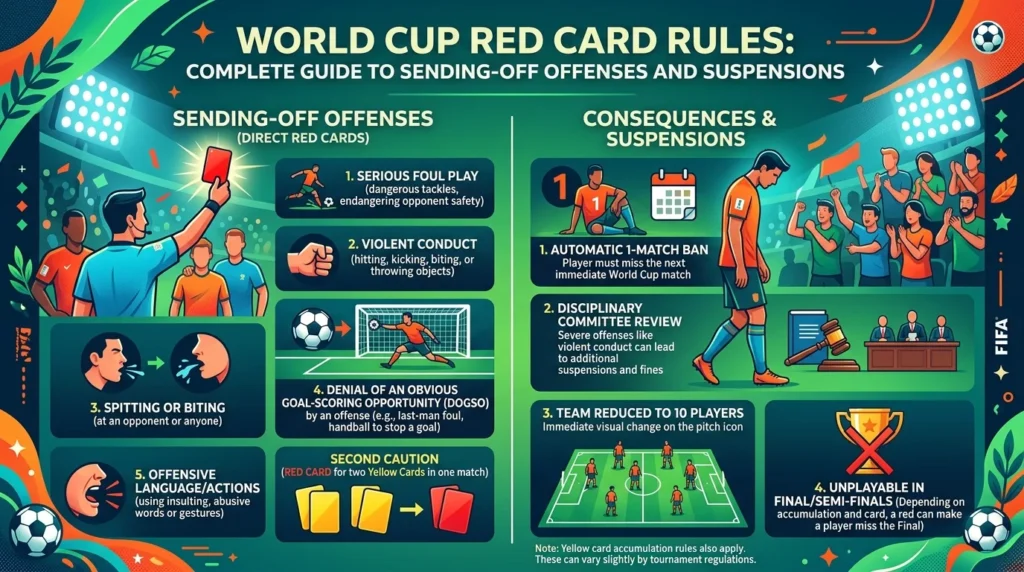
For players, the most serious offenses under Law 12 include serious foul play, violent conduct, biting or spitting, and denying an obvious goal-scoring opportunity in circumstances that require a sending-off. A second caution in the same match also results in a red card.
A red card is different from a yellow card:
| Card | Meaning | Basic consequence |
|---|---|---|
| Yellow card | Caution | Player remains in match |
| Second yellow | Two cautions | Red card and sending-off |
| Direct red card | Immediate sending-off | Player leaves match |
A red card can therefore happen in two ways: directly or after a player receives a second yellow card.
When Does a Player Get a Red Card at the World Cup?
The main red-card offenses come from Law 12 of the IFAB Laws of the Game. These rules apply to World Cup matches, subject to FIFA’s competition regulations and applicable competition options.
Serious Foul Play
A player can receive a direct red card for serious foul play.
This generally involves a tackle or challenge that endangers an opponent’s safety or uses excessive force or brutality.
For example, if a player makes a dangerous challenge with excessive force and puts an opponent at serious risk of injury, the referee can show a red card.
The important distinction is that a reckless challenge is normally a yellow-card offense, while a challenge involving excessive force or serious danger can become serious foul play and result in a red card.
Violent Conduct
Violent conduct is another major reason for a red card.
It involves using or attempting to use excessive force or brutality when the player is not challenging for the ball. The offense can involve an opponent, teammate, team official, referee, spectator, or another person.
Examples can include:
- Punching an opponent
- Striking an opponent away from the ball
- Kicking someone in anger
- Attempting to hit another person
- Violently attacking a teammate
- Deliberately striking someone in the head or face with the hand or arm, except where the force is negligible
The referee can issue a red card even if physical contact does not actually occur when the attempt itself involves excessive force or brutality.
Denying an Obvious Goal-Scoring Opportunity
A player can also be sent off for denying an opponent an obvious goal-scoring opportunity, commonly called DOGSO.
The referee considers factors such as:
- Distance from the goal
- Direction of play
- Likelihood that the attacker would keep or gain control of the ball
- Number and position of defenders
A foul that stops a clear one-on-one scoring opportunity can therefore result in a red card.
However, there is an important exception.
If a defender commits an offense inside their own penalty area while attempting to play the ball or challenging for the ball and the offense results in a penalty kick, the player may receive a yellow card instead of a red card.
This is sometimes called the double jeopardy rule.
Deliberate Handball to Stop a Goal
A player can be sent off for deliberately handling the ball to deny the opposing team a goal or obvious goal-scoring opportunity.
The rule does not apply in the same way to a goalkeeper handling the ball inside their own penalty area.
For example, if a defender deliberately uses their hand to stop a shot that is clearly going into the goal, a direct red card can be issued.
Biting or Spitting
Biting or spitting at another person is a sending-off offense.
This applies whether the target is:
- An opponent
- A teammate
- A team official
- A match official
- Another person involved in the match
These actions are treated as serious misconduct under the Laws of the Game.
Second Yellow Card
A player does not have to commit one extremely serious offense to receive a red card.
If a player receives two yellow cards in the same match, the second caution becomes a red card and the player is sent off.
For example:
- Player receives a yellow card in the first half.
- Player commits another cautionable offense in the second half.
- Referee shows a second yellow card.
- Referee then shows the red card.
- Player leaves the match.
This is often called an indirect red card.
What Happens When a Player Gets a Red Card?
Once a player is sent off after kick-off, the player cannot be replaced. The team must continue with fewer players.
For example, if Brazil starts with 11 players and one player receives a red card, Brazil continues with 10 players.
The opposing team does not receive an extra player. The advantage comes from having numerical superiority.
Can a Sent-Off Player Be Substituted?
After kick-off, no.
A player who is sent off cannot be replaced, so the team plays with one fewer player.
There is an important pre-match exception: if a player is sent off after being named on the team list but before kick-off, the player may be replaced by a named substitute, although the replacement cannot itself be replaced. The team’s permitted number of substitutions is not reduced.
Can a Team Play With Fewer Than 11 Players?
Yes.
A team can continue with fewer than 11 players after receiving red cards.
However, the Laws of the Game state that a match cannot be abandoned solely because a team has fewer than seven players.
This means a team may find itself playing with:
- 10 players after one red card
- 9 players after two red cards
- 8 players after three red cards
- 7 players after four red cards
The tactical impact becomes increasingly significant as more players are sent off.
Do Red Cards Carry a Suspension at the World Cup?
Yes. A red card can lead to a suspension from the team’s next match, and FIFA can impose additional disciplinary sanctions depending on the offense.
FIFA’s World Cup disciplinary framework can impose further suspensions, fines, or other penalties in serious cases.
For the 2026 World Cup, FIFA also made a specific change concerning red-card suspensions from the preliminary competition. Certain pending one- or two-match suspensions linked to cautions, indirect red cards, or direct red cards for DOGSO or serious foul play in the preliminary competition are not carried into the final tournament. Other pending suspensions resulting from a red card can carry over.
This distinction is important because World Cup qualifying matches and the final World Cup tournament are not treated identically for every disciplinary sanction.
How Long Is a World Cup Red Card Suspension?
There is no single suspension length that applies to every red card.
A player who receives a red card is normally unavailable for the team’s next match, while FIFA’s disciplinary authorities can impose additional sanctions based on the circumstances and seriousness of the offense.
The difference can be significant.
For example:
| Situation | Possible consequence |
|---|---|
| Second yellow card | Sending-off and suspension |
| Serious foul play | Sending-off plus possible additional suspension |
| Violent conduct | Sending-off plus potentially severe additional punishment |
| DOGSO | Sending-off and suspension |
| Major misconduct | Sending-off plus possible disciplinary sanctions |
FIFA can review serious incidents after a match and determine whether further punishment is appropriate.
What Happens if a Player Gets a Red Card in the Group Stage?
If a player is sent off during a group-stage match, the immediate effect is that the player leaves that match.
The player will generally be unavailable for the team’s following match because of the resulting suspension, subject to the applicable disciplinary decision.
If the suspension cannot be fully served during the tournament, FIFA’s disciplinary rules can determine whether the remaining suspension carries over to future representative-team matches.
Therefore, a red card late in the group stage can have consequences beyond the match in which it occurred.
What Happens if a Player Gets a Red Card in the Knockout Stage?
A red card in the knockout stage can be especially damaging because there may be no opportunity to recover from the suspension during the same tournament.
For example, if a player is sent off in a quarter-final, the player may miss the semi-final.
If the player is suspended for additional matches and the tournament ends before the suspension is completed, FIFA’s disciplinary rules can determine how the remaining matches are served.
Red cards are therefore particularly important in the:
- Round of 32
- Round of 16
- Quarter-finals
- Semi-finals
- Final
Can a Red Card Happen in Extra Time?
Yes.
A red card can be shown during extra time because the referee’s disciplinary authority continues throughout the match, including extra time.
For example, if a player commits serious foul play during the 110th minute, the referee can show a red card.
The team must then continue with fewer players for the remainder of extra time.
If the match proceeds to a penalty shootout, the sent-off player cannot participate in the shootout.
What Happens to Red Cards During a Penalty Shootout?
A penalty shootout takes place after the match has ended, but disciplinary rules still apply.
A player who was sent off during the match cannot take a penalty in the shootout.
Players and team officials can also receive disciplinary sanctions during the shootout.
An important point is that yellow cards from the match are not carried forward into the penalty shootout. A player who received a yellow card during the match and another yellow during the shootout is not sent off solely because of those two separate cautions.
Can a Coach Receive a Red Card at the World Cup?
Yes.
Red cards are not limited to players.
Team officials, including coaches, can also be sent off for serious misconduct. The referee has authority to discipline team officials in the technical area and its immediate surroundings.
Examples of misconduct can include:
- Aggressive behavior
- Offensive or abusive language
- Entering the field to confront an official
- Entering the opponent’s technical area aggressively
- Physical aggression
- Interfering with play
- Serious misconduct involving match officials
A red card to a coach does not reduce the team’s number of players on the field because the coach is not one of the 11 players.
New World Cup 2026 Red Card Provisions
The 2026 World Cup introduced notable disciplinary changes following decisions by IFAB and FIFA.
One new competition provision allows a player who covers their mouth during a confrontation with an opponent, in circumstances intended to conceal discriminatory behavior, to be sanctioned with a red card at the competition organiser’s discretion.
Another new provision allows the competition organiser to permit a red card for a player who leaves the field in protest at a referee’s decision. A team official who encourages players to leave the field in protest can also be subject to the corresponding disciplinary measure.
These provisions were specifically announced for implementation at the FIFA World Cup 2026.
Red Card vs Second Yellow Card
Although both result in a sending-off, there is a difference between a direct red card and an indirect red card.
| Feature | Direct Red Card | Second Yellow |
|---|---|---|
| First yellow required? | No | Yes |
| Player sent off? | Yes | Yes |
| Team loses a player? | Yes | Yes |
| Suspension possible? | Yes | Yes |
| Additional punishment possible? | Yes | Yes |
| Typical cause | Serious offense | Two cautionable offenses |
A direct red card usually indicates that the referee considers the individual offense serious enough to require immediate dismissal.
Does VAR Check Red Cards at the World Cup?
Yes, VAR can be involved in incidents where the Laws and competition protocol permit a review.
Red-card situations are among the incidents that can be reviewed under the VAR framework, particularly when the referee may have made a clear and obvious error concerning a potential sending-off offense.
VAR does not simply replace the referee. The referee remains responsible for the final decision.
A review may help determine whether an incident should result in:
- No card
- Yellow card
- Direct red card
- Another appropriate decision
This is particularly important for serious foul play, violent conduct, DOGSO, and other major incidents.
Common Misunderstandings About World Cup Red Cards
A Red Card Does Not Always Mean the Same Suspension
The basic sending-off consequence is clear, but the exact disciplinary punishment can vary depending on the offense and FIFA’s disciplinary process.
A Player Cannot Be Replaced After Kick-Off
Once the match has started, a sent-off player cannot simply be replaced by a substitute. The team plays with fewer players. (IFAB)
Two Yellow Cards Equal a Red Card
A player does not need to receive a direct red card to be sent off.
Two yellow cards in the same match result in a second yellow followed by a red card.
Red Cards Are Not Automatically Cancelled Like Some Yellow Cards
FIFA’s tournament regulations can provide specific rules for cancelling or carrying disciplinary records. Red-card suspensions are treated differently from ordinary single yellow cards.
For the 2026 World Cup, FIFA confirmed that single yellow cards in the final competition are cancelled after the group stage and again after the quarter-finals, while red-card sanctions are governed separately.
Examples of World Cup Red Card Situations
Consider these simple examples:
Example 1: Dangerous tackle
A defender lunges into an opponent with excessive force and endangers the opponent’s safety. The referee shows a direct red card for serious foul play.
Example 2: Two yellow cards
A midfielder receives a yellow card for delaying a restart. Later, the same player commits a reckless challenge and receives another yellow. The player is then sent off.
Example 3: DOGSO
An attacker is through on goal with a clear opportunity to score. A defender deliberately commits a foul that denies the opportunity. If the circumstances meet the DOGSO criteria, the defender can receive a red card.
Example 4: Violent conduct
A player punches an opponent away from the ball. This can result in a direct red card for violent conduct.
Example 5: Red card in extra time
A player commits serious foul play in the 115th minute. The referee sends the player off, and the team must finish extra time with one fewer player.
Tips for Players to Avoid Red Cards
Players can reduce the risk of a sending-off by controlling their behavior and understanding the Laws of the Game.
Useful habits include:
- Avoid reckless tackles.
- Never retaliate after a foul.
- Do not deliberately handle the ball to stop a goal.
- Respect the referee’s decisions.
- Avoid unnecessary confrontations.
- Know when you already have a yellow card.
- Control challenges when defending one-on-one situations.
- Avoid dangerous physical contact away from the ball.
- Do not use abusive or insulting language.
- Leave disciplinary decisions to the referee rather than demanding cards.
A player already carrying a yellow card should be particularly careful because another caution can end their match.
Why Red Cards Matter So Much at the World Cup
A red card is more than an individual punishment. It can change the entire tactical structure of a match.
When a team loses a player, the coach may need to:
- Change formation
- Replace an attacking player with a defender
- Defend deeper
- Reduce pressing
- Protect a narrow lead
- Give more possession to the opponent
- Adjust positioning during set pieces
A red card can therefore influence the score, tactics, substitutions, and even the outcome of a World Cup match.
Frequently Asked Questions About World Cup Red Card Rules
1. What happens when a player gets a red card in the World Cup?
The player is sent off and cannot continue playing. After kick-off, the player cannot be replaced, so the team continues with one fewer player.
2. Does a red card mean a player misses the next World Cup match?
A red card normally results in a suspension affecting the team’s next match, while FIFA can impose additional sanctions depending on the offense.
3. Can a player get a red card without receiving a yellow card first?
Yes. Serious foul play, violent conduct, certain DOGSO offenses, deliberate handball to deny a goal, biting, and spitting can result in a direct red card.
4. What happens after two yellow cards in one World Cup match?
The player receives a second yellow card followed by a red card and is sent off.
5. Can a goalkeeper receive a red card?
Yes. Goalkeepers are subject to the same disciplinary laws as other players. A goalkeeper can be directly sent off or receive a second yellow card.
6. Can a coach receive a red card at the World Cup?
Yes. Team officials can be shown red cards for serious misconduct.
7. Can a sent-off player take part in a penalty shootout?
No. A player who has been sent off during the match is not eligible to take part in the penalty shootout.
8. Can a red card suspension continue after the World Cup?
Yes. If a disciplinary suspension cannot be fully served during the tournament, FIFA’s applicable disciplinary rules can determine how the remaining suspension is served in subsequent representative-team matches. FIFA has also demonstrated that serious disciplinary cases can result in multiple-match suspensions.
Conclusion
World Cup red card rules are designed to protect players, maintain discipline, and ensure that serious misconduct is punished appropriately. A player can receive a direct red card for offenses such as serious foul play, violent conduct, certain DOGSO situations, deliberate handball denying a goal, biting, or spitting. A player can also be sent off after receiving two yellow cards in the same match.
Once sent off after kick-off, a player cannot be replaced, meaning the team must continue with fewer players. The dismissal can also lead to a suspension for the next match and, depending on the incident, additional FIFA disciplinary penalties.
The 2026 World Cup also includes updated disciplinary provisions covering certain protest and discriminatory behaviors.
For players and coaches, the best way to avoid a red card is to understand the Laws of the Game, control challenges, avoid retaliation, and respect match officials. For fans, understanding these rules makes controversial World Cup decisions much easier to follow.