
Imagine a defender stopping a dangerous counterattack by pulling an opponent’s shirt. The referee blows the whistle, reaches into a pocket, and shows a yellow card. The foul may look simple, but football’s yellow card rules cover much more than ordinary fouls.
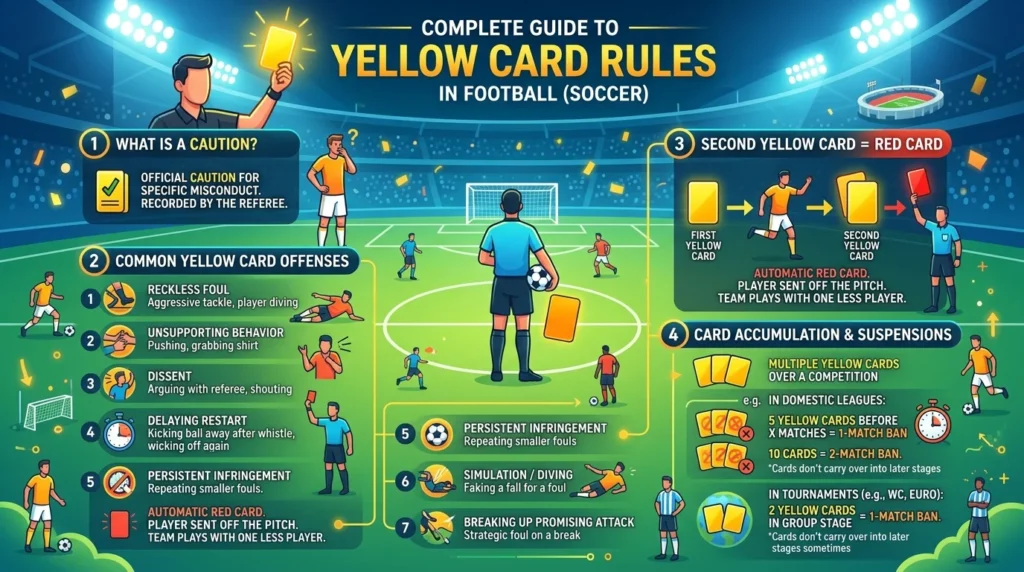
A yellow card is an official caution. It tells a player, substitute, substituted player, or team official that their behavior has broken a cautionable rule. Under the current Laws of the Game, yellow cards can result from delaying a restart, dissent, persistent offenses, unsporting behavior, entering or leaving the field without permission, and other specific actions.
Understanding these rules is important for players, coaches, referees, and fans. A first yellow card does not normally remove a player from the match, but a second yellow in the same game results in a red card and dismissal.
This guide explains when yellow cards are given, what happens after a caution, how second yellow cards work, why players receive them, and how competition-specific suspension rules can differ.
What Is a Yellow Card in Football?
A yellow card is a formal caution issued by the referee for a cautionable offense.
The referee uses the yellow card to communicate that a player or team official has committed an offense that requires disciplinary action. A caution is different from a simple foul: many fouls do not result in a yellow card.
For example, a player may commit a normal careless foul and receive a free kick against their team without receiving a card. If the same type of challenge is reckless, however, the player must be cautioned. IFAB defines reckless play as acting with disregard for the danger or consequences for an opponent.
What Does a Yellow Card Mean?
A yellow card means:
- The player has been officially cautioned.
- The player can normally continue playing.
- The caution is recorded by the match officials.
- Another cautionable offense can lead to a second yellow card.
- A second yellow card in the same match results in a red card and dismissal.
A yellow card is therefore both a warning and a formal disciplinary sanction.
Yellow Card Rules – When Is a Player Booked?
The referee can show a yellow card for several categories of misconduct. Law 12 lists the main cautionable offenses.
Delaying the Restart of Play
A player can be cautioned for deliberately or excessively delaying the restart.
Examples include:
- Kicking the ball away after the referee stops play.
- Carrying the ball away to prevent a quick restart.
- Taking too long to leave during a substitution.
- Deliberately provoking a confrontation.
- Taking a free kick from the wrong position to force a retake.
- Pretending to take a throw-in and then leaving it for a teammate.
The purpose of this rule is to prevent players from wasting time or stopping opponents from restarting quickly.
Dissent
Players must respect the referee’s decisions. Dissent by word or action is a cautionable offense.
Dissent can include:
- Aggressive or excessive arguing.
- Gestures showing clear disagreement.
- Sarcastic actions toward officials.
- Repeatedly demanding cards for opponents.
- Throwing or kicking objects in protest.
Players can disagree with a decision, but they must not cross the line into behavior that the Laws classify as dissent.
Persistent Offenses
A player can receive a yellow card for committing repeated offenses.
There is no fixed number that automatically means a player must be booked. The referee judges whether the player’s behavior amounts to persistent offending.
For example, a midfielder might repeatedly stop opponents with small fouls. Each individual foul may not always deserve a yellow card, but repeated offending can eventually result in a caution.
Entering or Leaving the Field Without Permission
A player can be cautioned for deliberately entering, re-entering, or leaving the field without the referee’s permission.
This rule helps officials control player movements and maintain the proper number of players on the field.
Failing to Respect the Required Distance
When play restarts with a corner kick, free kick, throw-in, or dropped ball, players must respect the required distance.
Deliberately failing to respect that distance can result in a yellow card.
Unsporting Behavior
Unsporting behavior covers several actions that damage fair play.
A player can be cautioned for actions such as:
- Simulating a foul.
- Pretending to be injured to deceive the referee.
- Stopping a promising attack through certain offenses.
- Handling the ball to stop a promising attack.
- Making an unsuccessful attempt to prevent a goal through deliberate handball.
- Showing a lack of respect for the game.
- Verbally distracting an opponent.
- Using a deliberate trick to bypass the back-pass restriction.
The exact disciplinary decision depends on the situation and the relevant Law.
Yellow Card Rules for Fouls and Tackles
Not every foul deserves a yellow card. One of the most important ideas for beginners is the difference between careless, reckless, and excessive force.
Careless Challenge
A careless action means the player shows a lack of attention or acts without proper precaution.
A careless foul normally results in a free kick, but no disciplinary sanction is required.
Reckless Challenge
A reckless challenge shows disregard for the danger or consequences to the opponent.
A reckless challenge must result in a yellow card.
For example, a player who lunges into a tackle without sufficient control and creates a clear risk to an opponent may be cautioned.
Excessive Force
Using excessive force is more serious.
It means the player goes beyond the necessary amount of force and/or endangers the opponent’s safety. This is a sending-off offense rather than a yellow-card offense.
| Type of challenge | Typical disciplinary action |
|---|---|
| Careless | Foul, normally no card |
| Reckless | Yellow card |
| Excessive force | Red card |
This distinction helps explain why two similar-looking tackles can receive different punishments.
Yellow Card Rules for Unsporting Behavior
Unsporting behavior is one of the broadest categories under Law 12.
Simulation
A player who deliberately tries to deceive the referee by pretending to have been fouled can be cautioned.
For example, an attacker may fall without meaningful contact in an attempt to win a penalty. That can be treated as simulation and punished with a yellow card.
Stopping a Promising Attack
A player may receive a yellow card for committing certain offenses that interfere with or stop a promising attack.
This can happen through:
- Holding.
- Pulling.
- Pushing.
- Certain handball offenses.
- Certain challenges.
The exact decision depends on the circumstances and the nature of the offense.
Goal-Scoring Attempts and Celebrations
Players can celebrate goals, but some celebrations require a caution.
A player must be cautioned, even if the goal is later disallowed, for actions such as:
- Climbing a perimeter fence and creating safety or security concerns.
- Acting in a provocative, derisory, or inflammatory way.
- Covering the face or head with a mask or similar item.
- Removing the shirt or covering the head with the shirt.
Simply leaving the field to celebrate is not itself a cautionable offense, although players should return promptly.
Yellow Card Rules for Handball
Handball can result in different disciplinary outcomes depending on what happened.
A player can be cautioned when they deliberately handle the ball:
- To interfere with or stop a promising attack, subject to the penalty-kick exception in the Law.
- In an attempt to score a goal.
- In certain situations where a non-deliberate handball denies a goal or obvious goal-scoring opportunity and a penalty kick is awarded.
A deliberate handball that denies an obvious goal-scoring opportunity can instead result in a red card.
Therefore, handball does not automatically mean yellow card. The referee must consider the specific circumstances.
Yellow Card Rules for Goalkeeper Offenses
Goalkeepers are subject to the same disciplinary framework as other players, although their position creates some special situations.
A goalkeeper can be cautioned for actions such as:
- Delaying a restart.
- Unsporting behavior.
- Dissent.
- Certain actions that stop promising attacks.
- Other cautionable offenses under Law 12.
For example, if a goalkeeper deliberately delays a restart by holding onto the ball or otherwise wasting time beyond what is permitted, the referee can issue a yellow card.
What Happens After a Yellow Card?
A yellow card does not normally force the player to leave the match.
The player remains on the field and can continue playing.
However, the situation becomes more dangerous for the player because another cautionable offense can lead to a second yellow card.
The Player’s Situation Changes
After receiving a yellow card, a player should generally:
- Avoid reckless challenges.
- Stop unnecessary arguments.
- Avoid delaying restarts.
- Be careful with tactical fouls.
- Avoid simulation.
- Follow referee instructions.
This is why commentators often say that a player is “walking a disciplinary tightrope.”
What Happens After Two Yellow Cards?
Two yellow cards to the same player in the same match result in a sending-off.
The process is:
First yellow card → Player remains on field
Second yellow card → Red card → Player is sent off
IFAB’s current Law 12 specifically lists receiving a second caution in the same match as a sending-off offense.
Does Two Yellow Cards Equal a Red Card?
Yes.
If a player receives two cautions in the same match, the referee sends the player off. The player must leave the vicinity of the field and technical area.
The player does not receive “two yellows instead of a red.” The second caution leads to the sending-off.
Yellow Card Rules and Advantage
Sometimes a referee allows play to continue after an offense because the non-offending team has an advantage.
If the offense would normally require a yellow card, the referee can issue the caution when play next stops.
However, there are important exceptions.
For example, if a promising attack is stopped and advantage is played, the disciplinary outcome can depend on whether the attack was actually restored. IFAB’s Law 12 explains how advantage affects cautions and sending-offs.
This is why a referee may allow play to continue and then show a yellow card several seconds later.
Yellow Card Rules for Team Officials
Yellow cards are not limited to players.
Substitutes, substituted players, and team officials can also receive disciplinary sanctions.
For team officials, cautionable behavior can include:
- Delaying restarts.
- Dissent.
- Entering the opposing technical area inappropriately.
- Excessive gestures for yellow or red cards.
- Entering the referee review area.
- Provocative or inflammatory behavior.
- Persistent unacceptable behavior.
This is important because coaches and substitutes are also expected to respect match officials.
Can a Substitute Receive a Yellow Card?
Yes.
A substitute can be cautioned for certain offenses, including:
- Delaying a restart.
- Dissent.
- Entering or re-entering the field without permission.
- Unsporting behavior.
- Entering the referee review area.
- Excessively using the review signal.
A substituted player can also receive a yellow card.
Yellow Card Accumulation and Suspensions
One important point is that yellow-card accumulation rules outside a single match are competition-specific.
The Laws of the Game establish the on-field disciplinary framework, but leagues, tournaments, and governing bodies can set their own competition regulations for suspensions.
For example, a competition may impose a suspension after a certain number of accumulated yellow cards over several matches. The threshold and the matches in which a suspension applies can vary.
Therefore, players and fans should always check the regulations of the specific:
- League
- Cup competition
- Tournament
- National association
- Continental competition
Do not assume that the accumulation rule from one competition applies everywhere.
Yellow Card Rules: Single Match vs Accumulation
These two concepts are often confused.
| Situation | Result |
|---|---|
| First yellow in a match | Player normally continues |
| Second yellow in same match | Red card and dismissal |
| Yellow cards across several matches | Possible suspension under competition rules |
| Yellow card in one competition | Does not automatically follow the same accumulation rule everywhere |
The second-yellow rule in the same match comes from the Laws of the Game. Multi-match accumulation depends on the relevant competition regulations.
Can a Yellow Card Be Given After Play Stops?
Yes.
A referee’s disciplinary authority is not limited to moments when the ball is actively being played.
For example, a player can be cautioned for dissent during the half-time interval. IFAB’s Law 5 allows referees to show cards during the interval, and Law 12 covers the relevant cautionable behavior.
This means players must maintain proper conduct even when the ball is not in play.
Can a Player Get Two Yellow Cards for Two Separate Offenses?
Yes.
If a player commits two separate cautionable offenses, even close together, both can result in cautions.
For example, a player might:
- Enter the field without permission.
- Then commit a reckless tackle.
If both actions independently qualify as cautionable offenses, the referee can issue two cautions, resulting in a sending-off.
Common Yellow Card Mistakes Players Make
Players often receive unnecessary cards because they repeat behaviors that referees monitor closely.
Arguing Too Much
A player may already have been cautioned and then continue arguing. This creates a serious risk of a second yellow.
Tactical Fouls
Stopping a promising attack through an appropriate cautionable offense can result in a yellow card.
Wasting Time
Kicking the ball away, delaying substitutions, or interfering with restarts can lead to a caution.
Simulation
Trying to deceive the referee by pretending to be fouled can result in a yellow card.
Reckless Tackling
A player who enters challenges without sufficient control may turn a normal foul into a cautionable offense.
How Players Can Avoid Yellow Cards
Players cannot avoid every caution, but they can reduce unnecessary disciplinary risks.
Stay Calm
Avoid excessive arguments with referees.
Control Tackles
Use proper timing and avoid reckless challenges.
Respect Restarts
Do not kick the ball away or deliberately delay free kicks, throw-ins, or other restarts.
Avoid Simulation
Play honestly rather than attempting to deceive the referee.
Manage Your First Yellow
Once booked, change your approach. A player who continues committing avoidable offenses puts the team at risk.
Yellow Cards in Modern Football
Modern football has placed greater emphasis on player behavior, referee protection, time management, and the use of video technology.
The Laws allow cautions for certain behavior connected with the referee review area and excessive use of the television-review signal.
IFAB’s current laws also allow competitions to use temporary-dismissal systems, commonly called sin bins, for defined cautionable offenses. These are competition options rather than a universal replacement for yellow cards in every match.
This means the disciplinary system can include different competition-specific measures while the standard yellow-card system remains central to football.
Yellow Card Rules: Quick Reference Table
| Offense | Possible disciplinary action |
|---|---|
| Careless foul | Usually foul only |
| Reckless challenge | Yellow card |
| Excessive force | Red card |
| Dissent | Yellow card |
| Persistent offenses | Yellow card |
| Delaying restart | Yellow card |
| Simulation | Yellow card |
| Some tactical fouls | Yellow card |
| Certain handball offenses | Yellow card |
| Removing shirt after scoring | Yellow card |
| Provocative celebration | Yellow card |
| Second yellow in same match | Red card and dismissal |
| Multi-match accumulation | Depends on competition regulations |
FAQs About Yellow Card Rules
1. How many yellow cards cause a red card?
In the same match, two yellow cards to the same player result in a red card and dismissal.
2. Does a yellow card mean a player must leave the field?
No. A single yellow card normally allows the player to continue playing.
3. What is the most common reason for a yellow card?
There is no single universal reason. Cautions commonly involve reckless challenges, dissent, delaying restarts, persistent offenses, and unsporting behavior.
4. Can a goalkeeper get a yellow card?
Yes. Goalkeepers can be cautioned for the same general categories of misconduct, including delaying restarts, dissent, and unsporting behavior.
5. Can a coach receive a yellow card?
Yes. Team officials, including coaches, can receive yellow cards for certain misconduct.
6. Do yellow cards carry over to other matches?
They can count toward competition-specific accumulation systems, but the exact rules depend on the league or tournament regulations.
7. Is every foul a yellow card?
No. Many fouls are punished with a free kick or penalty without a caution. The referee considers the nature and circumstances of the offense.
8. Can a player receive two yellow cards for two different offenses?
Yes. Two separate cautionable offenses can produce two cautions, with the second resulting in a sending-off.
Conclusion
Yellow card rules are an essential part of football’s disciplinary system. A yellow card is a formal caution used when a player, substitute, substituted player, or team official commits a cautionable offense.
Players can be booked for reckless challenges, dissent, delaying restarts, persistent offenses, entering or leaving the field without permission, simulation, certain handball offenses, and other forms of unsporting behavior.
The most important rule to remember is that two yellow cards in the same match result in a red card and dismissal. A single yellow does not normally remove a player, but it should change how that player approaches the rest of the match.
For yellow-card accumulation across multiple matches, always check the specific competition regulations because suspension thresholds can differ between leagues and tournaments.
For players, the best approach is simple: stay disciplined, control tackles, respect referees, avoid time-wasting, and do not give the referee unnecessary reasons to reach for the card.
Understanding these rules makes football easier to follow and helps players make smarter decisions on the pitch.