
Have you ever wondered how words like love, happiness, honesty, freedom, and courage can be nouns even though you cannot see or touch them? These words are called abstract nouns, and they help us talk about ideas, feelings, qualities, states, and concepts.
People often search for abstract noun because this grammar topic can be confusing. Many learners know that nouns name people, places, animals, or things, but they may not realize that nouns can also name things that exist as ideas or feelings. For example, book is a concrete noun because you can see and touch it, while knowledge is an abstract noun because it describes something you cannot physically touch.
Understanding abstract nouns is useful for students, English learners, teachers, writers, and anyone who wants to improve their grammar. In this guide, you will learn what an abstract noun means, how it differs from a concrete noun, where the term comes from, how British and American English use it, common mistakes, everyday examples, and answers to frequently asked questions.
Abstract Noun – Quick Answer
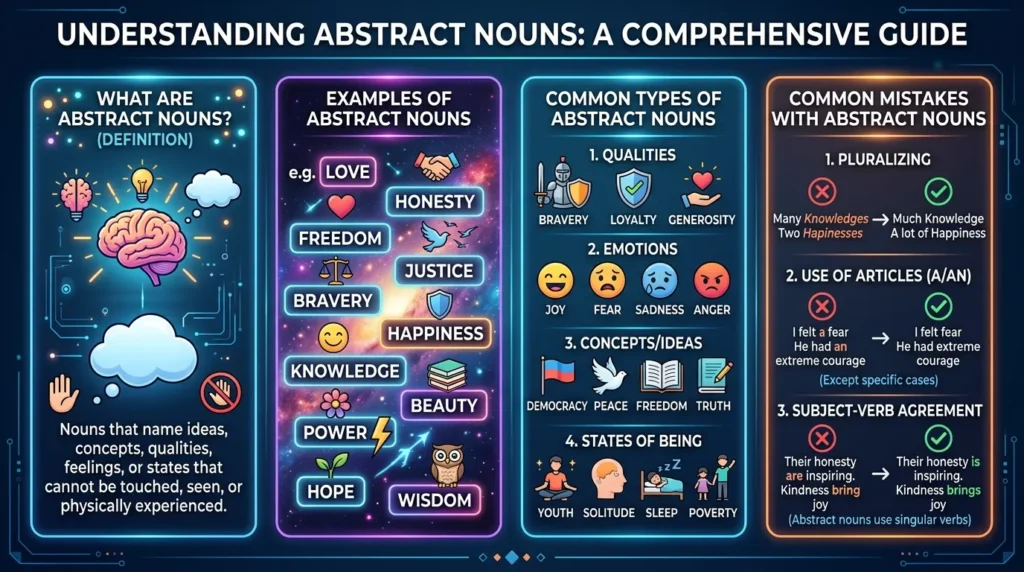
An abstract noun is a noun that names an idea, feeling, quality, condition, state, or concept that cannot usually be experienced through the five physical senses.
Examples of Abstract Nouns
- Love – a feeling
- Happiness – a state or feeling
- Honesty – a quality
- Freedom – an idea or condition
- Courage – a quality
- Knowledge – a state of understanding
- Beauty – a quality
- Friendship – a relationship or idea
- Anger – a feeling
- Justice – an idea or principle
Abstract Noun vs Concrete Noun
The easiest way to understand an abstract noun is to compare it with a concrete noun.
| Abstract Noun | Concrete Noun |
|---|---|
| love | heart |
| happiness | smile |
| knowledge | book |
| courage | soldier |
| beauty | flower |
| friendship | friend |
| freedom | country |
| anger | person |
A concrete noun names something that can normally be seen, heard, touched, smelled, or tasted.
An abstract noun names something that is not physically tangible.
For example:
The child showed great courage.
Here, courage is an abstract noun because courage is a quality, not a physical object.
The Origin of Abstract Noun
The word abstract comes from the Latin word abstractus, meaning “drawn away” or “separated.” It comes from the Latin verb abstrahere, which means “to draw away.”
The word noun comes from the Latin nomen, meaning “name.”
Together, the idea of an abstract noun refers to a noun that names something separated from a physical object, such as an idea, quality, feeling, or condition.
English grammar developed the distinction between abstract and concrete nouns to explain different kinds of things that nouns can name.
For example:
- stone → a physical object
- strength → a quality
- teacher → a person
- knowledge → an idea or state
The spelling abstract noun is the same in British and American English. There is no major spelling difference between the two varieties.
British English vs American English Spelling
There is no spelling difference between abstract noun in British English and American English. Both use the same words and the same spelling.
The basic grammar concept is also the same.
| Feature | British English | American English |
|---|---|---|
| Abstract noun | abstract noun | abstract noun |
| Spelling | Same | Same |
| Meaning | Idea, quality, feeling, state, or concept | Idea, quality, feeling, state, or concept |
| Capitalization | Lowercase in normal use | Lowercase in normal use |
| Examples | love, honesty, freedom | love, honesty, freedom |
Examples
British English:
Honesty is an important quality.
American English:
Honesty is an important quality.
The word honesty is spelled exactly the same in both forms of English.
Capitalization
Abstract nouns are normally written in lowercase unless they appear at the beginning of a sentence or form part of a proper name.
Correct:
Happiness is important.
Everyone wants happiness.
Incorrect:
Everyone wants Happiness.
Which Spelling Should You Use?
The correct spelling is abstract noun in both British and American English.
You do not need to change the spelling depending on your audience.
For US Audiences
Use abstract noun in school assignments, textbooks, business writing, and everyday communication.
Example:
Freedom is an example of an abstract noun.
For UK Audiences
Use abstract noun in British English as well.
Example:
Happiness is an abstract noun because it describes a feeling or state.
For Commonwealth Countries
Countries such as Australia, Canada, New Zealand, and India also use the term abstract noun.
For Global Audiences
Abstract noun is the safest and clearest term for international English learners.
The spelling does not change. The main goal is to understand what the noun describes.
Common Mistakes with Abstract Noun
Learners often understand the basic definition but make mistakes when identifying or using abstract nouns.
Mistake 1: Thinking All Nouns Must Be Physical
❌ Happiness is not a noun because you cannot touch it.
✅ Happiness is an abstract noun.
A noun does not have to be a physical object. It can name a feeling, idea, quality, or state.
Mistake 2: Confusing Abstract and Concrete Nouns
❌ Chair is an abstract noun.
✅ Chair is a concrete noun.
You can see and touch a chair, so it is concrete.
Mistake 3: Forgetting That Feelings Can Be Abstract Nouns
Words such as these are abstract nouns:
- love
- fear
- anger
- joy
- sadness
- excitement
For example:
Fear can affect our decisions.
Mistake 4: Capitalizing Abstract Nouns Without a Reason
❌ Education is important for Success.
✅ Education is important for success.
Success is normally lowercase unless it begins the sentence or is part of a proper name.
Mistake 5: Assuming Every Noun Ending in “-ness” Is the Same
Many abstract nouns end in -ness, but not every abstract noun has this ending.
Examples:
- kindness
- happiness
- darkness
- sadness
Other abstract nouns have different endings:
- freedom
- beauty
- courage
- wisdom
- knowledge
Mistake 6: Confusing an Abstract Noun With an Adjective
Compare:
She is honest.
Her honesty impressed me.
Honest is an adjective.
Honesty is an abstract noun.
Abstract Noun in Everyday Examples
Abstract nouns are common in almost every type of English writing. They help us describe emotions, ideas, values, and qualities.
In Emails
- Thank you for your kindness.
- We appreciate your patience.
- Your support means a lot to us.
- We value honesty in our workplace.
In News Articles
- The government promised greater freedom for citizens.
- The decision caused public anger.
- The organization promotes equality.
- Experts discussed the importance of education.
On Social Media
- Happiness comes from simple things.
- Never lose your confidence.
- Friendship makes life better.
- Choose kindness every day.
In Formal Writing
- Education plays an important role in economic development.
- Justice is an important principle in society.
- Leadership requires patience and responsibility.
- Innovation can improve business performance.
Abstract Noun Formation
Many abstract nouns are formed from adjectives, verbs, or other words.
| Base Word | Abstract Noun |
|---|---|
| happy | happiness |
| kind | kindness |
| honest | honesty |
| brave | bravery |
| free | freedom |
| strong | strength |
| wise | wisdom |
| beautiful | beauty |
| patient | patience |
| responsible | responsibility |
Learning these word families can help you recognize abstract nouns more easily.
Examples in Sentences
She is kind.
Her kindness helped everyone.He is brave.
His bravery inspired the team.They are honest.
Their honesty earned our trust.
Abstract Noun Comparison Table
| Abstract Noun | Meaning | Example |
|---|---|---|
| Happiness | A positive feeling or state | Happiness is important. |
| Love | A strong feeling of affection | Love can bring people together. |
| Honesty | The quality of being truthful | Honesty builds trust. |
| Freedom | The state of being free | Everyone values freedom. |
| Courage | The ability to face difficulty | Courage helped him continue. |
| Wisdom | Good judgment and understanding | Wisdom comes with experience. |
| Knowledge | Understanding of information | Knowledge can improve decisions. |
| Friendship | A relationship between friends | Their friendship lasted for years. |
| Justice | Fair treatment | People want justice. |
| Confidence | Belief in yourself | Confidence can improve performance. |
Abstract Noun – Google Trends & Usage Data
Search interest in abstract noun is closely linked to English grammar education. Students, teachers, parents, and English learners often search for the term when studying parts of speech or preparing for tests.
Common related searches include:
- abstract noun definition
- abstract noun examples
- 10 abstract nouns
- abstract noun list
- concrete and abstract nouns
- abstract noun of happy
- abstract noun exercises
- abstract noun examples in sentences
Interest can vary by country and educational season. Grammar searches often become more common during school terms, exam periods, and periods of active English-language learning.
The topic has global value because English learners need to understand the difference between physical objects and ideas, feelings, and qualities.
For SEO content, the strongest approach is to answer the user’s main question quickly and then provide examples, comparisons, word formation, exercises, and common mistakes.
Abstract Noun vs Concrete Noun
| Abstract Noun | Concrete Noun |
|---|---|
| love | person |
| happiness | smile |
| honesty | person |
| freedom | bird |
| courage | soldier |
| beauty | flower |
| knowledge | book |
| friendship | friend |
| anger | face |
| strength | muscle |
Remember that the concrete noun is usually something physical, while the abstract noun refers to an idea, quality, feeling, or state.
FAQs About Abstract Noun
1. What is an abstract noun?
An abstract noun names an idea, feeling, quality, state, or concept that cannot usually be experienced through the five senses.
Examples include love, happiness, honesty, freedom, and courage.
2. What are 10 examples of abstract nouns?
Ten common examples are:
love, happiness, honesty, courage, freedom, beauty, knowledge, wisdom, friendship, and justice.
3. What is the difference between an abstract noun and a concrete noun?
A concrete noun names something physical that can usually be experienced through the senses. An abstract noun names an idea, feeling, quality, or state.
Example:
- flower → concrete noun
- beauty → abstract noun
4. Is happiness an abstract noun?
Yes. Happiness is an abstract noun because it describes a feeling or state that cannot be physically touched.
5. Is love an abstract noun?
Yes. Love is an abstract noun when it refers to a feeling, emotion, or concept.
Example:
Love can make people feel connected.
6. Is honesty an abstract noun?
Yes. Honesty is an abstract noun because it names the quality of being truthful.
Example:
Honesty is important in every relationship.
7. Can an abstract noun be plural?
Yes, some abstract nouns can have plural forms when they refer to different instances, types, or expressions.
For example:
The artist captured the beauties of nature.
However, many abstract nouns are commonly used as singular or uncountable nouns.
8. Are abstract nouns always uncountable?
No. Some abstract nouns can be countable or uncountable depending on their meaning and context.
For example, experience can be used in different ways:
Experience is valuable.
I had several interesting experiences.
Conclusion
An abstract noun is a noun that names an idea, feeling, quality, state, or concept rather than a physical object. Words such as love, happiness, honesty, freedom, courage, knowledge, and justice are common examples.
The easiest way to identify an abstract noun is to ask whether the word describes something that cannot normally be seen, touched, heard, smelled, or tasted. If it names an idea, feeling, or quality, it may be an abstract noun. However, context is important because some words can have different meanings and uses.
Abstract nouns are used every day in emails, news reports, social media posts, academic writing, and professional communication. They allow us to talk about important ideas and human experiences.
There is also no spelling difference between British and American English. The term abstract noun is written the same way in both varieties. Learning common word endings such as -ness, -ity, -ship, -dom, and -tion can also help you recognize many abstract nouns.
Once you understand the difference between abstract and concrete nouns, this part of English grammar becomes much easier to use correctly.