
Nouns are one of the first grammar topics English learners study, but understanding the types of nouns can still be confusing. Why is Sarah different from girl? Why is water different from book? And why is team sometimes treated differently from people?
People search for types of nouns because they want to understand how nouns are classified and how each type works in a sentence. Knowing these categories can make grammar easier and help you write clearer English.
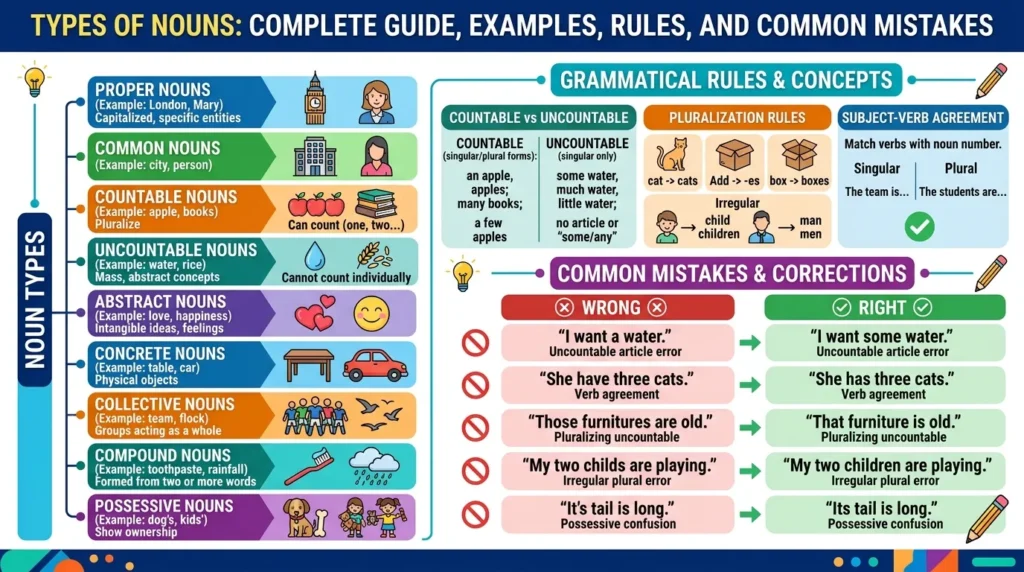
The main types of nouns include common nouns, proper nouns, concrete nouns, abstract nouns, collective nouns, countable nouns, uncountable nouns, compound nouns, and possessive nouns. Some nouns can belong to more than one category at the same time. For example, school can be a common, concrete, and countable noun.
This guide explains the major types of nouns in simple English. You will learn their meanings, examples, capitalization rules, common mistakes, everyday uses, and differences between British and American English.
Types of Nouns – Quick Answer
Types of nouns are different groups used to classify nouns according to their meaning, form, or use in a sentence.
Here are the most common types:
- Common Noun – names a general person, place, animal, or thing.
- teacher, city, dog, book
- Proper Noun – names a specific person, place, or thing.
- Sarah, London, India, Monday
- Concrete Noun – names something that can be experienced through the senses.
- table, apple, car, music
- Abstract Noun – names an idea, feeling, quality, or state.
- love, honesty, happiness, courage
- Collective Noun – names a group of people, animals, or things.
- team, family, class, flock
- Countable Noun – can be counted.
- one book, two books
- Uncountable Noun – usually cannot be counted as separate units.
- water, rice, information
- Compound Noun – combines two or more words to create a noun.
- toothpaste, bus stop, swimming pool
- Possessive Noun – shows ownership or relationship.
- John’s car, the girl’s bag
A single noun can fit into more than one category. For example, teacher is a common, concrete, and countable noun.
The Origin of Types of Nouns
The word noun comes from the Latin word nomen, meaning “name.” It entered English through Old French and developed into the modern word noun.
The idea of classifying nouns is much older than modern English. Ancient grammarians studied different kinds of words and their roles in sentences. Over time, English grammar developed clearer categories to help explain how nouns work.
The phrase types of nouns simply refers to different classifications of nouns.
For example:
- city is a general name → common noun
- Paris is a specific name → proper noun
- happiness names a feeling → abstract noun
- team names a group → collective noun
There are no major spelling differences in the phrase types of nouns between British and American English. The differences are mainly related to grammar and style, not the spelling of the phrase itself.
British English vs American English Spelling
The phrase types of nouns is spelled the same way in British English and American English. The main noun categories are also largely the same.
However, some usage rules can differ slightly, especially with collective nouns, punctuation, and certain expressions.
| Feature | British English | American English |
|---|---|---|
| Types of nouns | Same | Same |
| Common nouns | Same rules | Same rules |
| Proper nouns | Capitalized | Capitalized |
| Abstract nouns | Same rules | Same rules |
| Collective nouns | Can take singular or plural verbs | Usually takes a singular verb |
| Countable nouns | Same basic rules | Same basic rules |
| Uncountable nouns | Same basic rules | Same basic rules |
| Compound nouns | Similar rules | Similar rules |
| Possessive nouns | Same basic rules | Same basic rules |
Collective Noun Example
British English may use either a singular or plural verb depending on whether the group is viewed as one unit or as individuals.
British English:
The team are playing well.
American English:
The team is playing well.
Both varieties use team as a collective noun, but verb agreement can differ.
Which Spelling Should You Use?
There is only one standard spelling: types of nouns.
You do not need to change the spelling for different English-speaking audiences.
For US Audiences
Use types of nouns in American English textbooks, schoolwork, websites, and professional writing.
For UK Audiences
Use types of nouns in British English. The phrase is spelled exactly the same way.
For Commonwealth Countries
Countries such as Australia, Canada, New Zealand, and India also use types of nouns.
For Global Audiences
Types of nouns is the safest and clearest phrase for international readers and English learners.
The important difference is not spelling. It is understanding how each noun type works.
Common Mistakes with Types of Nouns
English learners often make mistakes when identifying or using different types of nouns.
Mistake 1: Confusing Common and Proper Nouns
❌ I live in london.
✅ I live in London.
London is a proper noun and needs a capital letter.
Mistake 2: Capitalizing Every Noun
❌ The Teacher gave the Student a Book.
✅ The teacher gave the student a book.
General nouns do not normally need capital letters.
Mistake 3: Using a Singular Verb With Every Collective Noun
The correct verb depends on the variety of English and the intended meaning.
British English:
The team are discussing the plan.
American English:
The team is discussing the plan.
Mistake 4: Treating Uncountable Nouns Like Countable Nouns
❌ I need two informations.
✅ I need two pieces of information.
Information is normally an uncountable noun.
Mistake 5: Using “A” With an Uncountable Noun
❌ I need a water.
✅ I need some water.
When ordering a drink, informal English may use a water to mean a serving or bottle of water, but the noun water itself is generally uncountable.
Mistake 6: Forgetting the Apostrophe in Possessive Nouns
❌ This is Johns car.
✅ This is John’s car.
The apostrophe shows possession.
Types of Nouns in Everyday Examples
Nouns appear in almost every sentence we speak or write. Understanding their types helps you use them correctly in different situations.
In Emails
- Please send the report before Monday.
- Sarah’s presentation was excellent.
- The team will meet tomorrow.
- We need more information about the project.
In News Articles
- The government announced a new policy.
- London hosted the event.
- The company created new jobs.
- The team won the final match.
On Social Media
- Friends make life better.
- Happiness comes from simple things.
- Our team won today!
- Dubai looks amazing at night.
In Formal Writing
- Education plays an important role in society.
- The organization supports local communities.
- Honesty is an important quality in leadership.
- The committee reviewed the proposal.
Types of Nouns Comparison Table
| Type of Noun | What It Names | Examples |
|---|---|---|
| Common noun | General person, place, animal, or thing | city, teacher, dog |
| Proper noun | Specific name | London, Sarah, Google |
| Concrete noun | Something experienced through the senses | table, apple, car |
| Abstract noun | Idea, feeling, quality, or state | love, courage, freedom |
| Collective noun | Group | team, family, class |
| Countable noun | Something that can be counted | book, chair, student |
| Uncountable noun | Something not normally counted individually | water, information, rice |
| Compound noun | Two or more words forming a noun | toothbrush, bus stop |
| Possessive noun | Shows ownership or relationship | John’s car, Mary’s book |
How to Identify the Type of Noun
You can identify a noun by asking a few simple questions.
Is It a Specific Name?
If yes, it may be a proper noun.
Pakistan is a beautiful country.
Can You Touch or See It?
If yes, it may be a concrete noun.
The table is new.
Does It Name an Idea or Feeling?
If yes, it may be an abstract noun.
Honesty is important.
Does It Name a Group?
If yes, it may be a collective noun.
The team won the game.
Can You Count It?
If yes, it may be a countable noun.
I have three books.
Can It Be Divided Into Separate Units?
If not normally, it may be an uncountable noun.
We need more water.
Types of Nouns – Google Trends & Usage Data
Search interest for types of nouns is strongly connected with education and English learning. People often search for this term when studying grammar, preparing for exams, completing homework, teaching English, or improving writing skills.
Related searches commonly include:
- types of nouns
- 8 types of nouns
- 9 types of nouns
- types of nouns with examples
- common and proper nouns
- abstract nouns
- collective nouns
- countable and uncountable nouns
- noun types in English
Interest can vary by country and time of year. Grammar-related searches often increase during school terms, examination periods, and periods of active English-language study.
The topic has global relevance because English learners in many countries use the phrase types of nouns when learning basic grammar.
8 Types of Nouns vs 9 Types of Nouns
Different textbooks and grammar resources may list different numbers of noun types. There is no single universal list that every grammar book follows.
| Common Classification | Another Classification |
|---|---|
| Common noun | Common noun |
| Proper noun | Proper noun |
| Concrete noun | Concrete noun |
| Abstract noun | Abstract noun |
| Collective noun | Collective noun |
| Countable noun | Countable noun |
| Uncountable noun | Uncountable noun |
| Compound noun | Compound noun |
| — | Possessive noun |
Some grammar books treat possessive nouns as a grammatical form rather than a separate noun type. This explains why one source may list eight types while another lists nine.
FAQs About Types of Nouns
1. What are the main types of nouns?
The main types include common, proper, concrete, abstract, collective, countable, uncountable, compound, and possessive nouns. Different grammar books may organize these categories differently.
2. What is a common noun?
A common noun names a general person, place, animal, or thing.
Examples: teacher, city, dog, book.
3. What is a proper noun?
A proper noun gives the specific name of a person, place, organization, or other unique entity.
Examples: Sarah, London, India, Microsoft.
4. What is an abstract noun?
An abstract noun names something that cannot usually be experienced through the five senses, such as an idea, feeling, quality, or state.
Examples: love, honesty, happiness, freedom.
5. What is a collective noun?
A collective noun refers to a group of people, animals, or things as one unit.
Examples: team, family, class, committee.
6. What is the difference between countable and uncountable nouns?
Countable nouns can be counted as individual items.
one apple, two apples
Uncountable nouns are not normally counted as separate individual units.
water, information, advice
7. Why do different sources list different numbers of noun types?
Grammar books classify nouns in different ways. Some treat possessive nouns or compound nouns as separate categories, while others treat them as forms of nouns. Therefore, one source may list eight types and another may list nine or more.
8. Can one noun belong to more than one type?
Yes. A noun can belong to several categories at the same time.
For example, teacher can be a common, concrete, and countable noun.
Similarly, London is a proper, concrete, and countable noun.
9. Is “types of nouns” the same in British and American English?
Yes. The phrase types of nouns is spelled the same way in both British and American English. The main differences are occasional usage rules, especially with collective nouns.
Conclusion
Understanding the types of nouns makes English grammar much easier. Nouns can be classified by what they name, how they behave, or how they are formed. The most common categories include common, proper, concrete, abstract, collective, countable, uncountable, compound, and possessive nouns.
The easiest way to learn these categories is through simple examples. A city is a common noun, while London is a proper noun. Happiness is an abstract noun, while table is a concrete noun. Team is a collective noun, while book is a countable noun. Water is normally an uncountable noun.
British and American English use the same spelling for types of nouns, although some grammar rules can differ slightly. Also, different textbooks may list different numbers of noun types because they classify nouns in different ways.
Once you understand what each category means, you can identify nouns more easily and avoid common grammar mistakes. Practice with real sentences, and noun classification will quickly become more natural.