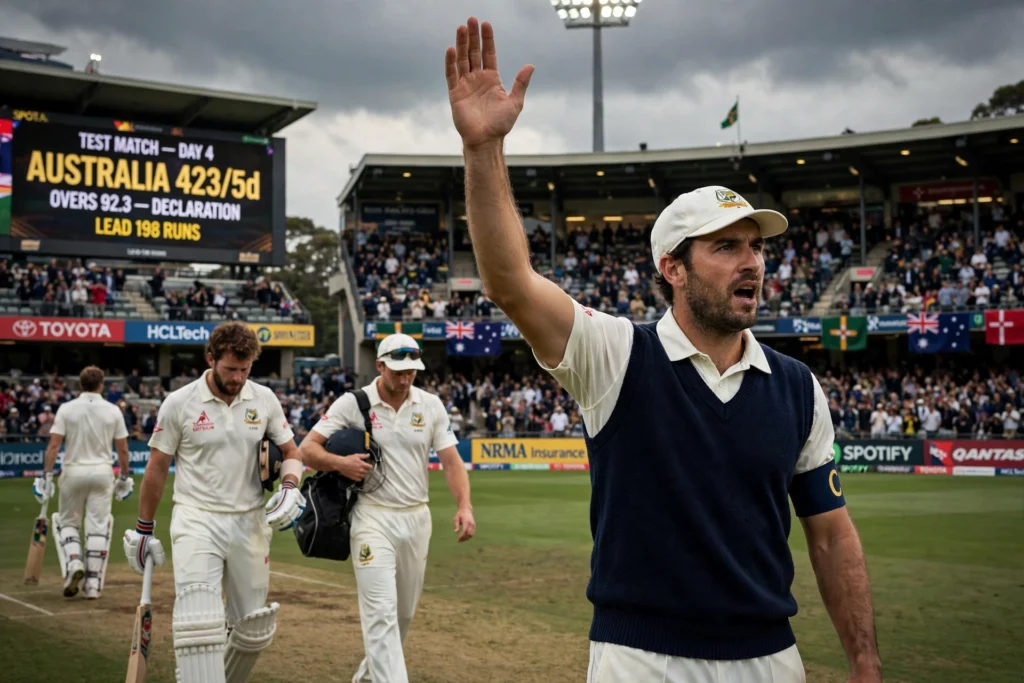
In Test cricket, the batting captain holds a power that does not exist in any limited-overs format: the power to end his own team’s innings whenever he chooses, even if all ten wickets are still intact. This is called a declaration, and it is one of the most fascinating tactical weapons in the longest format of the game.
A well-timed declaration can turn a certain draw into a famous victory. A poorly judged one can throw away a winning position. From defensive stonewalling to Bazball-era aggression, declarations have shaped some of Test cricket’s most memorable moments.
What Is a Declaration in Test Cricket?
A declaration is the batting captain’s decision to close his side’s innings voluntarily before all batters are out. Under Law 15 of the MCC Laws of Cricket, the captain of the batting side may declare an innings closed at any time during a match.
Once declared, the innings is over. The batters walk off, the not-out batters’ scores stand as they are, and the bowling side begins its innings. The declaration must be communicated to the opposing captain and the umpires, and it cannot be reversed.
It is important to understand that declaration applies only to multi-innings matches — Test cricket and first-class cricket. In ODIs and T20Is, an innings ends when the overs run out or all wickets fall, so there is nothing to declare.
Why Would a Captain Declare?
The logic behind a declaration is simple: Test matches have a time limit of five days, and a team must take twenty wickets to win. If a batting side keeps piling on runs forever, it may run out of time to bowl the opposition out twice.
Captains declare for three main reasons:
Setting a target. The most common reason. A captain decides his team has enough runs, declares, and challenges the opposition to chase a difficult total in the remaining time.
Leaving time to bowl the opposition out. Runs on the board mean nothing without time to take wickets. A declaration converts batting time into bowling time.
Avoiding the follow-on equation. Sometimes a declaration is used to manipulate the follow-on margin or to control when the opposition bats, such as making them bat during a difficult final session.
The eternal dilemma is balance: declare too early and you may not have enough runs; declare too late and rain, bad light, or a flat pitch may steal your victory.
Declaration vs Forfeiture: Know the Difference
Many fans confuse declaration with forfeiture, but they are different. A declaration closes the innings that is currently in progress. A forfeiture is when a captain gives up an innings that has not yet started — for example, forfeiting the second innings without playing it.
Forfeiture is extremely rare in international cricket but is used occasionally in county and domestic matches to manufacture a result on a rain-affected pitch.
Famous Declarations in Test History
Multan, 2004 — India’s bold call. With Rahul Dravid standing in as captain, India declared their first innings at 675 for 5 against Pakistan. The talking point: Sachin Tendulkar was left stranded on 194 not out, six runs short of a double century. Dravid’s decision prioritised the team’s push for victory over a personal milestone, and it sparked one of Indian cricket’s longest-running debates.
Edgbaston, 2023 — Bazball’s statement. On the very first day of the Ashes, England captain Ben Stokes declared at 393 for 8, with Joe Root unbeaten on 118. A first-day declaration in an Ashes Test was almost unheard of, but it summed up England’s aggressive new philosophy: always push for a result, never play safe.
Johannesburg and beyond. Aggressive declarations have also backfired famously. There have been matches where early declarations allowed the opposition to chase down targets that once looked impossible, reminding every captain that declaration is a gamble.
The Strategy Behind the Timing
Great declarations are about reading the match situation:
- Pitch behaviour. If the pitch is starting to crack and turn, a captain may declare earlier to exploit it.
- Weather. Cloud cover helps swing bowling; a captain may declare to bowl when conditions suit his attack.
- Opposition mindset. Setting a target that looks gettable can tempt the opposition into risky shots.
- Time remaining. The classic calculation: runs needed per over versus wickets in hand.
Modern captains also use data — scoring rates, bowler workloads, and session-by-session plans — but the gut feel of “enough is enough” remains an art.
Frequently Asked Questions
What is a declaration in Test cricket?
A declaration is when the batting captain voluntarily ends his team’s innings before all wickets have fallen, usually to leave enough time to bowl the opposition out and push for victory.
Can a captain declare in ODIs or T20Is?
No. Declarations exist only in multi-innings cricket (Tests and first-class matches). In limited-overs cricket, the innings ends automatically when the overs are completed or all wickets fall.
What is the difference between declaration and forfeiture?
A declaration closes the innings currently being played. A forfeiture surrenders an innings that has not yet begun. Both are covered under Law 15 of the MCC Laws.
Why did Dravid declare when Tendulkar was on 194?
In the 2004 Multan Test against Pakistan, stand-in captain Rahul Dravid declared India’s innings at 675 for 5 to maximise the time available to bowl Pakistan out, leaving Tendulkar six short of a double hundred. The decision remains controversial.
Can a declaration be reversed?
No. Once the captain has declared and informed the umpires and the opposing captain, the decision is final.
Conclusion
The declaration is Test cricket’s ultimate expression of captaincy — part mathematics, part psychology, and part courage. It is the moment a captain says “we have enough” and backs his bowlers to finish the job. Whether it produces famous victories or infamous miscalculations, the declaration guarantees one thing: Test cricket will never drift quietly into a draw while a brave captain is in charge.

Green Benn is a dedicated sports writer specializing in cricket, including IPL and international formats. Known for clear, engaging, and informative content, Green simplifies complex match analysis and player statistics for all readers. Passionate about sports storytelling, Green delivers reliable, SEO-friendly articles that keep fans updated and informed


Pingback: South Africa vs Australia, 2nd Test 2026: Proteas Seal Innings-and-31-Run Win to Level Series