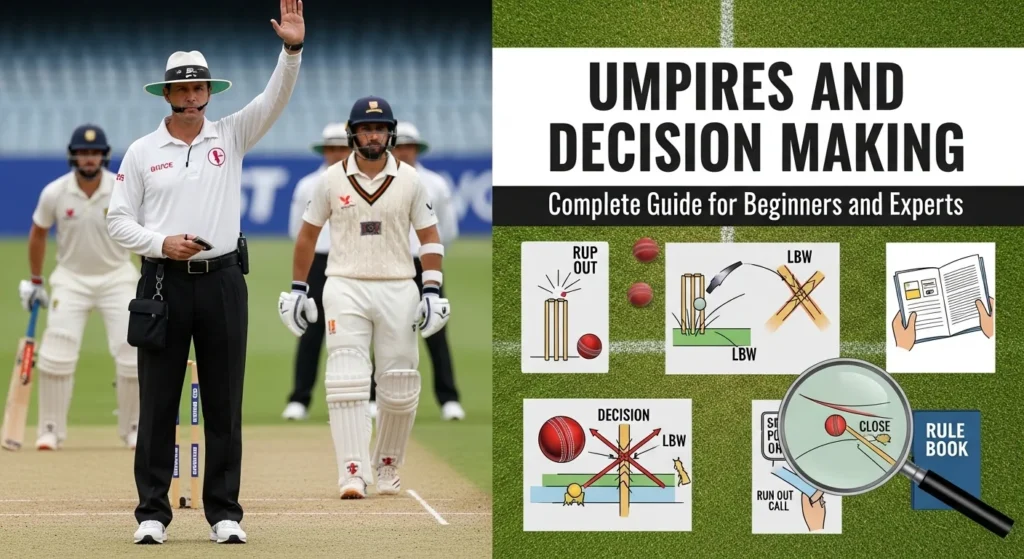

Umpires and decision making are at the heart of cricket. Every match depends on fair judgments, accurate calls, and clear understanding of the rules. Without umpires, the game would lack discipline, fairness, and structure.
For beginners, umpires may seem like simple rule enforcers. However, their role is much deeper. They manage the flow of the game, ensure players follow the laws, and make important decisions that can change the outcome of a match.
This complete guide will help you understand the role of umpires, how decision making works, and why it is so important in cricket.
What Is the Role of Umpires in Cricket?
The role of umpires in cricket is extremely important because they ensure that the game is played fairly, smoothly, and according to the official rules. Umpires act as neutral judges on the field, meaning they do not support any team and make decisions without bias. During a match, there are usually two on-field umpires who closely observe every ball, player movement, and action. Their main duty is to make decisions such as whether a batsman is out or not out, whether a delivery is a no-ball or a wide, and whether runs or boundaries are valid. These decisions must be made quickly and confidently, often under pressure from players, crowds, and match situations. Umpires also control the overall flow of the game by ensuring that players follow the rules, maintain discipline, and respect the spirit of cricket. In modern cricket, umpires are supported by technology like the Decision Review System (DRS), which helps them make more accurate decisions, especially in close situations such as LBW or run-outs. Apart from making decisions, umpires also check playing conditions such as light, weather, and pitch safety to ensure that the match can continue without risk. They use clear hand signals to communicate their decisions to players and spectators, which helps everyone understand what is happening in the game. Overall, umpires play a key role in maintaining fairness, discipline, and excitement in cricket, and without them, it would be very difficult to manage the game properly.
Key Responsibilities of Umpires
- Enforcing the rules of the game
- Making decisions on appeals (out or not out)
- Monitoring player behavior
- Ensuring fair play
- Managing match conditions (light, weather, pitch)
They act as neutral judges and must remain unbiased at all times.
History of Umpiring in Cricket
Early Days of Cricket
In the early days, players themselves made decisions. This often caused disputes and confusion during matches.
Introduction of Neutral Umpires
To reduce conflicts, official umpires were introduced. Over time, neutral umpires (from different countries) became standard in international cricket.
Modern Technology Era
Today, umpires are supported by advanced technologies like:
- Decision Review System (DRS)
- Hawk-Eye tracking
- UltraEdge (Snickometer)
These tools help improve accuracy in decision making.
Types of Umpires in a Cricket Match
On-Field Umpires
On-field umpires are the two main officials present on the cricket ground who are responsible for controlling the match and making real-time decisions during play. They stand in fixed positions—one at the bowler’s end behind the stumps and the other at square leg—so they can clearly observe every action from different angles. Their primary role is to ensure that the game is played according to the rules and in a fair manner. On-field umpires make important decisions such as giving a batsman out or not out, calling no-balls and wide balls, and judging run-outs, stumpings, and catches (sometimes with help from the third umpire). They also keep track of the number of balls in each over, monitor field placements, and ensure that players follow proper conduct and discipline on the field. In addition, they check external conditions like light, weather, and pitch safety to decide whether the match should continue or be stopped. On-field umpires must have strong concentration, quick decision-making ability, and deep knowledge of cricket laws, as they often make crucial decisions within seconds under pressure from players and spectators. Their signals, such as raising a finger for out or extending arms for a wide, help communicate decisions clearly to everyone watching. Overall, on-field umpires are essential for maintaining the flow, fairness, and integrity of the game.
- One stands behind the bowler’s end
- One stands at the square leg
They make most of the decisions during the game.
Third Umpire (TV Umpire)
The Third Umpire, also known as the TV Umpire, plays a very important role in modern cricket by assisting on-field umpires with the help of video technology. Unlike the on-field umpires, the third umpire sits off the ground in a control room where multiple camera angles and slow-motion replays are available. His main responsibility is to make accurate decisions in situations that are too close or difficult to judge with the naked eye. These include run-outs, stumpings, close catches, boundary decisions (whether the ball touched the rope), and checking if a batsman hit the ball before being caught. When on-field umpires are unsure about a decision, they signal for a review by making a TV screen gesture, and the third umpire then carefully analyzes the footage before giving the final decision. In addition, with the use of technologies like ball-tracking and edge detection, the third umpire also plays a key role in the Decision Review System (DRS), helping to confirm or overturn decisions such as LBW or caught-behind appeals. The third umpire must be highly focused, patient, and precise because even a small mistake can affect the outcome of the match. Clear communication between the third umpire and on-field umpires is also very important to ensure smooth decision making. Overall, the third umpire improves accuracy, reduces human error, and adds fairness and transparency to the game, making cricket more reliable and enjoyable for players and fans alike.
- Run-out decisions
- Stumpings
- Boundary checks
- Close catches
Match Referee
Although not an umpire, the match referee:
- Oversees player conduct
- Applies disciplinary actions
- Ensures fair competition
Decision Making in Cricket
Decision making is the most critical part of umpiring. Umpires must make quick and accurate decisions under pressure.
Types of Decisions
Out Decisions
- LBW (Leg Before Wicket)
- Bowled
- Caught
- Run-out
- Stumped
Not Out Decisions
- No valid dismissal
- Ball did not hit bat or pad correctly
- Safe inside crease
Other Decisions
- No-ball
- Wide ball
- Dead ball
- Boundary (four or six)
Important Rules Umpires Follow
LBW Decision Rules
LBW is one of the most complex decisions. Umpires must check:
- Ball pitching location
- Impact point
- Ball trajectory
No-Ball Rules
A no-ball is called if:
- Bowler oversteps the crease
- Illegal bowling action
- Dangerous delivery
Wide Ball Rules
A ball is considered wide if:
- It is too far from the batsman to play a normal shot
Use of Technology in Decision Making
Decision Review System (DRS)
DRS allows players to challenge umpire decisions.
How DRS Works
- Teams have limited reviews
- Technology checks the decision
- Final result is displayed
Hawk-Eye Technology
- Tracks the ball’s path
- Helps in LBW decisions
UltraEdge (Snickometer)
- Detects edges from bat to ball
- Helps in caught-behind decisions
Benefits of Technology
- Improves accuracy
- Reduces human error
- Increases fairness
Signals Used by Umpires
Umpires use hand signals to communicate decisions clearly.
Common Signals
- Out: Raised index finger
- Four: Arm waved horizontally
- Six: Both arms raised
- No-ball: One arm extended
- Wide: Both arms stretched
These signals help players and spectators understand decisions instantly.
Skills Required for Good Decision Making
Observation Skills
Umpires must carefully watch:
- Ball movement
- Bat contact
- Player positions
Concentration
Cricket matches can last many hours. Umpires must stay focused throughout.
Confidence
Umpires must make decisions without hesitation, even under pressure from players and crowd.
Knowledge of Rules
A strong understanding of cricket laws is essential for correct decisions.
Challenges Faced by Umpires
High Pressure Situations
- Close matches
- Loud crowds
- Player appeals
Human Error
Even experienced umpires can make mistakes due to:
- Fast gameplay
- Limited visibility
Criticism from Fans and Media
Umpires often face criticism for wrong decisions, especially in important matches.
Strategies for Better Decision Making
Staying Calm
Umpires must remain calm and composed during tense situations.
Proper Positioning
Correct positioning helps umpires see events clearly.
Using Technology Wisely
Combining human judgment with technology improves accuracy.
Role of Players in Decision Making
Players also play a role in supporting fair decisions.
Responsibilities of Players
- Respect umpire decisions
- Avoid aggressive behavior
- Follow the spirit of the game
Equipment Used by Umpires
Umpires use specific equipment to perform their duties effectively.
Common Equipment
- Protective hat or cap
- Counter for balls and overs
- Light meter
- Communication devices
- Decision review system tools
Umpires in Different Formats of Cricket
Test Matches
- Longer format
- More strategic decisions
- No time pressure
One Day Internationals (ODIs)
- Balanced format
- Moderate pace of decisions
T20 Matches
- Fast-paced
- Quick decision making required
- High pressure situations
Major Cricket Tournaments and Umpiring
Umpires play a crucial role in big tournaments such as:
- ICC Cricket World Cup
- ICC T20 World Cup
- International bilateral series
- Domestic leagues
Their decisions can impact match results and tournament outcomes.
Benefits of Understanding Umpires and Decision Making
For Players
- Better understanding of rules
- Improved gameplay awareness
For Fans
- More enjoyable viewing experience
- Better understanding of match situations
For Beginners
- Easier to learn cricket rules
- Builds interest in the game
Interesting Facts About Umpires
- Umpires must pass exams to qualify at higher levels
- Some decisions are reviewed within seconds using technology
- Umpires can overturn decisions using DRS
- Neutral umpires are used in international matches
How Umpires Impact Match Results
Umpires have a direct influence on the outcome of matches:
- Correct decisions ensure fairness
- Wrong decisions can change match results
- Technology helps reduce errors
Tips for Beginners to Understand Umpiring
- Watch umpire signals during matches
- Learn basic rules like LBW and no-ball
- Observe how decisions are reviewed
- Listen to expert commentary
Conclusion
Umpires and decision making are essential parts of cricket. They ensure fairness, maintain discipline, and keep the game running smoothly. With the help of modern technology, decision making has become more accurate and reliable.
Understanding how umpires work not only improves your knowledge of cricket but also makes watching the game more enjoyable. Whether you are a player, fan, or beginner, learning about umpiring will deepen your appreciation for this great sport.

Jon Smith is a passionate sports writer specializing in cricket and global sporting events. With a keen eye for match analysis and player performance, he creates clear, engaging, and informative content. His work focuses on simplifying complex sports insights, making them accessible for beginners and experienced fans alike worldwide.