
Football has many time-related terms that can confuse new fans. Two of the most common are extra time and injury time. They may sound similar because both add minutes to a football match, but they serve completely different purposes.
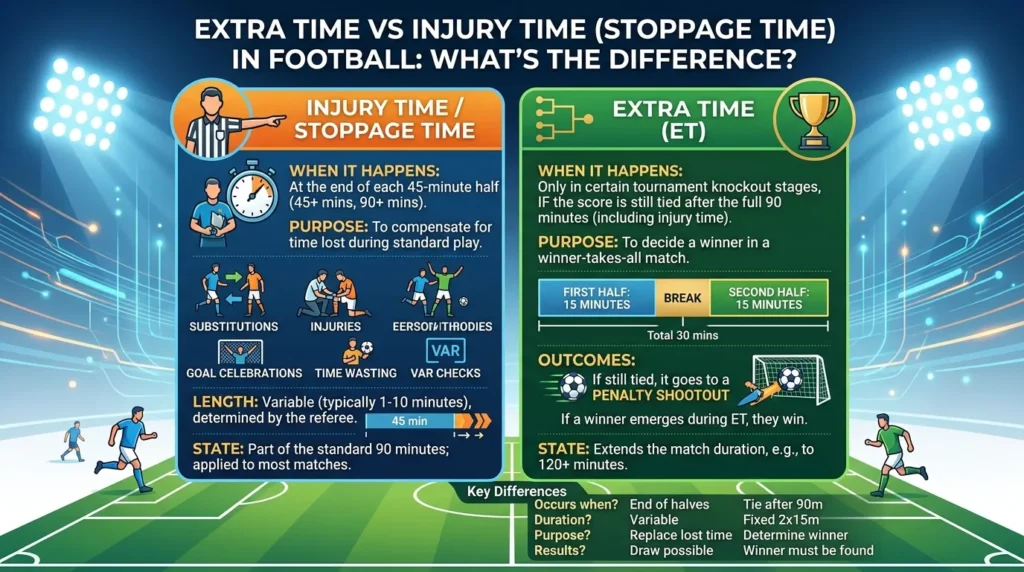
Injury time is the additional time played at the end of a normal half to compensate for time lost during that half. It can be added because of substitutions, injuries, time-wasting, goal celebrations, VAR checks, and other delays. The official Laws of the Game generally call this allowance for time lost or additional time.
Extra time, on the other hand, is an additional period played after the normal 90 minutes when a competition requires a winner and the score is still level. Under the Laws, extra time consists of two equal periods of up to 15 minutes each.
Understanding extra time vs injury time makes it much easier to follow knockout matches, cup competitions, and dramatic finishes. This guide explains the difference, rules, examples, and common misconceptions in simple English.
Extra Time vs Injury Time – Quick Answer
The easiest way to remember the difference is:
Injury time adds back time lost during a half, while extra time adds new playing periods after a drawn match.
| Feature | Injury Time | Extra Time |
|---|---|---|
| When is it played? | At the end of each half | After 90 minutes |
| Main purpose | Compensate for lost playing time | Decide a winner |
| Typical length | Varies | Two periods of up to 15 minutes |
| Played in every match? | Potentially, yes | No |
| Score must be tied? | No | Usually, when competition rules require a winner |
| Official concept | Allowance for time lost | Extra time |
| Can goals be scored? | Yes | Yes |
| Can penalties follow? | No | Yes, if the score remains level and competition rules require it |
For example, if an injury stops play for several minutes during the second half, the referee may add several minutes after the 90th minute. That is injury time, commonly called stoppage time or additional time.
If a cup final is tied after 90 minutes and the competition rules require a winner, the teams may play extra time.
What Is Injury Time in Football?
Injury time is the time added to the end of a half to account for significant playing time lost during that half.
Although fans often call it injury time, injuries are only one reason for additional time. The referee can allow time for many different interruptions.
According to IFAB’s Laws of the Game, allowance can be made for time lost through substitutions, injuries, time-wasting, disciplinary sanctions, permitted medical stoppages, VAR checks and reviews, goal celebrations, and other significant delays.
Why Is It Called Injury Time?
The term injury time became popular because injuries are one of the most visible reasons that play stops.
However, the term can be misleading. A match does not receive additional minutes only because players are injured.
For this reason, stoppage time and additional time are often more accurate terms.
How Does Injury Time Work?
Imagine a first half in which:
- A player receives treatment for two minutes.
- Three substitutions take place.
- A goal celebration takes one minute.
- A VAR review causes another delay.
The referee considers the time lost and determines the minimum amount of additional time to be played.
The fourth official normally displays the minimum additional time at the end of the half. The referee can increase it if further time is lost, but the displayed amount is not simply a guaranteed countdown that must end exactly at that number.
What Is Extra Time in Football?
Extra time is an additional period of football played after normal playing time when competition rules require a winner and the match is level.
A standard football match consists of two 45-minute halves. If the competition requires a winner after a draw, its regulations may provide for extra time or another permitted method of deciding the winner. (IFAB)
Under the Laws of the Game, extra time consists of two equal periods of up to 15 minutes each. (IFAB)
That means the maximum normal extra-time playing period is:
15 minutes + 15 minutes = 30 minutes
If the teams are still level after extra time, the competition may use a penalty shoot-out to determine the winner.
When Is Extra Time Used?
Extra time is generally associated with knockout competitions where one team must advance.
Examples can include:
- Cup finals
- Knockout rounds
- Two-legged ties
- Playoff matches
- Other competitions where regulations require a winner
However, not every competition uses extra time. The competition regulations determine how a tied match is decided.
Key Difference Between Extra Time and Injury Time
The biggest difference is why the additional minutes are played.
Injury Time Replaces Lost Time
Injury time compensates for time that was lost because the match was temporarily stopped or significantly delayed.
Suppose the second half has reached 90 minutes, but several minutes were lost because of injuries and substitutions. The referee may allow additional time so that the match includes the appropriate amount of playing time.
Extra Time Creates More Playing Time
Extra time is different.
If two teams finish 90 minutes level in a competition that requires a winner, they may play two additional periods of up to 15 minutes.
So, extra time is not compensation for delays. It is an additional stage of the competition.
Injury Time vs Extra Time: How the Clock Works
One common misunderstanding is that a match automatically ends exactly when the displayed injury time reaches zero.
That is not always how it works.
The referee determines the minimum additional time. If another significant delay occurs during that period, more time may be added. IFAB specifically states that the additional time may be increased by the referee but not reduced.
Example
Suppose the fourth official shows:
+5 minutes
At 94:30, a player requires medical attention and play stops.
The referee can allow further time for that interruption. Therefore, the final whistle does not necessarily have to occur at exactly 95:00.
This is why fans sometimes see a match continue beyond the displayed number.
How Long Is Injury Time?
There is no fixed number of injury-time minutes.
The amount depends on how much playing time was lost.
A match might have:
- 1 minute
- 3 minutes
- 5 minutes
- 8 minutes
- 10 minutes
- More in unusual circumstances
The referee decides the allowance based on the events of that particular half.
Is Injury Time Always Added?
Not necessarily.
If very little significant time has been lost, the allowance may be very short. The important point is that the referee determines the appropriate minimum amount rather than following a fixed formula such as “one minute per injury.”
How Long Is Extra Time?
Extra time consists of two equal periods of up to 15 minutes each when used under the competition’s regulations.
Therefore:
- First extra-time period: up to 15 minutes
- Second extra-time period: up to 15 minutes
- Total: up to 30 minutes
Additional time can also be allowed during extra-time periods when playing time is lost.
This is an important detail. Extra time itself can contain additional time.
Does Injury Time Happen During Extra Time?
Yes.
This is one of the most important points when understanding extra time vs injury time.
Extra time is a period of play. During that period, players can still suffer injuries, substitutions can occur, and other delays can happen.
The referee can therefore allow additional time at the end of an extra-time period to compensate for time lost during that period.
For example:
90 minutes → Extra time begins → 15 minutes → additional time → 15 minutes → additional time
The exact amount depends on the competition and events during the match.
Can a Goal Be Scored in Injury Time?
Yes.
A goal scored during additional time counts in exactly the same way as a goal scored during normal playing time, provided the goal is valid under the Laws.
For example, if a team is losing 1–0 after 90 minutes and scores at 90+6, the score becomes 1–1.
If the match is a knockout game and the competition requires a winner, the teams may then proceed to extra time if applicable.
Can a Goal Be Scored in Extra Time?
Yes.
Goals scored during extra time count toward the final score.
For example:
- 90 minutes: 1–1
- Extra time: Team A scores
- Final score after extra time: 2–1
If the score remains level after the two extra-time periods and the competition requires a winner, a penalty shoot-out may follow.
Extra Time vs Injury Time vs Penalty Shoot-Out
These three concepts are often mixed together, but they are separate.
| Stage | Purpose | Typical Situation |
|---|---|---|
| Normal time | Main match | Two 45-minute halves |
| Injury/stoppage time | Compensate for lost time | End of each half |
| Extra time | Find a winner | Level after 90 minutes |
| Penalty shoot-out | Find a winner after extra time | Still level after extra time |
A penalty shoot-out is not extra time.
Penalty kicks used in a shoot-out take place after the match has ended, under the competition’s applicable procedure.
Common Mistakes About Extra Time and Injury Time
Mistake 1: Thinking Injury Time Is Always 5 Minutes
There is no universal five-minute rule.
The amount depends on the time lost during the half.
Mistake 2: Thinking Injury Time Only Covers Injuries
Injuries are only one reason for additional time.
Substitutions, time-wasting, VAR delays, goal celebrations, disciplinary incidents, and other significant interruptions can also contribute.
Mistake 3: Thinking Extra Time Is Added to Every Draw
Extra time is not automatically played whenever a match is tied.
Competition regulations determine whether a winner must be produced and what procedure is used.
Mistake 4: Thinking Extra Time Means 30 Minutes Immediately
Extra time consists of two periods of up to 15 minutes, rather than one uninterrupted 30-minute period.
Mistake 5: Thinking the Match Must End Exactly at 90:00
The referee can allow additional time for time lost during the half.
Therefore, the match can continue beyond 90 minutes.
Practical Examples
Example 1: League Match
Team A and Team B are tied 2–2 after normal time.
The referee adds four minutes because of substitutions and other delays.
Team B scores at 90+3.
Result: Team B wins 3–2.
No extra time is required simply because the game was tied at 90 minutes.
Example 2: Knockout Match
A cup match is tied 1–1 after 90 minutes.
The competition rules require a winner.
The teams play extra time.
Team A scores during the first extra-time period and wins 2–1 after extra time.
Example 3: Level After Extra Time
A knockout match finishes 0–0 after 90 minutes.
Extra time is played, but the score remains 0–0.
The competition requires a winner.
The teams then proceed to a penalty shoot-out.
Why the Difference Matters for Football Fans
Understanding these terms helps fans interpret match reports, live scores, commentary, and tournament rules correctly.
When you see 90+4, it means the match is in the fourth minute of additional time after the 90-minute second half.
When commentators say extra time, they are referring to a separate period played after normal time because the competition requires a winner.
This distinction is also useful for players and coaches. Tactical decisions change significantly during extra time because players have already completed 90 minutes and fatigue becomes a major factor.
FAQs About Extra Time vs Injury Time
Is injury time the same as extra time?
No. Injury time is additional time used to compensate for time lost during a half. Extra time is additional playing periods used to decide a winner when competition rules require one.
Why is injury time added?
It is added to compensate for significant playing time lost through events such as injuries, substitutions, time-wasting, VAR reviews, goal celebrations, and other delays.
How many minutes is extra time in football?
Extra time consists of two equal periods of up to 15 minutes, giving up to 30 minutes of extra-time play.
Is extra time played in every football match?
No. Extra time is generally used when competition regulations require a winner after a drawn match or tie.
Can injury time be added during extra time?
Yes. Time lost during extra-time periods can also lead to additional time being allowed.
What happens if the score is still tied after extra time?
If the competition requires a winner, a penalty shoot-out may be used after extra time.
Why do people call additional time “injury time”?
Injuries are a common reason for stoppages, so the term became widely used. However, the official Laws describe the concept more broadly as allowance for time lost.
Conclusion
The difference between extra time vs injury time is simple once you understand their purposes. Injury time, also called stoppage time or additional time, compensates for playing time lost during a half. It can be caused by injuries, substitutions, time-wasting, VAR checks, goal celebrations, and other delays.
Extra time is completely different. It is played after the normal 90 minutes when a competition requires a winner and the match is still level. It consists of two periods of up to 15 minutes, giving teams another opportunity to decide the result.
Remember the simple rule: injury time replaces lost time; extra time adds a new stage of the match. Once this distinction is clear, terms such as 90+5, 105th minute, 120th minute, and penalty shoot-out become much easier to understand.