
A single word can name a person, place, object, idea, or even an action. Words such as teacher, London, phone, happiness, and running can all work as nouns. But what exactly makes a word a noun?
If you are learning English grammar, “What is a noun?” is one of the first questions you will meet. Nouns are one of the main parts of speech in English, and they appear in almost every kind of writing and conversation. They can work as subjects, objects, complements, and parts of larger noun phrases.
The basic definition is simple: a noun is a word used to name or refer to a person, place, thing, idea, quality, state, or action. However, nouns are more flexible than this basic rule suggests.
In this guide, you will learn what a noun is, where the word comes from, how nouns work, common mistakes, examples, and answers to frequently asked questions.
What Is a Noun? – Quick Answer
A noun is a word that names or refers to a person, place, thing, idea, quality, or other entity.
Examples of Nouns
| Category | Examples |
|---|---|
| Person | teacher, doctor, Sarah |
| Place | school, London, park |
| Animal | dog, horse, elephant |
| Thing | table, phone, book |
| Idea | freedom, justice, hope |
| Quality | kindness, beauty, honesty |
| Action | swimming, reading |
| State | happiness, sleep |
For example:
The teacher opened the book.
Here, teacher and book are nouns.
Another example:
Sarah lives in London.
Sarah and London are nouns because they name a person and a place.
Nouns can also refer to things that cannot be touched. Words such as love, happiness, freedom, and knowledge are nouns too.
The Origin of the Word Noun
The word noun has a long history.
English received the word through Middle English nowne, which came from Anglo-French forms related to nom, meaning “name.” The deeper origin is the Latin word nomen, meaning “name.” Merriam-Webster records the first known English use of noun in the 14th century.
This history fits the basic function of a noun. A noun gives a name to something or someone.
For example:
- cat names an animal.
- teacher names a person.
- city names a place.
- happiness names a feeling or state.
Over time, grammar scholars developed more detailed ways to describe nouns. Modern grammar does not limit nouns only to physical objects. Nouns can refer to ideas, qualities, actions, and other concepts as well.
British English vs American English Spelling
Unlike words such as color/colour or gray/grey, the word noun has the same spelling in British and American English.
British English
British English uses:
noun
Example:
A noun names a person, place, thing, or idea.
American English
American English also uses:
noun
Example:
A noun can be the subject or object of a sentence.
There is no standard British-American spelling difference for the word itself.
Comparison Table
| Feature | British English | American English |
|---|---|---|
| Spelling | noun | noun |
| Meaning | Same | Same |
| Pronunciation | Usually the same | Usually the same |
| Plural | nouns | nouns |
| Grammar use | Same basic concept | Same basic concept |
| Capitalization | noun | noun |
Some grammar terms or teaching preferences can differ between countries, but noun itself does not change spelling.
Which Spelling Should You Use?
You should simply use noun in both British and American English.
For American Readers
Write:
A noun can name a person, place, thing, or idea.
For British Readers
Write:
A noun can name a person, place, thing, or idea.
The spelling remains identical.
For Commonwealth English
Countries such as Australia, New Zealand, and other English-speaking regions also use noun.
For Global English
If your website or educational content targets an international audience, noun is the correct form.
The important issue is not spelling. Instead, focus on understanding how nouns function in sentences.
How Do Nouns Work in a Sentence?
Nouns can have several important jobs.
Nouns as Subjects
A noun can be the subject of a sentence.
The dog barked.
The noun dog tells us who performed the action.
Another example:
Maria studies English.
Maria is the subject.
Nouns as Objects
A noun can receive an action.
John bought a car.
The noun car is the object of the verb bought.
Another example:
She reads books.
Books is the object.
Nouns After Prepositions
Nouns can also follow prepositions.
The keys are on the table.
We walked through the park.
Here, table and park are nouns.
Nouns as Complements
A noun can also provide more information about the subject.
Maria is a doctor.
James became a teacher.
In these sentences, doctor and teacher provide information about the subject.
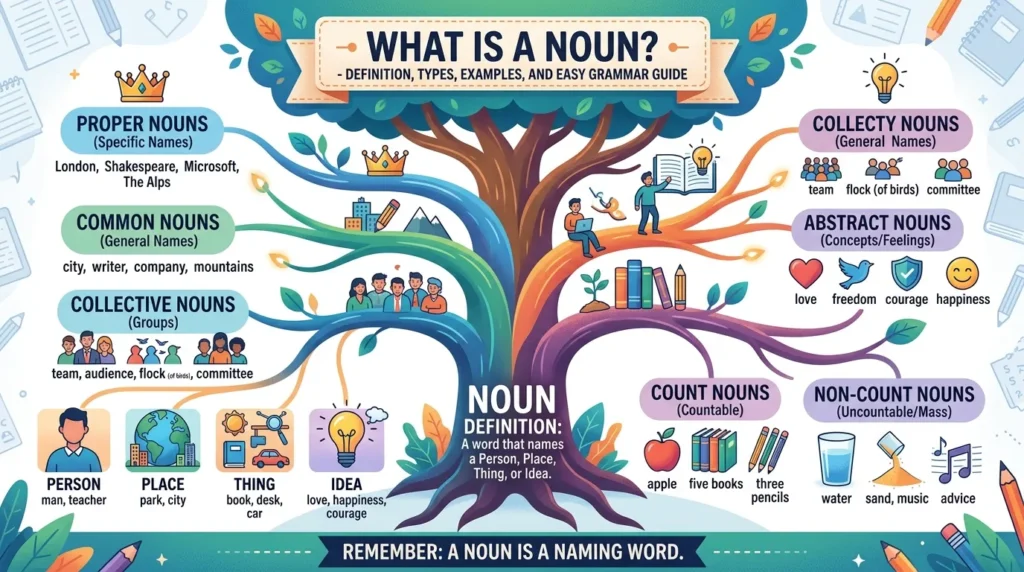
Common Types of Nouns
Nouns can be divided into several groups. A single noun can sometimes belong to more than one group.
Common Nouns
A common noun gives a general name.
Examples:
- city
- school
- teacher
- car
- river
Example:
The teacher entered the classroom.
Proper Nouns
A proper noun gives the specific name of a person, place, organization, or other unique entity.
Examples:
- Sarah
- London
- Canada
- Monday
- Microsoft
Proper nouns normally begin with a capital letter.
London is a large city.
Concrete Nouns
A concrete noun refers to something that can be experienced through the senses.
Examples:
- apple
- chair
- dog
- house
- phone
The phone is on the desk.
Abstract Nouns
An abstract noun refers to an idea, feeling, quality, or concept that cannot normally be touched.
Examples:
- love
- happiness
- freedom
- honesty
- knowledge
Honesty is important.
Collective Nouns
A collective noun refers to a group as a unit.
Examples:
- team
- family
- audience
- committee
- herd
The team won the match.
Countable Nouns
Countable nouns can normally be counted.
Examples:
- one book
- two books
- three cars
- four students
They can usually have singular and plural forms.
Uncountable Nouns
Uncountable nouns are not normally counted as individual units.
Examples:
- water
- information
- advice
- rice
- money
We normally say:
some information
rather than:
some informations
Common Mistakes With Nouns
Understanding nouns is easy, but using them correctly can still cause problems.
Mistake 1: Confusing Nouns and Verbs
Some words can work as both nouns and verbs.
Compare:
I run every morning.
Here, run is a verb.
I went for a run.
Here, run is a noun.
The meaning and grammatical role depend on the sentence.
Mistake 2: Incorrect Plurals
Some learners add -s to every noun to make it plural.
For example:
informations ❌
information ✅
Another common mistake:
advices ❌
advice ✅
Some nouns have irregular plural forms:
- child → children
- man → men
- woman → women
- tooth → teeth
- mouse → mice
Mistake 3: Incorrect Capitalization
Common nouns normally do not need capital letters in the middle of a sentence.
I visited the city. ✅
I visited the City. ❌
However, a specific place name is a proper noun:
I visited London. ✅
Mistake 4: Confusing Nouns and Pronouns
A pronoun can replace a noun or noun phrase.
For example:
Maria is tired because Maria worked all day.
This can become:
Maria is tired because she worked all day.
Maria is a noun. She is a pronoun.
What Is a Noun Phrase?
A noun phrase is a noun together with words that describe or identify it.
For example:
The small brown dog
The main noun is dog.
The other words provide information about the dog.
More examples include:
- the old house
- a new computer
- my best friend
- three large boxes
- the red sports car
A noun phrase can be very short or quite long. Grammar references commonly describe noun phrases as structures built around a noun or pronoun. (Scribbr)
What Is a Noun in Everyday Examples?
Nouns are everywhere in daily communication.
In Emails
Please send the report before Friday.
Report is a noun.
In News
The government announced a new policy.
Government is a noun.
On Social Media
This movie is amazing!
Movie is a noun.
In Formal Writing
Education plays an important role in society.
Education and society are nouns.
In Conversation
Where is my phone?
Phone is a noun.
This shows why nouns are so important. They help us identify the people, places, objects, ideas, and other things we are talking about.
What Is a Noun? – Google Trends & Usage Data
The search phrase “What is a noun?” is a common type of educational grammar query. Searchers usually want a simple definition, examples, noun types, or help identifying nouns in sentences.
Current grammar resources also continue to publish dedicated explanations of the topic. Major educational and reference sources describe nouns as words that can refer to people, places, things, concepts, qualities, states, and actions. (Merriam-Webster)
Search interest is especially relevant in contexts such as:
- English grammar learning
- School homework
- ESL learning
- Teacher resources
- Grammar tests
- Writing improvement
- Online English courses
Common related searches include:
- What is a noun?
- noun definition
- noun examples
- types of nouns
- common noun
- proper noun
- abstract noun
- concrete noun
- noun and pronoun
- noun in grammar
Because noun is one of the basic English parts of speech, the topic has broad educational value.
Noun Examples: Quick Comparison Table
| Noun Type | Example | Example Sentence |
|---|---|---|
| Common | city | The city is busy. |
| Proper | London | London is busy. |
| Concrete | chair | The chair is broken. |
| Abstract | happiness | Happiness matters. |
| Collective | team | The team won. |
| Countable | apple | I ate two apples. |
| Uncountable | water | I need some water. |
FAQs About What Is a Noun?
What is a noun in simple words?
A noun is a word that names or refers to a person, place, thing, idea, quality, or other entity.
What are 10 examples of nouns?
Ten examples are:
teacher, school, dog, city, book, phone, happiness, freedom, water, team.
What are the main types of nouns?
Common categories include common, proper, concrete, abstract, collective, countable, and uncountable nouns.
Can a noun be an action?
Yes. Some words that describe actions can function as nouns. For example:
Swimming is good exercise.
Here, swimming functions as a noun.
What is the difference between a noun and a pronoun?
A noun names or refers to something, while a pronoun can stand in for a noun or noun phrase.
Example:
Sarah is happy because she passed the test.
Sarah is a noun, while she is a pronoun.
Can one word be both a noun and a verb?
Yes. Some words can have different grammatical roles.
I work every day. — verb
I have a lot of work. — noun
Do nouns always name physical things?
No. Nouns can also refer to ideas, feelings, qualities, states, and actions.
Examples include love, honesty, happiness, knowledge, and reading.
Does the word “noun” change in British and American English?
No. The word is spelled noun in both British and American English.
Conclusion
A noun is one of the most important parts of English grammar. In simple terms, it is a word that names or refers to a person, place, thing, idea, quality, state, action, or other entity.
Nouns can appear as subjects, objects, complements, and parts of noun phrases. They can be common or proper, concrete or abstract, collective, countable, or uncountable. The same noun can sometimes fit more than one category.
For beginners, the easiest way to recognize a noun is to ask, “Who or what am I talking about?” In many cases, the answer will be a noun.
Remember that nouns are not limited to physical objects. Words such as freedom, happiness, knowledge, and honesty can also be nouns.
Once you understand nouns, it becomes much easier to understand verbs, pronouns, adjectives, sentence structure, and other parts of English grammar.