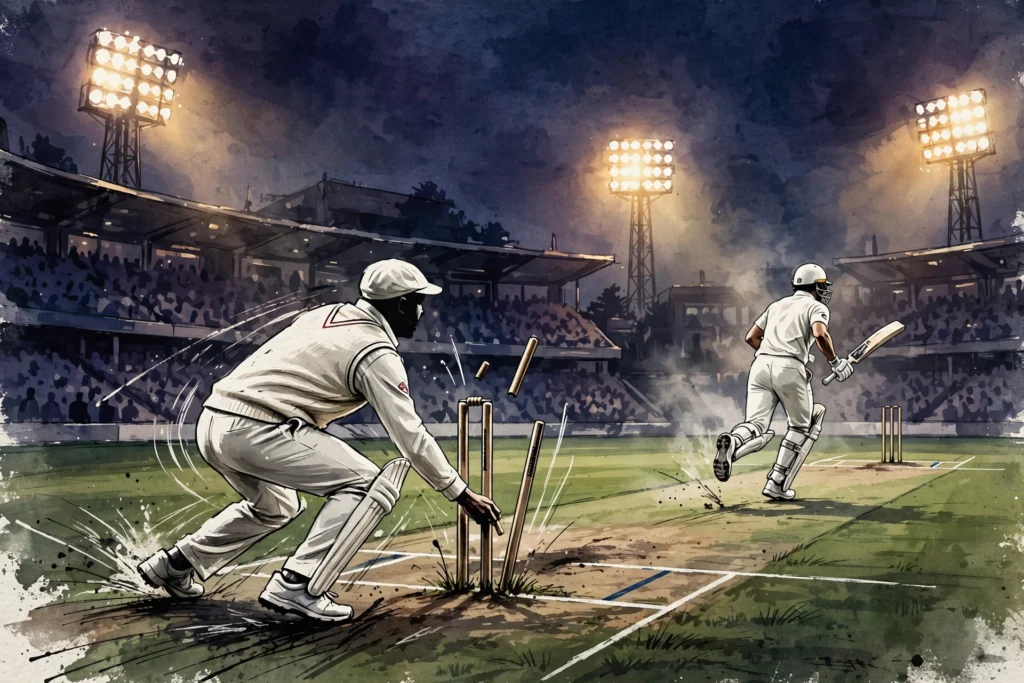
Cricket has few dismissals as debated as the Mankad. Named after Indian legend Vinoo Mankad, this run-out of the non-striker backing up too far divides the cricket world every time it happens. Is it clever gamesmanship or against the spirit of cricket? Here is the complete guide.
What Is Mankad in Cricket?
Mankading is when the bowler runs out the non-striker for leaving the crease too early — before the ball is delivered. The bowler, in their delivery stride, removes the bails at the non-striker’s end while the batter is backing up outside the crease.
It is a form of run out, not a separate dismissal type, and it is completely legal under the Laws of Cricket.
The ICC Law Behind Mankading
Mankading is governed by Law 38 (Run Out) of the MCC Laws of Cricket. The law states that the non-striker is liable to be run out from the moment the ball comes into play until the bowler would normally be expected to release the ball.
Key points of the law:
- The bowler may attempt the run out before entering the delivery stride
- Once the bowler’s arm reaches its highest point in the delivery swing, they can no longer Mankad
- No warning to the batter is required by law (though many bowlers give one as courtesy)
- In 2022, the ICC moved it from “unfair play” (Law 41) to the run-out law (Law 38), confirming it is a legitimate dismissal
Why Is Mankad Controversial?
The controversy is about the spirit of cricket versus the laws of the game:
- Critics say batters should get a warning first, and that it feels unsporting
- Supporters argue the non-striker is gaining an unfair advantage by leaving early, and the bowler is within their rights
- The debate explodes on social media every time a high-profile Mankading happens
Famous Mankading Incidents
- Vinoo Mankad vs Australia, 1947 — the original incident. Mankad ran out Bill Brown twice in the series, giving the dismissal its name
- Ravichandran Ashwin vs Jos Buttler, IPL 2019 — the most debated modern incident; Buttler was well out of his crease and Ashwin removed the bails, sparking a global debate
- Deepti Sharma vs Charlie Dean, 2022 — in a women’s ODI at Lord’s, Deepti ran out Dean at the non-striker’s end to seal India’s win, with the ICC backing the decision
How Batters Can Avoid Being Mankaded
- Stay inside the crease until the bowler releases the ball
- Watch the bowler’s action instead of taking a big early start
- Time the backup run with the actual release, not the gathering stride
Frequently Asked Questions (FAQs)
Is Mankad legal in cricket?
Yes. It is a legitimate run out under Law 38 of the MCC Laws of Cricket, and the ICC confirmed this by moving it out of the “unfair play” section in 2022.
Why is it called Mankad?
It is named after India’s Vinoo Mankad, who first ran out Australia’s Bill Brown this way during the 1947–48 tour.
Does the bowler need to warn the batter first?
No. The laws do not require any warning, though some bowlers warn as a courtesy before attempting it later.
Can a bowler Mankad after starting the bowling action?
No. The attempt must happen before the bowler enters the delivery stride — once the arm reaches its highest point, Mankading is no longer allowed.
Final Summary
The Mankad rule is simple: if the non-striker leaves early, the bowler can run them out — legally and fairly. The controversy will never fully die, but since the ICC’s 2022 law change, Mankading is firmly established as smart, legitimate cricket rather than a breach of spirit. Batters have one easy fix: stay in the crease until the ball is bowled.

Green Benn is a dedicated sports writer specializing in cricket, including IPL and international formats. Known for clear, engaging, and informative content, Green simplifies complex match analysis and player statistics for all readers. Passionate about sports storytelling, Green delivers reliable, SEO-friendly articles that keep fans updated and informed