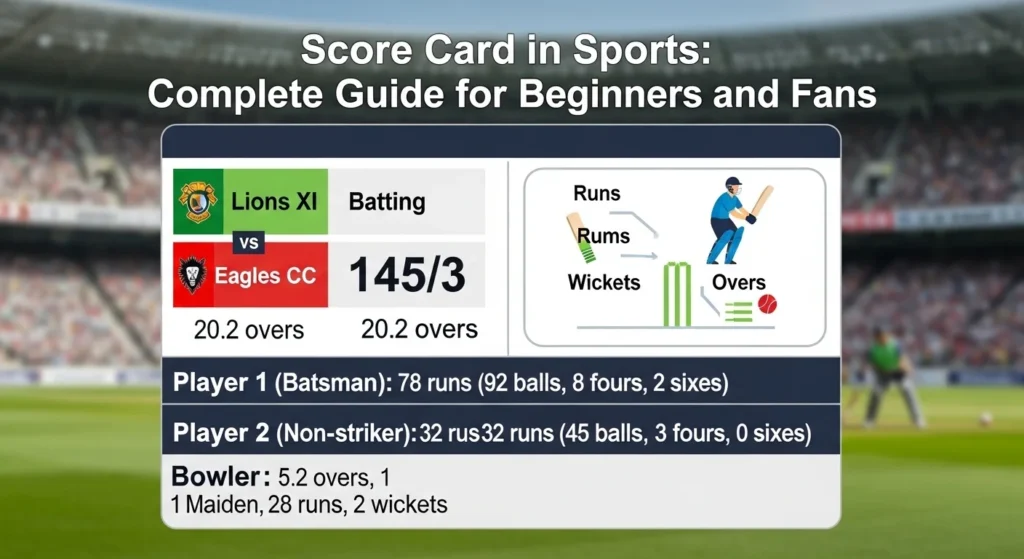

In every sport, especially cricket, football, and baseball, one of the most important tools for understanding a match is the score card. It provides a complete summary of how the game is played, who performed well, and what the final result is.
For beginners and sports fans, reading a score card can sometimes feel confusing. However, once you understand it, a score card becomes a powerful way to analyze matches in detail. It shows runs, wickets, overs, player performance, and key match moments.
The concept of a score card is essential for coaches, players, and analysts because it helps track performance and improve strategies. It also allows fans to relive the match in a structured way.
In this article, you will learn everything about score cards, including their meaning, history, structure, importance, rules, and how to read them in different sports.
What is a Score Card?
A score card is a written or digital record that shows the detailed performance of a team or player during a sports match.
Simple Explanation:
It is a summary sheet that records all important match statistics like runs, goals, points, or scores.
How It Works:
- Tracks player performance
- Records match progress
- Shows final results
Real-Life Example:
In cricket, a score card shows how many runs each player scored, how many wickets were taken, and how many overs were bowled.
History and Origin of Score Cards
The use of score cards started in early sports recording systems, especially in cricket and baseball.
Early Development:
- Cricket scorekeeping began in the 18th century
- Handwritten records were used initially
- Later, printed scorecards were introduced
Modern Evolution:
- Digital scorecards now used in live matches
- Apps and websites provide real-time updates
- Advanced analytics are included today
Rules and Structure of a Score Card
A score card follows a structured format depending on the sport.
Common Elements:
- Team names
- Player names
- Scores or runs
- Wickets or goals
- Overs or time duration
Cricket Score Card Example:
- Runs scored
- Balls faced
- Strike rate
- Wickets taken
How to Read a Score Card
Understanding a score card is simple once you know the basics.
Step-by-Step:
- Check team scores
- Look at individual player performance
- Analyze extras and penalties
- Understand match result
Simple Tip:
Always start from the top of the score card and move downward.
Types of Score Cards in Sports
🏏 Cricket Score Card
- Shows runs, wickets, overs
- Includes batting and bowling details
⚽ Football Score Card
- Shows goals scored
- Assists and fouls
- Match time details
🏀 Basketball Score Card
- Points per player
- Rebounds and assists
- Team total score
Important Techniques in Score Keeping
1. Manual Score Keeping
- Writing scores by hand
- Used in traditional matches
2. Digital Score Keeping
- Software-based recording
- Real-time updates
3. Statistical Analysis
- Performance charts
- Player ranking systems
Player Roles and Performance Tracking
Score cards help track different player roles:
In Cricket:
- Batsman: runs scored
- Bowler: wickets taken
- All-rounder: both batting and bowling
In Football:
- Striker: goals
- Defender: tackles
- Goalkeeper: saves
Equipment Used for Score Cards
Traditional Tools:
- Score sheets
- Pen and paper
- Manual boards
Modern Tools:
- Tablets
- Scoring apps
- Live broadcasting software
Major Tournaments Using Score Cards
Score cards are used in all major sports events:
Cricket:
- ICC Cricket World Cup
- T20 World Cup
- IPL (Indian Premier League)
Football:
- FIFA World Cup
- UEFA Champions League
Basketball:
- NBA League
- International Championships
Benefits of Score Cards
Physical and Game Benefits:
- Helps analyze performance
- Improves team strategy
- Identifies strengths and weaknesses
Mental Benefits:
- Increases game understanding
- Helps fans stay engaged
- Improves decision-making for coaches
Interesting Facts About Score Cards
- The first cricket scorecards were handwritten
- Modern scorecards update in real-time
- Advanced analytics use AI today
- Some scorecards include player heat maps
Importance of Score Cards in Modern Sports
Score cards are not just records; they are powerful tools.
Key Importance:
- Performance tracking
- Match analysis
- Player selection decisions
- Fan engagement
Advantages and Disadvantages of Score Cards
Advantages:
- Easy match analysis
- Clear performance tracking
- Useful for coaching decisions
- Enhances sports understanding
Disadvantages:
- Can be complex for beginners
- Requires accuracy in recording
- Human errors in manual scoring
Applications / Real-Life Impact
In Sports:
- Helps teams improve strategy
- Assists coaches in training
For Fans:
- Better understanding of matches
- Increases excitement
For Media:
- Provides data for commentary
- Supports sports journalism
Common Questions & Practical Solutions (FAQ)
Q1: What is a score card in simple words?
It is a record of all scores and performance details in a sports match.
Q2: Why is a score card important?
It helps analyze match performance and results.
Q3: Can score cards be digital?
Yes, most modern sports use digital scorecards.
Q4: Who maintains a score card?
Official scorers, referees, or automated systems.
Future Trends in Score Cards
- AI-based automatic scoring
- Real-time player analytics
- 3D performance visualization
- Smart wearable integration
These advancements make scorecards more accurate and interactive.
Conclusion
A score card is one of the most important elements in any sport. It provides a complete summary of the match, helping players, coaches, and fans understand performance in detail.
From traditional handwritten records to modern digital systems, score cards have evolved significantly. They are now essential for analysis, strategy building, and fan engagement.
Understanding score cards helps improve sports knowledge and appreciation of the game. Whether you are a beginner or a sports enthusiast, learning how to read a score card will enhance your overall experience of any sport.

Jon Smith is a passionate sports writer specializing in cricket and global sporting events. With a keen eye for match analysis and player performance, he creates clear, engaging, and informative content. His work focuses on simplifying complex sports insights, making them accessible for beginners and experienced fans alike worldwide.