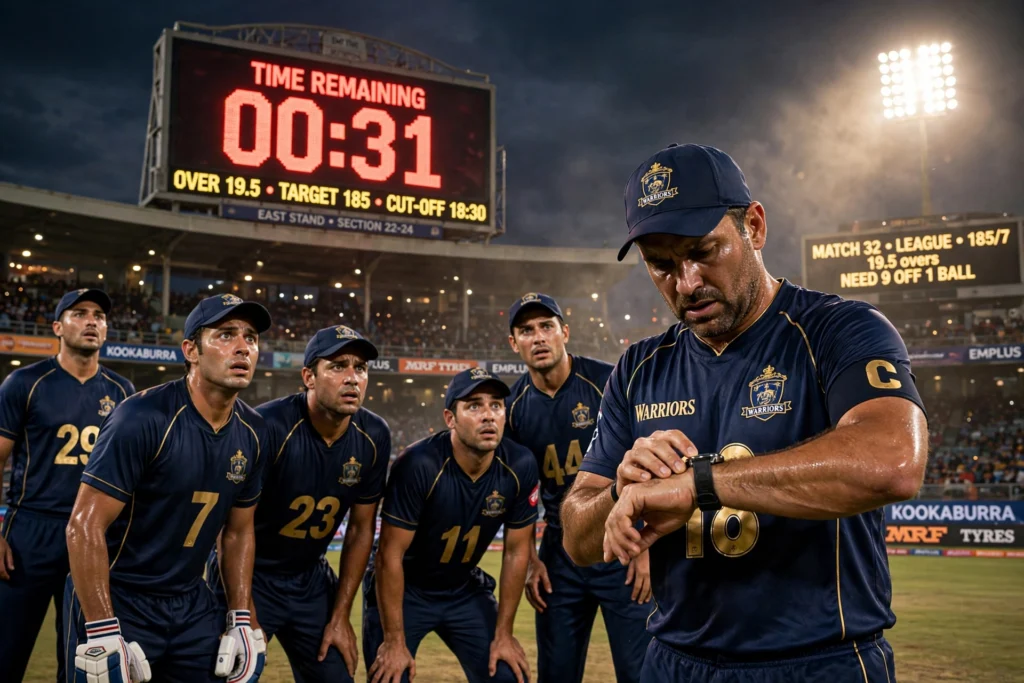
Nothing frustrates cricket fans more than a team crawling through its overs — except, perhaps, losing World Test Championship points because of it. Slow over rates have cost captains their match fees, teams their points, and fans their patience. Here is how cricket punishes teams that cannot keep up with the clock.
What Is Over Rate in Cricket?
Over rate is the average number of overs a bowling side completes per hour. The ICC sets minimum required over rates for each format:
- Tests: 15 overs per hour
- ODIs: 14.28 overs per hour (50 overs in 3.5 hours)
- T20Is: 14.28 overs per hour (20 overs in 85 minutes)
These rates account for normal stoppages — drinks breaks, wickets, DRS reviews — through allowances added to the time. Only unjustified delays count against the team.
How Is Over Rate Calculated?
The match referee calculates the over rate by dividing the overs bowled by the time taken, minus allowances. Allowances include time lost to wickets falling, injuries, DRS reviews, drinks breaks, and weather interruptions. What remains is the time the fielding side actually controlled — and if they still fall short, penalties follow.
In Test cricket, the calculation happens at the end of each day’s play and across the whole match. In limited-overs games, it is assessed at the innings break.
ICC Penalties for Slow Over Rate
The ICC punishes slow over rates on three levels:
1. Fines
Players are fined a percentage of their match fee for every over the team falls short. The captain — held responsible for the team’s pace — pays double the players’ rate. In major ICC events, these fines add up quickly across a tournament.
2. WTC Points Deductions
In the World Test Championship, teams lose one championship point for every over short. This has decided finalists: in the 2021–2023 cycle, slow over rates cost teams crucial points in a tight race. A single point can be the difference between playing the final at Lord’s and watching it on television.
3. Suspensions
Repeat offences can lead to the captain being suspended for one or more matches. The ICC treats persistent slow over rates as a serious breach of the Code of Conduct.
In-Match Penalties: The Fielding Restriction Rule
Since 2022, the ICC has added teeth to over-rate enforcement in limited-overs cricket. If the fielding side has not started the final over by the scheduled time, they must bring one extra fielder inside the 30-yard circle for the remaining overs — a huge advantage to the batting side at the death.
This in-match penalty hurts immediately, unlike fines that sting later. Captains now watch the clock as closely as the scoreboard in the final overs.
Why Do Teams Bowl Slowly?
- Tactical delays: Slowing the game to disrupt a batter’s rhythm or run down the clock in a chase.
- Frequent conferences: Captain, bowler, and senior players meeting between balls.
- DRS reviews: Each review burns several minutes.
- Field changes: Elaborate field resets for every batter.
- Glove changes and drinks: Batters calling for unnecessary breaks.
The ICC’s allowances cover legitimate delays — penalties target the deliberate ones.
Famous Slow Over Rate Cases
India vs Australia, 2020: India were fined and docked WTC points for a slow over rate in the first Test at Adelaide — points that mattered in the race for the WTC final, which India still reached.
England’s 2023 Ashes: England’s aggressive “Bazball” approach could not save them from over-rate sanctions — they lost WTC points despite the thrilling cricket.
Multiple T20I fines: In T20 internationals, the in-match fielding restriction has been triggered several times, handing batting sides a visible advantage in crunch overs.
Frequently Asked Questions
What is the required over rate in Test cricket?
15 overs per hour, after allowances for wickets, injuries, DRS, drinks, and weather.
What happens if a team bowls too slowly?
Players are fined, the captain pays double, WTC points are deducted (one per over short in Tests), and in limited-overs cricket an extra fielder must come inside the circle.
How many WTC points are deducted for slow over rate?
One championship point per over the team is short.
Can a captain be suspended for slow over rate?
Yes. Repeated offences can lead to match suspensions under the ICC Code of Conduct.
What is the in-match penalty in T20Is?
If the final over has not started on time, one extra fielder must stay inside the 30-yard circle for the remaining overs.
Conclusion
The clock is cricket’s silent umpire. Slow over rates cost money, points, and sometimes finals — and the in-match fielding penalty means the punishment now arrives while the game is still alive. Captains who cannot manage the clock will keep paying for it. Learn more in the MCC Laws of Cricket.

Green Benn is a dedicated sports writer specializing in cricket, including IPL and international formats. Known for clear, engaging, and informative content, Green simplifies complex match analysis and player statistics for all readers. Passionate about sports storytelling, Green delivers reliable, SEO-friendly articles that keep fans updated and informed