
Cricket is a sport that combines skill, patience, strategy, and discipline. Over the years, cricket authorities have introduced several new rules to make the game faster, fairer, and more exciting for players and fans. One of the latest changes in modern cricket is the “Stop Clock Rule.” This rule was introduced to reduce unnecessary delays between overs and improve the pace of play during matches.
The Stop Clock Rule mainly applies to limited-overs cricket, especially One Day Internationals (ODIs) and T20 Internationals. The rule requires fielding teams to begin a new over within a fixed time limit after the previous over ends. If teams fail to follow the time limit repeatedly, penalties may apply.
This rule has become an important topic in world cricket because slow over rates have long frustrated players, officials, broadcasters, and spectators. The Stop Clock Rule aims to make matches more efficient while maintaining the competitive balance of the game. This article explains everything about the Stop Clock Rule in cricket, including its history, rules, effects on teams, player strategies, equipment, major tournaments, benefits, challenges, and interesting facts.
What Is the Stop Clock Rule in Cricket?
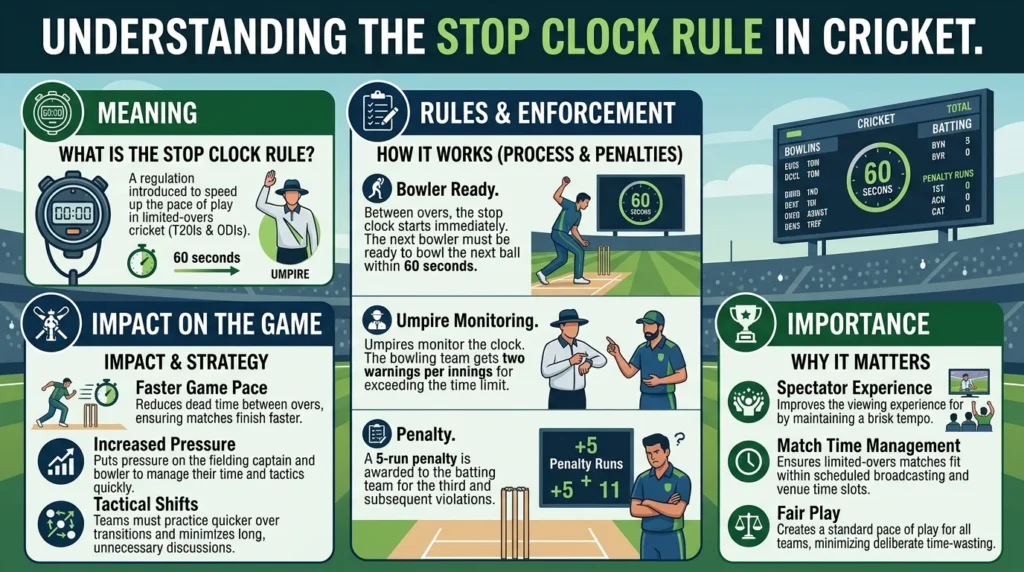
The Stop Clock Rule is a cricket regulation designed to speed up the game by limiting delays between overs. It uses a countdown timer to ensure the fielding team is ready to start the next over within a specific period.
Under the rule, the fielding side must begin the next over within 60 seconds after the previous over finishes.
Purpose of the Stop Clock Rule
The rule was introduced to:
- Reduce slow over rates
- Improve match flow
- Shorten unnecessary delays
- Increase entertainment for fans
- Maintain broadcast schedules
It encourages teams to stay organized and disciplined throughout the match.
Where the Rule Applies
The Stop Clock Rule mainly applies in:
- One Day Internationals (ODIs)
- T20 Internationals (T20Is)
The rule is especially important in limited-overs cricket because timing is critical in shorter formats.
History of the Stop Clock Rule
Cricket has always faced challenges related to slow match progress. Over time, matches became longer due to frequent interruptions and tactical delays.
Slow Over Rates in Cricket
In earlier years:
- Bowlers took extra time between overs.
- Field changes delayed play.
- Discussions among players slowed the game.
- Reviews and interruptions increased match duration.
These delays frustrated fans and broadcasters.
Modern Cricket and Time Management
As cricket evolved into a fast-paced entertainment sport, governing bodies focused more on improving match speed.
The International Cricket Council introduced several changes to improve over rates and game flow.
Trial Introduction of the Rule
The Stop Clock Rule was first tested in international limited-overs cricket before becoming officially adopted in certain competitions.
Cricket authorities monitored:
- Match duration
- Team discipline
- Fan reactions
- Umpire control
The trial showed positive results in reducing delays.
Official Rules of the Stop Clock Rule
The Stop Clock Rule includes clear guidelines for teams and umpires.
60-Second Time Limit
Fielding teams must be ready to begin the next over within 60 seconds after the previous over ends.
A visible countdown clock may appear in stadiums or television broadcasts.
Warning System
Teams usually receive warnings before penalties apply.
First and Second Violations
- Teams may receive official warnings.
- Captains are informed by the umpires.
Third Violation
If delays continue, penalty runs may be awarded to the batting team.
Exceptions to the Rule
Certain situations may stop or reset the clock, including:
- Injuries
- DRS reviews
- Boundary celebrations
- Weather interruptions
- Player equipment problems
Umpires decide whether delays are reasonable.
Why the Stop Clock Rule Was Introduced
The Stop Clock Rule solves several problems in modern cricket.
Improving Match Speed
Fans prefer matches with continuous action and fewer interruptions.
Better Television Scheduling
Broadcasters need matches to finish on time for scheduling purposes.
Enhancing Viewer Experience
Fast-paced cricket keeps audiences engaged and entertained.
Supporting Modern Cricket Formats
T20 cricket especially depends on speed, excitement, and entertainment value.
Popular tournaments affected by time-management rules include:
- ICC Cricket World Cup
- ICC T20 World Cup
- Indian Premier League
- Big Bash League
Impact of the Stop Clock Rule on Players
The rule affects players in different ways.
Faster Field Positioning
Fielders must quickly move into position after each over.
Reduced Recovery Time
Bowlers and fielders have less time to rest between overs.
Increased Pressure on Captains
Captains must organize field settings quickly and efficiently.
Improved Fitness Requirements
Players need strong fitness levels to maintain energy throughout the match.
Impact on Bowlers
Bowlers are directly affected by the Stop Clock Rule.
Quick Preparation
Bowlers must return to their bowling mark quickly.
Better Physical Conditioning
Fast bowlers especially require excellent stamina and endurance.
Reduced Delays Between Deliveries
The rule prevents unnecessary slowing of the game.
Famous fast bowlers known for disciplined over rates include:
- Glenn McGrath
- Jasprit Bumrah
- Shaheen Afridi
Role of Umpires in the Stop Clock Rule
Umpires play a major role in enforcing the rule.
Monitoring the Timer
Umpires carefully watch the countdown clock after every over.
Issuing Warnings
Officials communicate with captains regarding slow over rates.
Awarding Penalties
If teams repeatedly violate the rule, umpires apply penalty runs.
Strategies Teams Use Under the Stop Clock Rule
Teams have developed new strategies to avoid penalties.
Faster Field Adjustments
Captains now simplify field changes to save time.
Better Communication
Players communicate more efficiently during overs.
Organized Bowling Rotations
Teams plan bowling changes carefully to avoid delays.
Fitness and Conditioning
Modern cricket teams focus heavily on fitness training and recovery.
Playing Time and Match Flow
The Stop Clock Rule directly improves playing time efficiency.
Shorter Match Duration
Matches finish faster with fewer unnecessary pauses.
Better Audience Engagement
Fans enjoy smoother gameplay with constant action.
Balanced Competition
Both teams operate under the same timing rules.
Equipment and Technology Used
Technology supports enforcement of the Stop Clock Rule.
Digital Countdown Clocks
Stadiums may display countdown timers for players and spectators.
Broadcast Graphics
Television broadcasts often show over-rate graphics.
Communication Systems
Match officials use communication devices to monitor timing.
Benefits of the Stop Clock Rule
The rule offers several advantages for cricket.
Faster and More Exciting Matches
Continuous action improves entertainment value.
Improved Discipline
Teams become more organized and professional.
Better Fitness Standards
Players maintain higher physical conditioning.
Enhanced Fan Experience
Spectators enjoy matches with fewer interruptions.
Challenges and Criticism of the Rule
Some players and experts also criticize the rule.
Pressure on Bowlers
Fast bowlers may struggle with reduced recovery time.
Increased Physical Fatigue
Quick transitions can increase player exhaustion.
Difficult Conditions
Hot weather and long matches make timing more challenging.
Tactical Limitations
Captains may have less time for strategic planning.
Major Competitions Using the Stop Clock Rule
The rule is especially relevant in modern international cricket.
ICC Events
The International Cricket Council introduced the rule in selected international tournaments.
Franchise T20 Leagues
Fast-paced leagues prioritize efficient gameplay and entertainment.
International Limited-Overs Matches
ODI and T20 matches benefit most from time-management rules.
Interesting Facts About the Stop Clock Rule
Here are some interesting facts about the Stop Clock Rule:
- The rule mainly targets slow over rates in limited-overs cricket.
- It encourages teams to improve fitness and organization.
- Countdown timers may appear live on television broadcasts.
- Umpires have authority to apply penalty runs.
- The rule supports cricket’s modern entertainment-focused approach.
Future of the Stop Clock Rule
The Stop Clock Rule may continue evolving in international cricket.
Possible Expansion
The rule could become standard across more tournaments and leagues.
Advanced Technology Integration
Future systems may automatically track over rates and delays.
Improved Match Scheduling
Cricket boards may further shorten match durations for audiences.
Benefits of Playing Cricket Despite Time Pressure
Even with modern timing rules, cricket continues offering many benefits.
Physical Benefits
Cricket improves:
- Endurance
- Agility
- Coordination
- Strength
- Reflexes
Mental Benefits
Players also develop:
- Concentration
- Patience
- Leadership
- Decision-making
- Teamwork
Conclusion
The Stop Clock Rule in cricket represents a major step toward faster and more organized gameplay. Introduced to reduce delays and improve over rates, the rule has changed how players, captains, and officials manage limited-overs matches.
Although some critics believe the rule increases pressure on bowlers and fielding teams, many fans and experts support it because it creates smoother, more entertaining cricket. Modern cricket continues evolving with new technology, improved fitness standards, and smarter time management.
As international tournaments and franchise leagues grow in popularity, the Stop Clock Rule will likely remain an important part of cricket’s future.

Jon Smith is a passionate sports writer specializing in cricket and global sporting events. With a keen eye for match analysis and player performance, he creates clear, engaging, and informative content. His work focuses on simplifying complex sports insights, making them accessible for beginners and experienced fans alike worldwide.