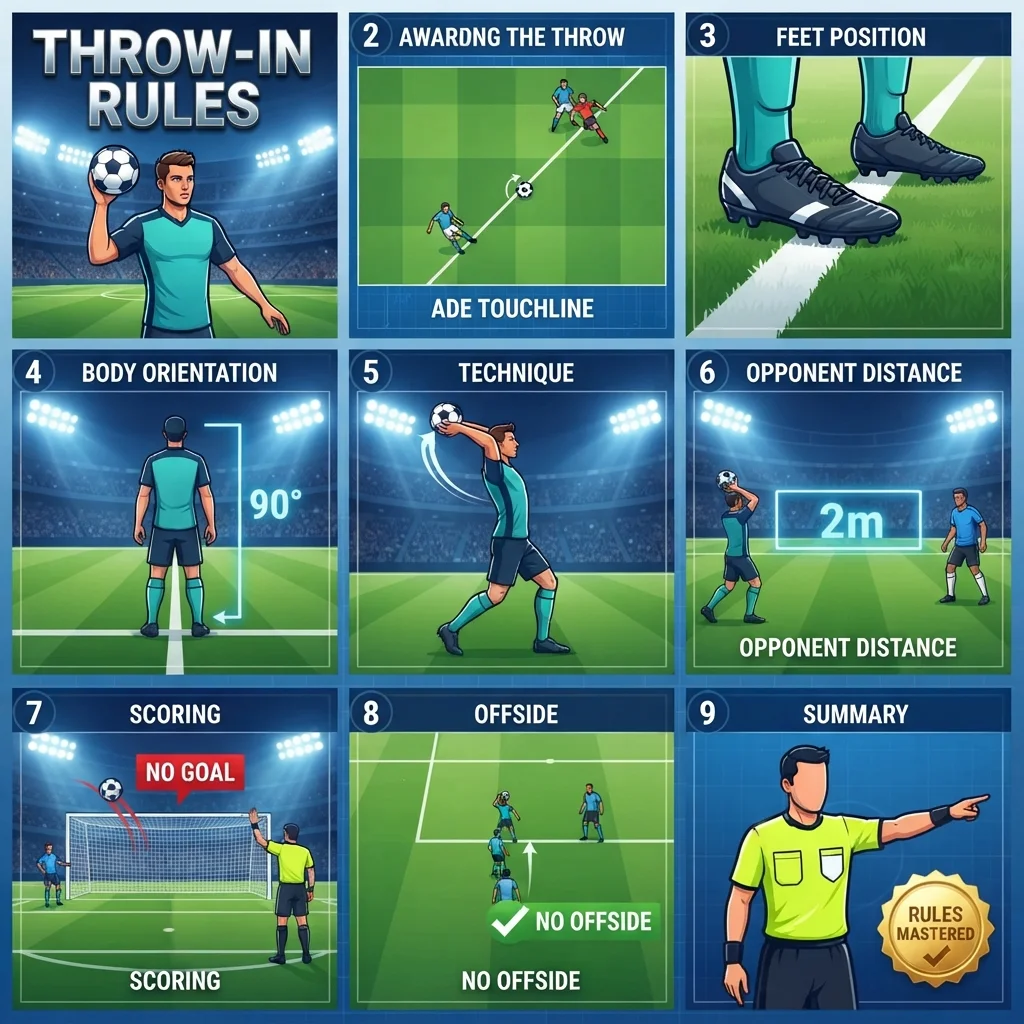

When the ball goes out over the sideline during a football match, play does not simply stop. The team that did not touch the ball last is awarded a throw-in, giving them a chance to restart the game and keep possession. Although a throw-in looks simple, players must follow several specific rules regarding foot position, hand movement, ball placement, and where the thrower can stand.
Understanding throw-in rules is important for beginners, players, coaches, referees, parents, and football fans. A correctly taken throw-in can restart an attack, relieve defensive pressure, or create an opportunity to move the ball quickly into dangerous areas. A poorly taken throw can result in the other team receiving possession.
In this complete guide, we will explain what a throw-in is, when it is awarded, how to take one correctly, where players must stand, common violations, tactical techniques, and the difference between throw-ins and other restarts. You will also learn about quick throw-ins, long throw-ins, offside rules, common mistakes, and frequently asked questions.
What Is a Throw-In in Football?
A throw-in is a method of restarting play when the entire ball crosses the touchline, also known as the sideline, whether the ball travels along the ground or through the air.
The throw-in is awarded to the team whose opponent last touched the ball before it completely crossed the touchline.
For example, if a defender kicks the ball over the sideline, the attacking team receives the throw-in.
Simple Throw-In Example
Imagine Team A is attacking down the right side of the field. A Team B defender attempts to tackle the attacker but touches the ball last, sending it completely over the touchline.
The referee awards a throw-in to Team A.
A Team A player then takes the ball and restarts play from the location where it crossed the touchline.
When Is a Throw-In Awarded?
A throw-in is awarded when:
- The entire ball crosses the touchline.
- The ball leaves the field of play.
- The last player to touch the ball is from the opposing team.
- The ball does not leave the field through the goal line.
The location where the ball crossed the touchline determines approximately where the throw-in is taken.
Throw-In Rules: How to Take a Throw-In Correctly
The Laws of the Game specify several requirements for a legal throw-in.
A player taking the throw-in must:
- Face the field of play.
- Have part of each foot either on the touchline or on the ground outside the touchline.
- Hold the ball with both hands.
- Deliver the ball from behind and over the head.
- Release the ball from the point where it left the field.
These requirements must all be followed.
Face the Field of Play
The thrower must face the field when taking the throw.
The player cannot deliberately face away from the pitch while performing the throw-in.
Use Both Hands
The ball must be held with both hands.
A player cannot legally throw the ball with one hand like a baseball or cricket throw.
Bring the Ball Behind the Head
The ball must be delivered from behind and over the head.
The movement should be continuous and controlled.
Keep Proper Foot Position
The thrower must have part of each foot:
- On the touchline, or
- On the ground outside the touchline.
A player cannot take the throw with both feet completely inside the field.
Where Is a Throw-In Taken?
The throw-in is taken from the place where the ball crossed the touchline.
The player does not have unlimited freedom to move along the sideline before taking the restart.
What If the Exact Location Is Unclear?
In some situations, it may be difficult to identify the precise point where the ball crossed the line.
The referee or assistant referee determines the appropriate location.
Players should avoid moving too far from the correct position because this can result in the throw-in being awarded to the opposition.
Who Takes the Throw-In?
The throw-in is taken by a player from the team that did not touch the ball last.
It does not have to be taken by the player closest to where the ball went out.
Teams can choose which eligible player takes the throw.
Can the Goalkeeper Take a Throw-In?
Yes.
A goalkeeper is allowed to take a throw-in if the goalkeeper is the appropriate player available.
However, goalkeepers usually remain near their own goal unless the tactical situation requires them to move forward.
When Is the Ball in Play From a Throw-In?
The ball is in play when it enters the field of play.
Once the ball crosses into the field after being correctly released, normal play continues.
Other players can immediately challenge for or receive the ball according to the Laws of the Game.
Can a Player Score Directly From a Throw-In?
No.
A goal cannot be scored directly from a throw-in.
If the Ball Goes Directly Into the Opponent’s Goal
If a player throws the ball directly into the opponents’ goal without another player touching it, a goal kick is awarded to the defending team.
If the Ball Goes Directly Into the Thrower’s Own Goal
If a player throws the ball directly into their own goal without another player touching it, the opposing team receives a corner kick.
This rule prevents a direct goal from being scored from a throw-in in either direction.
Throw-In and the Offside Rule
A player cannot be penalized for being offside directly from a throw-in.
This is one of the specific exceptions to the offside law.
For example, an attacker can receive a throw-in while positioned beyond the second-last defender without being called offside.
However, once another teammate touches the ball and the next phase of play begins, the normal offside law applies.
Why Is the Offside Exception Important?
This rule allows teams to use throw-ins to move the ball forward quickly.
Attackers can make runs behind the defensive line without being penalized for offside directly from the throw.
What Happens If a Throw-In Is Taken Incorrectly?
If a player fails to follow the required throw-in procedure, the opposing team is generally awarded the throw-in.
This is known as a throw-in turnover.
Common Reasons for a Turnover
A throw-in can be considered incorrectly taken if the player:
- Uses only one hand.
- Does not bring the ball from behind and over the head.
- Has both feet completely inside the field.
- Takes the throw from the wrong location.
- Does not follow the required procedure.
The referee determines whether the restart has been taken correctly.
Can the Same Player Touch the Ball Again?
The player taking the throw-in cannot touch the ball again until another player has touched it.
For example, if a player throws the ball into the field and immediately kicks or touches it again, an offence occurs.
What Happens Next?
If the thrower touches the ball again before another player does, the referee awards an indirect free kick to the opposing team.
If the second touch is a deliberate handball offence, the appropriate restart and disciplinary consequences can differ depending on the circumstances.
Can You Take a Quick Throw-In?
Yes.
A team does not always need to wait for a long set-up before taking a throw-in.
A player can take a quick throw when:
- The ball is available.
- The correct location is clear.
- The required technique is followed.
- The referee has not stopped the restart.
Quick throw-ins can catch an unorganized defense by surprise.
Benefits of a Quick Throw-In
A quick throw can:
- Maintain momentum.
- Prevent opponents from getting organized.
- Start a counterattack.
- Find an unmarked teammate.
- Keep possession moving.
Players should still make sure the throw is legally taken.
Types of Throw-Ins
There are several tactical styles of throw-ins used in football.
Short Throw-In
A short throw is directed toward a nearby teammate.
It is commonly used when the team wants to maintain possession and build an attack.
Long Throw-In
A long throw is delivered over a greater distance, often toward the penalty area.
Some players have exceptional throwing power and can deliver the ball deep into dangerous areas.
Quick Throw-In
A quick throw is taken immediately after the ball goes out.
Its purpose is often to exploit a temporary gap in the opposition’s defensive organization.
Defensive Throw-In
A team under pressure may use a short throw to a safe teammate rather than attempting a risky forward pass.
The priority is to maintain possession and reduce danger.
Long Throw-In Technique
Long throw-ins can be highly effective, especially near the opponent’s penalty area.
Build Momentum
Players often take several steps before releasing the ball.
This helps generate additional throwing power.
Use the Upper Body
A long throw requires coordinated movement from the legs, hips, shoulders, arms, and core.
Aim for a Target
The throw should not simply be as far as possible.
The player should target a teammate or a specific area.
Practice Accuracy
Distance is useful, but accuracy is more important.
A powerful throw that goes directly to an opponent does not help the attacking team.
Attacking Strategies for Throw-Ins
Throw-ins can be used as planned attacking situations.
Create Passing Triangles
Three players can position themselves so the thrower has multiple passing options.
This makes it harder for defenders to predict the next move.
Use a Target Player
A physically strong player can receive a long throw and attempt to control or flick the ball toward a teammate.
Make Decoy Runs
One attacker can make a run to pull a defender away while another teammate moves into the space created.
Throw Into Space
Instead of throwing directly to a player’s feet, the thrower can send the ball into open space for a teammate to run onto.
Defensive Strategies Against Throw-Ins
Defending a throw-in requires concentration because the ball can be delivered quickly.
Mark Nearby Players
Defenders should identify the closest attacking options.
Protect Dangerous Areas
Near the penalty area, defenders should pay particular attention to players capable of receiving long throws.
Avoid Giving Away Easy Space
Poor defensive positioning can allow attackers to turn and run toward goal.
Communicate
Defenders should communicate clearly about marking responsibilities and potential runs.
Common Throw-In Mistakes
Standing Completely Inside the Field
A player cannot have both feet completely on the field while taking the throw.
Using One Hand
A one-handed throw is not legal.
Throwing From the Wrong Position
The restart should be taken from where the ball crossed the touchline.
Using the Wrong Motion
The ball must be delivered from behind and over the head.
Throwing Directly to an Opponent
This is not technically a foul, but it can quickly give away possession.
Taking Too Long
Deliberately delaying a restart can result in disciplinary action for delaying the restart.
Throw-In Rules for Youth Football
Youth football competitions may sometimes use modified rules depending on the governing organization, age group, or competition regulations.
For example, certain youth leagues may have specific requirements for:
- Field dimensions.
- Ball size.
- Substitution procedures.
- Throw-in enforcement.
Players, coaches, and parents should therefore check the competition’s regulations rather than assuming every youth competition uses identical procedures.
Throw-In vs Other Football Restarts
Understanding the difference between restarts helps beginners follow matches more easily.
| Restart | When It Happens | Method |
|---|---|---|
| Throw-in | Ball crosses touchline | Both hands, from behind and over head |
| Goal kick | Attacker last touches ball before it crosses goal line | Kick |
| Corner kick | Defender last touches ball before it crosses goal line | Kick from corner |
| Free kick | Certain fouls or offences | Kick |
| Kick-off | Start or restart after a goal | Kick from center |
The throw-in is unique because it is the only standard restart that uses the hands.
Professional Tips for Better Throw-Ins
Look Before Receiving the Ball
Players should already understand their available options before the ball reaches them.
Move After Passing
The thrower should not always remain stationary after releasing the ball.
The player can move into a new position and support the next phase of play.
Use Communication
Clear communication helps the thrower identify the safest or most useful target.
Vary the Distance
Use short passes when possession is the priority and longer throws when space is available.
Watch the Opposition
A quick throw can be especially effective when opponents are not organized.
Why Throw-Ins Matter in Football
Throw-ins occur frequently during football matches, so small improvements can have a significant effect over 90 minutes.
A well-organized team can use throw-ins to:
- Keep possession.
- Start attacks.
- Relieve pressure.
- Create scoring opportunities.
- Launch counterattacks.
- Control the game’s tempo.
At professional level, some teams even employ specific throw-in routines and coaches who focus on maximizing possession from these restarts.
Frequently Asked Questions About Throw-In Rules
What are the basic throw-in rules?
The thrower must face the field, use both hands, deliver the ball from behind and over the head, and have part of each foot on the touchline or on the ground outside it.
Can you be offside from a throw-in?
No. A player cannot be penalized for an offside offence directly from a throw-in.
Can you score directly from a throw-in?
No. If the ball enters the opponent’s goal directly, a goal kick is awarded. If it enters the thrower’s own goal directly, the opponents receive a corner kick.
Can a goalkeeper take a throw-in?
Yes. A goalkeeper can take a throw-in like any other eligible player.
Can you take a quick throw-in?
Yes. A player can restart quickly as long as the ball is taken from the correct location and all throw-in requirements are followed.
Can the thrower touch the ball again?
No. The thrower cannot touch the ball again until another player has touched it.
How far can a player move during a throw-in?
The thrower should take the throw from the location where the ball crossed the touchline. The player cannot simply move a significant distance away to gain an advantage.
What happens after an illegal throw-in?
The opposing team is generally awarded the throw-in if the original throw was taken incorrectly.
Conclusion
Understanding throw-in rules is essential for anyone who wants to play or follow football confidently. A throw-in is awarded when the entire ball crosses the touchline, with the opposing team receiving the restart based on who touched the ball last.
The player taking the throw must face the field, use both hands, bring the ball from behind and over the head, and keep part of each foot on the touchline or on the ground outside it. The ball becomes in play once it enters the field.
Throw-ins are much more than simple restarts. Teams can use short throws to maintain possession, quick throws to catch opponents unprepared, and long throws to create attacking opportunities near the penalty area. There is also no offside offence directly from a throw-in, making forward runs especially useful.
By learning the basic laws and practicing accurate, quick, and well-planned throws, players can turn an ordinary restart into an effective part of their team’s attacking and defensive strategy.