
Watch a football match for the first time and you may notice that players seem to have different jobs. Some stay close to the goal, others control the middle of the pitch, while forwards spend much of their time trying to create and score goals. Understanding these roles makes the game much easier to follow.
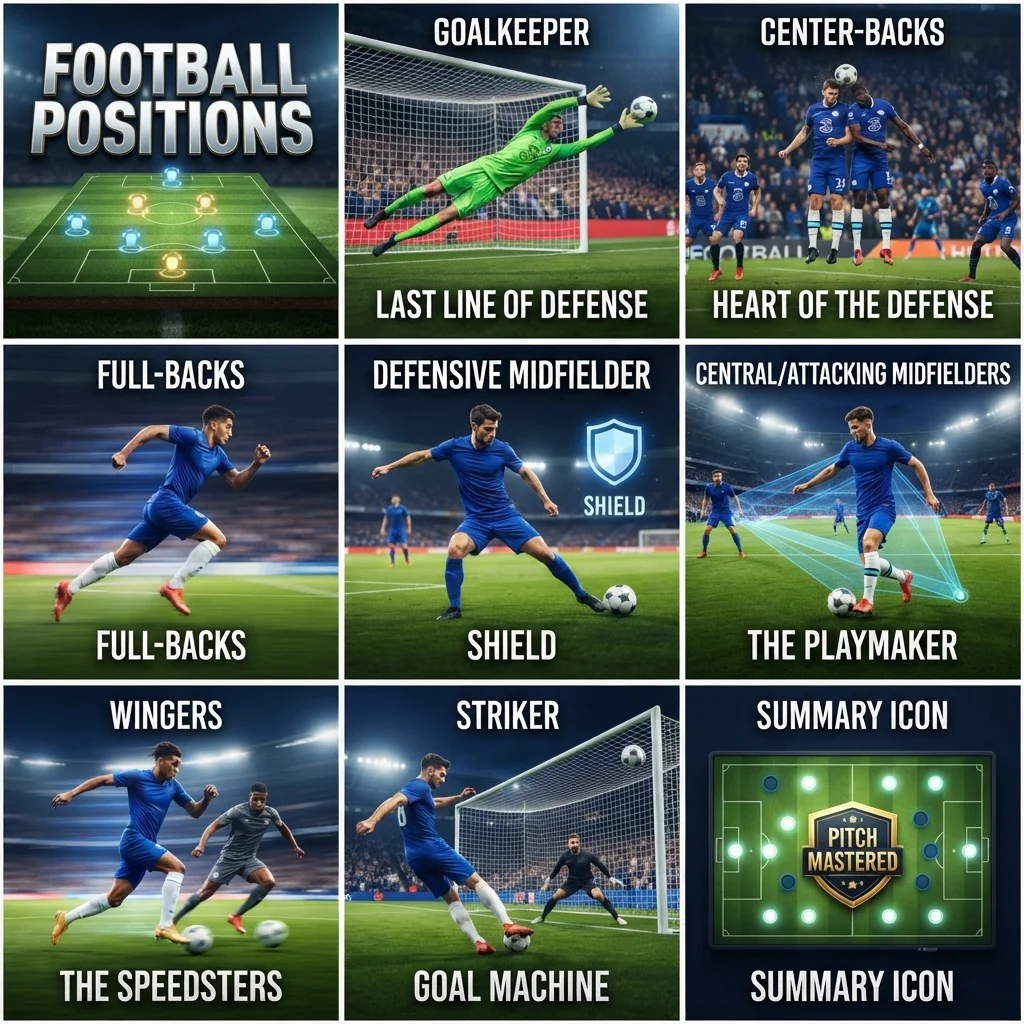
Football positions explained is a useful starting point for beginners who want to understand where players play and what they are expected to do. The main positions are goalkeeper, defender, midfielder, and forward, but each group contains several specialized roles. A center-back does not have exactly the same job as a full-back, just as a defensive midfielder performs different duties from a striker.
Modern football is flexible, so players often move outside their basic positions during a match. Teams can also change formations and responsibilities depending on their tactics, the opponent, and the situation of the game.
This guide explains every major football position, including responsibilities, important skills, common formations, examples, and advice for choosing the right position.
What Are Football Positions?
Football positions describe the main areas of the pitch where players normally operate and the responsibilities they have during a match.
A team has 11 players, including one goalkeeper. The other 10 players are usually divided among defenders, midfielders, and forwards.
However, there is no single formation that every team must use. A coach can organize players in different ways, such as:
- 4-4-2
- 4-3-3
- 4-2-3-1
- 3-5-2
- 5-3-2
- 4-1-4-1
The formation determines how players are positioned, but their roles can change during attacking and defensive phases.
Football Positions at a Glance
| Position | Main Role | Key Skills |
|---|---|---|
| Goalkeeper | Protects the goal | Saves, positioning, communication |
| Center-back | Defends central areas | Tackling, marking, heading |
| Full-back | Defends wide areas | Pace, tackling, crossing |
| Wing-back | Provides width and defensive cover | Stamina, crossing, defending |
| Defensive midfielder | Protects defense and controls possession | Passing, tackling, positioning |
| Central midfielder | Connects defense and attack | Passing, vision, stamina |
| Attacking midfielder | Creates chances | Creativity, passing, shooting |
| Winger | Attacks from wide areas | Pace, dribbling, crossing |
| Second striker | Supports the main striker | Movement, finishing, creativity |
| Striker | Leads the attack and scores goals | Finishing, movement, positioning |
Goalkeeper
The goalkeeper, often called the keeper or GK, is the player who protects the team’s goal.
They are the only player who can legally use their hands within their own penalty area, subject to the Laws of the Game.
Main Responsibilities of a Goalkeeper
A goalkeeper’s primary responsibility is to prevent the opposition from scoring.
Their duties include:
- Making saves
- Catching or parrying shots
- Dealing with crosses
- Organizing the defense
- Starting attacks
- Taking goal kicks
- Communicating with defenders
- Positioning themselves correctly
Modern goalkeepers are also expected to be comfortable with the ball at their feet.
Important Goalkeeper Skills
A good goalkeeper needs:
- Fast reactions
- Good positioning
- Courage
- Hand-eye coordination
- Communication
- Decision-making
- Footwork
- Distribution skills
A goalkeeper who moves too early or stands in the wrong position can give attackers an easy scoring opportunity.
Defenders
Defenders are responsible mainly for preventing the opposition from creating and scoring goals.
The defensive line can contain center-backs, full-backs, or wing-backs depending on the team’s formation.
Center-Back
The center-back, or central defender, usually operates in the middle of the defensive line.
Center-backs defend against opposing forwards and help protect the area in front of the goal.
Center-Back Responsibilities
Their duties include:
- Marking attackers
- Winning tackles
- Intercepting passes
- Blocking shots
- Clearing dangerous balls
- Winning aerial challenges
- Maintaining the defensive line
- Starting attacks with passes
Center-backs need good positioning because they cannot simply chase the ball everywhere.
Center-Back Skills
Important skills include:
- Tackling
- Heading
- Strength
- Positioning
- Reading the game
- Passing
- Concentration
- Communication
Some modern center-backs are excellent passers and can help control possession from deep positions.
Full-Back
A full-back normally plays on either side of the defensive line.
The right-back operates on the right side, while the left-back operates on the left.
Full-Back Responsibilities
Full-backs must contribute in both defense and attack.
Defensively, they may:
- Mark wingers
- Stop crosses
- Make tackles
- Cover central defenders
- Track attacking runs
When attacking, they may:
- Overlap wingers
- Deliver crosses
- Pass into midfield
- Create width
- Support attacking moves
Because they often travel up and down the pitch, full-backs need excellent stamina.
Wing-Back
A wing-back combines some responsibilities of a full-back and winger.
Wing-backs are commonly used in formations with three central defenders, such as 3-5-2 or 3-4-3.
They usually operate higher up the pitch than traditional full-backs.
Wing-Back Responsibilities
A wing-back may need to:
- Defend wide areas
- Support attacks
- Cross the ball
- Press opponents
- Track opposition wingers
- Provide width
- Recover quickly after losing possession
This position requires considerable physical fitness because the player must contribute in both directions.
Midfielders
Midfielders operate between defense and attack.
They are often described as the engine of the team because they help connect different areas of the pitch.
A midfield can contain defensive, central, box-to-box, and attacking players.
Defensive Midfielder
A defensive midfielder, often called a holding midfielder, plays in front of the defenders.
Their main purpose is to protect the defensive line and help the team control possession.
Defensive Midfielder Responsibilities
They may:
- Break up attacks
- Intercept passes
- Protect center-backs
- Recover loose balls
- Start attacks
- Control the tempo
- Cover teammates who move forward
Positioning is especially important because a defensive midfielder often acts as a shield between the midfield and defense.
Central Midfielder
A central midfielder usually operates around the middle of the pitch.
This role can vary significantly depending on the team’s tactics.
A central midfielder may be expected to:
- Pass the ball
- Support attacks
- Help defend
- Change the direction of play
- Maintain possession
- Make forward runs
- Press opponents
Central midfielders need to understand both attacking and defensive football.
Box-to-Box Midfielder
A box-to-box midfielder contributes throughout the pitch.
They may defend near their own penalty area and then make a forward run toward the opposition’s penalty area.
This role demands:
- High stamina
- Strong positioning
- Passing ability
- Tackling
- Ball control
- Attacking movement
Attacking Midfielder
An attacking midfielder operates between the midfield and forward line.
Their main job is to create scoring opportunities.
Attacking Midfielder Responsibilities
They may:
- Provide key passes
- Create chances
- Dribble past defenders
- Shoot from distance
- Link midfield with attack
- Make late runs into the penalty area
Creativity and vision are especially valuable in this position.
An attacking midfielder needs to recognize spaces and identify opportunities before defenders can react.
Wingers
A winger usually plays on the left or right side of the attacking line.
Wingers provide width and try to create problems for defenders.
Winger Responsibilities
Their duties can include:
- Dribbling
- Crossing
- Creating chances
- Cutting inside
- Taking shots
- Pressing defenders
- Making runs behind the defensive line
A right winger may stay wide and cross with their right foot, or cut inside onto their stronger or weaker foot depending on the player’s style.
Important Winger Skills
Successful wingers often have:
- Speed
- Acceleration
- Dribbling
- Ball control
- Crossing
- Finishing
- Creativity
- One-on-one ability
Modern wingers are often expected to contribute defensively as well.
Striker
The striker is usually the team’s main attacking player.
Their most obvious responsibility is to score goals, but a modern striker often performs many other tasks.
Main Striker Responsibilities
A striker may:
- Finish chances
- Hold up the ball
- Make runs behind defenders
- Link with midfielders
- Press defenders
- Create space for teammates
- Attack crosses
- Participate in counterattacks
A striker does not always need to score every attack. Their movement can create opportunities for teammates.
Important Striker Skills
Key skills include:
- Finishing
- Positioning
- Ball control
- Heading
- Movement
- Strength
- Timing
- Composure
A good striker can often score with limited space and time.
Second Striker
A second striker operates close to the main striker but usually has more freedom to move.
This player can connect midfield with the attack and exploit spaces around defenders.
The role may include:
- Creating chances
- Supporting the main striker
- Making runs
- Shooting
- Dribbling
- Combining with attacking midfielders
The exact role depends heavily on the team’s formation.
False Nine
A false nine is an attacking role in which a player starts in a central forward position but frequently drops deeper into midfield.
Instead of staying close to the opposition’s center-backs, the player moves into space and creates uncertainty for defenders.
This can allow wingers or midfielders to make attacking runs into the space left behind.
The false nine role requires excellent:
- Ball control
- Passing
- Vision
- Movement
- Decision-making
- Tactical awareness
How Football Positions Work Together
Football positions should not be viewed as completely separate jobs.
Every position depends on the others.
For example, when a full-back moves forward to support an attack, another player may need to provide defensive cover.
Similarly, when a striker drops into midfield, a winger may move into the central attacking area.
This movement is why modern football is often described as fluid.
Attacking Phase
During an attack:
- Defenders may build from the back.
- Midfielders create passing options.
- Wingers provide width.
- Attacking midfielders find spaces.
- Strikers attack dangerous areas.
Defensive Phase
When possession is lost:
- Forwards may press defenders.
- Midfielders close passing lanes.
- Full-backs recover their positions.
- Center-backs protect the penalty area.
- The goalkeeper organizes the defense.
Successful teams work as a connected unit rather than as 11 players performing isolated jobs.
Football Positions and Common Formations
Different formations require different combinations of positions.
4-4-2 Formation
A traditional 4-4-2 usually contains:
- 1 goalkeeper
- 2 center-backs
- 2 full-backs
- 4 midfielders
- 2 forwards
It provides a balanced structure and is easy for beginners to understand.
4-3-3 Formation
A 4-3-3 commonly contains:
- 1 goalkeeper
- 4 defenders
- 3 midfielders
- 2 wingers
- 1 striker
This formation can provide width and strong attacking options.
4-2-3-1 Formation
A 4-2-3-1 generally includes:
- 1 goalkeeper
- 4 defenders
- 2 defensive or central midfielders
- 3 attacking midfielders or wide attackers
- 1 striker
It can provide a strong balance between defense and attack.
3-5-2 Formation
A 3-5-2 generally uses:
- 1 goalkeeper
- 3 center-backs
- 2 wing-backs
- 3 central midfielders
- 2 forwards
Wing-backs are especially important because they provide width.
How to Choose the Right Football Position
Young or amateur players often wonder which position is best for them.
There is no universal answer. The right position depends on physical abilities, technical skills, personality, and understanding of the game.
Choose Goalkeeper If You Have
- Good reactions
- Confidence
- Strong communication
- Courage
- Good hand-eye coordination
Choose Defender If You Have
- Strong tackling ability
- Good positioning
- Physical strength
- Concentration
- Ability to read attacks
Choose Midfielder If You Have
- Good passing
- Stamina
- Vision
- Ball control
- Tactical awareness
Choose Winger If You Have
- Pace
- Dribbling ability
- Creativity
- One-on-one confidence
- Crossing or finishing skills
Choose Striker If You Have
- Good finishing
- Strong movement
- Composure
- Positioning
- Confidence around goal
Players should not feel forced to remain in one position permanently. Learning multiple positions can improve overall football understanding.
Common Mistakes Beginners Make About Positions
Thinking Players Must Stay in One Spot
Players constantly move. A position describes a player’s primary role, not a fixed location.
Believing Strikers Only Score Goals
Modern forwards also press, create space, link play, and assist teammates.
Thinking Defenders Should Never Attack
Full-backs and other defenders can support attacks when tactics allow it.
Ignoring Defensive Work From Attackers
Forwards and wingers are often expected to press and help the team defend.
Choosing a Position Only Because It Looks Exciting
A player should consider their skills, fitness, personality, and tactical understanding when choosing a position.
Tips for Improving in Any Football Position
Whatever position you play, several habits can improve your performance.
Improve Your First Touch
A good first touch gives you more time and space to make your next decision.
Scan Before Receiving the Ball
Look around before the ball arrives. Knowing where teammates and opponents are can help you make faster decisions.
Communicate
Use simple, useful communication with teammates.
Understand Space
Do not only watch the ball. Learn where space is available and how your movement affects other players.
Improve Fitness
Football involves repeated running, acceleration, recovery, and changes of direction. Fitness is important for almost every position.
Study Professional Matches
Watching matches with attention to player movement can teach you more about positioning than simply watching the ball.
Frequently Asked Questions About Football Positions
1. What are the four main football positions?
The four broad groups are goalkeeper, defender, midfielder, and forward. Each group contains several specialized roles.
2. What is the most important position in football?
There is no single most important position. Football is a team sport, and every position contributes to the team’s performance.
3. What does a midfielder do?
A midfielder connects defense and attack. Depending on their role, they may pass, defend, create chances, control possession, and make attacking runs.
4. What does a striker do in football?
A striker is usually responsible for leading the attack, scoring goals, creating space, making attacking runs, and helping the team press.
5. What is the difference between a winger and a striker?
A winger normally operates in wide attacking areas, while a striker usually operates more centrally and focuses heavily on finishing and attacking the penalty area.
6. What does a center-back do?
A center-back protects the central defensive area by marking attackers, making tackles, intercepting passes, clearing the ball, and defending crosses.
7. Can football players change positions during a match?
Yes. Players regularly move into different areas during attacks and defensive situations. Tactical systems often require players to temporarily perform duties outside their normal starting position.
8. How do I know which football position is right for me?
Consider your speed, stamina, passing, defending, dribbling, finishing, physical strength, confidence, and understanding of the game. Trying different positions during training can also help you discover where you perform best.
Conclusion
Understanding football positions explained is one of the easiest ways to develop a better understanding of the game. The goalkeeper protects the goal, defenders prevent attacks, midfielders connect different areas of the pitch, and forwards create and finish scoring opportunities. Within these groups, positions such as center-back, full-back, defensive midfielder, attacking midfielder, winger, and striker have different responsibilities.
Modern football is not completely fixed. Players move, switch positions, support teammates, and adapt to tactical situations throughout a match. A winger may help defend, a full-back may join an attack, and a striker may drop into midfield to create space.
For beginners, the best approach is to learn the basic responsibilities first and then study how different formations change those roles. Whether you are a player, coach, parent, student, or fan, understanding positions will help you read the game more intelligently and appreciate the tactical decisions happening on the pitch.