
A single word can change how a sentence sounds and how two ideas connect. Words such as and, but, or, because, although, and if may look small, but they play a major role in English grammar. These words are called conjunctions.
Many students and English learners search for “what is a conjunction?” because they want a simple definition, easy examples, or help understanding different types of conjunctions. The term can also seem confusing because a conjunction may connect words, phrases, or complete clauses.
For example, look at these sentences:
- I like tea and coffee.
- She was tired but she continued working.
- We stayed home because it was raining.
- You can call me if you need help.
In each sentence, the conjunction connects ideas or parts of the sentence.
This guide explains what a conjunction is, where the word comes from, the main types of conjunctions, common mistakes, and how conjunctions are used in everyday English. It also explains whether British and American English use different spellings and gives practical advice for students, writers, and English learners.
What Is a Conjunction? – Quick Answer
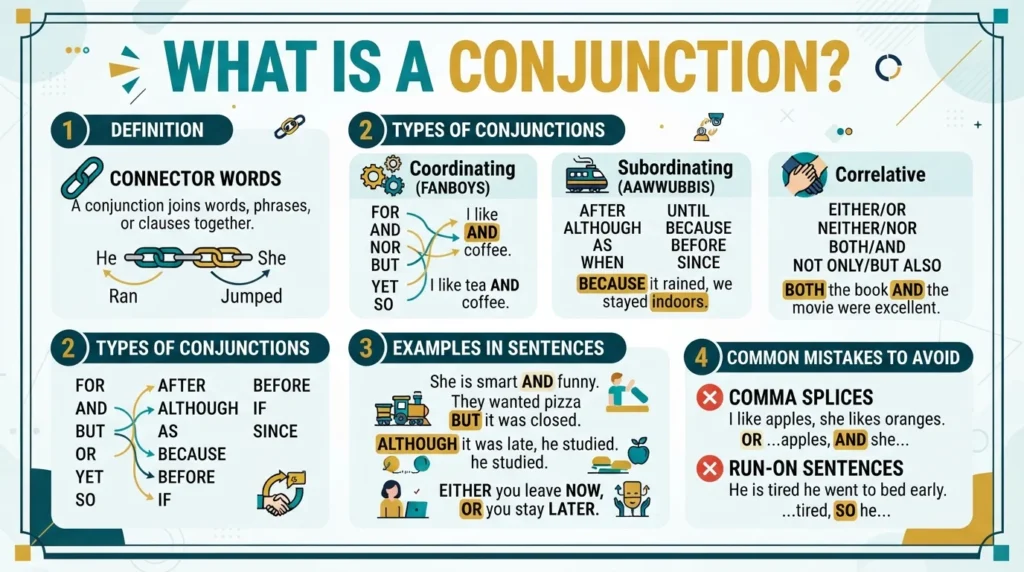
A conjunction is a word that connects words, phrases, or clauses in a sentence.
Common conjunctions include:
- and
- but
- or
- so
- because
- although
- if
- when
- while
- unless
Simple Examples
Tom and Ali are friends.
The word and connects two names.
I wanted to go, but I was busy.
The word but connects two ideas.
We stayed inside because it was raining.
The word because connects a reason with the main idea.
Conjunctions help sentences flow. Without them, writing can sound short, broken, or repetitive.
For example:
I was hungry. I made a sandwich.
This is correct, but we can connect the ideas:
I was hungry, so I made a sandwich.
A conjunction can therefore show a relationship such as addition, contrast, choice, reason, result, time, or condition.
Types of Conjunctions
English conjunctions are commonly grouped into three main types: coordinating conjunctions, subordinating conjunctions, and correlative conjunctions.
Coordinating Conjunctions
Coordinating conjunctions connect words, phrases, or clauses of equal grammatical importance.
The common coordinating conjunctions can be remembered with FANBOYS:
| Conjunction | Main Use | Example |
|---|---|---|
| For | Reason | I stayed home, for I was sick. |
| And | Addition | Sara and John arrived. |
| Nor | Negative alternative | He does not call, nor does he write. |
| But | Contrast | I was tired, but I worked. |
| Or | Choice | Do you want tea or coffee? |
| Yet | Contrast | It was difficult, yet she continued. |
| So | Result | It was late, so we left. |
Subordinating Conjunctions
Subordinating conjunctions connect a dependent clause to an independent clause.
Common examples include:
- because
- although
- if
- when
- while
- after
- before
- since
- unless
- until
Examples:
I stayed home because I was sick.
Although it was raining, we went outside.
Call me when you arrive.
These conjunctions often explain time, reason, condition, contrast, or purpose.
Correlative Conjunctions
Correlative conjunctions work in pairs.
Common pairs include:
- either … or
- neither … nor
- both … and
- not only … but also
- whether … or
Examples:
You can either call me or send an email.
She is both smart and hardworking.
He is not only a teacher but also a writer.
These pairs should normally connect similar grammatical structures.
The Origin of What Is a Conjunction?
The word conjunction comes from Latin coniunctio, meaning a joining or connection. It is related to the Latin verb coniungere, meaning “to join together.” The English word entered Middle English through Anglo-French forms.
The meaning fits its grammatical job very well. A conjunction joins parts of language together.
For example:
Jack and Jill went home.
The word and joins Jack and Jill.
The idea of conjunctions has been part of English grammar teaching for centuries. Older grammar books described conjunctions as words that join sentences or show the relationship between them.
Why Does the Word Sometimes Look Different?
The standard English spelling is:
conjunction
There is no normal British-versus-American spelling difference such as the differences seen in words like colour/color or centre/center.
You may see related forms such as:
- conjunction
- conjunctions
- conjunctional
But conjunction remains the standard spelling in both major varieties of English.
British English vs American English Spelling
The spelling of conjunction is the same in British English and American English.
| Feature | British English | American English |
|---|---|---|
| Singular | conjunction | conjunction |
| Plural | conjunctions | conjunctions |
| Adjective | conjunctional | conjunctional |
| Spelling difference | None | None |
| Meaning | Same | Same |
| Grammar use | Same | Same |
Examples
British English:
What is a conjunction?
American English:
What is a conjunction?
Both sentences use exactly the same spelling.
The main differences between British and American English usually appear in other areas, such as vocabulary, pronunciation, punctuation preferences, and certain spellings. Conjunction is not one of the words with a standard US/UK spelling difference.
Which Spelling Should You Use?
Use conjunction regardless of whether you write for a British, American, or international audience.
For a US Audience
Use:
What is a conjunction?
This is the normal spelling in American English.
For a UK or Commonwealth Audience
Use:
What is a conjunction?
The spelling is also standard in British English and many Commonwealth varieties.
For a Global Audience
Use the same spelling:
conjunction
If you are writing educational content for an international audience, focus more on clear examples and simple explanations than on changing the spelling.
Best SEO Advice
For SEO, do not create separate pages for imaginary spellings such as “conjunktion” or other incorrect forms.
Use natural search phrases such as:
- what is a conjunction
- conjunction definition
- conjunction examples
- types of conjunctions
- conjunctions in English
- coordinating conjunction
- subordinating conjunction
- correlative conjunction
These variations cover different parts of the same search intent.
Common Mistakes with What Is a Conjunction?
Conjunctions are easy to understand, but they can still cause grammar problems.
Mistake 1: Using a Comma Without a Reason
Incorrect:
I was tired, because I worked all day.
In many simple sentences, the comma is not needed before because.
Better:
I was tired because I worked all day.
Mistake 2: Joining Two Complete Sentences Incorrectly
Incorrect:
I was tired I went home.
There is no connector or proper punctuation.
Better:
I was tired, so I went home.
Mistake 3: Using “And” Too Often
Incorrect:
I woke up and ate breakfast and went outside and called my friend.
Better:
I woke up, ate breakfast, went outside, and called my friend.
Not every action needs a conjunction.
Mistake 4: Confusing “But” and “Although”
Incorrect:
Although I was tired, but I worked.
Better:
Although I was tired, I worked.
Or:
I was tired, but I worked.
Do not normally use although and but together to connect the same contrast.
Mistake 5: Breaking Correlative Pairs
Incorrect:
Either you can stay or leave.
Better:
You can either stay or leave.
The pair either … or should clearly connect the alternatives.
Mistake 6: Thinking Every Linking Word Is a Conjunction
Some words can work differently depending on the sentence.
For example, before can introduce a clause:
Call me before you leave.
It can also work as a preposition:
Call me before lunch.
So, always look at how the word functions in the sentence.
What Is a Conjunction in Everyday Examples?
Conjunctions are everywhere in everyday English. You use them in conversations, emails, news stories, social media posts, school assignments, and professional writing.
In Emails
I have attached the report and the updated schedule.
I will attend the meeting if I finish my work on time.
In News
The team played well, but it lost the match.
The company reduced prices because demand was lower.
On Social Media
I wanted to go, but I was too tired.
Follow us and share this post.
In Formal Writing
The results were positive, although further research is needed.
The project was delayed because several materials arrived late.
In Everyday Conversation
Do you want tea or coffee?
I will call you when I arrive.
We stayed home because it was raining.
These examples show why conjunctions are important. They help speakers and writers connect ideas instead of presenting every thought as a separate sentence.
Conjunction Variations Compared Side by Side
| Conjunction | Type | Main Purpose | Example |
|---|---|---|---|
| and | Coordinating | Adds information | I bought bread and milk. |
| but | Coordinating | Shows contrast | I called, but he did not answer. |
| or | Coordinating | Shows choice | Tea or coffee? |
| so | Coordinating | Shows result | It was late, so we left. |
| because | Subordinating | Gives a reason | I stayed because I was tired. |
| although | Subordinating | Shows contrast | Although it rained, we played. |
| if | Subordinating | Shows condition | Call me if you need help. |
| when | Subordinating | Shows time | Call me when you arrive. |
| either…or | Correlative | Gives alternatives | Either call or email me. |
| neither…nor | Correlative | Gives two negative choices | Neither John nor Ali came. |
| both…and | Correlative | Adds two items | Both tea and coffee are available. |
| not only…but also | Correlative | Adds emphasis | She is not only smart but also kind. |
What Is a Conjunction? – Google Trends & Usage Data
The search phrase “what is a conjunction” has clear educational intent. People usually search for it when they need a quick grammar definition, examples, homework help, exam preparation, or English-learning support.
Search interest for grammar terms can change by country, language-learning demand, school schedules, examination periods, and the selected Google Trends date range. Google Trends values are relative rather than absolute search-volume numbers, so they should be treated as an indicator of interest rather than an exact number of searches.
For SEO, related searches are often more useful than focusing on one exact phrase. Relevant variations include:
- what is a conjunction
- what is conjunction
- conjunction definition
- what are conjunctions
- types of conjunctions
- conjunction examples
- examples of conjunctions
- coordinating conjunctions
- subordinating conjunctions
- correlative conjunctions
Countries with large English-learning populations can show strong interest in basic grammar questions. The exact ranking of countries can change over time, so a current Google Trends comparison should be checked using the desired country and date range rather than treating a fixed country list as permanent.
For an SEO article, this means you should answer the main question quickly, then cover definition, types, examples, mistakes, and related searches naturally.
Why Are Conjunctions Important?
Conjunctions make communication clearer.
Compare these two examples:
The road was closed. We took another road.
Now connect the ideas:
The road was closed, so we took another road.
The second sentence shows the relationship between the two ideas.
Conjunctions can show:
- Addition: and
- Contrast: but, although
- Choice: or
- Reason: because
- Result: so
- Condition: if, unless
- Time: when, while, before, after
This makes writing smoother and helps readers understand the writer’s meaning.
FAQs About What Is a Conjunction?
What is a conjunction in simple words?
A conjunction is a word that joins words, phrases, or clauses. Common examples are and, but, or, because, and if.
What are the three main types of conjunctions?
The three common types are coordinating, subordinating, and correlative conjunctions.
What are 10 examples of conjunctions?
Ten common examples are and, but, or, so, for, nor, yet, because, although, and if.
Is “and” a conjunction?
Yes. And is a coordinating conjunction. It usually adds or connects similar words, phrases, or clauses.
Example:
John and Sarah are friends.
Is “because” a conjunction?
Yes. Because is a subordinating conjunction. It introduces a reason.
Example:
I stayed home because I was sick.
Is “but” a conjunction?
Yes. But is commonly used as a coordinating conjunction to show contrast.
Example:
The task was difficult, but we finished it.
Is “or” a conjunction?
Yes. Or is a coordinating conjunction used to show a choice or alternative.
Example:
Would you like tea or coffee?
Is there a British spelling of conjunction?
No. Conjunction is spelled the same in British and American English.
What is the easiest way to remember conjunctions?
Think of conjunctions as joining words. They connect ideas, words, phrases, or clauses. A simple starting group is and, but, or, because, so, and if.
Conclusion
A conjunction is a word that joins words, phrases, or clauses and helps show the relationship between ideas. Common examples include and, but, or, because, if, although, and when.
The three main types are coordinating, subordinating, and correlative conjunctions. Coordinating conjunctions connect equal elements, subordinating conjunctions connect a dependent clause to a main clause, and correlative conjunctions work in pairs such as either…or and both…and.
The word conjunction comes from a Latin term connected with the idea of joining. Despite differences between British and American English, the spelling conjunction is the same in both varieties.
For students and English learners, the best way to understand conjunctions is to study simple examples and notice what relationship each conjunction shows. When used correctly, conjunctions make sentences smoother, clearer, and easier to understand. They are small words, but they are essential for good English writing and speaking.