
English sentences become clearer and more powerful when they use the right verbs. But many learners get confused when they see words like is, have, do, can, will, and should before another verb. These words are called helping verbs, and they play an important role in English grammar.
People search for “helping verb” because they want a simple definition, examples, lists, and an easy explanation. Students often ask questions such as: What is a helping verb? How is it different from a main verb? Which words are helping verbs? These questions can make grammar seem difficult.
The good news is that helping verbs are easy to understand. A helping verb works with the main verb to show time, ability, possibility, permission, or action. For example, in the sentence “She is reading a book,” the word is helps the main verb reading.
This guide explains the meaning, origin, examples, spelling rules, common mistakes, everyday use, and FAQs about helping verbs in simple English.
Helping Verb – Quick Answer
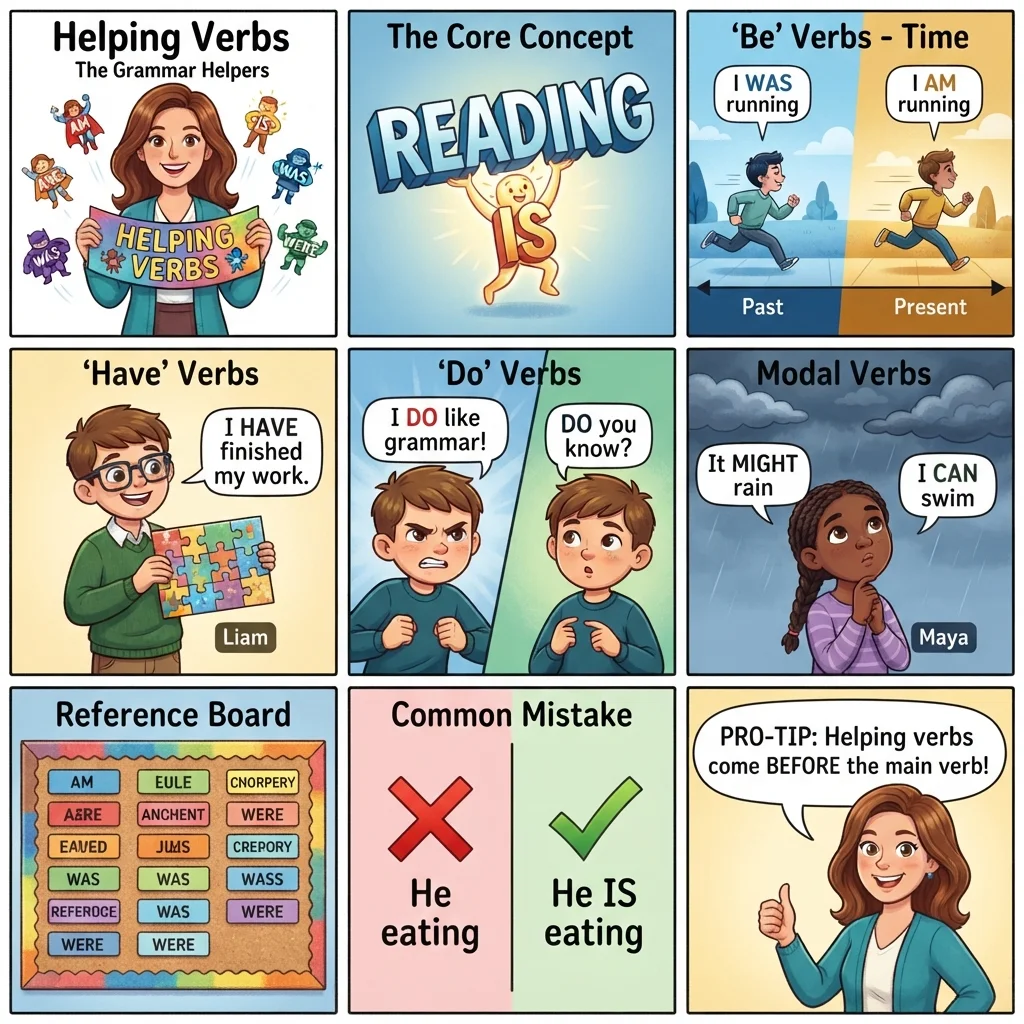
A helping verb is a verb that works with a main verb to complete its meaning.
Helping verbs show:
- Time (present, past, future)
- Ability
- Possibility
- Permission
- Necessity
Examples
- She is reading.
- They have finished.
- I will call you.
- You can swim.
- We should study.
In these sentences, the helping verbs are:
- is
- have
- will
- can
- should
The main verbs are:
- reading
- finished
- call
- swim
- study
Common Helping Verbs
Be Verbs
- am
- is
- are
- was
- were
- be
- been
- being
Have Verbs
- have
- has
- had
Do Verbs
- do
- does
- did
Modal Helping Verbs
- can
- could
- may
- might
- must
- shall
- should
- will
- would
The Origin of Helping Verb
The word verb comes from the Latin word verbum, meaning “word.” The term helping verb was created later by English grammar experts to describe verbs that assist the main verb.
Helping verbs have been part of English for hundreds of years. Old English used verbs such as be, have, and do to create different sentence structures.
For example:
- Be helps form continuous tenses:
- She is running.
- Have helps form perfect tenses:
- They have completed the work.
- Do helps form questions and negatives:
- Do you like tea?
- I do not know.
Over time, English added modal helping verbs like:
- can
- could
- may
- might
- should
- would
These helping verbs make English more flexible and expressive.
Unlike words such as colour/color or centre/center, the term helping verb has the same spelling in British and American English.
British English vs American English Spelling
The phrase helping verb is spelled the same in British and American English.
However, some verb forms connected with helping verbs may have different spellings.
| Word | British English | American English |
|---|---|---|
| Helping Verb | helping verb | helping verb |
| Travel | travelled | traveled |
| Cancel | cancelled | canceled |
| Learn | learnt / learned | learned |
| Burn | burnt / burned | burned |
| Dream | dreamt / dreamed | dreamed |
Examples
British English:
She has travelled to London.
American English:
She has traveled to New York.
The helping verb has stays the same. Only the main verb spelling changes.
Which Spelling Should You Use?
Choose your spelling style based on your audience.
For US Readers
Use American spelling:
- traveled
- canceled
- learned
Example:
The team has traveled to California.
For UK Readers
Use British spelling:
- travelled
- cancelled
- learnt
Example:
The team has travelled to Manchester.
For Global Websites
Choose one style and use it consistently.
Consistency is more important than mixing spellings.
Correct:
She has travelled.
He has cancelled.
Or:
She has traveled.
He has canceled.
Avoid mixing styles in one article.
Common Mistakes with Helping Verb
Many learners make small mistakes with helping verbs.
Mistake 1: Missing Helping Verb
Incorrect:
She reading a book.
Correct:
She is reading a book.
Mistake 2: Wrong Helping Verb
Incorrect:
He have finished.
Correct:
He has finished.
Mistake 3: Double Helping Verbs
Incorrect:
She is can swim.
Correct:
She can swim.
Mistake 4: Wrong Tense
Incorrect:
They has gone.
Correct:
They have gone.
Mistake 5: Forgetting “Do” in Questions
Incorrect:
You like coffee?
Correct:
Do you like coffee?
Helping Verb in Everyday Examples
Helping verbs appear in daily communication.
In Emails
I have attached the file.
We will contact you soon.
In News
The company has opened a new factory.
The government will announce new policies.
On Social Media
I am watching a movie.
We have visited Dubai.
In Formal Writing
The engineer has completed the report.
The team will inspect the machine.
In Daily Conversation
I can drive.
She is cooking.
They have arrived.
Helping verbs make communication clear and accurate.
Helping Verb – Google Trends & Usage Data
The keyword “helping verb” is searched by:
- Students
- Teachers
- Parents
- English learners
- Competitive exam candidates
Search interest is high in countries where English is widely taught, including:
- India
- Pakistan
- United States
- United Kingdom
- Canada
- Australia
Common searches include:
- helping verb examples
- helping verbs list
- helping verb meaning
- auxiliary verbs
- modal verbs
Searches often increase during school exams and grammar lessons.
The keyword has strong educational value because helping verbs are essential for speaking and writing correct English.
Helping Verb Comparison Table
| Type | Examples | Use |
|---|---|---|
| Be Verbs | am, is, are | Continuous tense |
| Have Verbs | have, has, had | Perfect tense |
| Do Verbs | do, does, did | Questions and negatives |
| Modal Verbs | can, may, should | Ability, possibility |
| Primary Helping Verbs | be, have, do | Basic grammar support |
| Auxiliary Verbs | all helping verbs | Help the main verb |
Types of Helping Verbs
Primary Helping Verbs
These are:
- Be
- Have
- Do
Examples:
She is working.
They have arrived.
Do you know him?
Modal Helping Verbs
Examples:
- can
- could
- may
- might
- must
- shall
- should
- will
- would
Examples:
I can swim.
You should study.
We will travel tomorrow.
Helping Verb vs Main Verb
| Helping Verb | Main Verb |
|---|---|
| Helps another verb | Shows action |
| Cannot stand alone sometimes | Gives main meaning |
| is | reading |
| have | finished |
| can | swim |
| will | go |
Example:
She is writing.
- Helping verb: is
- Main verb: writing
FAQs About Helping Verb
What is a helping verb?
A helping verb is a verb that supports the main verb in a sentence.
What is another name for a helping verb?
Another name is auxiliary verb.
How many helping verbs are there?
English has primary helping verbs and modal helping verbs. Common lists include about 23 helping verbs.
Is “is” a helping verb?
Yes. Is can be a helping verb.
Example:
She is reading.
Is “can” a helping verb?
Yes. Can is a modal helping verb.
What are the three primary helping verbs?
The three primary helping verbs are:
- be
- have
- do
What is the difference between a helping verb and a main verb?
A helping verb supports another verb, while a main verb shows the main action.
Conclusion
Helping verbs are an important part of English grammar. They work with main verbs to show time, ability, permission, possibility, and action. Common helping verbs include be, have, do, can, should, will, and must.
The phrase helping verb has the same spelling in British and American English. However, some main verbs may have different spellings, such as travelled/traveled or cancelled/canceled.
To use helping verbs correctly, learn the basic groups: be verbs, have verbs, do verbs, and modal verbs. Practice using them in everyday speaking and writing. Avoid common mistakes such as missing helping verbs or using incorrect forms.
A good understanding of helping verbs will improve grammar, writing, reading, and communication skills. Whether you are a student, teacher, or English learner, mastering helping verbs is an important step toward using English correctly and confidently.