
Cricket is a sport filled with milestones and achievements that help measure a player’s performance. Among these achievements, a half century is one of the most respected batting milestones. Whether in Test cricket, One Day Internationals (ODIs), or Twenty20 (T20) matches, scoring a half century demonstrates skill, concentration, and consistency at the crease.
Many new cricket fans often ask, “What is a half century in cricket?” The answer is simple: a half century occurs when a batter scores between 50 and 99 runs in a single innings. Reaching 50 runs is considered a significant accomplishment because it helps build the team’s total and often lays the foundation for victory.
While a century receives more attention, half centuries are equally important in many match situations. A well-played fifty can stabilize an innings, rescue a team from trouble, or guide a successful run chase.
This comprehensive guide explains what a half century is, its history, importance, scoring methods, strategies, player roles, records, major tournaments, and interesting facts. By the end, you will fully understand why a half century is one of cricket’s most valuable batting achievements.
What Is a Half Century in Cricket?
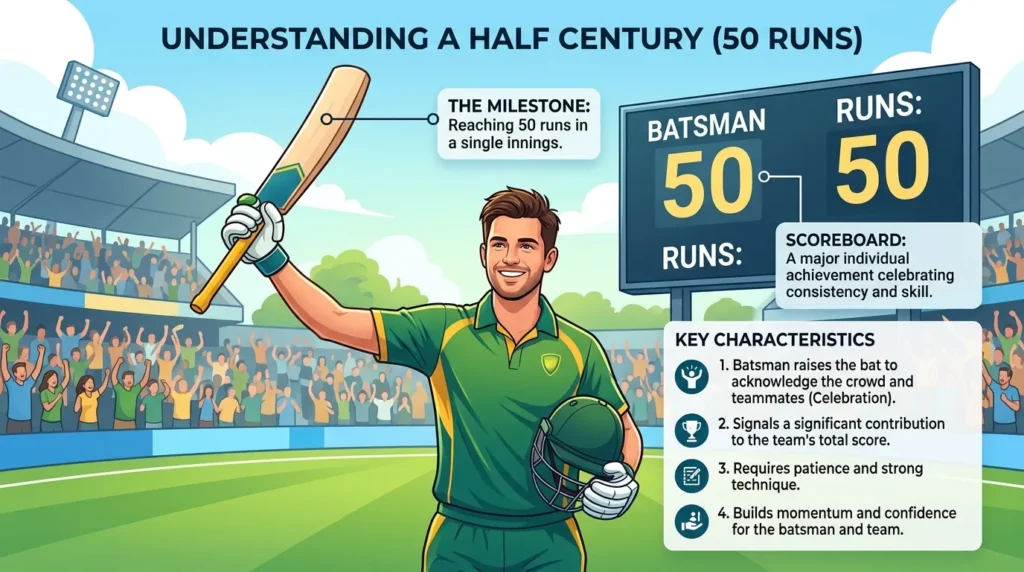
A half century in cricket is a batting milestone reached when a player scores 50 runs in a single innings. Once the batter reaches 50, they are said to have completed a half century or scored a fifty.
A batter can continue scoring after reaching 50. For example, an innings of 62, 75, 89, or 99 runs is still commonly described as a half century because the player passed the fifty-run milestone without reaching 100.
Examples include:
- 50 runs
- 55 runs
- 62 runs
- 75 runs
- 89 runs
- 99 runs
When a batter reaches 100 runs, the achievement changes from a half century to a century.
A fifty can have different levels of importance depending on the format and match situation. A patient 50 in Test cricket may require long concentration, while a rapid 50 in T20 cricket can change the momentum of a match.
Quick Definition of a Half Century
In simple terms, a half century means a batter has reached the 50-run milestone in one innings.
It is commonly called a fifty in cricket.
A half century involves:
- Scoring at least 50 runs
- Reaching the milestone in one innings
- Continuing to bat after 50 if the player is not dismissed
- Being recorded as a fifty until the batter reaches 100
For example, if a batter scores 49 runs, they have not yet completed a half century. After scoring the next run, their score becomes 50 and the milestone is achieved.
This simple distinction is useful when reading cricket scorecards and player statistics.
History of the Half Century in Cricket
The fifty-run milestone developed as cricket became more organised and statistical records became increasingly important. While early cricket did not always have the same detailed statistical systems used today, significant batting scores gradually became important measures of individual performance.
Early Cricket Milestones
In earlier periods of cricket, reaching 50 could be a demanding achievement because players faced very different playing conditions from those common today.
Challenges included:
- Uneven playing surfaces
- Less advanced protective equipment
- Different bat designs
- More limited training methods
- Bowling conditions that could make batting difficult
Batters often placed greater emphasis on survival and defensive technique, particularly in longer forms of the game.
As cricket developed, scores such as 50 and 100 became widely recognised batting milestones.
Growth of Statistical Records
The development of detailed scorekeeping made it easier to track individual batting performances.
Statistics began recording achievements such as:
- Half centuries
- Centuries
- Double centuries
- Batting averages
- Total career runs
- Strike rates in limited-overs cricket
Half centuries became particularly useful for measuring consistency.
A player who regularly reaches 50 demonstrates an ability to make meaningful contributions even when they do not always convert those innings into centuries.
Modern Cricket
Today, half centuries are recorded across the major international formats, including Test matches, One Day Internationals, and T20 cricket.
The way a fifty is achieved can vary considerably.
A Test batter may spend several hours reaching 50, while a T20 batter may reach the same milestone in fewer than 30 balls.
Because of this difference, statistics such as balls faced and strike rate can provide additional context when evaluating a half century.
Why Is a Half Century Important?
A half century is an important batting achievement because it usually represents a substantial contribution to the team’s innings.
Its value, however, depends on the match situation.
Demonstrates Consistency
Regular fifties can show that a batter is consistently getting established at the crease.
A player who frequently scores 50 or more is often able to provide dependable runs for their team.
Supports Team Success
Half centuries can help create competitive totals and successful run chases.
A batter reaching fifty may also build an important partnership with another player, giving the team a stronger position in the match.
Builds Confidence
Reaching a personal milestone can provide confidence, especially after a difficult start.
Once a batter becomes settled, they may find it easier to play attacking shots and control the innings.
Reflects Batting Skill
A successful fifty generally requires several skills working together.
These can include:
- Good technique
- Concentration
- Shot selection
- Understanding of field placements
- Running between the wickets
- Ability to adapt to bowling conditions
How a Batter Scores a Half Century
A batter can reach 50 through any combination of runs. There is no requirement to score a particular number of fours, sixes, singles, or doubles.
The important factor is simply reaching the 50-run milestone.
Singles and Doubles
Many batters build an innings through regular singles and twos.
This approach helps keep the scoreboard moving while reducing the pressure created by consecutive dot balls.
Quick running between the wickets can be particularly important when boundaries are difficult to find.
Boundaries
Fours and sixes allow batters to increase their scores quickly.
A four adds four runs to the batter’s score, while a six adds six.
Aggressive batters may reach fifty largely through boundary hitting, particularly in limited-overs cricket.
However, boundaries are not essential for a half century. A batter can reach 50 entirely through running between the wickets if the circumstances allow it.
Partnerships
Batting partnerships can make it easier for players to build substantial scores.
When two batters communicate well and rotate the strike, they can put pressure back on the bowling side.
Partnerships also help reduce the risk of one batter having to face every delivery during a difficult period.
Smart Shot Selection
Good shot selection is one of the most important parts of building a fifty.
Batters consider factors such as:
- Field placement
- Type of delivery
- Bowling speed
- Pitch conditions
- Match situation
- Required scoring rate
A batter does not need to attack every ball. Knowing when to defend, rotate the strike, or play an attacking shot can make the difference between reaching 50 and getting dismissed in the 30s or 40s.
What Happens After a Batter Reaches 50?
Reaching 50 does not end the innings.
If the batter remains not out, they can continue scoring until they are dismissed, the innings ends, or the match situation changes.
For many batters, the next target is 100.
This is why commentators often describe a player as being “well set” after reaching a fifty. The batter has already established themselves and may have an opportunity to convert the innings into a century.
However, reaching 50 is still a significant achievement even if the player is dismissed soon afterward.
Types of Half Centuries
Not every half century is scored in the same way. A batter may reach fifty through defensive batting in a Test match or aggressive strokeplay in a T20 game. The importance of a fifty also depends on the match situation, pitch, opposition, and required run rate.
Slow and Defensive Half Century
A slow or defensive half century is built around patience, concentration, and careful shot selection. This type of innings is particularly common in Test cricket, where a batter may need to spend a long period at the crease.
The main objective is not always to score quickly. Instead, the batter focuses on protecting the wicket while gradually adding runs to the team’s total.
Common characteristics include:
- Patience and concentration
- Strong defensive technique
- Careful shot selection
- Long periods at the crease
- Ability to handle sustained bowling pressure
- Regular singles when scoring opportunities are available
A defensive fifty can become especially valuable when the pitch is difficult or when the team is trying to recover after losing early wickets.
Fast Half Century
A fast half century is an aggressive fifty scored from relatively few deliveries. This type of innings is especially common in T20 cricket, although quick fifties can also occur in ODI matches.
The batter normally looks to attack scoring areas from the beginning or increase the scoring rate after becoming settled.
Typical characteristics include:
- High scoring rate
- Frequent boundaries
- Powerful strokeplay
- Aggressive running between the wickets
- Positive intent against bowlers
- Ability to exploit fielding restrictions
A quick fifty can put immediate pressure on the opposition and give the batting team momentum.
Match-Saving Half Century
A match-saving half century is an innings in which the batter’s main objective is to protect the team’s position rather than chase a large score.
This is particularly important in Test cricket. A team facing a difficult target or trying to survive a dangerous period may need batters to spend a long time at the crease.
A fifty in this situation can help reduce the opposition’s chances of taking enough wickets to win the match.
Important qualities include:
- Concentration under pressure
- Defensive technique
- Patience
- Good understanding of match conditions
- Ability to manage the bowling attack
The final score may not look spectacular, but the innings can be extremely valuable to the team.
Match-Winning Half Century
A match-winning half century is a fifty that makes a major contribution to a successful team performance.
In limited-overs cricket, a batter might score a rapid 50 while chasing a target. In Test cricket, a patient fifty could help establish a winning position.
The value of the innings depends on the circumstances rather than the number alone.
A half century can be particularly important when:
- The team is chasing a difficult target
- Early wickets have fallen
- The pitch is challenging
- The required scoring rate is high
- The batter builds an important partnership
Half Century in Different Cricket Formats
The meaning and value of a half century can change considerably between Test cricket, ODI cricket, and T20 cricket. Each format demands a different approach to scoring runs.
Test Cricket
In Test matches, batters generally have more time to build an innings. A half century can therefore represent sustained concentration and technical discipline.
A batter may face dozens or even hundreds of deliveries while dealing with changing conditions and different bowling strategies.
Important factors include:
- Patience
- Defensive technique
- Shot selection
- Concentration
- Ability to handle long bowling spells
A Test fifty can also become the foundation for a much larger innings. Once a batter reaches 50, the next target is often a century or a substantial partnership.
One Day Internationals
ODI cricket requires a balance between patience and attacking cricket.
Teams have 50 overs, so batters cannot always play as slowly as they might in Test cricket. At the same time, they have considerably more time than in T20 cricket.
A half century in an ODI can provide stability while allowing the batting side to maintain a healthy scoring rate.
ODI batters often need to:
- Rotate the strike
- Find boundaries regularly
- Build partnerships
- Adapt to field placements
- Increase the scoring rate at the right time
A well-timed fifty can form the backbone of a competitive team total.
T20 Cricket
T20 cricket places much greater emphasis on scoring speed.
With only 20 overs available, a batter reaching fifty quickly can have a major influence on the match.
T20 half centuries often involve aggressive shots, boundary hitting, and fast running between the wickets.
Key characteristics include:
- High strike rate
- Frequent boundary attempts
- Innovative shot selection
- Quick decision-making
- Aggressive running
- Ability to attack different types of bowlers
A batter who scores a rapid fifty can sometimes change the momentum of an entire innings within a few overs.
Difference Between Half Century and Century
A half century and a century are both important batting milestones, but they represent different levels of individual scoring.
Half Century
A batter reaches a half century when they score 50 runs in an innings.
A half century generally means:
- 50 or more runs
- A significant individual contribution
- A recognised batting milestone
- Evidence that the batter has successfully built an innings
The batter does not have to stop at 50. Once the score passes 50, they can continue batting until they are dismissed or the innings ends.
Century
A century is reached when a batter scores 100 runs in an innings.
A century represents a larger individual achievement and usually receives greater attention from spectators, commentators, and statistics records.
It can involve:
- 100 or more runs
- Extended time at the crease
- Strong concentration
- Consistent scoring
- Greater contribution to the team total
However, a century is not always more valuable to the team than a fifty. Match conditions determine the real importance of an innings.
For example, a fast 70 in a T20 chase could be more influential than a slow century in a match where the team needed runs much faster.
Player Roles and Half Centuries
A batter’s position in the batting order can strongly influence how they approach a half century. Openers, top-order batters, middle-order players, and finishers all have different responsibilities.
Opening Batters
Opening batters face the opposition’s new ball and are often responsible for establishing the innings.
Their challenges may include:
- Facing fresh fast bowlers
- Handling swing and seam movement
- Building an opening partnership
- Taking advantage of fielding restrictions in limited-overs cricket
- Protecting the wicket during difficult early overs
An opener who reaches fifty can provide an excellent platform for the rest of the batting order.
Top-Order Batters
Top-order players generally have more opportunities to spend a significant amount of time at the crease.
Positions one through four often contain a team’s most consistent run-scorers.
These batters are expected to:
- Build substantial innings
- Rotate the strike
- Control the middle phase
- Create partnerships
- Accelerate when required
Because they frequently face a large number of deliveries, top-order players often accumulate many half centuries throughout their careers.
Middle-Order Batters
Middle-order batters usually enter when the opening phase has already been completed.
Their role can change depending on the match situation. They may need to rebuild after early wickets or attack immediately if the team has a strong platform.
A middle-order half century can be particularly valuable when the team needs stability under pressure.
Finishers
Finishers usually bat later in limited-overs innings and have fewer deliveries available.
Their primary objective is often to score rapidly and maximise the team’s total during the final overs.
A finisher reaching fifty can therefore produce an extremely high-scoring innings.
These players commonly rely on:
- Power hitting
- Boundary options
- Running between the wickets
- Innovative shots
- Strong decision-making under pressure
A quick fifty from a finisher can dramatically increase a team’s final score and change the momentum of a limited-overs match.
Why the Situation Matters More Than the Number
The number 50 is an important milestone, but the circumstances surrounding the innings determine its true value.
For example, a batter scoring 50 from 40 balls while chasing a modest target has a different impact from a batter scoring 50 from 20 balls during a high-pressure T20 chase.
Similarly, a patient Test fifty on a difficult pitch can require more technical discipline than a fifty scored on a flat batting surface.
This is why cricket statistics are most useful when they are considered alongside the match situation, strike rate, pitch conditions, opposition, and team result.
Batting Techniques for Scoring a Half Century
Solid Defense
Strong defensive skills help batters survive difficult conditions.
Footwork
Good foot movement improves shot execution.
Shot Selection
Successful batters avoid unnecessary risks.
Concentration
Maintaining focus for long periods is essential.
Fitness
Physical endurance helps players perform throughout the innings.
Strategies for Reaching a Half Century
Start Carefully
Many batters take time to settle at the crease before increasing their scoring rate. A controlled start can help them understand the pitch and bowling conditions.
Rotate the Strike
Regular singles and twos keep the scoreboard moving and prevent bowlers from building too much pressure.
Build Partnerships
A strong partnership can reduce pressure on an individual batter while creating more opportunities to score runs.
Capitalize on Loose Deliveries
Good batters look to punish poor deliveries. Finding boundaries from loose balls can help them move quickly toward fifty.
Adapt to Conditions
Pitch, weather, ball movement, and the quality of the opposition can all influence a batter’s approach. Adapting to these conditions is an important part of building a successful innings.
Equipment Used by Batters
Proper cricket equipment helps batters perform confidently while providing protection during an innings.
Cricket Bat
The cricket bat is the main piece of equipment used to strike the ball and score runs.
Helmet
A helmet protects the head and face from fast deliveries, making it an essential part of a batter’s protective equipment.
Batting Gloves
Batting gloves improve grip while also protecting the hands and fingers from impact.
Batting Pads
Batting pads protect the legs and knees from the cricket ball, particularly when facing fast bowlers.
Abdominal Guard
An abdominal guard provides additional protection to a sensitive area and is an important safety item for batters.
Cricket Shoes
Cricket shoes provide grip, balance, and stability when running between the wickets and playing shots.
Modern cricket equipment helps players perform effectively while reducing the risk of injury.
Major Cricket Tournaments Where Half Centuries Matter
ICC Cricket World Cup
Half centuries can be valuable in World Cup matches because they often provide the foundation for competitive totals or successful run chases.
ICC T20 World Cup
In T20 cricket, a quick fifty can significantly influence the outcome of a match because teams have only 20 overs to score.
ICC World Test Championship
Test batters often need patience and strong technique to reach fifty, particularly when playing against high-quality bowling attacks.
Indian Premier League (IPL)
The IPL features many talented batters, and half centuries are regularly important during high-scoring T20 matches.
The Ashes
The Ashes is one of cricket’s most recognised Test series, where substantial individual scores can play an important role in determining match results.
Benefits of Playing Cricket
Cricket provides physical, mental, and social benefits for players of different ages and skill levels.
Physical Benefits
Regular cricket can help develop:
- Fitness
- Stamina
- Hand-eye coordination
- Reflexes
- Agility
Mental Benefits
Cricket can also encourage the development of:
- Concentration
- Strategic thinking
- Decision-making
- Patience
- Mental discipline
Social Benefits
Playing cricket can help develop:
- Teamwork
- Communication
- Leadership
- Cooperation
- Sportsmanship
Famous Half Century Records
Half-century statistics provide another way to understand a batter’s consistency and contribution across a cricket career.
Fastest Half Centuries
Some international and domestic players have reached fifty in remarkably few deliveries, particularly in T20 cricket.
Most Half Centuries
Top-level batters can accumulate a large number of half centuries over long careers across Test, ODI, and T20 cricket.
Consistency Records
The number of fifties and centuries can help show how regularly a batter converts opportunities into significant scores. However, statistics should always be considered alongside matches played and the format of cricket.
Interesting Facts About Half Centuries
- A score of exactly 50 runs is commonly described as a half century.
- Batters often acknowledge reaching fifty by raising their bat.
- An innings between 50 and 99 runs is still a half century even if the batter does not reach 100.
- Half centuries are recorded across Test, ODI, and T20 cricket.
- A batter can score more than one fifty in a Test match.
- T20 cricket often produces some of the fastest half centuries.
- Many successful international batters have accumulated a large number of half centuries during their careers.
Common Mistakes Batters Make Near Fifty
Losing Concentration
Many players get out in the 40s because they lose concentration after building a good innings.
Playing Risky Shots
Aggressive shots can lead to unnecessary dismissals when a batter is close to reaching fifty.
Thinking Too Much About the Milestone
Focusing too much on reaching 50 can create additional pressure and affect normal decision-making.
Poor Shot Selection
Impatience can cause batters to play shots that they would normally avoid.
Experienced batters usually remain calm, trust their technique, and continue following their game plan.
Why Coaches Value Half Centuries
Coaches value half centuries because they can demonstrate several important qualities, including:
- Technical ability
- Mental toughness
- Match awareness
- Consistency
A player who regularly scores fifties can become a dependable and valuable member of a cricket team.
Conclusion
Famous Fastest Half Century Records
Some half centuries are remembered for their incredible speed. The fastest fifty in T20 internationals was scored by Yuvraj Singh, who reached 50 in just 12 balls against England during the 2007 T20 World Cup, hitting six sixes in one over on the way. In One Day Internationals, the record belongs to AB de Villiers, who smashed a 16-ball fifty against the West Indies in 2015.
The fastest Test fifty was scored by Misbah-ul-Haq, who reached 50 in 21 balls against Australia in 2014. These records show how the meaning of a “fast” half century changes with the format — a 12-ball fifty is possible in T20 cricket, while even the quickest Test fifty takes nearly twice as many deliveries.
Half Century vs Fifty: Is There a Difference?
There is no difference at all. “Fifty” is simply the shorter, everyday name for a half century, and both terms describe the same 50-run milestone. Cricket scorecards and commentators use the two words interchangeably, so when you hear that a batter “scored a fifty,” it means they completed a half century.
Frequently Asked Questions About Half Centuries
What is the fastest half century in T20I cricket?
Yuvraj Singh’s 12-ball fifty against England in the 2007 T20 World Cup is the fastest in T20 internationals.
Is a half century the same as a fifty?
Yes. “Fifty” is just the shorter name for a half century — both mean 50 runs in one innings.
Does a not-out innings of 50 count as a half century?
Yes. The milestone counts whether the batter is dismissed or finishes not out.
How fast is a good half century in T20 cricket?
A fifty scored in 25 to 30 balls or fewer is considered very good in T20 cricket, where quick scoring matters most.
Understanding what a half century is in cricket helps fans appreciate one of the game’s most important batting milestones. A half century occurs when a batter scores between 50 and 99 runs in a single innings, demonstrating skill, concentration, and consistency. Whether in Test cricket, ODIs, or T20 matches, fifties often provide the foundation for team success and memorable victories. While centuries receive greater recognition, half centuries remain a crucial measure of batting performance and reliability. For players, coaches, and fans, the half century continues to be one of cricket’s most respected achievements.

Jon Smith is a passionate sports writer specializing in cricket and global sporting events. With a keen eye for match analysis and player performance, he creates clear, engaging, and informative content. His work focuses on simplifying complex sports insights, making them accessible for beginners and experienced fans alike worldwide.